The GMU purification process development group is responsible for the development of viral and non ... Protein purification chromatography o Virus clearance and inactivation • Familiarity with ...
The GMU purification process development group is responsible for the development of viral and non ... Protein purification chromatography o Virus clearance and inactivation • Familiarity with ...

Extensive working knowledge of Purification process development for recombinant protein expression & purification including operational proficiency with AKTA Explorer / AKTA Pilot / AKTA Crossflow ...
Extensive working knowledge of Purification process development for recombinant protein expression & purification including operational proficiency with AKTA Explorer / AKTA Pilot / AKTA Crossflow ...
Execute routine protein purification with affinity, size exclusion, ion exchange, and hydrophobic interaction chromatography using AKTA systems (Unicorn software) * Perform analyses including but not ...
Execute routine protein purification with affinity, size exclusion, ion exchange, and hydrophobic interaction chromatography using AKTA systems (Unicorn software) * Perform analyses including but not ...

Development Specialist
$50K - $69K/yr
They will be responsible for performing laboratory and pilot scale column chromatography, Tangential flow filtration and analytical assays to support protein purification process development. The ...
Development Specialist
$50K - $69K/yr
They will be responsible for performing laboratory and pilot scale column chromatography, Tangential flow filtration and analytical assays to support protein purification process development. The ...
Experience and knowledge in protein purification process development, including ultrafiltration, diafiltration, ion-exchange, affinity, mixed mode and HIC column chromatography. Experience in protein ...
Experience and knowledge in protein purification process development, including ultrafiltration, diafiltration, ion-exchange, affinity, mixed mode and HIC column chromatography. Experience in protein ...
Must have processing protein production, purification experience #2 Required skill: Must have ... Characterization and quality check of membrane proteins to support biotherapeutics development.
Quick apply
Must have processing protein production, purification experience #2 Required skill: Must have ... Characterization and quality check of membrane proteins to support biotherapeutics development.

We are seeking to hire an Associate Scientist to join our Purification Process Development team ... Experience in protein characterization, design of experiments and analytics * Experience monitoring ...
New
We are seeking to hire an Associate Scientist to join our Purification Process Development team ... Experience in protein characterization, design of experiments and analytics * Experience monitoring ...
New
Principal Scientist, Purification Process Development
South San Francisco, CA · On-site
$159K - $207K/yr
... development activities * Execute methods for in-process testing using ELISA, HPLC, UV and SDS-Page ... Experience developing protein purification processes to support early or late-stage clinical ...
Principal Scientist, Purification Process Development
South San Francisco, CA · On-site
$159K - $207K/yr
... development activities * Execute methods for in-process testing using ELISA, HPLC, UV and SDS-Page ... Experience developing protein purification processes to support early or late-stage clinical ...
Vision insurance Lead Process Engineer (Protein Purification), Food Science and Product Development, Full-time, Exempt South San Francisco, CA Alpine Bio is a plant ingredient and genetics company ...
Quick apply
Vision insurance Lead Process Engineer (Protein Purification), Food Science and Product Development, Full-time, Exempt South San Francisco, CA Alpine Bio is a plant ingredient and genetics company ...
Lead Process Engineer - Protein Purification
South San Francisco, CA · On-site
$113K - $134K/yr
Lead Process Engineer (Protein Purification), Food Science and Product Development, Full-time, Exempt South San Francisco, CA Alpine Bio is a plant ingredient and genetics company focused on ...
Quick apply
Lead Process Engineer - Protein Purification
South San Francisco, CA · On-site
$113K - $134K/yr
Lead Process Engineer (Protein Purification), Food Science and Product Development, Full-time, Exempt South San Francisco, CA Alpine Bio is a plant ingredient and genetics company focused on ...
Principal Scientist, Purification Process Development
South San Francisco, CA · On-site
$159K - $207K/yr
... development activities * Execute methods for in-process testing using ELISA, HPLC, UV and SDS-Page ... Experience developing protein purification processes to support early or late-stage clinical ...
Principal Scientist, Purification Process Development
South San Francisco, CA · On-site
$159K - $207K/yr
... development activities * Execute methods for in-process testing using ELISA, HPLC, UV and SDS-Page ... Experience developing protein purification processes to support early or late-stage clinical ...
Lead Process Engineer - Protein Purification
South San Francisco, CA · On-site
$113K - $134K/yr
Lead Process Engineer (Protein Purification), Food Science and Product Development, Full-time, Exempt South San Francisco, CA Alpine Bio is a plant ingredient and genetics company focused on ...
Quick apply
Lead Process Engineer - Protein Purification
South San Francisco, CA · On-site
$113K - $134K/yr
Lead Process Engineer (Protein Purification), Food Science and Product Development, Full-time, Exempt South San Francisco, CA Alpine Bio is a plant ingredient and genetics company focused on ...

Research Associate II
Waltham, MA · On-site
Adecco Healthcare & Life SciencesSenior Research Associate - Downstream Process Development (Protein Purification) Fully Onsite | Waltham, MA | Temp Opportunity Pay: Up to 54/hr depending on relevant ...
Quick apply
Research Associate II
Waltham, MA · On-site
Adecco Healthcare & Life SciencesSenior Research Associate - Downstream Process Development (Protein Purification) Fully Onsite | Waltham, MA | Temp Opportunity Pay: Up to 54/hr depending on relevant ...

Regeneron's Preclinical Manufacturing & Process Development Group (PMPD), located in Tarrytown, NY ... A strong fundamental understanding of various protein purification and technology transfer ...
New
Regeneron's Preclinical Manufacturing & Process Development Group (PMPD), located in Tarrytown, NY ... A strong fundamental understanding of various protein purification and technology transfer ...
New
Knowledge of protein chemistry and purification techniques and purification process development experience is preferred. Basic knowledge of cGMP policies and procedures. Basic knowledge of regulatory ...
Knowledge of protein chemistry and purification techniques and purification process development experience is preferred. Basic knowledge of cGMP policies and procedures. Basic knowledge of regulatory ...
... processes at the research scale The candidate will have solid training and knowledge in mammalian ... protein purification The candidate will be able to independently and proactively apply this ...
... processes at the research scale The candidate will have solid training and knowledge in mammalian ... protein purification The candidate will be able to independently and proactively apply this ...

$36 - $41/hr
Engineer - Biologics Purification Process Development & Purification (JP14792) Location: Thousand Oaks, CA. 91320 Hybrid Employment Type: Contract Business Unit: Drug Substance Technology Engineering ...
$36 - $41/hr
Engineer - Biologics Purification Process Development & Purification (JP14792) Location: Thousand Oaks, CA. 91320 Hybrid Employment Type: Contract Business Unit: Drug Substance Technology Engineering ...

Position Overview We are seeking an experienced and motivated Principal Purification Process Development Scientist to support our growing ADC pipeline. This role will be responsible for the ...
Position Overview We are seeking an experienced and motivated Principal Purification Process Development Scientist to support our growing ADC pipeline. This role will be responsible for the ...
USA Scientist I Scientific
Waltham, MA · On-site
$57/hr
Scientist - Purification Process Development Location: Waltham, MA Schedule: Full-Time | Onsite Pay ... Protein purification chromatography * AKTA chromatography systems * Depth filtration * Tangential ...
Quick apply
USA Scientist I Scientific
Waltham, MA · On-site
$57/hr
Scientist - Purification Process Development Location: Waltham, MA Schedule: Full-Time | Onsite Pay ... Protein purification chromatography * AKTA chromatography systems * Depth filtration * Tangential ...
Principal Scientist, Purification Process Development
Bothell, WA · On-site
$180K - $200K/yr
Oversee Purification Process Development strategies, including Design of Experiment (DOE) and One Factor at a Time (OFAT) approaches for critical process parameters. * Fulfill the role of a ...
Principal Scientist, Purification Process Development
Bothell, WA · On-site
$180K - $200K/yr
Oversee Purification Process Development strategies, including Design of Experiment (DOE) and One Factor at a Time (OFAT) approaches for critical process parameters. * Fulfill the role of a ...
Protein Purification Process Development information
See salary details
$18.99 - $21.77
3% of jobs
$21.77 - $24.54
6% of jobs
$24.54 - $27.32
12% of jobs
$27.79 is the 25th percentile. Wages below this are outliers.
$27.32 - $30.09
23% of jobs
The median wage is $31.18 / hr.
$30.09 - $32.87
15% of jobs
$32.87 - $35.64
15% of jobs
$36.80 is the 75th percentile. Wages above this are outliers.
$35.64 - $38.42
3% of jobs
$38.42 - $41.19
3% of jobs
$41.19 - $43.97
6% of jobs
$43.97 - $46.74
3% of jobs
$46.74 - $49.52
11% of jobs
$18
$33
$49
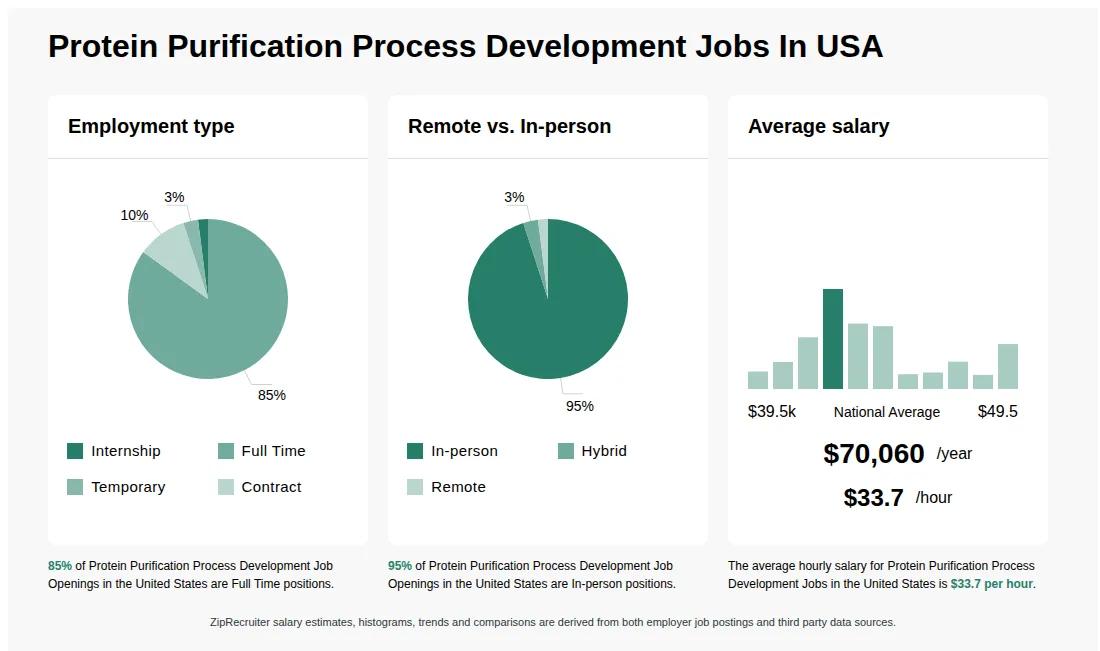
How much do protein purification process development jobs pay per hour?
As of Jun 27, 2026, the average hourly pay for protein purification process development in the United States is $33.68, according to ZipRecruiter salary data. Most workers in this role earn between $27.64 and $41.35 per hour, depending on experience, location, and employer.
What is the difference between Protein Purification Process Development vs Protein Purification Technician?
| Aspect | Protein Purification Process Development | Protein Purification Technician |
|---|---|---|
| Credentials | Bachelor's or higher in Biochemistry, Molecular Biology, or related fields | Associate's or Bachelor's in Life Sciences or related areas |
| Work Environment | Research labs, development facilities, collaborative teams | Manufacturing or production labs, hands-on processing |
| Responsibilities | Designing protocols, optimizing purification methods, process scale-up | Executing purification procedures, operating equipment, maintaining documentation |
Protein Purification Process Development professionals focus on designing and optimizing purification methods, often working in research and development settings. In contrast, Protein Purification Technicians perform routine purification tasks, operating equipment in manufacturing environments. Both roles require knowledge of protein chemistry but differ in scope, responsibilities, and work environment.
What is protein purification process development?
Protein purification process development is the design, optimization, and scaling up of methods to isolate and purify proteins from complex biological mixtures. This field involves selecting appropriate techniques like chromatography, filtration, and centrifugation to obtain a protein of interest with high purity and yield. Professionals in this area work on developing efficient, reproducible, and cost-effective processes that can be transferred from laboratory scale to industrial manufacturing. They also ensure the process meets regulatory standards for use in pharmaceuticals, research, or industrial applications.
What are the key skills and qualifications needed to thrive in Protein Purification Process Development, and why are they important?
To excel in Protein Purification Process Development, a strong background in biochemistry, molecular biology, or chemical engineering—often with a relevant degree or advanced degree—is essential. Familiarity with chromatographic techniques (such as HPLC, FPLC), analytical instruments, and regulatory documentation systems like GMP are typically required. Strong problem-solving, attention to detail, and effective collaboration skills help professionals optimize processes and troubleshoot issues. Mastery of these skills ensures the efficient development of scalable purification methods, high product yield, and compliance with quality standards.
What are some common challenges faced during protein purification process development, and how are they typically addressed?
Protein purification process development often involves overcoming challenges such as low protein yield, maintaining protein stability, and removing impurities efficiently. To address these, scientists frequently optimize buffer conditions, select appropriate chromatography methods, and test various purification strategies in small-scale experiments before scaling up. Cross-functional collaboration with analytical and downstream processing teams is essential to troubleshoot issues and ensure process robustness. Continuous learning and adaptability are key, as each protein can present unique purification challenges.
More about Protein Purification Process Development jobs
What states have the most Protein Purification Process Development jobs? States with the most job openings for Protein Purification Process Development jobs include:
What job categories do people searching Protein Purification Process Development jobs look for? The top searched job categories for Protein Purification Process Development jobs are:

Other
This job post has expired today. Applications are no longer accepted.
Job description
Job Title- Scientist I
Location: Waltham, MA 02451
Duration: Contract till Apr 2027 with possibility to extend
Checklist:
- Purification experience/ Protein purification chromatography
- Bachelor’s degree with a minimum of 6 years of relevant experience • Master’s degree with a minimum of 4 years of relevant experience • PhD in Biotechnology, Biochemistry, Chemical Engineering, 0-3 years
- Technical experience in modern analytical techniques such as spectrophotometry, ELISA, DLS,
- Late-stage purification experience such as design space mapping and process robustness studies
Position Overview/Department Description
The Genomic Medicine Unit (GMU) in *** is responsible for the design and optimization of cell and gene therapy manufacturing processes and platforms. This organization encompasses vector and cell line engineering, upstream and downstream process development, drug product development, analytics, and clinical manufacturing support.
The GMU purification process development group is responsible for the development of viral and non-viral gene therapy purification processes and supporting gene therapy purification for next-generation production platforms to enable high-dose gene therapy programs. The Scientist – Purification Process Development role requires leadership both inside and outside the laboratory and will rely on industry expertise and the exploration of Client technologies in order to build robust and efficient purification processes.
We are looking for a candidate with experience in biologics or gene therapy purification development and bioprocess analytics.
Key Responsibilities:
• Lead and conduct viral/non-viral vector purification process development and process analytics
• Develop and optimize robust viral/non-viral vector purification process using advanced knowledge of column chromatography, filtration, and other downstream purification technology
• Develop, conduct, maintain analytical assays such as ELISA, DLS, Octet, QPCR/ddPCR, HPLC, and CE-SDS etc. for in-process sample testing to support process development
• Provide scientific and technical expertise for in-process sample testing activities, including product quality and process impurity methodologies
• Perform troubleshooting experiments and communicate findings with appropriate working groups
• Maintain industry knowledge and keep abreast of new and relevant technologies
• Perform data analysis, contribute to technical reports, external publications, patent applications and internal/external presentations
• Lead scale-up activities to implement a manufacturing process based on DSP development knowledge
• Communicate effectively with internal and external teams, e.g. CDMOs for tech transfer activities
• Mentor and support junior staff and build a culture of support and collaboration
Basic Qualifications
• PhD in Biotechnology, Biochemistry, Chemical Engineering or related discipline or master’s degree with a minimum of 4 years of relevant experience or a bachelor’s degree with a minimum of 6 years of relevant experience
• Technical experience in modern analytical techniques such as spectrophotometry, ELISA, DLS, Octet, QPCR/ddPCR, HPLC, and CE-SDS
• Significant experience, knowledge and understanding of purification technologies and operations such as:
o Filtration unit operations at various scales, including depth filtration, tangential flow filtration, etc.
o Protein purification chromatography
o Virus clearance and inactivation
• Familiarity with advanced purification technologies and process analytical technologies
• Familiarity with analytical method transfer, analytical method bridging across organizations
• Experience with process technology transfers and performing gap analyses and risk assessments
• Understanding of critical quality attributes and the principles of Quality by Design and ability to apply DOE to downstream development
• Expertise in technical report writing
Preferred Qualifications
• Experience in AAV and/or non-viral purification development
• Experience in writing CMC components of regulatory dossiers
• Knowledge of product comparability, target product profile and quality risk assessment activities
• Viral clearance study design and execution
• Late-stage purification experience such as design space mapping and process robustness studies
• Ability to work in Biosafety Level 2, follow safe lab procedures and maintain good laboratory practices (GLPs)
• Ability to work under minimal supervision and function within a collaborative, team-oriented environment
• Excellent organization and communication skills
• Innovative, critical and creative thinker, unafraid of proposing aggressive solutions to complex problems
• Experience with biophysical characterization
• Experience in continuous manufacturing and process analytical technology
• Experience in mentoring junior staff
• Ability to build and nurture cross-functional relationships
• Ability to communicate and represent group in diverse, multi-functional meetings