PowerBuilder 9.5 Object-oriented programming and how it is applied in PowerBuilder 9.5 SOAP web services and WSDL's Creating web service proxies and calling web services in PowerBuilder using ...
PowerBuilder 9.5 Object-oriented programming and how it is applied in PowerBuilder 9.5 SOAP web services and WSDL's Creating web service proxies and calling web services in PowerBuilder using ...

PowerBuilder Developer
Fort Worth, TX · On-site
Syntricate Technologies is seeking a PowerBuilder Developer to join their team in Fort Worth, TX. The role involves designing, developing, and implementing large-scale solutions in production ...
PowerBuilder Developer
Fort Worth, TX · On-site
Syntricate Technologies is seeking a PowerBuilder Developer to join their team in Fort Worth, TX. The role involves designing, developing, and implementing large-scale solutions in production ...

PowerBuilder Developer
Saint Paul, MN · On-site
PowerBuilder Developer Location: Saint Paul, Minnesota Duration: 12+ Months Minimum Qualifications * Nine (9+) years experience in Developer/Programmer role * A Master s degree substitutes for three ...
PowerBuilder Developer
Saint Paul, MN · On-site
PowerBuilder Developer Location: Saint Paul, Minnesota Duration: 12+ Months Minimum Qualifications * Nine (9+) years experience in Developer/Programmer role * A Master s degree substitutes for three ...

PowerBuilder Developer
Augusta, ME · On-site
They are seeking a PowerBuilder Developer to upgrade their current SACWIS system, assist in converting databases, implement change requests, and test system modifications. Responsibilities : • ...
PowerBuilder Developer
Augusta, ME · On-site
They are seeking a PowerBuilder Developer to upgrade their current SACWIS system, assist in converting databases, implement change requests, and test system modifications. Responsibilities : • ...
PowerBuilder Developer
Overland Park, KS · On-site
PowerBuilder Developer Location: Overland Park, Kansas. We're transitioning a business-critical application in-house from Amdocs and seeking an experienced PowerBuilder Developer to stabilize, evolve ...
Quick apply
PowerBuilder Developer
Overland Park, KS · On-site
PowerBuilder Developer Location: Overland Park, Kansas. We're transitioning a business-critical application in-house from Amdocs and seeking an experienced PowerBuilder Developer to stabilize, evolve ...

Sr Powerbuilder Developer
Richmond, VA · On-site
Senior PowerBuilder Developer Location: Richmond, VA Duration: 04 Month Work Model: Onsite (3-4 days per week) Interview: In-person required Job Overview We are seeking a Senior PowerBuilder ...
Quick apply
Sr Powerbuilder Developer
Richmond, VA · On-site
Senior PowerBuilder Developer Location: Richmond, VA Duration: 04 Month Work Model: Onsite (3-4 days per week) Interview: In-person required Job Overview We are seeking a Senior PowerBuilder ...
PowerBuilder Developer
Addison, TX · On-site
PowerBuilder Developer Location: Addison, TX Worksite Schedule: 4-days onsite in Addison, TX (Monday - Thursday, Fridays remote) Duration: 6 months C2H Requirements: * 3+ years of experience in ...
Quick apply
PowerBuilder Developer
Addison, TX · On-site
PowerBuilder Developer Location: Addison, TX Worksite Schedule: 4-days onsite in Addison, TX (Monday - Thursday, Fridays remote) Duration: 6 months C2H Requirements: * 3+ years of experience in ...
PowerBuilder 9.5 Object-oriented programming and how it is applied in PowerBuilder 9.5 SOAP web services and WSDL's Creating web service proxies and calling web services in PowerBuilder using ...
PowerBuilder 9.5 Object-oriented programming and how it is applied in PowerBuilder 9.5 SOAP web services and WSDL's Creating web service proxies and calling web services in PowerBuilder using ...
This application development was commenced in an early version of PowerBuilder that predates the PFC. The application is a typical two tier client server application chiefly built around the ...
This application development was commenced in an early version of PowerBuilder that predates the PFC. The application is a typical two tier client server application chiefly built around the ...

Sybase PowerBuilder
Hartford, CT · On-site
ONSITE ROLE - LOCATION Hartford - CT Sybase PowerBuilder A minimum of nine (9) years of prior experience demonstrating the following knowledge and skills: * Experience with the PowerBuilder ...
Sybase PowerBuilder
Hartford, CT · On-site
ONSITE ROLE - LOCATION Hartford - CT Sybase PowerBuilder A minimum of nine (9) years of prior experience demonstrating the following knowledge and skills: * Experience with the PowerBuilder ...

Role: PowerBuilder Developer/Programmer Duration: 12 months Location: Remote (CST time) Qualifications: * Experience in PowerBuilder application development role(s) * Experience writing PL/SQL ...
Quick apply
Role: PowerBuilder Developer/Programmer Duration: 12 months Location: Remote (CST time) Qualifications: * Experience in PowerBuilder application development role(s) * Experience writing PL/SQL ...

Powerbuilder Developer
Lansing, MI · On-site
PowerBuilder Developer w/.Net Location: Lansing, MI Duration: 6 Months Skills Required The Application Software Engineer must have the following skills and expertise: Application Software Engineer ...
Powerbuilder Developer
Lansing, MI · On-site
PowerBuilder Developer w/.Net Location: Lansing, MI Duration: 6 Months Skills Required The Application Software Engineer must have the following skills and expertise: Application Software Engineer ...

Appeon PowerBuilder Developer
Dallas, TX · On-site
Appeon PowerBuilder Developer Location: Dallas, TX (Hybrid) Experience: 5+ Years We are seeking an experienced Appeon PowerBuilder Developer to design, develop, and maintain enterprise applications.
Appeon PowerBuilder Developer
Dallas, TX · On-site
Appeon PowerBuilder Developer Location: Dallas, TX (Hybrid) Experience: 5+ Years We are seeking an experienced Appeon PowerBuilder Developer to design, develop, and maintain enterprise applications.

Sr. Powerbuilder Developer
Richmond, VA · On-site
Title: Sr. Powerbuilder Developer Location: Richmond, VA [ Hybrid ] 12 months Project: Project Lighthouse backfill to maintain IRMS legacy systems and develop interfaces between GentTax and IRMS ...
Quick apply
Sr. Powerbuilder Developer
Richmond, VA · On-site
Title: Sr. Powerbuilder Developer Location: Richmond, VA [ Hybrid ] 12 months Project: Project Lighthouse backfill to maintain IRMS legacy systems and develop interfaces between GentTax and IRMS ...

Senior Powerbuilder Developer
Richmond, VA · On-site
$65 - $70/hr
Experience developing PowerBuilder applications using PowerBuilder 12.5 or higher * Hands-on experience using Relational Databases, such as Oracle 19C or higher or MySQL or similar. * Experience ...
Quick apply
Senior Powerbuilder Developer
Richmond, VA · On-site
$65 - $70/hr
Experience developing PowerBuilder applications using PowerBuilder 12.5 or higher * Hands-on experience using Relational Databases, such as Oracle 19C or higher or MySQL or similar. * Experience ...
This application development was commenced in an early version of PowerBuilder that predates the PFC. The application is a typical two tier client server application chiefly built around the ...
This application development was commenced in an early version of PowerBuilder that predates the PFC. The application is a typical two tier client server application chiefly built around the ...
Successful candidates will upgrade PowerBuilder in the first quarter of calendar year 2018. 10%: Application is written in PowerBuilder 12 and PL SQL. It has an Oracle 11G back end soon to be ...
Successful candidates will upgrade PowerBuilder in the first quarter of calendar year 2018. 10%: Application is written in PowerBuilder 12 and PL SQL. It has an Oracle 11G back end soon to be ...
PowerBuilder Programmer
Albany, NY · On-site
PowerBuilder Programmer Location: Albany, NY 12207 Duration: 2 year Responsibilities: * Analysis, design, coding, component and assembly testing of all application code owned by the Application Team
PowerBuilder Programmer
Albany, NY · On-site
PowerBuilder Programmer Location: Albany, NY 12207 Duration: 2 year Responsibilities: * Analysis, design, coding, component and assembly testing of all application code owned by the Application Team
Powerbuilder Developer
Lansing, MI · On-site
PowerBuilder Developer w/.Net Location: Lansing, MI Duration: 6 Months Skills Required The Application Software Engineer must have the following skills and expertise: Application Software Engineer ...
Powerbuilder Developer
Lansing, MI · On-site
PowerBuilder Developer w/.Net Location: Lansing, MI Duration: 6 Months Skills Required The Application Software Engineer must have the following skills and expertise: Application Software Engineer ...

Programmer Analyst 5 - PowerBuilder Developer Job Location: Lansing, MI (Hybrid) Job Type: Contract / Requirement: * Resource must have a high level of SQL query writing skills to write complex ...
Programmer Analyst 5 - PowerBuilder Developer Job Location: Lansing, MI (Hybrid) Job Type: Contract / Requirement: * Resource must have a high level of SQL query writing skills to write complex ...
Powerbuilder information
See salary details
$5.29 - $7.85
0% of jobs
$7.85 - $10.40
0% of jobs
$10.40 - $12.96
0% of jobs
$14.03 is the 25th percentile. Wages below this are outliers.
$12.96 - $15.52
60% of jobs
$15.52 - $18.07
0% of jobs
$18.07 - $20.63
0% of jobs
$20.63 - $23.19
0% of jobs
$24.53 is the 75th percentile. Wages above this are outliers.
$23.19 - $25.74
29% of jobs
$25.74 - $28.30
0% of jobs
$28.30 - $30.86
0% of jobs
$30.86 - $33.41
11% of jobs
$5
$20
$33
How much do powerbuilder jobs pay per hour?
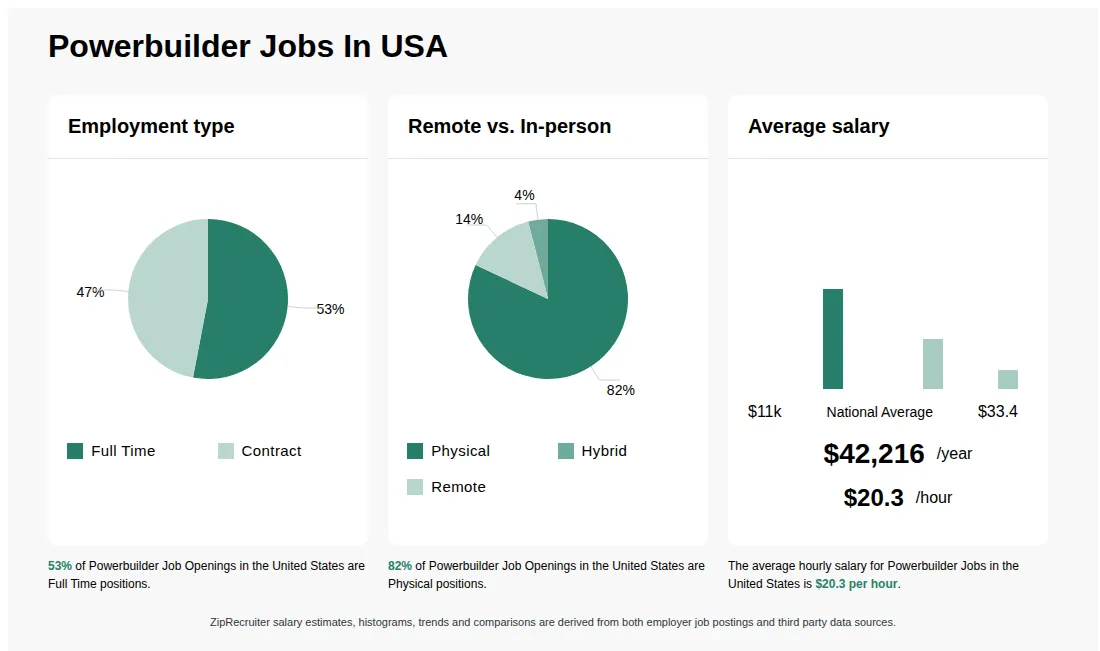
As of Sep 12, 2026, the average hourly pay for powerbuilder in the United States is $20.30, according to ZipRecruiter salary data. Most workers in this role earn between $13.46 and $24.04 per hour, depending on experience, location, and employer.
What is a PowerBuilder developer?
PowerBuilder developers are IT professionals who specialize in using PowerBuilder, a rapid application development tool, to design, develop, and maintain business applications. They typically work with databases, user interfaces, and enterprise systems, often in industries like finance, healthcare, and government that rely on legacy applications. PowerBuilder developers are skilled in PowerScript (the language of PowerBuilder), troubleshooting, upgrading legacy systems, and integrating applications with modern technologies. Their role is crucial for organizations that continue to depend on stable, data-driven applications developed in PowerBuilder.
What does a PowerBuilder do?
PowerBuilder is an object-related computer language and integrated development environment, or IDE. Being known as a PowerBuilder means that you use this software in a diverse range of jobs and responsibilities. It is used to make programs for creating comprehensive suites of tools for application development. These tools can include a source code editor, debugging tools, and automation services. PowerBuilder continues to be used in a range of business categories that include banking, insurance, education, government services, network services, and telecommunication. Career positions that can involve the use of PowerBuilder software include Developer, Programmer, Analyst, and other roles in tech support.
What are the key skills and qualifications needed to thrive as a PowerBuilder developer?
To excel as a PowerBuilder Developer, you need strong programming skills in PowerBuilder, experience with SQL databases, and a background in software development, often supported by a relevant degree or certifications. Familiarity with PowerBuilder IDE, database management systems like Oracle or SQL Server, and version control tools is essential. Analytical thinking, problem-solving, and effective communication are vital soft skills for understanding user requirements and collaborating with teams. These competencies ensure efficient development, maintenance, and enhancement of business-critical applications built on the PowerBuilder platform.
What are some common challenges faced by PowerBuilder developers when maintaining legacy applications?
PowerBuilder developers often encounter challenges related to maintaining and modernizing legacy applications, such as dealing with outdated code, limited documentation, and compatibility issues with newer operating systems or databases. Collaborating with cross-functional teams to integrate PowerBuilder applications with modern technologies can also be complex, requiring strong problem-solving and communication skills. However, these challenges provide opportunities to develop expertise in modernization strategies and to play a vital role in supporting critical business systems.
What is the difference between Powerbuilder vs SQL Developer?
| Aspect | Powerbuilder | SQL Developer |
|---|---|---|
| Primary Role | Application development and client-server software | Database design, development, and management |
| Required Skills | Powerbuilder language, UI design, database integration | SQL, PL/SQL, database architecture |
| Work Environment | Software development teams, client-side applications | Database teams, data management environments |
| Common Usage | Building enterprise applications with rich UI | Managing and optimizing databases |
Powerbuilder focuses on developing client-server applications with a strong emphasis on UI and application logic, while SQL Developer specializes in database management, querying, and optimization. Both roles often collaborate but serve different core functions within the software development and data management lifecycle.
More about Powerbuilder jobs
What cities are hiring for Powerbuilder jobs?
Cities with the most Powerbuilder job openings:
What are the most commonly searched types of Powerbuilder jobs?
The most popular types of Powerbuilder jobs are:
What states have the most Powerbuilder jobs?
States with the most job openings for Powerbuilder jobs include:
What job categories do people searching Powerbuilder jobs look for?
The top searched job categories for Powerbuilder jobs are:

Lead Developer - PowerBuilder
Jacksonville, FL • On-site
TecTammina
• IT Services • 201 - 500 employees201 - 500 employees
Full-time
Re-posted 13 days ago
Job description
Company Description
First IT Solutions
Job Description
Technical/Functional Skills :
PowerBuilder 9.5
Object-oriented programming and how it is applied in PowerBuilder 9.5
SOAP web services and WSDL's
Creating web service proxies and calling web services in PowerBuilder using EasySoap
Debugging PowerBuilder applications
Using external API's/dll's from within PowerBuilder
SQL Server databases
Creating and populating DataStores from database queries
Generic Managerial Skills :
Leading and Mentoring both Onsite and Offshore teams for developing Powerbuilder applications
Creating Project Plan and Track status
Handling Customer communications and Management reporting
Experience in Health Care (preferable)
Qualifications
Bachelor's degree in an IT related field or equivalent work experience
Additional Information
Job Status: Permanent
Share the Profiles to mdanish(at)1stitsolutions.com
Contact: 703-349-1004
Keep the subject line with Job Title and Location

About TechTammina
Sourced by ZipRecruiter
Industry
It services
Company size
201 - 500 Employees
Headquarters location
Chantilly, VA, US
Year founded
2005