1

Pneumatic Engineer Jobs (NOW HIRING)

PNEUMATIC TUBE TECHNICIAN

Saint Louis, MO · On-site

$16.25 - $20/hr

Facilities Engineering maintains 6 million square foot of facilities dedicated to clinical and ... pneumatic tube transport system while monitoring performance data to improve efficiency and ...

Opportunities are available in the following areas: • Research and Development • New Product Development Programs • Sustaining/In-Service Programs As an Air Systems / Pneumatics Engineer we ...

PNEUMATIC TUBE TECHNICIAN

Saint Louis, MO · On-site

$28.30 - $47.03/hr

Facilities Engineering maintains 6 million square foot of facilities dedicated to clinical and ... pneumatic tube transport system while monitoring performance data to improve efficiency and ...

Showing results 21-40

Pneumatic Engineer information

See salary details

$33K

$89.2K

$142K

How much do pneumatic engineer jobs pay per year?

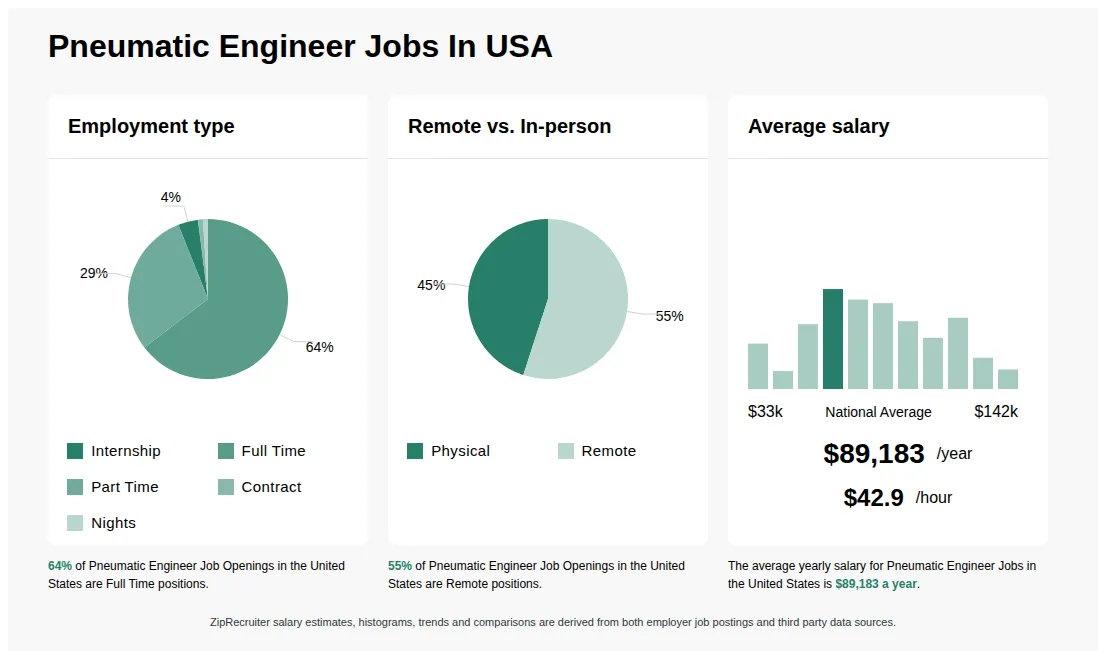
As of Sep 5, 2026, the average yearly pay for pneumatic engineer in the United States is $89,183.00, according to ZipRecruiter salary data. Most workers in this role earn between $66,500.00 and $109,000.00 per year, depending on experience, location, and employer.

What is a pneumatic engineer?

A Pneumatic Engineer is a professional who specializes in designing, developing, and maintaining systems and equipment that use compressed air or gases to transmit and control energy. They work on machinery and industrial processes that rely on pneumatic technology, such as automation systems, robotics, and manufacturing lines. Pneumatic Engineers are responsible for ensuring these systems operate efficiently, safely, and reliably, often collaborating with other engineers and technicians. Their work is essential in industries like automotive, aerospace, pharmaceuticals, and food processing. They also troubleshoot and optimize existing pneumatic systems to improve performance and reduce energy consumption.

What are the key skills and qualifications needed to thrive as a pneumatic engineer, and why are they important?

To thrive as a Pneumatic Engineer, you need a solid background in mechanical engineering, fluid dynamics, and pneumatic system design, generally supported by a relevant engineering degree. Familiarity with CAD software, PLC programming, and pneumatic simulation tools, along with certifications like Professional Engineer (PE), is often required. Strong problem-solving skills, attention to detail, and effective communication are essential soft skills for this role. These abilities ensure the safe, efficient, and innovative design and maintenance of pneumatic systems in industrial settings.

What are some common challenges a pneumatic engineer might face when collaborating with cross-functional teams?

Pneumatic Engineers often work closely with mechanical, electrical, and controls engineers, which can present challenges in aligning requirements and technical specifications across disciplines. Effective communication is essential to ensure that pneumatic systems integrate seamlessly with broader automation or manufacturing processes. Additionally, balancing the priorities of different teams while adhering to project deadlines and safety standards requires strong organizational and interpersonal skills. Being proactive in addressing potential issues and fostering open dialogue can help smooth collaboration and drive successful project outcomes.

What is the difference between Pneumatic Engineer vs Mechanical Engineer?

AspectPneumatic EngineerMechanical Engineer
CredentialsBachelor's in Mechanical or Pneumatics, certifications in pneumaticsBachelor's in Mechanical Engineering, Professional Engineer (PE) license
Work EnvironmentManufacturing plants, automation systems, fluid power labsDesign offices, manufacturing facilities, research labs
Industry UsageAutomation, machinery, fluid power systemsAutomotive, aerospace, manufacturing, product design

While both roles involve mechanical principles, Pneumatic Engineers specialize in pneumatic systems and fluid power, working primarily with compressed air and automation. Mechanical Engineers have a broader scope, focusing on various mechanical systems and design. The two roles often collaborate but differ in their specific technical focus and work environments.

More about Pneumatic Engineer jobs

What states have the most Pneumatic Engineer jobs?

States with the most job openings for Pneumatic Engineer jobs include:

What job categories do people searching Pneumatic Engineer jobs look for?

The top searched job categories for Pneumatic Engineer jobs are:

Infographic showing various Pneumatic Engineer job openings in the United States as of August 2026, with employment types broken down into 93% Full Time, 3% Part Time, and 4% Contract. Highlights an 86% Physical, 5% Hybrid, and 9% Remote job distribution, with an average salary of $89,183 per year, or $42.9 per hour.

Engineering - Air Systems/Pneumatics

Axius Group

Wichita, KS • On-site

$85 - $120/hr

Other

Re-posted 5 days ago


Job description

Job DetailsJob Location: Wichita, KS 67209SUMMARY

SUMMARY

The Professional Engineering - Air Systems/Pneumatics role is responsible for performing systems engineering activities related to aircraft pneumatic systems. This position supports pneumatic system architecture, requirements definition, integration, supplier coordination, design review, validation, verification, certification documentation, and technical issue resolution. The role also supports test platforms, production and in-service troubleshooting, technical reporting, and cross-functional engineering activities while ensuring adherence to program schedules, milestones, and engineering standards.

ESSENTIAL FUNCTIONS
  • Act as a systems engineer and carry out pneumatics discipline activities in support of aircraft systems engineering requirements
  • Assure integration and interface management of assigned systems and coordinate with internal groups and suppliers
  • Define pneumatic system architecture, prepare specifications and requirements, and conduct functional modeling and trade studies
  • Ensure engineering requirements management, validation, and verification
  • Manage suppliers from an engineering project and engineering technical perspective
  • Review and approve engineering design documents, including vendor drawings, test procedures, acceptance test procedures, qualification reports, and certification documents
  • Document technical engineering analysis, ground test results, and flight test results
  • Prepare engineering technical reports to show compliance with applicable certification requirements
  • Support the build and operation of test platforms, including rigs and flight test vehicles
  • Work within multi-disciplinary teams to address product engineering definition and issue resolution
  • Prepare design change modifications and optimized solutions
  • Support production and in-service teams in troubleshooting engineering systems-related issues
  • Ensure adherence to program schedules and milestones
  • Contribute to Knowledge Domain and Bombardier Engineering System initiatives
QualificationsKNOWLEDGE
  • Knowledge of fluid flow, thermodynamic concepts, pneumatic systems, aircraft system architecture, and system performance
  • Basic knowledge of pneumatics and interfacing technical disciplines, including system installation, avionics, power plant, and related aircraft systems
  • Familiarity with component qualification requirements, including DO-160 and MIL-STD-810
  • Familiarity with Design Process Assurance requirements, including ARP4754A
  • Knowledge of functional modeling, system performance testing, validation, verification, and requirements management
  • Working knowledge of Microsoft Office tools and system design tools such as Model Based Engineering or simulation software
  • Knowledge of engineering documentation, supplier technical reviews, test procedures, qualification reports, and certification documents
COMPETENCIES
  • Strong analytical thinking and technical problem-solving
  • Ability to quickly understand complex technical issues and develop practical solutions
  • Clear and professional written and verbal communication
  • Ability to manage engineering requirements, suppliers, technical documentation, and project milestones
  • Collaborative team approach with the ability to build effective relationships across multi-disciplinary teams
  • Self-motivated, dynamic, detail-oriented, and comfortable balancing technical execution with project management responsibilities
EXPERIENCE AND EDUCATION
  • Bachelor's or master's degree in Mechanical Engineering, Aerospace Engineering, or a related engineering discipline required
  • Five to eight years of relevant technical experience in an aerospace engineering field preferred
  • Experience with pneumatic systems, aircraft systems integration, requirements development, validation, verification, and certification documentation preferred
  • Experience reviewing supplier technical documentation, coordinating with internal teams, and supporting test platforms is preferred
  • Bilingual proficiency in French and English is required or preferred based on program requirements
WORKING CONDITIONS
  • Prolonged periods of sitting at a desk and working at a computer
  • Repetitive use of the hands, wrists, and arms due to computer usage
  • Work is primarily performed in an office or engineering environment with occasional exposure to test, laboratory, aircraft, production, or shop environments
  • Short-term travel may be required to support testing, technical reviews, supplier coordination, or project assignments
  • Reasonable accommodations may be made to enable qualified individuals with disabilities to perform the essential functions of the position
WORK AUTHORIZATION/SECURITY CLEARANCE
  • Must be legally authorized to work in the United States
  • If a security clearance is required:
  • Candidate must be able to obtain and maintain applicable security clearance requirements
  • Successful candidates must be able to obtain required Program Access approval, if applicable
#J-18808-Ljbffr