The Pipe Insulation Technician is responsible for installing, repairing, and maintaining insulation systems on piping, ductwork, vessels, tanks, and related mechanical equipment to meet project ...
The Pipe Insulation Technician is responsible for installing, repairing, and maintaining insulation systems on piping, ductwork, vessels, tanks, and related mechanical equipment to meet project ...
Be Seen First
Pipe Insulator
Sacramento, CA · Remote
$20 - $30/hr
Our company installs pipe insulation primarily at facilities such as wineries, food manufacturing and hospitals. We also insulate tanks as well. This is a specialty construction business that ...
Quick apply
Be Seen First
Pipe Insulator
Sacramento, CA · Remote
$20 - $30/hr
Our company installs pipe insulation primarily at facilities such as wineries, food manufacturing and hospitals. We also insulate tanks as well. This is a specialty construction business that ...

Insulator Technician
Valdosta, GA · On-site
$16 - $40/hr
Install insulation on pipes, tanks, and other surfaces in industrial settings * Prepare surfaces by cleaning and measuring before insulation application * Cut insulation materials to specified ...
Quick apply
Insulator Technician
Valdosta, GA · On-site
$16 - $40/hr
Install insulation on pipes, tanks, and other surfaces in industrial settings * Prepare surfaces by cleaning and measuring before insulation application * Cut insulation materials to specified ...

Pipe Insulator
Idaho Falls, ID · On-site
$20 - $28/hr
Pipe Insulator Company Name: Bingham Mechanical, Inc. Pay Range: $20.00 - $28.00 per hour, based on ... In this role, you'll be responsible for installing and finishing mechanical insulation systems on ...
Quick apply
Pipe Insulator
Idaho Falls, ID · On-site
$20 - $28/hr
Pipe Insulator Company Name: Bingham Mechanical, Inc. Pay Range: $20.00 - $28.00 per hour, based on ... In this role, you'll be responsible for installing and finishing mechanical insulation systems on ...
Pipe and Duct Insulator
Jacksonville, FL · On-site
$16 - $30/hr
Register Insulation provides insulation services to Mechanical (HVAC) and Plumbing contractors ... Duct and Pipes on Commercial and Industrial Projects - Learning Hands on with other Tradesmen ...
Quick apply
Pipe and Duct Insulator
Jacksonville, FL · On-site
$16 - $30/hr
Register Insulation provides insulation services to Mechanical (HVAC) and Plumbing contractors ... Duct and Pipes on Commercial and Industrial Projects - Learning Hands on with other Tradesmen ...
Pipe and Duct Insulator
Savannah, GA · Remote
$16 - $30/hr
Register Insulation provides insulation services to Mechanical (HVAC) and Plumbing contractors ... Duct and Pipes on Commercial and Industrial Projects - Learning Hands on with other Tradesmen ...
Quick apply
Pipe and Duct Insulator
Savannah, GA · Remote
$16 - $30/hr
Register Insulation provides insulation services to Mechanical (HVAC) and Plumbing contractors ... Duct and Pipes on Commercial and Industrial Projects - Learning Hands on with other Tradesmen ...

Insulator (Grades 7 - 9)
$35.15 - $39.03/hr
Required - Verifiable experience installing various types of structural insulation, pipe insulation, ventilation insulation. Required - Must meet the requirements of the I02 physical task analysis.
Insulator (Grades 7 - 9)
$35.15 - $39.03/hr
Required - Verifiable experience installing various types of structural insulation, pipe insulation, ventilation insulation. Required - Must meet the requirements of the I02 physical task analysis.
Insulator (Grades 7 - 9)
$35.15 - $39.03/hr
Required - Verifiable experience installing various types of structural insulation, pipe insulation, ventilation insulation. Required - Must meet the requirements of the I02 physical task analysis.
Insulator (Grades 7 - 9)
$35.15 - $39.03/hr
Required - Verifiable experience installing various types of structural insulation, pipe insulation, ventilation insulation. Required - Must meet the requirements of the I02 physical task analysis.
Insulator (Grades 7 - 9)
Bath, ME · On-site
$35.15 - $39.03/hr
Required - Verifiable experience installing various types of structural insulation, pipe insulation, ventilation insulation. Required - Must meet the requirements of the I02 physical task analysis.
Insulator (Grades 7 - 9)
Bath, ME · On-site
$35.15 - $39.03/hr
Required - Verifiable experience installing various types of structural insulation, pipe insulation, ventilation insulation. Required - Must meet the requirements of the I02 physical task analysis.
Plumber Helper - Pipe Insulator - North Port
Sarasota, FL · On-site
$15.75 - $20.25/hr
Installs Pipe insulation * Install pipes and fixtures, such as sinks and toilets, for water, gas, steam, air, or other liquids. * Install supports for pipes, equipment, and fixtures prior to ...
Quick apply
Plumber Helper - Pipe Insulator - North Port
Sarasota, FL · On-site
$15.75 - $20.25/hr
Installs Pipe insulation * Install pipes and fixtures, such as sinks and toilets, for water, gas, steam, air, or other liquids. * Install supports for pipes, equipment, and fixtures prior to ...
HVAC Sr Insulation Mechanic
Maitland, FL · On-site
$28 - $35/hr
Work with duct wrap, pipe insulation, board insulation, vapor barriers, adhesives, sealants, pins, tape, and related materials. * Read and understand mechanical plans, specifications, and insulation ...
Quick apply
HVAC Sr Insulation Mechanic
Maitland, FL · On-site
$28 - $35/hr
Work with duct wrap, pipe insulation, board insulation, vapor barriers, adhesives, sealants, pins, tape, and related materials. * Read and understand mechanical plans, specifications, and insulation ...
HVAC Sr Insulation Mechanic
Maitland, FL · On-site
$28 - $35/hr
Work with duct wrap, pipe insulation, board insulation, vapor barriers, adhesives, sealants, pins, tape, and related materials. * Read and understand mechanical plans, specifications, and insulation ...
Quick apply
HVAC Sr Insulation Mechanic
Maitland, FL · On-site
$28 - $35/hr
Work with duct wrap, pipe insulation, board insulation, vapor barriers, adhesives, sealants, pins, tape, and related materials. * Read and understand mechanical plans, specifications, and insulation ...

Essential Functions Tests, repairs, or replaces valves, fittings and pipe insulation associated with the steam distribution system. Makes standard types of water and sewer connections within manholes ...
Essential Functions Tests, repairs, or replaces valves, fittings and pipe insulation associated with the steam distribution system. Makes standard types of water and sewer connections within manholes ...
Install insulation on pipes, water lines, drain lines, ductwork, boilers, and other equipment to manage temperature and protect systems. * Measure, cut, and prepare various insulation materials, such ...
Quick apply
Install insulation on pipes, water lines, drain lines, ductwork, boilers, and other equipment to manage temperature and protect systems. * Measure, cut, and prepare various insulation materials, such ...
HVAC Pipefitter
Madisonville, LA · On-site
$21.75 - $27.75/hr
Perform equipment setting, pipe routing, soldering, pipe insulation, and mechanical system assembly * Knowledge of purging, soldering, evacuation, refrigerant charging per industry standards
HVAC Pipefitter
Madisonville, LA · On-site
$21.75 - $27.75/hr
Perform equipment setting, pipe routing, soldering, pipe insulation, and mechanical system assembly * Knowledge of purging, soldering, evacuation, refrigerant charging per industry standards
HVAC Pipefitter
Madisonville, LA · On-site
$21.75 - $27.75/hr
Perform equipment setting, pipe routing, soldering, pipe insulation, and mechanical system assembly * Knowledge of purging, soldering, evacuation, refrigerant charging per industry standards
HVAC Pipefitter
Madisonville, LA · On-site
$21.75 - $27.75/hr
Perform equipment setting, pipe routing, soldering, pipe insulation, and mechanical system assembly * Knowledge of purging, soldering, evacuation, refrigerant charging per industry standards

Installer - Insulation
Cranston, RI · On-site
$17.50 - $23.25/hr
Wrap air ducts and water lines with insulating materials, such as duct wrap and pipe insulation. * Clean and maintain tools and equipment. * High school diploma or equivalent. * Excellent customer ...
Installer - Insulation
Cranston, RI · On-site
$17.50 - $23.25/hr
Wrap air ducts and water lines with insulating materials, such as duct wrap and pipe insulation. * Clean and maintain tools and equipment. * High school diploma or equivalent. * Excellent customer ...
Must have the endurance, strength and skill to install insulation and sheet metal covering - for example, employees must be capable of installing pipe insulation and metal coverings from ladders ...
Must have the endurance, strength and skill to install insulation and sheet metal covering - for example, employees must be capable of installing pipe insulation and metal coverings from ladders ...

INSULATOR PIPE - SKILLED
Pascagoula, MS · On-site
$35.99/hr
If you're ready to put your insulation expertise to work on a world-class scale, a rewarding career at Ingalls Shipbuilding - "America's Shipyard" and Mississippi's largest private employer - is ...
INSULATOR PIPE - SKILLED
Pascagoula, MS · On-site
$35.99/hr
If you're ready to put your insulation expertise to work on a world-class scale, a rewarding career at Ingalls Shipbuilding - "America's Shipyard" and Mississippi's largest private employer - is ...

Installer - Insulation
Cranston, RI · On-site
$17.50 - $23.25/hr
Wrap air ducts and water lines with insulating materials, such as duct wrap and pipe insulation. * Clean and maintain tools and equipment. * High school diploma or equivalent. * Excellent customer ...
Installer - Insulation
Cranston, RI · On-site
$17.50 - $23.25/hr
Wrap air ducts and water lines with insulating materials, such as duct wrap and pipe insulation. * Clean and maintain tools and equipment. * High school diploma or equivalent. * Excellent customer ...
Pipe Insulation information
See salary details
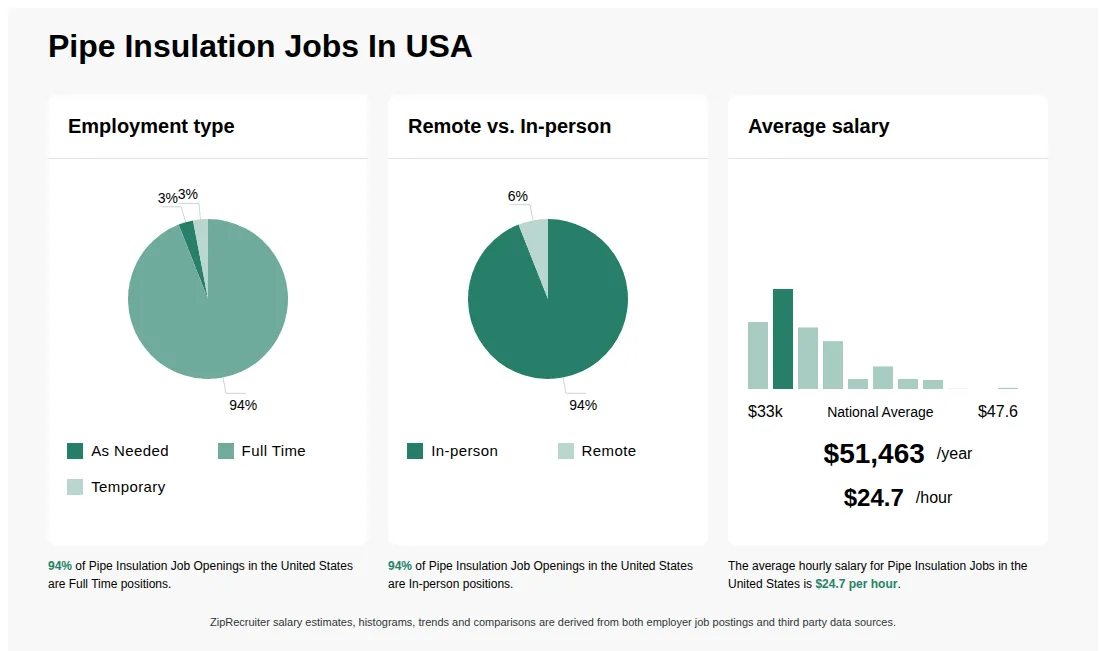
$15.87 - $18.75
21% of jobs
$19.13 is the 25th percentile. Wages below this are outliers.
$18.75 - $21.63
31% of jobs
$21.63 - $24.52
19% of jobs
$25.34 is the 75th percentile. Wages above this are outliers.
$24.52 - $27.40
15% of jobs
$27.40 - $30.29
3% of jobs
$30.29 - $33.17
6% of jobs
$33.17 - $36.06
3% of jobs
$36.06 - $38.94
2% of jobs
$38.94 - $41.83
0% of jobs
$41.83 - $44.71
0% of jobs
$44.71 - $47.60
0% of jobs
$15
$24
$47
How much do pipe insulation jobs pay per hour?
As of Sep 3, 2026, the average hourly pay for pipe insulation in the United States is $24.74, according to ZipRecruiter salary data. Most workers in this role earn between $19.23 and $25.00 per hour, depending on experience, location, and employer.
What is pipe insulation?
A Pipe Insulation job involves installing materials around pipes to regulate temperature, prevent energy loss, and reduce condensation. Workers measure, cut, and secure insulation using various materials like foam, fiberglass, or rubber. This role is essential in industrial, commercial, and residential settings to enhance energy efficiency and protect piping systems. Skilled pipe insulators follow safety guidelines and may work in extreme temperatures or tight spaces.
What does a typical day look like for someone working in pipe insulation?
A typical day for a pipe insulation worker involves measuring and cutting insulation materials, fitting them around various types of piping, and securing the materials according to project specifications and safety standards. You’ll often work on construction sites, industrial plants, or commercial buildings as part of a team, sometimes collaborating with plumbers, HVAC technicians, or project managers. The role can be physically demanding and may require working in tight spaces or at heights. Workers must follow strict safety protocols and maintain accurate records of their work. As you gain experience, there are opportunities to move into supervisory roles or specialized areas within insulation contracting.
What are the key skills and qualifications needed to thrive in pipe insulation, and why are they important?
To excel in pipe insulation, you need strong manual dexterity, experience with insulation materials and installation techniques, and often a high school diploma or equivalent. Familiarity with hand and power tools, safety regulations, and in some cases certification such as OSHA safety training is valuable. Attention to detail, reliability, and effective team communication are important soft skills in this trade. These abilities are crucial for ensuring proper insulation installation, maintaining job site safety, and contributing positively to project outcomes.
How much does a pipe insulator make?
The average salary for a pipe insulator in the United States ranges from $35,000 to $60,000 per year, depending on experience, location, and certifications. Skilled insulators with union membership or specialized training can earn higher wages, and the job often involves working in construction or industrial environments with safety protocols.
Is pipe insulation a trade?
Pipe insulation is a skilled trade involving the installation of insulating materials on pipes to prevent heat loss, condensation, and freezing. Workers in this field often learn through apprenticeships or technical training and may need certifications depending on the region. It is part of the broader construction and HVAC industries.
More about Pipe Insulation jobs
What cities are hiring for Pipe Insulation jobs?
Cities with the most Pipe Insulation job openings:
What are the most commonly searched types of Pipe Insulation jobs?
The most popular types of Pipe Insulation jobs are:
What states have the most Pipe Insulation jobs?
States with the most job openings for Pipe Insulation jobs include:
What job categories do people searching Pipe Insulation jobs look for?
The top searched job categories for Pipe Insulation jobs are:

Full-time
Re-posted 13 days ago
Job description
Cruz Associates Inc. of Yorktown, VA has an open position and is looking for qualified candidates for a Pipe Insulation Technician. The job location is at the Naval Surface Warfare Center, Indian Head MD.
Scope of Performance: The Pipe Insulation Technician is responsible for installing, repairing, and maintaining insulation systems on piping, ductwork, vessels, tanks, and related mechanical equipment to meet project specifications, safety standards, and customer requirements. This position requires the ability to interpret drawings, measure and fabricate insulation materials, and perform work in industrial, commercial, and government environments while maintaining high standards of quality and workmanship. This position will be full-time technician, including overtime and some shift work, and shall be subject to Department of Transportation physical examinations and certification requirements.
Key Responsibilities:
- Install thermal, acoustic, and protective insulation on piping, valves, fittings, ductwork, tanks, vessels, and mechanical equipment.
- Measure, cut, fabricate, and install insulation materials including fiberglass, mineral wool, elastomeric foam, calcium silicate, and other specified materials.
- Install protective jacketing and vapor barriers using aluminum, stainless steel, PVC, or other approved materials.
- Read and interpret blueprints, isometric drawings, work packages, and technical specifications.
- Prepare surfaces for insulation installation and remove/replace damaged insulation as required.
- Seal joints, seams, and penetrations to ensure proper thermal performance and moisture protection.
- Operate hand tools, power tools, and specialized insulation equipment safely and efficiently.
- Inspect completed work to ensure compliance with project specifications, quality standards, and applicable codes.
- Maintain a clean, organized, and safe work area in accordance with company policies and OSHA requirements.
- Identify material shortages, quality concerns, and potential safety hazards, and report them to supervision.
- Work effectively with supervisors, project managers, quality personnel, and other trades to support project completion.
- Complete required documentation, including daily work reports, material usage, and quality records.
- Perform other duties as assigned.
Education and Experience – Required:
- High School Diploma or equivalent
- Previous experience installing industrial or commercial pipe insulation
- Ability to read measuring devices, blueprints, and technical drawings
- U.S. Citizen and valid driver’s license
- Ability to obtain and maintain a Secret Clearance
- Ability to pass Ammo-18 Certification class
- Ability to work with automated computer systems
- Ability to communicate with all levels of personnel, both military and private industry