1

Nasa Logistics Jobs (NOW HIRING)

Lead Logistics Clerk

Clearwater, FL · On-site

$16 - $19/hr

... NASA, other federal agencies, and commercial customers. KBR's areas of expertise include ... logistics, operations, science, program management, mission IT and cybersecurity. This role is with ...

You will initiate and oversee operational improvement efforts for NASA Google Cloud Logistics, analyze operational impacts to inform improvements, work with key stakeholders, motivate innovation ...

... and NASA. Together, we're helping everyone design, prototype, and manufacture faster than ever ... Your Impact: We're seeking a highly organized and detail-oriented Event Logistics Intern to join ...

Lead Logistics Clerk

Clearwater, FL

$16 - $19/hr

... NASA, other federal agencies, and commercial customers. KBR's areas of expertise include ... logistics, operations, science, program management, mission IT and cybersecurity. This role is with ...

next page

Showing results 1-20

Nasa Logistics information

See salary details

$12

$25

$42

How much do nasa logistics jobs pay per hour?

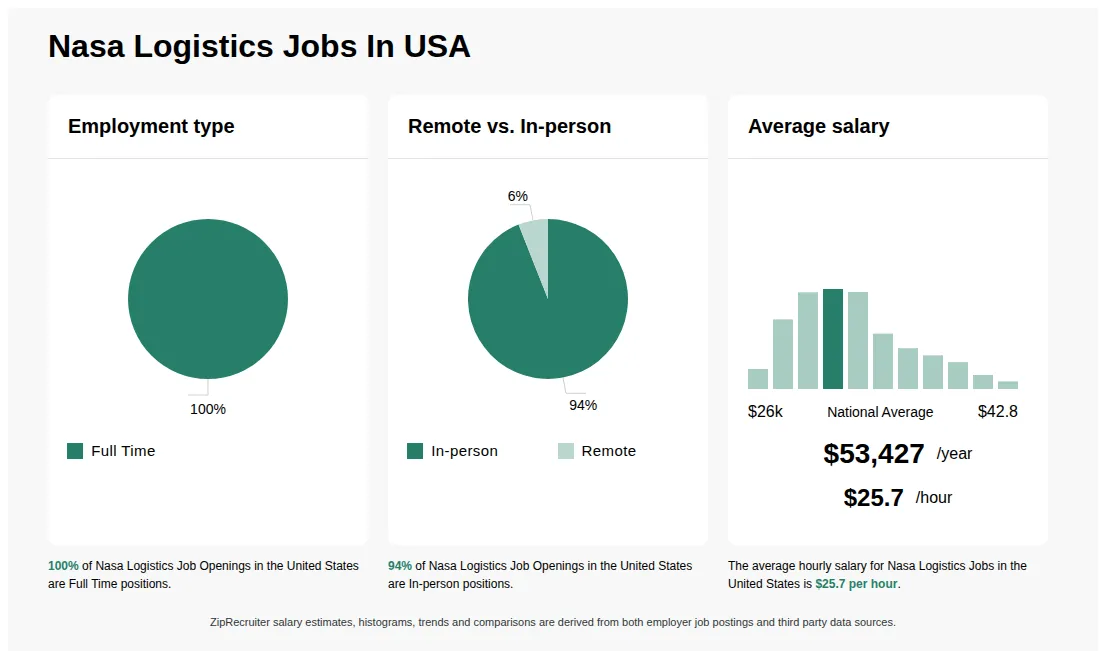
As of Jun 11, 2026, the average hourly pay for nasa logistics in the United States is $25.69, according to ZipRecruiter salary data. Most workers in this role earn between $19.47 and $29.09 per hour, depending on experience, location, and employer.

Is NASA Logistics carriers legit?

NASA Logistics is a legitimate organization involved in managing logistics for NASA projects. As a logistics role, it typically requires skills in supply chain management, inventory control, and familiarity with aerospace operations. Job seekers should verify specific job postings and company credentials through official NASA channels.

What are high paying jobs at NASA?

High-paying jobs at NASA include senior engineering roles, aerospace engineers, and mission managers, often requiring advanced degrees and specialized skills. Executive positions such as NASA administrators and senior scientists also offer top salaries, with compensation influenced by experience, education, and security clearances.

What are some common challenges faced by professionals working in NASA Logistics?

Professionals in NASA Logistics often face unique challenges such as managing high-value or specialized equipment, coordinating shipments to remote or secure locations, and adapting to rapidly changing mission requirements. They must work closely with engineers, scientists, procurement teams, and external vendors to ensure materials are delivered accurately and on time. Attention to detail and proactive problem-solving are crucial, as even minor delays or errors can impact critical mission deadlines. Additionally, the work environment is highly structured and process-driven, requiring flexibility and a strong sense of accountability. Embracing these challenges helps logistics professionals support NASA's complex projects and contribute to mission success.

What is a NASA Logistics job?

A NASA Logistics job involves planning, coordinating, and managing the transportation and distribution of equipment, supplies, and materials for NASA missions. Logistics specialists ensure that critical components arrive on time and in optimal condition, supporting space exploration and research efforts. They work with supply chain management, inventory control, and transportation planning to meet mission deadlines efficiently.

What are the key skills and qualifications needed to thrive in the Nasa Logistics position, and why are they important?

To thrive in NASA Logistics, a strong background in supply chain management, inventory control, and logistics coordination—often supported by a relevant degree or experience—is essential. Familiarity with enterprise resource planning (ERP) systems, NASA-specific tracking databases, and certifications such as APICS or Six Sigma can be highly beneficial. Strong organizational skills, attention to detail, and clear communication are vital for managing complex, high-stakes projects and collaborating across technical teams. These skills ensure precise handling and delivery of critical materials, enabling mission success and maintaining strict timelines in the dynamic aerospace environment.

What is the highest paid supply chain job?

In supply chain roles, executive positions such as Supply Chain Director or Vice President of Supply Chain tend to be the highest paid, often earning six-figure salaries. These roles require extensive experience, strategic planning skills, and often involve overseeing large teams and complex logistics operations.

Is it hard to get hired at NASA?

Getting hired at NASA for logistics or related roles can be competitive due to high standards and limited openings. Candidates typically need relevant education, security clearances, and experience in logistics, supply chain management, or engineering. Strong technical skills and a background in STEM fields improve chances of employment.
What cities are hiring for Nasa Logistics jobs? Cities with the most Nasa Logistics job openings:
What are the most commonly searched types of Nasa Logistics jobs? The most popular types of Nasa Logistics jobs are:
What states have the most Nasa Logistics jobs? States with the most job openings for Nasa Logistics jobs include:
Infographic showing various Nasa Logistics job openings in the United States as of June 2026, with employment types broken down into 86% Full Time, and 14% Contract. Highlights an 100% In-person job distribution, with an average salary of $53,427 per year, or $25.7 per hour.

Senior Mechanical Engineer (supporting NASA)

asrcfh

Greenbelt, MD

$104K - $137K/yr

Other

Posted 11 days ago


Job description

ASRC Federal Facilities Logistics (AFFL) is seeking a Senior Mechanical Engineer to support our work at NASA’s Goddard Space Flight Center in Greenbelt MD. This role is in support of the Repair, Operations, Maintenance and Engineering (ROME) contract.

Researches, develops, plans, and designs mechanical and electromechanical products and systems that may involve nanotechnology. Oversees and coordinates activities involved in fabrication, operation, application, installation, and repair of mechanical or electromechanical products and systems. Activities may involve but are not limited to electric generators, internal
combustion engines, and steam and gas turbines, power-using machines such as refrigeration and air-conditioning equipment, machine tools, material handling systems, elevators and escalators, industrial production equipment, and robots used in manufacturing, etc. Excludes supervisory and paraprofessional level positions. 

Requires a Bachelor's degree and a minimum of 8-10 years of experience in a related or applicable field, or an equivalent combination of education and experience.

Professional Engineer license or other applicable professional registration. Registration/licensure shall be recognized by the Maryland and/or Virginia Department of Licensing and Regulation.