1

Motion Control Engineering Jobs in California (NOW HIRING)

Control Engineer

San Diego, CA ยท On-site

$88K - $114K/yr

As a well-established engineering consulting firm with over 20 years in business, they are known ... Experience with PLCs, motion control, process control, robotics, machine vision, and SCADA systems

Control Engineer

San Diego, CA

$88K - $114K/yr

As a well-established engineering consulting firm with over 20 years in business, they are known ... Experience with PLCs, motion control, process control, robotics, machine vision, and SCADA systems

Sr Systems Controls Engineer

Monrovia, CA ยท On-site

$102K - $135K/yr

... motion control, machine vision integration, and enterprise-level manufacturing connectivity. Key Responsibilities Controls Design & Automation Engineering * System Architecture: Develop pre-sale ...

Senior Responsible Engineer

Torrance, CA ยท On-site

$120K - $140K/yr

... engineering voice for our precision motion control products. You will own the technical integrity of assigned hardware from design release through certification and fielding - signing off on drawings ...

Senior Responsible Engineer

Torrance, CA ยท On-site

$120K - $140K/yr

... engineering voice for our precision motion control products. You will own the technical integrity of assigned hardware from design release through certification and fielding - signing off on drawings ...

next page

Showing results 1-20

Motion Control Engineering information

See California salary details

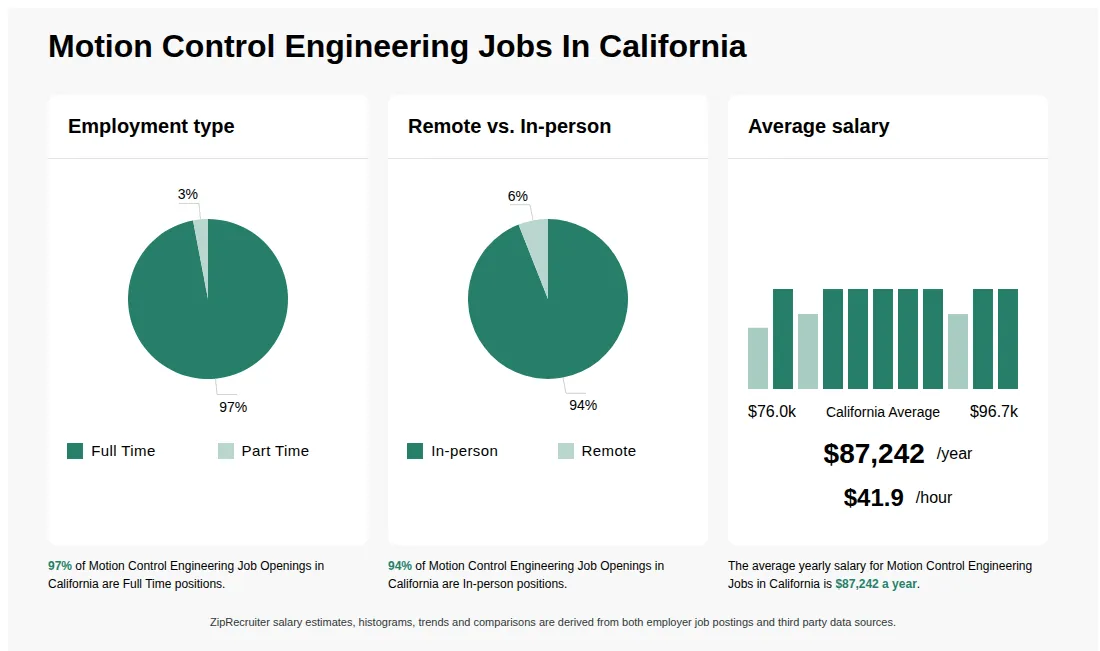
$76K

$87.2K

$96.7K

How much do motion control engineering jobs pay per year?

As of Jul 13, 2026, the average yearly pay for motion control engineering in California is $87,242.00, according to ZipRecruiter salary data. Most workers in this role earn between $81,900.00 and $92,800.00 per year, depending on experience, location, and employer.

What is motion control engineering?

Motion control engineering is a field focused on the design and implementation of systems that control the movement of machines or mechanical systems. This often involves the use of motors, actuators, sensors, and controllers to achieve precise positioning, speed, and acceleration in applications such as robotics, manufacturing automation, and aerospace. Motion control engineers work with both hardware and software to develop efficient, reliable movement solutions. Their work is critical in industries where accurate and repeatable movement is required.

What is the difference between Motion Control Engineering vs Robotics Engineering?

AspectMotion Control EngineeringRobotics Engineering
Required CredentialsBachelor's in Electrical, Mechanical, or Control Engineering; certifications in automation or control systemsBachelor's in Robotics, Mechanical, Electrical Engineering; certifications in robotics or automation
Work EnvironmentManufacturing plants, automation facilities, R&D labsResearch labs, manufacturing, autonomous systems development
Industry UsageAutomation, CNC machines, industrial equipmentAutonomous robots, drones, robotic arms
Common Search/ComparisonYesYes

Motion Control Engineering focuses on designing and implementing systems that precisely control movement in machinery and automation equipment. Robotics Engineering encompasses the broader development of robotic systems, including sensors, control algorithms, and mechanical design. While both roles require control system knowledge and similar credentials, Motion Control Engineers specialize in movement precision within industrial settings, whereas Robotics Engineers work on creating autonomous and interactive robotic systems.


What are the key skills and qualifications needed to thrive as a Motion Control Engineer, and why are they important?

To thrive as a Motion Control Engineer, you need a solid background in electrical or mechanical engineering, with expertise in automation, robotics, and control systems. Familiarity with PLC programming, servo systems, CAD software, and relevant certifications (such as Certified Motion Control Professional) is typically required. Strong problem-solving, analytical thinking, and effective communication skills help you collaborate with cross-functional teams and troubleshoot complex systems. These competencies ensure precise, efficient, and reliable motion solutions critical to manufacturing and automation industries.

What are some common challenges faced by motion control engineers when integrating new automation systems into existing manufacturing environments?

Motion control engineers often encounter challenges such as ensuring compatibility between new automation components and legacy systems, minimizing downtime during integration, and maintaining precise synchronization across various machines. Troubleshooting communication protocols and adapting control algorithms to fit unique production requirements can also be complex. Effective collaboration with cross-functional teams, such as maintenance and software engineers, is essential to address these challenges and achieve a seamless integration process.
What job categories do people searching Motion Control Engineering jobs in California look for? The top searched job categories for Motion Control Engineering jobs in California are:
What cities in California are hiring for Motion Control Engineering jobs? Cities in California with the most Motion Control Engineering job openings:
Senior Locomotion Control Engineer

Senior Locomotion Control Engineer

Faraday Future

El Segundo, CA โ€ข On-site

$110K - $135K/yr

Other

Medical, Dental, Vision, Retirement

Posted 15 days ago


Job description

The Company:

Faraday Future (FF) is a California-based embodied artificial intelligence ecosystem company, leveraging the latest technologies and world's best talent to realize exciting new possibilities in mobility and robotics. We're producing user-centric, technology-first vehicles and robots to establish new paradigms in human-AI interaction. We're not just seeking to change how our cars and robots work - we're seeking to change the way we drive and interact with machines. At FF, we're creating something new, something connected, and something with a true global impact.

Your Role:

We are seeking a Senior Locomotion Control Engineer to lead the design, implementation, and real-world deployment of robot motion capabilities. This role is responsible for building robust locomotion systems that work reliably across simulation and hardware, and for driving the technical direction of gait, balance, terrain adaptation, and control integration.

Responsibilities:

  • Design, implement, and optimize robot locomotion systems, including gait generation, balance control, and terrain adaptation.
  • Develop and improve locomotion controllers using MPC, whole-body control, reinforcement learning, or hybrid control approaches.
  • Own the full loop from simulation to hardware deployment, including controller tuning, regression validation, and failure analysis.
  • Improve robot stability, robustness, safety, and energy efficiency in real-world operating conditions.
  • Work closely with runtime, simulation, behavior, and hardware teams to define clean interfaces and reliable integration paths.
  • Support real-robot bring-up, debugging, performance analysis, and root-cause investigation for motion failures.
  • Contribute to control architecture decisions, testing methodology, and technical roadmap planning for motion control capabilities.

Basic Qualifications:

  • Master's degree or above in Robotics, Computer Science, Electrical Engineering, Mechanical Engineering, or a related field.
  • 5+ years of experience developing robotics locomotion, motion control, or autonomous robotic systems.
  • 3+ years of hands-on experience supporting quadruped, humanoid, or legged robot development and deployment.
  • Strong foundation in robotics, including dynamics, kinematics, estimation, and control theory.
  • Hands-on experience with at least one locomotion approach such as MPC, whole-body control, reinforcement learning locomotion, or heuristic gait control.
  • Strong C++ skills for production robotics software development.
  • Proficiency in Python for research workflows, simulation, tooling, and analysis.
  • Experience deploying algorithms on real robots, ideally quadrupeds, humanoids, or mobile manipulation systems.
  • Prior experience deploying locomotion or control algorithms on physical robots is required.
  • Ability to diagnose real-system failures and translate observations into actionable control or systems improvements.

Preferred Qualifications:

  • Experience with RL locomotion, imitation learning, or policy-based control for physical robots.
  • Experience with sim-to-real workflows, including actuator modeling, latency compensation, domain randomization, or system identification.
  • Familiarity with MuJoCo, Isaac, RaiSim, Gazebo, or equivalent simulation platforms.
  • Experience with real-time robotics systems, ROS 2, controller scheduling, and control-runtime integration.
  • Background in contact-rich control, force control, or whole-body coordination.
  • Track record of shipping motion capabilities from prototype to robust field performance.

Annual Salary Range:

($110,000 - $135,000 DOE), plus benefits and incentive plans

ย Perks + Benefits

  • Healthcare + dental + vision benefits (Free for you/discounted for family)
  • 401(k) options
  • Casual dress code + relaxed work environment
  • Culturally diverse, progressive atmosphere

Faraday Future is an equal opportunity employer and does not discriminate on the basis of race, national origin, gender, gender identity, sexual orientation, protected veteran status, disability, age, or other legally protected status.