1

Medical Coding Jobs in Florida (NOW HIRING)

Medical Coder

Jupiter, FL · On-site

$18.25 - $24.50/hr

Complying with medical coding guidelines and policies * Receiving and reviewing patients' charts and documents for verification and accuracy * Following up and clarifying any information that is not ...

Medical Coder

Jupiter, FL · On-site

$18.25 - $24.50/hr

Complying with medical coding guidelines and policies * Receiving and reviewing patients' charts and documents for verification and accuracy * Following up and clarifying any information that is not ...

Medical Coder

Pensacola, FL · On-site

$15 - $20/hr

Medical Coder Come work at Hixardt Technologies, Inc. (Hixardt) a leading firm in our industry. We ... Perform Coding for records pertaining to Inpatient, outpatient, and surgeries performed with a ...

Medical Coder Come work at Hixardt Technologies, Inc. (Hixardt) a leading firm in our industry. We ... Perform Coding for records pertaining to Inpatient, outpatient, and surgeries performed with a ...

Manager Hospital Outpatient Coding

Cape Coral, FL · On-site +1

$38.48 - $50.01/hr

Ensures all medical coding complies with federal and state laws, through a process of audits and process improvement. Through a process of root cause analysis, will identify areas of opportunity and ...

Biller Coder

Miramar, FL

$17.50 - $22.25/hr

... medical coding for all healthcare activities · Ensure that medical coding used is in compliance with all medical coding laws and regulations · Ensure that the coding used is for reimbursable ...

next page

Showing results 1-20

Medical Coding information

See Florida salary details

$11

$16

$25

How much do medical coding jobs pay per hour?

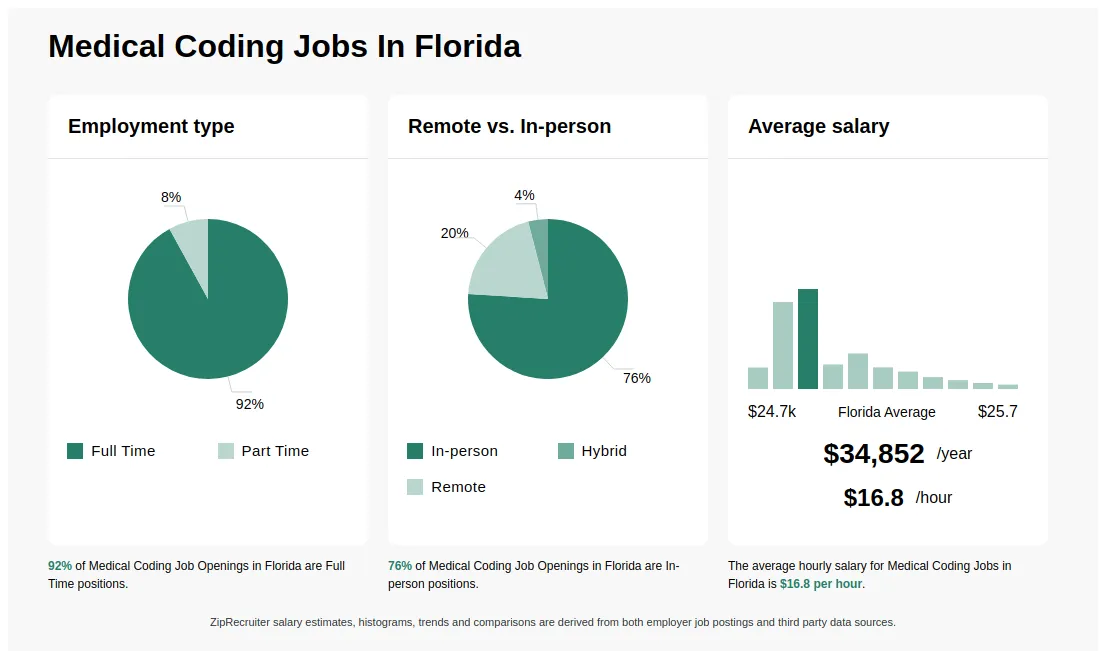
As of Jul 26, 2026, the average hourly pay for medical coding in Florida is $16.76, according to ZipRecruiter salary data. Most workers in this role earn between $13.46 and $17.98 per hour, depending on experience, location, and employer.

What is medical coding?

Medical coding is the process of translating healthcare diagnoses, procedures, medical services, and equipment into standardized codes. These codes are used for billing, insurance claims, and maintaining patient records. Medical coders review clinical documents to assign the appropriate codes from classification systems like ICD-10, CPT, and HCPCS. Accurate coding is essential to ensure proper reimbursement and compliance with regulations.

What exactly does a Medical Coder do?

A Medical Coder reviews healthcare documentation, such as physician notes and patient records, and assigns standardized codes to diagnoses, procedures, and services using coding systems like ICD-10 and CPT. These codes are used for billing, insurance claims, and medical record keeping, requiring attention to detail and knowledge of medical terminology and coding guidelines.

What is the difference between Medical Coding vs Medical Billing?

AspectMedical CodingMedical Billing
Primary RoleAssigns standardized codes to diagnoses and proceduresProcesses insurance claims and manages billing for healthcare services
CredentialsCertification (e.g., CPC, CCS)Certification (e.g., CPC, Certified Professional Biller)
Work EnvironmentHospitals, clinics, insurance companiesMedical offices, billing companies, hospitals
Industry UsageUsed for record-keeping, reimbursement, and data analysisHandles claims submission, payment follow-up, and patient billing

Medical Coding and Medical Billing are closely related healthcare roles. Medical Coders focus on translating medical records into standardized codes, while Medical Billers handle the financial aspect by submitting claims and managing payments. Both roles often work together but serve distinct functions within the revenue cycle.

Which medical coding pays the most?

Senior medical coders, especially those with certifications like CPC-H or CCS, tend to earn the highest salaries in medical coding. Specialized roles such as coding managers or auditors also typically offer higher pay, often due to increased experience and expertise in complex coding systems and compliance requirements.

What are some common challenges faced by medical coders and how can they be managed effectively?

Medical coders often encounter challenges such as keeping up with frequent updates to coding standards (like ICD-10, CPT, and HCPCS), interpreting complex patient records accurately, and ensuring compliance with healthcare regulations. To manage these challenges, it's crucial to participate in ongoing training, utilize coding resources and guidelines, and communicate regularly with healthcare providers for clarification. Many organizations also provide support through collaborative coding teams and access to coding software, making it easier to maintain accuracy and stay current with industry changes.

What are the key skills and qualifications needed to thrive as a Medical Coder, and why are they important?

To thrive as a Medical Coder, you need a thorough understanding of medical terminology, anatomy, and ICD-10/CPT coding systems, usually supported by a relevant certification such as CPC or CCS. Familiarity with electronic health record (EHR) systems and coding software like 3M or EncoderPro is essential. Attention to detail, analytical thinking, and strong organizational skills help ensure accuracy and efficiency in coding. These competencies are crucial for ensuring correct billing, compliance with regulations, and timely reimbursement for healthcare providers.

Is medical coding still a good career?

Medical coding is a stable and in-demand profession, as healthcare providers require accurate coding for billing and compliance. The role often requires certification, such as CPC, and offers opportunities for remote work and career advancement within the healthcare industry.

How long will it take to become a Medical Coder?

Becoming a medical coder typically requires completing a training program or certificate course that lasts from several months up to a year. Many coders also pursue certification, such as the Certified Professional Coder (CPC), which can take additional time to prepare for and obtain. Overall, the process can take from 6 months to 1 year depending on the program and certification path chosen.
What are the most commonly searched types of Medical Coding jobs in Florida? The most popular types of Medical Coding jobs in Florida are:
What cities in Florida are hiring for Medical Coding jobs? Cities in Florida with the most Medical Coding job openings:
Infographic showing various Medical Coding job openings in Florida as of July 2026, with employment types broken down into 83% Full Time, 13% Part Time, 1% Temporary, and 3% Contract. Highlights an 83% Physical, 3% Hybrid, and 14% Remote job distribution, with an average salary of $34,852 per year, or $16.8 per hour.

Medical Coding Specialist

KIDZ MEDICAL SERVICE.

Hollywood, FL • On-site

Full-time

Medical, Dental, Vision, Life, Retirement

Posted 4 days ago


Job description

SUMMARY: Full Time Medical Coding Specialist performs diagnosis and procedural coding to individual patient medical records for data retrieval, analysis, and claims processing. This is a hybrid position initially required in office presence and the opportunity to work partially remote when workflow allows.


DUTIES AND RESPONSIBILITIES:

  • Reviews the patient ‘s medical record for accurate and complete documentation prior to coding.
  • Works closely with the physician coordinator regarding discrepancies found in patient’s record prior to claim submission
  • Codes for assigned physicians, locations, and/or departments from review of medical record documentation.
  • Applies knowledge of current coding and billing requirements to assure claims are submitted correctly
  • Brings identified concerns and trends to the manager/team lead for resolution.
  • Reviews coding and billing worklists and resolves claim rejections.
  • Enters patient demographic information and verifies patient insurance coverage


QUALIFICATIONS:

  • Working knowledge of CPT and ICD10 coding
  • Medical coding certification (AAPC or AHIMA) preferred or currently in progress
  • Minimum 2 years’ experience in medical billing and coding
  • Excellent attention to detail and follow up
  • Knowledgeable of payer rules and requirements for both coding and eligibility checking
  • High school diploma or general education degree
  • Computer skills required: Efficient data entry skills for both speed and accuracy

JOB TYPE / WORK SCHEDULE:

  • This is a hybrid position initially required in office presence
  • Standard office hours, Monday – Friday
  • Bilingual (Required)

Competitive pay and a full benefits package, including 401(k), health, dental, vision, life, and disability insurance.