1

Law Enforcement Support Jobs (NOW HIRING)

$89K/yr

In addition, you must submit the supporting documents listed under the required documents section of this job announcement. Note: Secondary Administrative Law Enforcement Officer retirement coverage ...

next page

Showing results 1-20

Law Enforcement Support information

See salary details

$12

$21

$36

How much do law enforcement support jobs pay per hour?

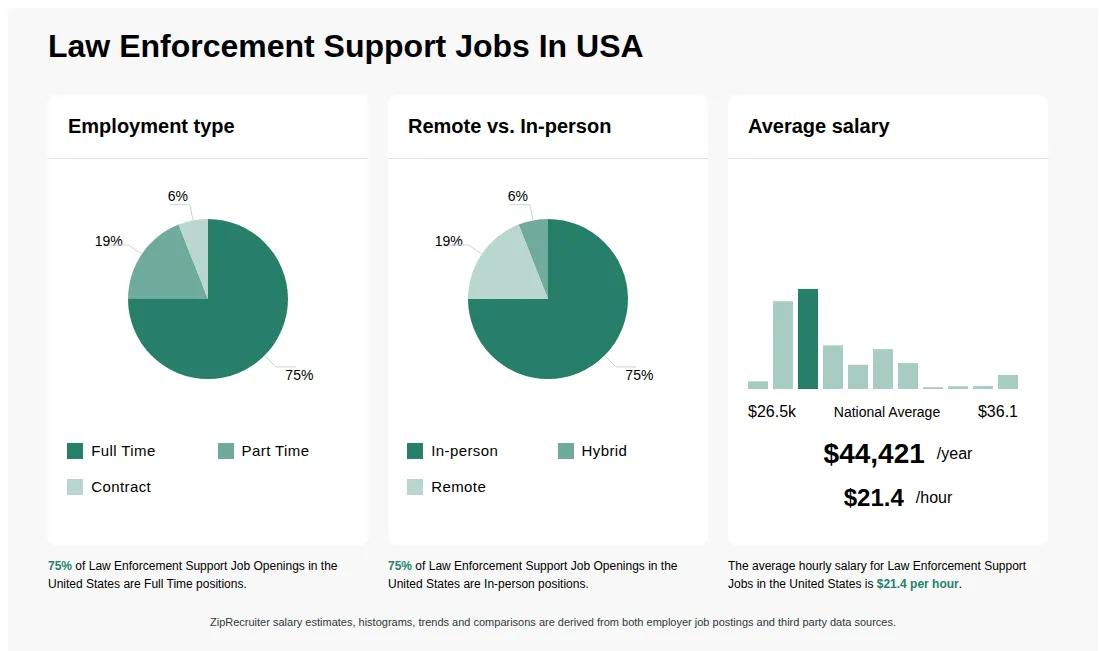
As of Jun 14, 2026, the average hourly pay for law enforcement support in the United States is $21.36, according to ZipRecruiter salary data. Most workers in this role earn between $16.83 and $24.04 per hour, depending on experience, location, and employer.

What are law enforcement support jobs?

Law enforcement support jobs are roles that assist police officers and other law enforcement professionals in their daily duties, but do not typically involve direct law enforcement authority or carrying a firearm. These positions can include dispatchers, crime analysts, evidence technicians, records clerks, and administrative support staff. Their responsibilities may involve handling communications, managing records, analyzing data, processing evidence, and providing logistical or technical support. Law enforcement support personnel play a crucial role in ensuring that law enforcement agencies operate efficiently and effectively. These jobs are essential for maintaining public safety and supporting sworn officers in the field.

What are some typical challenges faced by professionals in Law Enforcement Support roles, and how can they be managed?

Professionals in Law Enforcement Support often encounter challenges such as managing sensitive information, handling high-stress situations, and adapting to rapidly changing priorities. Balancing administrative tasks with the urgency of supporting officers in the field requires strong organizational and communication skills. To manage these challenges, it's important to stay detail-oriented, be adaptable, and maintain clear communication with both law enforcement personnel and the public. Regular training and strong teamwork also help ensure smooth operations and effective support.

What is the difference between Law Enforcement Support vs Police Officer?

AspectLaw Enforcement SupportPolice Officer
CredentialsHigh school diploma or equivalent; some roles may require certificationsHigh school diploma or GED; police academy training required
Work EnvironmentOffices, patrol support, administrative settings, community eventsPatrol, crime scenes, traffic stops, community engagement
Employer & IndustryLaw enforcement agencies, government contractsMunicipal, state, or federal police departments
Search & Comparison IntentUnderstanding support roles in law enforcementActive law enforcement duties and responsibilities

Law Enforcement Support roles focus on assisting police officers through administrative, technical, or logistical tasks, often in support centers or community programs. Police Officers are responsible for patrolling, enforcing laws, and responding directly to incidents. Both roles require some law enforcement credentials, but Police Officers typically undergo more extensive training and perform frontline duties, while Support roles provide essential backing to ensure effective law enforcement operations.

What are the key skills and qualifications needed to thrive as a Law Enforcement Support professional, and why are they important?

To thrive in Law Enforcement Support, you need a solid understanding of criminal justice procedures, recordkeeping, and administrative protocols, often backed by a relevant associate's degree or equivalent experience. Familiarity with law enforcement databases, records management systems, and communication tools like CAD (Computer-Aided Dispatch) is typically required. Exceptional attention to detail, discretion, and strong interpersonal skills help build trust and ensure accurate information handling. These competencies are essential for maintaining public safety, supporting officers effectively, and ensuring compliance with legal standards.
More about Law Enforcement Support jobs
What cities are hiring for Law Enforcement Support jobs? Cities with the most Law Enforcement Support job openings:
What states have the most Law Enforcement Support jobs? States with the most job openings for Law Enforcement Support jobs include:
Infographic showing various Law Enforcement Support job openings in the United States as of June 2026, with employment types broken down into 1% As Needed, 48% Full Time, 47% Part Time, 1% Temporary, 2% Contract, and 1% Nights. Highlights an 99% Physical, and 1% Remote job distribution, with an average salary of $44,421 per year, or $21.4 per hour.
Law Enforcement Academy Manager & Lead Instructor

Law Enforcement Academy Manager & Lead Instructor

Concho Valley Council of Governments

San Angelo, TX โ€ข On-site

$70K - $78K/yr

Full-time

Posted 3 days ago


Job description

CONCHO VALLEY COUNCIL OF GOVERNMENTS

CRIMINAL JUSTICE

NOTICE OF JOB OPENING

Law Enforcement Academy Manager & Lead Instructor

LAW ENFORCEMENT ACADEMY MANAGER & LEAD INSTRUCTOR REQUIREMENTS:

  • Must possess a Valid Driverโ€™s License
  • Must be a certified Texas Peace Officer with Instructor Credentials
  • Bachelor's Degree from four-year accredited college with major coursework in Criminal Justice or Public Administration and minimum of five yearsโ€™ experience as a Texas Peace Officer OR
  • Any combination of experience and training that provides the required knowledge, skills and abilities.
  • Must be able to pass background check

Instruct and coordinate all basic, specialized, and advanced in-service training courses for telecommunicators, jailers, and law enforcement officers for the Concho Valley Regional Law Enforcement Academy, according to guidelines prescribed by TCOLE. Coordinate all training activities for the 14-county coverage area. Develop, administer, and ensure compliance of rules and guidelines of the Texas Commission on Law Enforcement (TCOLE).

STATUS AND PAY:

Full-Time Position

Annually: $70,500 to $78,000 โ€“ pay dependent on experience


This is a unique opportunity to transition from operational policing into a leadership role that shapes the next generation of officers, while maintaining a strong connection to the profession.
The position combines student instruction, mentorship, and program coordination within a structured, well-supported Academy environment.

Why This Role Stands Out

No shift work, call-outs, or patrol demands
Opportunity to mentor and develop current and future officers
Established curriculum aligned with Texas Commission on Law Enforcement standards.

Opportunity to build and improve curriculum.
Ability to build and lead a team of contract adjunct instructors
Meaningful, legacy-driven work in your local law enforcement community


Schedule

Flexible self-scheduling of your calendar in advance, to accommodate day-time in-service, and evening BPOC.
Day time in-service

Evening instruction (approx. 6:30โ€“10:30 PM M-Th)
Occasional Saturdays

Ability to coordinate and schedule a team of contracted Adjunct Instructors
Instruction & Training
Deliver assigned portions of the Basic Peace Officer Course (BPOC), Basic County Corrections Course (BCCC), and Basic Telecommunicator Course.

Hold requested in-service trainings for certification of existing local law enforcement.

Facilitate engaging, scenario-based learning
Evaluate cadet performance (academic and skills)
Program Coordination
Coordinate academy schedule and course delivery
Ensure compliance with all TCOLE curriculum and hour requirements
Maintain training records and documentation for audit readiness
Instructor Leadership
Recruit, support, and coordinate contract adjunct instructors
Provide guidance and consistency across instructional blocks
Cadet Development
Mentor cadets and reinforce professionalism and ethical standards
Support student success and remediation when needed


Ideal Candidate Profile
Passionate about training and developing officers
Seeking a career transition or next step in leadership
Organized and comfortable managing structured programs
Interested in leaving a lasting impact on the profession