1

Civilian Law Enforcement Jobs (NOW HIRING)

Civilian Investigator - TPT

Hemet, CA ยท On-site

$26 - $34.84/hr

Civilian Investigators do not have law enforcement powers. ESSENTIAL DUTIES 1. Respond to non-emergency incidents that are not in-progress to conduct investigations. 2. Interview witnesses, victims ...

$106K/yr

"The Federal Law Enforcement Training Centers (FLETC), through strategic partnerships, prepares the ... Have held a federal civilian position in the 1801 occupational series. -AND- Specialized Experience:

next page

Showing results 1-20

Civilian Law Enforcement information

See salary details

$28.5K

$60K

$94K

How much do civilian law enforcement jobs pay per year?

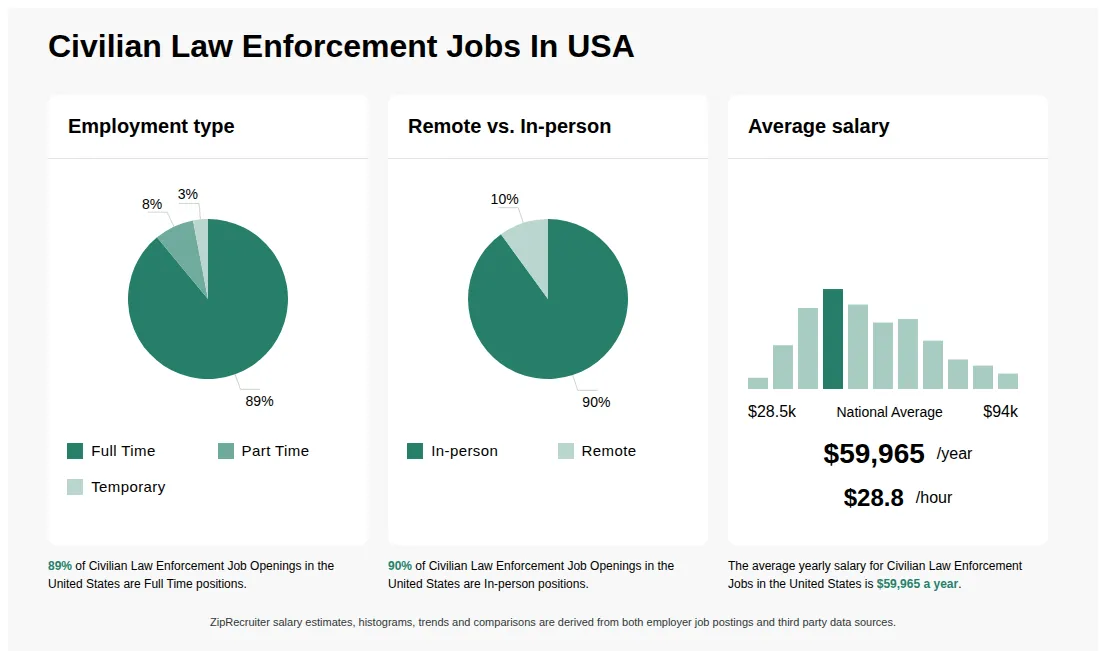
As of Aug 30, 2026, the average yearly pay for civilian law enforcement in the United States is $59,965.00, according to ZipRecruiter salary data. Most workers in this role earn between $47,000.00 and $69,000.00 per year, depending on experience, location, and employer.

What is a civilian law enforcement officer?

Civilian Law Enforcement officers are non-military personnel who work for local, state, or federal government agencies to enforce laws, maintain public order, and protect citizens and property. Their duties often include patrolling neighborhoods, investigating crimes, apprehending suspects, and responding to emergencies. Civilian law enforcement includes roles such as police officers, detectives, and other public safety officials who do not serve as part of the armed forces. They play a crucial role in upholding the justice system and ensuring community safety.

What are the key skills and qualifications needed to thrive as a civilian law enforcement officer?

To thrive as a Civilian Law Enforcement Officer, you need a solid understanding of criminal law, investigative procedures, and public safety protocols, often supported by a high school diploma or college degree and successful completion of police academy training. Familiarity with law enforcement software, evidence management systems, and radio communications equipment is typically required. Strong interpersonal skills, ethical judgment, and emotional resilience help officers build community trust and maintain composure in high-pressure situations. These skills and qualities are essential for upholding the law, ensuring public safety, and effectively serving diverse communities.

What are typical challenges faced by civilian law enforcement officers in balancing administrative duties with fieldwork?

Civilian law enforcement officers often juggle a mix of administrative responsibilities, such as paperwork, report writing, and evidence management, alongside active fieldwork like community outreach, investigations, and support roles. Balancing these duties can be challenging, especially when urgent field tasks arise while administrative deadlines are looming. Effective time management and organizational skills are essential, and many agencies provide training and team support to help officers prioritize tasks. Collaboration with sworn officers and other civilian staff ensures smooth operations and the ability to adapt quickly to shifting priorities.

What is the difference between Civilian Law Enforcement vs Police Officer?

AspectCivilian Law EnforcementPolice Officer
Required CredentialsHigh school diploma or equivalent; specialized training or certifications often requiredHigh school diploma or equivalent; police academy training required
Work EnvironmentOffice settings, administrative roles, or support positions within law enforcement agenciesPatrol, crime scene investigation, and active law enforcement duties
Employer & Industry UsageLaw enforcement agencies, government offices, security firmsMunicipal, state, or federal police departments

In summary, Civilian Law Enforcement roles typically involve administrative, support, or specialized functions within law enforcement agencies, requiring similar credentials but often less emphasis on active patrol duties. Police Officers are frontline personnel responsible for patrolling, crime response, and enforcement activities. Both roles are essential to law enforcement but differ mainly in responsibilities and work environment.

More about Civilian Law Enforcement jobs

What cities are hiring for Civilian Law Enforcement jobs?

Cities with the most Civilian Law Enforcement job openings:

What states have the most Civilian Law Enforcement jobs?

States with the most job openings for Civilian Law Enforcement jobs include:

Infographic showing various Civilian Law Enforcement job openings in the United States as of August 2026, with employment types broken down into 83% Full Time, 16% Part Time, and 1% Contract. Highlights an 96% Physical, 1% Hybrid, and 3% Remote job distribution, with an average salary of $59,965 per year, or $28.8 per hour.

LAW ENFORCEMENT DISPATCHER (CLASS TITLE: DUTY OFFICER)

MyFlorida

Sanford, FL โ€ข On-site

$1.6K/wk

Full-time

Medical, Dental, Vision, Life, Retirement, PTO

Re-posted 29 days ago


Job description

Requisition No:ย 880544ย 

Agency: Florida Fish and Wildlife Conservation Commission

Working Title: LAW ENFORCEMENT DISPATCHER (CLASS TITLE: DUTY OFFICER)

ย Pay Plan: Career Service

Position Number:ย 77000453ย 

Salary:ย  $1,651.38 Bi-weeklyย 

Posting Closing Date: 10/29/2026ย 

Total Compensation Estimatorย Tool

FLORIDA FISH & WILDLIFE CONSERVATION COMMISSION

DIVISION OF LAW ENFORCEMENT

TECHNOLOGY & COMMUNICATION SERVICES SECTION

SANFORD REGIONAL COMMUNICATIONS CENTER

LAW ENFORCEMENT DISPATCHER (CLASS TITLE: DUTY OFFICER)

SEMINOLE COUNTY

ย This is a civilian law enforcement dispatch opportunity

ย 

This advertisement will be used to fill multiple vacancies in Seminole County

ย 

Do you want to be part of FWC's elite Division of Law Enforcement?

Are you looking for a professional career within the first responder community?

Multiple opportunities for career advancement, salary incentives, and paid leave are only some of the options we offer.

Challenge yourself and apply today, you won't be disappointed.

WHAT IS THE FWC?

The Florida Fish and Wildlife Conservation Commission (FWC) is a constitutional state agency entrusted with conserving fish and wildlife resources for their long-term well-being and the benefit of the people. The FWC Division of Law Enforcement protects Florida's natural resources and people through proactive and responsive law enforcement services. FWC Officers are state law enforcement police officers who are also dually certified as National Oceanic and Atmospheric Administration, and United States Fish and Wildlife Service federal officers that can enforce federal laws pertaining to national marine fishery and federal fish / wildlife violations.ย ย  FWC's Division of Law Enforcement is the leading conservation law enforcement agency in the nation, set apart by strategic vision, clear missions, strong leadership, and a professional officer Corp.

WHAT IS AN FWC DUTY OFFICER?

A Duty Officer is a certified law enforcement dispatcher who is responsible for monitoring and operating a two-way radio system, FCIC/ NCIC computer terminal (i.e., teletype) communication, and making independent decisions. Duty Officers learn and master the art of multitasking while composing and disseminating information through various communication sources to deliver routine and/or emergency correspondence to agency personnel, partnering law enforcement agencies, and the public to remain compliant with standards set forth by the Agency, Federal Communication Commission (FCC) and Florida Department of Law Enforcement (FDLE).ย ย ย ย 

Tasks performed by the Duty Officer include but are not limited to:

  • Monitor and operate a two-way radio system, telephone, and teletype system
  • Dispatch law enforcement officers and other personnel to citizen complaints and/or crimes in progress
  • Communicate and formally document messages regarding the safety of officers performing hazardous duties between the field and base station
  • Contacts law enforcement administrators regarding any emergency radio broadcast and maintains location and status of law enforcement personnel through constant radio and telephone contact
  • Operates the Florida Crime Information Center / National Crime Information Center (FCIC/NCIC) computer terminal
  • Broadcasts 'Be on the Look Out' (BOLO) alerts regarding dangerous or wanted criminals
  • Receives emergency and/or routine requests to and from officers and enters these messages into the computer
  • Evaluates, disseminates, and provides criminal and/or confidential information to authorized personnel 24 hours per day
  • Expected to remain current on all procedures, laws, rules, and regulations, and disseminate this information to the public and staff as necessary
  • Handles various administrative tasks as required ย 

ย 

WHY SHOULD I APPLY?

Do you want to earn a good salary, secure benefits, and plan for your retirement?

  • Agency-sponsored training and state certification combined with on-the-job training while working towards professional certification
  • Annual and Sick Leave Package
  • Nine Paid Holidays
  • State Health and Life Insurance
  • Supplemental Insurance Options such as Disability, Dental and Vision
  • Contributory Retirement Plan
  • Employee Assistance Program
  • Tuition waivers for college courses

Become a part of the team of Duty Officers (dispatchers) who work cohesively in the Regional Communication Center (RCC). ย Dispatchers also work in unison with statewide RCCs to form a close bond that bolsters a family friendly environment while cultivating a positive and welcoming workplace culture.

A rewarding career that can make a difference in public safety, resource protection and conservation. This is a unique and challenging position requiring quick thinking, teamwork, and the ability to remain calm and professional while responding to stressful situations and emotionally charged individuals.

SALARY

$42,935.88 Annually ($1,651.38 bi-weekly)

Salary incentives include:

  • Shift Differential pay:10% for evening shifts and 15% for overnight shifts
  • Communications Training Officer (CTO) pay: 5% increase while training
  • Career Development Plan opportunities
  • Duty Officer Supervisor roles
  • Regional Communications Center Management positions

ย 

ย 

NOTICE:

ย 

Applicants, including qualified veterans seeking veteran's preference: Due toย FDLE CJIS security requirements regardingย FCIC/NCIC access, candidates/veterans selected for consideration must successfully pass a preliminary level 1 background check prior to participating in the required Public-Safety Dispatcher/Call Taker Pre-employment testing. Applicantsย that pass the pre-determined test scoring criteria will be invited to participate in a verbal assessment and interview.ย ย ย 

Minimum Qualifications:

1. Must be willing to work rotating shifts including nights, weekends, and holidays.

2. Must be willing to be called in to work during staff shortages, special details or emergency situations and be onsite withinย the hour.

3. Must be proficient in Microsoft Word, Excel, and Outlook.

4. Type a minimum of 35 correct words per minute.

5. Qualified applicants/veterans selected forย considerationย are required toย pass a preliminary level -1 background checkย toย advance to the Public-Safety Dispatcher / Call Taker Pre-Employment Test (Please allow for 1 to 2 hours for this assessment).ย Applicantsย passing the pre-determined scoring criteria will advance to a verbal assessment and interview.ย 

6. Employee mustย obtainย CJIS certification within first six months of employment.ย 

7. Pass a level 2 background check.

Candidates requiring a reasonable accommodation, as defined by the Americans with Disabilities Act, must notify the agency hiring authority and/or People First Service Center (1-866-663-4735). Notification to the hiring authority must be made in advance to allow sufficient time to provide the accommodation.

The State of Florida supports a Drug-Free workplace. All employees are subject to reasonable suspicion drug testing in accordance with Section 112.0455, F.S., Drug-Free Workplace Act.

VETERANS' PREFERENCE. ย Pursuant to Chapter 295, Florida Statutes,ย candidates eligible for Veterans' Preference will receive preference in employment for Career Service vacancies and are encouraged to apply.ย  Certain service members may be eligible to receive waivers for postsecondary educational requirements.ย ย Candidates claiming Veterans' Preference must attach supporting documentation with each submission that includes character of service (for example, DD Form 214 Member Copy #4) along with any other documentation as required by Rule 55A-7, Florida Administrative Code.ย  Veterans' Preference documentation requirements are available by clicking here.ย  All documentation is due by the close of the vacancy announcement.ย