1

Civilian Law Enforcement Jobs (NOW HIRING)

$106K/yr

Have held a federal civilian position in the 1801 occupational series. -AND- Specialized Experience ... Performing law enforcement duties directly related to the topical area(s) for which you are ...

Civilian Investigator - TPT

Hemet, CA · On-site

$26 - $34.84/hr

Civilian Investigators do not have law enforcement powers. ESSENTIAL DUTIES 1. Respond to non-emergency incidents that are not in-progress to conduct investigations. 2. Interview witnesses, victims ...

$106K/yr

"The Federal Law Enforcement Training Centers (FLETC), through strategic partnerships, prepares the ... Have held a federal civilian position in the 1801 occupational series. -AND- Specialized Experience:

Law Enforcement Officer (Certified) ID: 1018 Agency: Tampa Police Department, FL Location: Tampa ... civilian support staff. We serve a vibrant community of 400,000+ residents at a ratio of 2.66 ...

... civilian support staff. We serve a vibrant community of 400,000+ residents at a ratio of 2.66 ... High-school diploma + three years of law enforcement or corrections experience at a medium-to-large ...

$57 - $65/hr

Coordinates law enforcement, security, and civilian training programs to ensure efficient scheduling and assignment of qualified instructors, as well as competitive events. - (Essential) * Prepares ...

New

Showing results 21-40

Civilian Law Enforcement information

See salary details

$28.5K

$60K

$94K

How much do civilian law enforcement jobs pay per year?

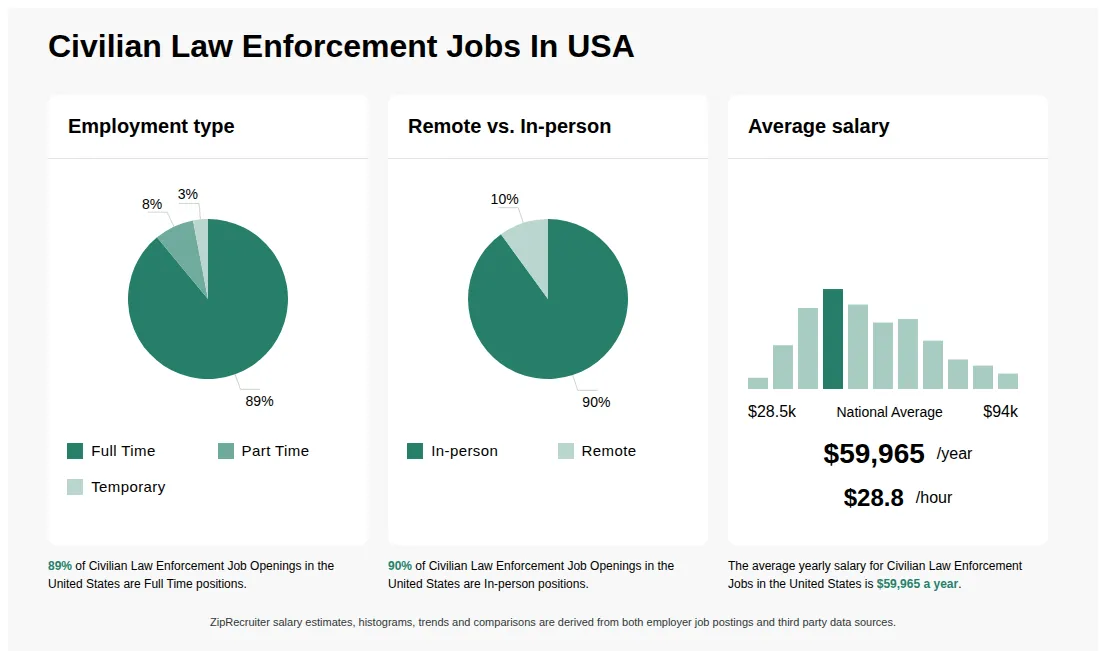
As of Sep 4, 2026, the average yearly pay for civilian law enforcement in the United States is $59,965.00, according to ZipRecruiter salary data. Most workers in this role earn between $47,000.00 and $69,000.00 per year, depending on experience, location, and employer.

What is a civilian law enforcement officer?

Civilian Law Enforcement officers are non-military personnel who work for local, state, or federal government agencies to enforce laws, maintain public order, and protect citizens and property. Their duties often include patrolling neighborhoods, investigating crimes, apprehending suspects, and responding to emergencies. Civilian law enforcement includes roles such as police officers, detectives, and other public safety officials who do not serve as part of the armed forces. They play a crucial role in upholding the justice system and ensuring community safety.

What are the key skills and qualifications needed to thrive as a civilian law enforcement officer?

To thrive as a Civilian Law Enforcement Officer, you need a solid understanding of criminal law, investigative procedures, and public safety protocols, often supported by a high school diploma or college degree and successful completion of police academy training. Familiarity with law enforcement software, evidence management systems, and radio communications equipment is typically required. Strong interpersonal skills, ethical judgment, and emotional resilience help officers build community trust and maintain composure in high-pressure situations. These skills and qualities are essential for upholding the law, ensuring public safety, and effectively serving diverse communities.

What are typical challenges faced by civilian law enforcement officers in balancing administrative duties with fieldwork?

Civilian law enforcement officers often juggle a mix of administrative responsibilities, such as paperwork, report writing, and evidence management, alongside active fieldwork like community outreach, investigations, and support roles. Balancing these duties can be challenging, especially when urgent field tasks arise while administrative deadlines are looming. Effective time management and organizational skills are essential, and many agencies provide training and team support to help officers prioritize tasks. Collaboration with sworn officers and other civilian staff ensures smooth operations and the ability to adapt quickly to shifting priorities.

What is the difference between Civilian Law Enforcement vs Police Officer?

AspectCivilian Law EnforcementPolice Officer
Required CredentialsHigh school diploma or equivalent; specialized training or certifications often requiredHigh school diploma or equivalent; police academy training required
Work EnvironmentOffice settings, administrative roles, or support positions within law enforcement agenciesPatrol, crime scene investigation, and active law enforcement duties
Employer & Industry UsageLaw enforcement agencies, government offices, security firmsMunicipal, state, or federal police departments

In summary, Civilian Law Enforcement roles typically involve administrative, support, or specialized functions within law enforcement agencies, requiring similar credentials but often less emphasis on active patrol duties. Police Officers are frontline personnel responsible for patrolling, crime response, and enforcement activities. Both roles are essential to law enforcement but differ mainly in responsibilities and work environment.

More about Civilian Law Enforcement jobs

What cities are hiring for Civilian Law Enforcement jobs?

Cities with the most Civilian Law Enforcement job openings:

What states have the most Civilian Law Enforcement jobs?

States with the most job openings for Civilian Law Enforcement jobs include:

Infographic showing various Civilian Law Enforcement job openings in the United States as of August 2026, with employment types broken down into 83% Full Time, 16% Part Time, and 1% Contract. Highlights an 96% Physical, 1% Hybrid, and 3% Remote job distribution, with an average salary of $59,965 per year, or $28.8 per hour.

Law Enforcement Specialist (Instructor)

US Department of Homeland Security

Cheltenham, MD • On-site

$106K/yr

Full-time

Re-posted 26 days ago


U.S. Department Of Homeland Security rating

7.8

Company rating: 7.8 out of 10

Based on 86 frontline employees who took The Breakroom Quiz

100th of 297 rated public sector bodies


Job description

"The Federal Law Enforcement Training Centers (FLETC), through strategic partnerships, prepares the federal law enforcement community to safeguard America's people, property, and institutions." We are a unique inter-agency organization preparing the next generation of law enforcement officers to meet our Nation's most pressing security challenges." Click here to learn more.
This announcement is a part of the Voluntary Applicant File (VAF). See Duties for more information.Qualifications:A resume must be no more than two pages. If an applicant's resume exceeds two pages, the USAJOBS database will not allow the application to be submitted. For additional assistance, please visit: USAJOBS Help Center - Update your resume now so it meets new resume requirements
This position has a Selective Placement Factor (SPF). If your resume does not demonstrate possession of the SPF, you will be rated ineligible.

SELECTIVE PLACEMENT FACTOR: In order to be considered for this position you must:

A. Possess experience as a sworn law enforcement officer or agent with full arrest authority in the prevention, detection, apprehension, detention and/or investigation of felony and/or misdemeanor violations of federal, state, local, tribal, or military criminal laws;
-OR-
B. Have held a federal civilian position in the 1801 occupational series.

-AND-
Specialized Experience: You qualify for the GS-13 grade level if you possess one year of specialized experience, equivalent to the GS-12 grade level or pay band in the federal service, or equivalent experience in the private or public sector performing the following duties:
  • Performing law enforcement duties directly related to the topical area(s) for which you are applying. -OR-
  • Instructing law enforcement training curricula in the topical area(s) for which you are applying
Substitution of education in lieu of specialized experience may not be used for this grade level.
All qualifications and eligibility requirements must be met by the closing date of the announcement.
The law enforcement topical areas for which we are accepting applications include: firearms, driver training, marine training, maritime, active shooter, behavioral science, general investigative skills, counterterrorism, physical techniques, tactical medicine, financial fraud, forensics and special investigations, digital photography/video, electronic surveillance, cyber/digital forensics, enforcement operations, law enforcement leadership, online campus, and general training. Additional information on our instructor positions may be found here.
Time-in-grade: Current General Schedule (GS) federal employees, and those that have served in GS positions within the last 52 weeks, must have served 52 weeks at the next lower grade, or a combination of the next lower grade level and an equivalent band in the federal service by the closing of this announcement.
Note: Current or former Federal employees MUST submit a copy of their SF-50 Form which shows competitive service appointment ("position occupied" block 34 on the SF-50 should show a "1"), tenure group (block 24 should show a 1 or 2), grade, and salary. If you are applying for a higher grade, please provide the SF-50 Form which shows the length of time you have been in your current/highest grade (examples of appropriate SF-50s include promotions, With-in Grade/Range Increases, and SF-50s dated a year apart within the same grade/job). If you have promotion potential in your current position, please provide proof. Employees applying with an interchange agreement must provide proof of their permanent appointment. IF YOU DO NOT SUBMIT ALL OF THE REQUIRED DOCUMENTATION, YOU WILL NOT RECEIVE CONSIDERATION AS A STATUS CANDIDATE.
Experience refers to paid and unpaid experience, including volunteer work done through National Service programs (e.g., Peace Corps, AmeriCorps) and other organizations (e.g., professional, philanthropic, religious, spiritual, community, student, social). Volunteer work helps build critical competencies, knowledge, and skills and can provide valuable training and experience that translates directly to paid employment. You will receive credit for all qualifying experience, including volunteer experience.
Current or Former Political Appointees: The Office of Personnel Management (OPM) must authorize employment offers made to current or former political appointees. If you are currently, or have been within the last 5 years, a political Schedule A, Schedule C, Non-career SES or Presidential Appointee employee in the Executive Branch, you must disclose this information to the Human Resources Office.

Physical Techniques Instructors: The work requires repetitive long distance running (1 to 3 miles several times daily), repetitive calisthenics, lifting moderate to heavy weights, and considerable physical exertion during the demonstration, instruction and active participation in other physical fitness related activities which include: warm-ups which involve multiple sets of calisthenics and flexibility exercises; strength training requiring full range of motion in all joints; cardiovascular training with the ability to perform a variety of cardiovascular training modes; calisthenics enabling you to perform calisthenics sessions for 30-45 minutes continuously and repetitively; and anaerobic training with the ability to perform sprints of various distances varying 30 feet to 440 yards. As such you will undergo a:

  1. Physical Examination. This is a routine physical examination in accordance with Optional Form 178. No invasive procedures will be included (e.g., blood work); AND
  2. Physical Efficiency Battery (PEB) test. A fitness test consisting of five different elements, you must pass with a minimum 40 percentile in each event. PEB score charts delineated by age and gender may be found here.

Firearms Instructors:

  1. Firearms Proficiency test. This is the standard 60-round course of fire used in the Firearms Instructor Training Program (FITP). A minimum score of 85%, which equates to 255 points out of a possible 300, is considered passing.
Note: Secondary Administrative Law Enforcement Officer (LEO) Retirement Coverage is offered for most of the positions advertised. If selected, you will be offered LEO retirement coverage if approval is available from DHS at the time of the official offer.
Transfer Requirement for CSRS: To be eligible for secondary coverage, an employee must: - Transfer without a break in service exceeding 3 days directly from a primary position to a secondary position; AND - Be continuously employed in a secondary position since moving from a primary position; except a break in employment in secondary positions that begins with an involuntary separation (not for cause) and/or voluntary breaks in service that began prior to January 20, 1988.
Transfer Requirement for FERS: To be eligible for secondary coverage, an employee must: - Transfer without a break in service exceeding 3 days directly from a primary position to a secondary position; AND - Have completed 3 years of service in a primary position, including any such service during which no FERS deductions were withheld; AND - Be continuously employed in a secondary position since moving from a rigorous position; except a break in employment in secondary positions that begins with an involuntary separation (not for cause).
Pub. Law 114-285 grants the FLETC approval to hire retired federal employees with law enforcement/investigative experience to meet the expanding mission of the FLETC. Individuals may be selected for time-limited positions with eligibility for the dual-compensation waiver. The dual-compensation waiver allows retirees to return to work, earning their full salary with no offset to their FERS annuity. However, this waiver does not exempt the FERS annuity supplement from being reduced. Therefore, FERS retirees receiving a FERS annuity supplement, must be aware that like social security benefits, the FERS annuity supplement is subject to an earnings test and may be reduced if the salary earned is more than the social security exempt amount of earnings. Additional information is available on OPM's website or by contacting OPM.

FLETC Reemployed Annuitants | Federal Law Enforcement Training Centers
If selected, federal retirees will be eligible for a waiver of the dual compensation reduction. Click here for more information.

Education:Not Applicable
Employment Type: OTHER

What U.S. Department Of Homeland Security employees say

Pay

Benefits

Hours and flexibility

Workplace

Get the full story on Breakroom


U.S. Department of Homeland Security logo

About U.S. Department of Homeland Security

Sourced by ZipRecruiter

The US Department of Homeland Security (DHS) is a federal agency operating within the government services industry in Washington, DC, US. Established in 2003, the DHS is directly responsible for public security, roughly comparable to the interior or home ministries of other countries. Its main responsibilities include protecting the United States from and responding to terrorist attacks, man-made accidents, and natural disasters. Through its more than 20 component agencies including Coast Guard, Customs and Border Protection, Immigration and Customs Enforcement, it ensures the safety of the US through numerous programs and initiatives. The DHS upholds a core value system with the mission of safeguarding the American people, our homeland, and values. Notably, the DHS plays a critical role in the spectral range of activities to prepare, prevent, and respond to possible threats to the US.

Industry

Public administration

Company size

10,000+ Employees

Headquarters location

Washington, DC, US

Year founded

2003