1

Kaiser Permanente Engineering Jobs (NOW HIRING)

Showing results 21-40

Kaiser Permanente Engineering information

See salary details

$6

$115

$153

How much do kaiser permanente engineering jobs pay per hour?

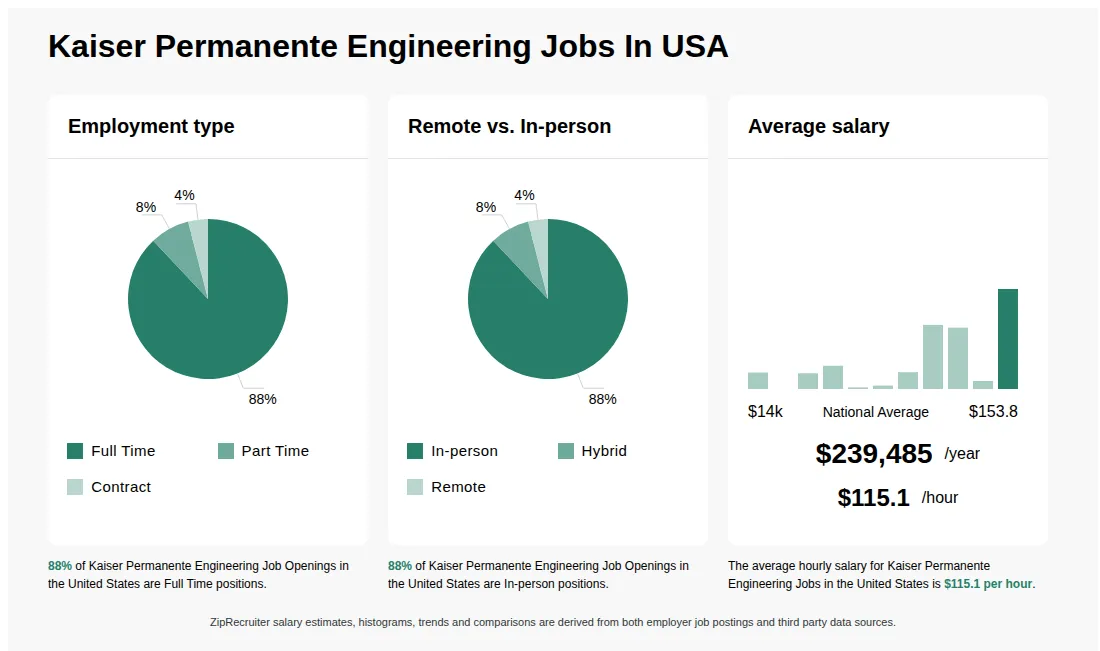
As of Sep 5, 2026, the average hourly pay for kaiser permanente engineering in the United States is $115.14, according to ZipRecruiter salary data. Most workers in this role earn between $101.92 and $153.12 per hour, depending on experience, location, and employer.

What is a Kaiser Permanente engineering job?

A Kaiser Permanente Engineering job involves designing, maintaining, and improving the healthcare system's infrastructure, technology, and operational efficiency. Engineers in this field may work on biomedical devices, facilities management, IT systems, or process optimization to enhance patient care and organizational effectiveness. These roles require technical expertise, problem-solving skills, and collaboration with healthcare professionals to ensure safe, efficient, and innovative healthcare solutions.

What are some typical projects or responsibilities for engineering professionals at Kaiser Permanente?

Engineering professionals at Kaiser Permanente may work on projects such as upgrading hospital infrastructure, implementing energy efficiency initiatives, or ensuring compliance with healthcare safety standards. Daily responsibilities can include coordinating with clinical staff to assess facility needs, managing contractors, and maintaining building systems or medical equipment. Team members often collaborate with departments like facilities management, IT, and environmental health to deliver solutions that enhance patient care and operational efficiency. The diverse project scope offers opportunities to develop technical expertise while making a direct impact on healthcare environments.

What are the key skills and qualifications needed to thrive in the Kaiser Permanente engineering position, and why are they important?

To succeed in Kaiser Permanente Engineering roles, candidates typically need a bachelor's degree in engineering, strong analytical abilities, and experience in healthcare-related or facilities engineering. Familiarity with tools such as AutoCAD, building automation systems, and industry certifications like Professional Engineer (PE) licensure are often required. Excellent teamwork, project management, and communication skills help individuals thrive when working across diverse clinical and administrative teams. These skills are crucial for ensuring safe, efficient, and compliant healthcare environments that support patient care delivery.

More about Kaiser Permanente Engineering jobs

What cities are hiring for Kaiser Permanente Engineering jobs?

Cities with the most Kaiser Permanente Engineering job openings:

What are the most commonly searched types of Kaiser Permanente Engineering jobs?

The most popular types of Kaiser Permanente Engineering jobs are:

What states have the most Kaiser Permanente Engineering jobs?

States with the most job openings for Kaiser Permanente Engineering jobs include:

What job categories do people searching Kaiser Permanente Engineering jobs look for?

The top searched job categories for Kaiser Permanente Engineering jobs are:

Infographic showing various Kaiser Permanente Engineering job openings in the United States as of August 2026, with employment types broken down into 92% Full Time, 4% Part Time, 3% Contract, and 1% Nights. Highlights an 86% Physical, 4% Hybrid, and 10% Remote job distribution, with an average salary of $239,485 per year, or $115.1 per hour.

Cyber Risk Defense Consultant V

Kaiser Permanente

Greensboro, NC • On-site

$140 - $190/hr

Other

Posted 6 days ago


Key responsibilities

  • Develops and executes threat hunts to proactively identify advanced threats using security telemetry.

  • Communicates investigative findings to both technical and non-technical audiences and collaborates with various cybersecurity teams.

  • Leads the investigation, triage, and response to security events and incidents across multiple domains.


Kaiser Permanente rating

8.2

Company rating: 8.2 out of 10

Based on 927 frontline employees who took The Breakroom Quiz

55th of 898 rated healthcare providers


Job description

Tech Summary

The Threat Hunting Lead will serve as the technical lead for Kaiser Permanente's Threat Hunting function within the Threat Intelligence and Detection Engineering (TIDE) team. This role is responsible for proactively identifying advanced threats by leveraging threat intelligence and analyzing endpoint, network, cloud, identity, email, asset, and other security telemetry. The successful candidate will develop and execute threat hunts, translate intelligence into actionable detection and hunting strategies, identify gaps in defensive coverage, and drive improvements to the organization's security posture. Working closely with Threat Intelligence, Detection Engineering, Incident Response, and Cyber Defense teams, the Threat Hunting Lead will provide technical leadership, mentor analysts, communicate findings to both technical and executive audiences, and help ensure Kaiser Permanente remains protected against an evolving threat landscape. The ideal candidate is a collaborative, intellectually curious cybersecurity professional with a passion for emerging threats, data-driven analysis, and continuous improvement.

Job Summary

This senior level employee is primarily responsible for overseeing the maintenance and protection of integrity and reliability of the security of data, systems and networks.

Essential Responsibilities
  • Conducts or oversees business-specific projects by applying deep expertise in subject area; promoting adherence to all procedures and policies; developing work plans to meet business priorities and deadlines; determining and carrying out processes and methodologies; coordinating and delegating resources to accomplish organizational goals; partnering internally and externally to make effective business decisions; solving complex problems; escalating issues or risks, as appropriate; monitoring progress and results; recognizing and capitalizing on improvement opportunities; evaluating recommendations made; and influencing the completion of project tasks by others.
  • Practices self-leadership and promotes learning in others by building relationships with cross-functional stakeholders; communicating information and providing advice to drive projects forward; influencing team members within assigned unit; listening and responding to, seeking, and addressing performance feedback; adapting to competing demands and new responsibilities; providing feedback to others, including upward feedback to leadership and mentoring junior team members; creating and executing plans to capitalize on strengths and improve opportunity areas; and adapting to and learning from change, difficulties, and feedback.
  • Leads team in the proactive monitoring and/or response to known or emerging threats against the KP network.
  • Effectively communicates investigative findings to non-technical audiences.
  • Plans and facilitates regular operations meeting with Cyber Risk Defense Center (CRDC) teams.
  • Supports closed loop processes on security efforts by providing feedback to the TDA leads and/or leadership.
  • Participates in information fusion procedures across operations and engineering, including activities such as Use Case planning/development, Use Case quality assurance validation, and response procedure documentation.
  • Serves as a liaison between stage teams and upper management by identifying issues, improvement areas, or security/architectural gaps and suggesting appropriate improvements.
  • Drives the development of the CRDC intellectual capital by leading process or procedure improvements, consulting on brown bag training sessions, and leading the development of new training documents.
  • Partners with the CRDC Policy Engineers and Remediation teams to contain identified issues and determine the best approach for improving security posture.
  • Facilitates follow-up remediation design and review efforts.
  • Leads the investigation and triage of security events across multiple domains.
  • Leads complex data analyses in support of security event management processes, including root cause analysis.
  • Coordinates the response and resolution of high impact or critical cyber security incidents.
  • Leads the deployment of threat detection capabilities and/or incident response plans which may include after-hours support and coordination among responsible teams.
  • Drives the execution of incident detection and/or handling processes which may include containment, protection, and remediation activities.
Minimum Qualifications
  • Minimum two (2) years in an informal leadership role working with project or technical teams.
  • Bachelors degree in Business Administration, Computer Science, Social Science, Mathematics, or related field and Minimum eight (8) years experience in IT or a related field, including Minimum two (2) years in information security or network engineering. Additional equivalent work experience may be substituted for the degree requirement.
Preferred Qualifications
  • One (1) year supervisory experience
  • Two (2) years of work experience in a role requiring interaction with senior leadership (e.g., Director level and above)
#J-18808-Ljbffr

What Kaiser Permanente employees say

Pay

Benefits

Hours and flexibility

Workplace

Get the full story on Breakroom