1

Junior Cyber Security Analyst Jobs (NOW HIRING)

JOB SUMMARY The Junior Cyber Security Analyst supports information security operations across GMR and its subsidiaries by monitoring security alerts, reviewing event activity, assisting with incident ...

New

Cybersecurity Analyst, Junior

Rome, NY · On-site

$52K - $108K/yr

Cybersecurity Analyst, Junior The Opportunity: As a Cybersecurity Risk Analyst, you understand the value of hunt-forward operations, and you know that battles are won in the grey. At Booz Allen, you ...

JOB SUMMARY The Junior Cyber Security Analyst supports information security operations across GMR and its subsidiaries by monitoring security alerts, reviewing event activity, assisting with incident ...

New

Showing results 21-40

Junior Cyber Security Analyst information

See salary details

$15

$32

$53

How much do junior cyber security analyst jobs pay per hour?

As of Aug 9, 2026, the average hourly pay for junior cyber security analyst in the United States is $32.12, according to ZipRecruiter salary data. Most workers in this role earn between $23.08 and $35.34 per hour, depending on experience, location, and employer.

What are the typical challenges a junior cyber security analyst faces during their first year on the job?

Junior Cyber Security Analysts often encounter challenges such as adapting to rapidly changing threat landscapes and learning to use a variety of security tools and systems. They may also need to quickly develop strong analytical skills to assess alerts, investigate incidents, and differentiate between false positives and real threats. Collaboration is key, as juniors frequently work alongside senior analysts and IT teams to coordinate responses and implement security measures. Navigating these challenges helps build a solid foundation for growth in the cyber security field.

What is the difference between Junior Cyber Security Analyst vs Cyber Security Technician?

AspectJunior Cyber Security AnalystCyber Security Technician
Required CertificationsCompTIA Security+, CEH (Certified Ethical Hacker)CompTIA Security+, Network+
Work EnvironmentMonitoring security systems, analyzing threats, reportingImplementing security measures, maintaining hardware/software
Employer & Industry UsageIT security teams in various industriesIT support and security teams in organizations
Common Search/ComparisonYesYes

The main difference between a Junior Cyber Security Analyst and a Cyber Security Technician lies in their focus. Analysts primarily monitor, analyze, and respond to security threats, while Technicians focus on implementing and maintaining security infrastructure. Both roles often require similar certifications and work within IT security teams, but their day-to-day tasks differ based on their core responsibilities.

What does a junior cyber security analyst do?

A Junior Cyber Security Analyst is responsible for assisting in the protection of an organization’s computer systems and networks from security breaches and cyber threats. Their day-to-day tasks often include monitoring network traffic for suspicious activity, responding to minor security incidents, maintaining security tools, and collaborating with senior analysts to investigate vulnerabilities. They may also help with security audits, update documentation, and educate staff about basic security practices. This entry-level role is a great starting point for a career in the rapidly growing field of cyber security.

What are the key skills and qualifications needed to thrive as a junior cyber security analyst?

To thrive as a Junior Cyber Security Analyst, you need a foundational understanding of networking, operating systems, and security principles, typically supported by a relevant degree or certifications like CompTIA Security+. Familiarity with security tools such as SIEM platforms, vulnerability scanners, and incident response systems is commonly expected. Attention to detail, analytical thinking, and strong communication skills are crucial soft skills for success in this role. These competencies are vital for identifying threats, mitigating risks, and ensuring clear reporting in dynamic security environments.

What does a junior cyber security analyst do?

As a junior cyber security analyst, your responsibilities involve identifying and preventing cyber threats to a company or other organization. Your duties may include establishing threat plans and protocols, maintaining data, monitoring security network access, performing tests and risk analysis, reviewing security alerts and taking steps to protect the information, updating and maintaining a firewall, and recommending security tools and countermeasures to your superiors. Most junior cyber security analyst positions are entry-level, so you usually work under the supervision of a senior cyber security analyst until you have gained the necessary skills and experience to work on your own.

What cities are hiring for Junior Cyber Security Analyst jobs? Cities with the most Junior Cyber Security Analyst job openings:
What are the most commonly searched types of Cyber Security Analyst jobs? The most popular types of Cyber Security Analyst jobs are:
What states have the most Junior Cyber Security Analyst jobs? States with the most job openings for Junior Cyber Security Analyst jobs include:
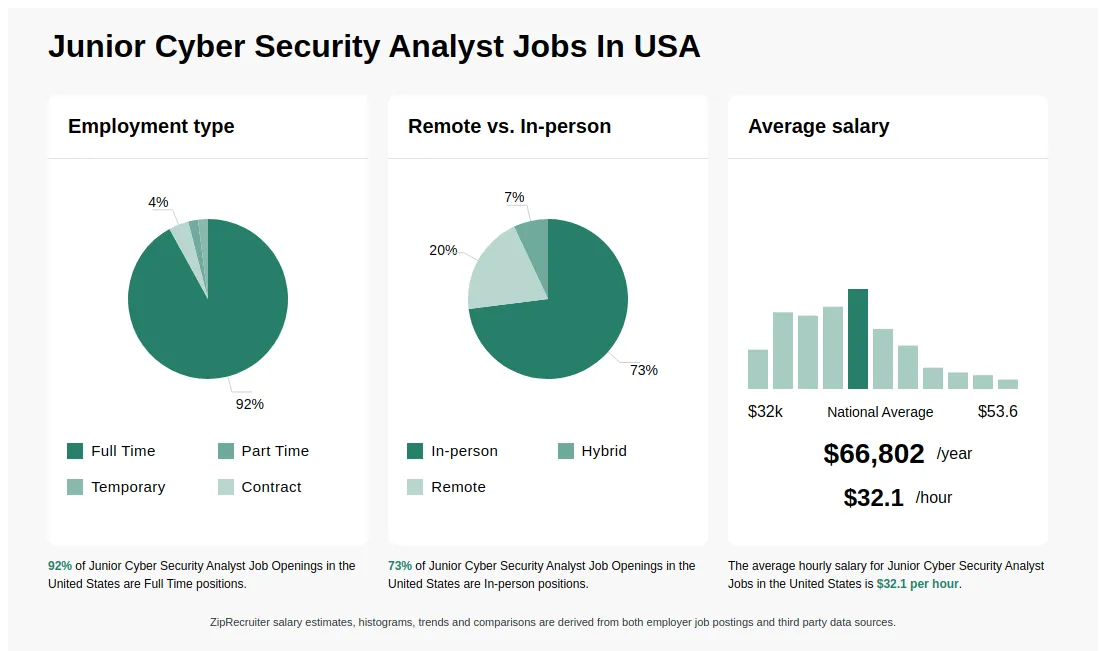
Infographic showing various Junior Cyber Security Analyst job openings in the United States as of August 2026, with employment types broken down into 84% Full Time, 13% Part Time, and 3% Contract. Highlights an 93% Physical, 2% Hybrid, and 5% Remote job distribution, with an average salary of $66,802 per year, or $32.1 per hour.

Full-time

Re-posted 27 days ago


City Of New York rating

7.2

Company rating: 7.2 out of 10

Based on 81 frontline employees who took The Breakroom Quiz

620th of 844 rated public administrative organizations


Job description

Job Description

DCAS's mission is to make city government work for all New Yorkers. From managing New York City's most iconic courthouses and municipal buildings, to purchasing over $1 billion annually in goods and services for more than 80 City agencies. What we do ensures that all agencies can deliver on their mission. Our reach
touches every facet of City government and is instrumental to the successful day-to-day operations of the City of New York. Our commitment to equity, effectiveness, and sustainability guides our work providing City agencies with the critical resources and support needed to succeed, including:
- Recruiting, hiring, and training City employees.
- Managing 56 public buildings.
- Acquiring, selling, and leasing City property.
- Purchasing over $1 billion in goods and services for City agencies.
- Overseeing the greenest municipal vehicle fleet in the country.
- Leading the City's efforts to reduce carbon emissions from government operations.
When you work at DCAS, you're not just working for one agency, but in service to all of them. It's an opportunity to provide meaningful support, quality customer service, and help protect the future of New York City for generations to come. Visit our website at NYC.GOV/DCAS to learn more about the work we do.
DCAS Information Technology works in conjunction with the NYC Office of Technology and Innovation (OTI) on the daily management and support of the DCAS computer network. DCAS IT team members are responsible for the agencies software and hardware needs, the development and maintenance of applications, maintenance of the DCAS internet and intranet (DCASConnect) sites, the DCAS Help Desk, telecommunications services and equipment for DCAS employees, and the Cyber Security program to thwart any attempts at unauthorized access to the network
The Infrastructure Engineer reports directly to the agency Chief Information Security Officer (CISO), responsible for protecting, monitoring, and enhancing the infrastructure and security posture of NYC Department of Citywide Administrative Services information systems, applications, networks, and cloud environments. The position combines advanced incident response, digital forensics, threat detection, vulnerability management, cybersecurity analytics, governance, risk and compliance (GRC), and security operations functions. The role serves as a technical escalation point for cybersecurity incidents, supports enterprise security initiatives, conducts cybersecurity assessments and audits, develops policies and procedures, and collaborates with City agencies, vendors, and stakeholders to improve cyber resilience and operational security.
- Assist the Agency CISO in ensuring cybersecurity-related change management and CI/CD processes align with NIST separation of duties requirements.
- Support the CISO with agency cyber awareness training, security onboarding and readiness assurance, and knowledge transfer for cloud-based applications.
- Lead and coordinate cybersecurity incident response, digital forensics, malware analysis, threat hunting, containment, eradication, recovery, and post-incident activities.
- Monitor and analyze security events, alerts, logs, and threat intelligence using SIEM, endpoint protection, cloud security, and monitoring platforms.
- Perform vulnerability assessments, risk analyses, remediation tracking, validation testing, and reporting across infrastructure, applications, cloud environments, and endpoints.
- Conduct cybersecurity audits, control assessments, risk reviews, and compliance evaluations aligned with NIST CSF, NIST SP 800-53, CIS Controls, Zero Trust principles, and Citywide cybersecurity policies.
- Develop and maintain cybersecurity policies, standards, procedures, playbooks, incident response plans, and operational documentation.
- Support Identity and Access Management (IAM) operations, including SSO, MFA, RBAC, access reviews, provisioning, deprovisioning, and privileged access governance.
- Analyze cybersecurity metrics, trends, vulnerabilities, incidents, and operational performance indicators; develop executive-level reports and recommendations.
- Partner with internal technology teams, application owners, vendors, City agencies, and external partners to improve cybersecurity capabilities and remediation outcomes.
- Support cloud security reviews, application security assessments, secure application onboarding, and software security initiatives.
- Provide technical leadership, mentoring, and guidance to junior cybersecurity staff and cross-functional stakeholders.
- Assist with audit readiness, evidence collection, regulatory compliance activities, and cybersecurity governance initiatives.
- Research emerging threats, technologies, attack techniques, and industry best practices to strengthen defensive capabilities.
To Apply:
Please go to www.nyc.gov/jobs, or www.nyc.gov/ess for current NYC employees, and search for Job ID #788324.
No phone calls, faxes or personal inquiries permitted. Only those candidates under consideration will be contacted.
IT INFRASTRUCTURE ENGINEER - 95714

Qualifications

1. A baccalaureate degree from an accredited college in computer science, engineering or a related field and four years of satisfactory full-time experience related to datacenter engineering and operations, cloud engineering and operations, complex IT infrastructure engineering; or,
2. A baccalaureate degree from an accredited college and eight years of satisfactory full-time experience related to datacenter engineering and operations, cloud engineering and operations, complex IT infrastructure engineering; or,
3. Education and/or experience which is equivalent to "1" or "2" above.

Additional Information

The City of New York is an inclusive equal opportunity employer committed to recruiting and retaining a diverse workforce and providing a work environment that is free from discrimination and harassment based upon any legally protected status or protected characteristic, including but not limited to an individual's sex, race, color, ethnicity, national origin, age, religion, disability, sexual orientation, veteran status, gender identity, or pregnancy.


What City Of New York employees say

Pay

Benefits

Hours and flexibility

Workplace

Get the full story on Breakroom