1

Hospital Emergency Management Jobs (NOW HIRING)

Training new/current employees in workplace safety and emergency management procedures. Coordinating/Managing the Hospital Emergency Response Team (HERT) for disaster response. * Updating the ...

Training new/current employees in workplace safety and emergency management procedures. Coordinating/Managing the Hospital Emergency Response Team (HERT) for disaster response. * Updating the ...

The Hospital emergency Dispatcher -Central Communications Operators play a critical role in ... Experience with electronic health record systems and call management software * Ability to ...

next page

Showing results 1-20

Hospital Emergency Management information

See salary details

$39K

$98.7K

$174K

How much do hospital emergency management jobs pay per year?

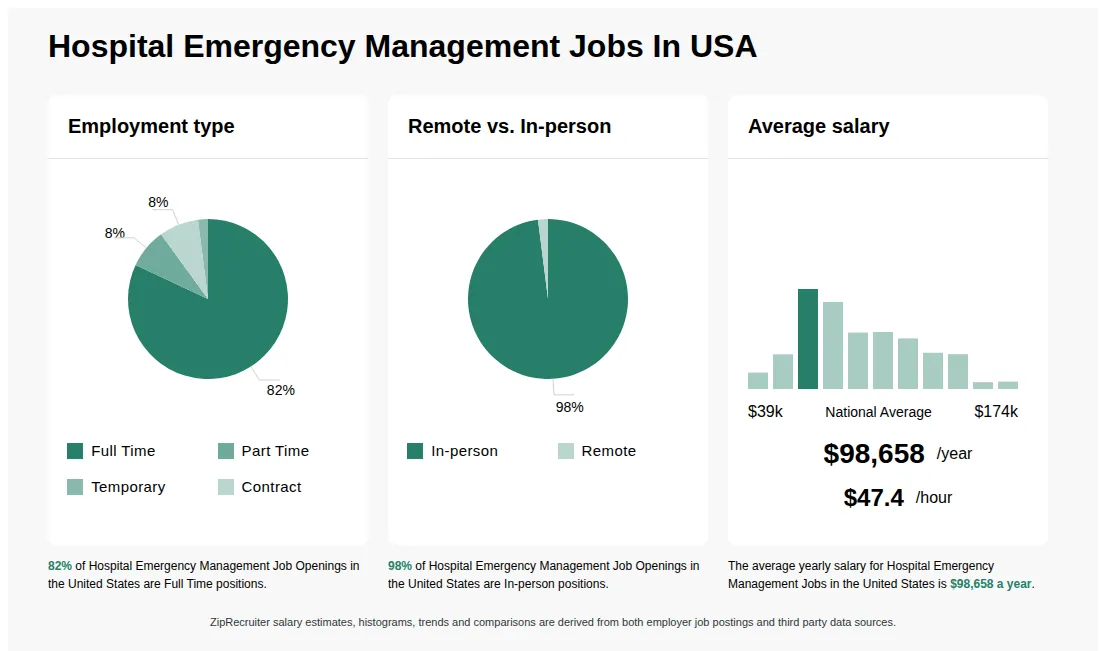
As of Jun 11, 2026, the average yearly pay for hospital emergency management in the United States is $98,658.00, according to ZipRecruiter salary data. Most workers in this role earn between $72,500.00 and $121,000.00 per year, depending on experience, location, and employer.

What is the difference between Hospital Emergency Management vs Emergency Preparedness Coordinator?

AspectHospital Emergency ManagementEmergency Preparedness Coordinator
CertificationsFEMA certifications, healthcare emergency management credentialsFEMA certifications, emergency management certifications
Work EnvironmentHospitals, healthcare facilities, emergency response teamsPublic health agencies, hospitals, government agencies
Employer & IndustryHealthcare industry, hospitals, emergency servicesPublic health, government agencies, healthcare organizations
Primary FocusManaging hospital-specific emergency plans and responseDeveloping and coordinating emergency preparedness programs

Hospital Emergency Management focuses on planning and responding to emergencies within healthcare facilities, ensuring patient safety and operational continuity. Emergency Preparedness Coordinator has a broader role, developing community-wide or organizational emergency plans. Both roles require similar certifications and work in related environments, but their scope and focus differ.

What are some common challenges faced by professionals in Hospital Emergency Management, and how can they be addressed?

Professionals in Hospital Emergency Management frequently encounter challenges such as coordinating across multiple departments, ensuring compliance with ever-changing regulations, and maintaining readiness for a wide range of emergencies. Effective communication, ongoing staff training, and regular drills are essential to overcoming these challenges. Building strong relationships with local agencies and fostering a culture of preparedness within the hospital can also help ensure swift, coordinated responses during crises.

What is hospital emergency management?

Hospital emergency management refers to the coordinated process of preparing for, responding to, and recovering from emergencies and disasters that may affect a hospital's operations. This includes developing plans and procedures to handle events like natural disasters, mass casualty incidents, infectious disease outbreaks, and other crises. The goal is to ensure the safety of patients, staff, and visitors while maintaining continuous healthcare services. Emergency management teams work to identify risks, train staff, conduct drills, and coordinate with local agencies to enhance hospital readiness.

What are the key skills and qualifications needed to thrive as a Hospital Emergency Management professional, and why are they important?

A successful Hospital Emergency Management professional needs a background in emergency preparedness, risk assessment, and healthcare operations, often supported by a degree in emergency management or public health. Familiarity with incident command systems (ICS), hazard vulnerability analysis tools, and certifications such as Certified Emergency Manager (CEM) or FEMA courses are typically required. Strong communication, leadership, and problem-solving skills help coordinate multidisciplinary teams and manage high-pressure scenarios. These competencies are crucial to ensure effective disaster response, patient safety, and hospital resilience during emergencies.
More about Hospital Emergency Management jobs
What cities are hiring for Hospital Emergency Management jobs? Cities with the most Hospital Emergency Management job openings:
What are the most commonly searched types of Hospital Emergency Management jobs? The most popular types of Hospital Emergency Management jobs are:
What states have the most Hospital Emergency Management jobs? States with the most job openings for Hospital Emergency Management jobs include:
Emergency Management Program Administrator - Philhaven Hospital - Day

Emergency Management Program Administrator - Philhaven Hospital - Day

WellSpan Health

Lebanon, PA • On-site

Full-time

Medical, Retirement, PTO

Posted 24 days ago


WellSpan Health rating

7.5

Company rating: 7.5 out of 10

Based on 287 frontline employees who took The Breakroom Quiz

225th of 870 rated healthcare providers


Job description

General Summary

Plans, develops, implements and evaluates the Hospital's emergency management programs required by legal, regulatory, and accrediting agencies. Designs and facilitates disaster response plans for the organization and serves as primary contact with local authorities and emergency response personnel. Responsible for regulatory agency compliance and preparedness as it relates to facility safety. Designs, implements, and presents training programs for management and staff. Shares responsibility for the coordination of the regulatory survey preparation.

Qualifications
Minimum Education:

  • Bachelors Degree Required
  • Bachelors Degree in Emergency Management or a related response type field (EMS, Fire, Haz-Mat) Preferred

Work Experience:

  • 5 years of experience in Emergency Management or equivalent responder role (Police, Fire, EMS, Haz-Mat, Local Government Planning section) Required and
  • 7 years of experience in Emergency Management, emergency or equivalent responder role (Police, Fire, EMS, Haz-Mat, Local Government Planning section), decontamination response, and use of PPE Required and
  • Supervisory/Management experience Required

Driver's License Statement:

Must possess a valid driver's license in the current state of residence. Driving record must meet requirements established by WellSpan Risk Management.

Courses and Training:

  • IS 100 / 200 / 700 and 800, Hazmat Operations, Emergency Medical Technician preferred, or Emergency Responder / Advanced First Aid and CPR Upon Hire Required and
  • IS 300 and 400, Emergency Vehicle Operator's Course (EVOC) Upon Hire Preferred

Knowledge, Skills, and Abilities:

  • Excellent human relations and oral/written communications skills;
  • computer and software skills;
  • analytical ability;
  • ability to collaborate with professional and administrative groups in developing and evaluating educational programs.

Benefits Offered:

  • Comprehensive health benefits
  • Retirement savings plan
  • Paid time off (PTO)
  • Education assistance
  • Financial education and support, including DailyPay
  • Expanded Paid Parental Leave

For additional details: Benefits & Incentives | WellSpan Careers (joinwellspan.org)

Duties and Responsibilities

  • Plans, develops, implements, and evaluates the Emergency Operations Plan and reports statistically significant findings to the Emergency Management Committee.
  • Formulates and implements the Environment of Care/Life Safety program. Utilizes general safety information to improve the Environment of Care, resolves issues with Environment of Care by reporting the deficiencies to the appropriate staff and ensures that all associated entities are following all regulatory agencies in regard to Environment of Care Safety.
  • Designs and facilitates disaster response plans for the organization and serves as the primary contact with local authorities and emergency rescue personnel.
  • Acts as a consultant/resource to administrators, managers, physicians, and staff on matters related to emergency management, disaster, and chemical response.
  • Completes annual review of department emergency management/disaster policies.
  • Coordinates efforts to ensure all required emergency management and chemical safety training is updated.
  • Develops, implements, and evaluates management plans for Hazardous Materials, Waste Management, and Emergency Management. Also reviews and offers feedback to appropriate authors of the Fire Safety, Utility Systems and Medical Equipment Management plans, as able.
  • Chairs Emergency Management Committee and Physical Environment Safety Committee. Is responsible for follow up on recommendations made by the committees.
  • Designs, implements, and presents training programs and drills as required for management and staff.
  • Communicates and educates Administrators and staff members on matters related to safety and Emergency preparedness.
  • Evaluates expansion and/or changes to the fire alarm system to remain compliant with NFPA and the manufacturers recommendations, as appropriate.
  • Schedules, conducts, and documents fire drills for assigned locations..
  • Reviews and develops Emergency Management Plans/Policies and recommends corrective action.
  • Leads the annual review of the Hazard & Vulnerability Analysis (HVA). Compiles annual summary of Hazard & Vulnerability Analysis (HVA) results.
  • Leads the annual review of Emergency Operations Plan (EOP) to be compliant with the annual review of the HVA findings.
  • Assists with monthly drill(s) as able. Monitors compliance of facility and staff regarding fire drills.

Common Expectations:

  • Develops, monitors, and evaluates budget for area(s) of responsibility.
  • Enhances and maintains professional growth and development through participation in educational programs/seminars, current literature, in-service meetings, workshops, professional affiliations to keep abreast of latest trends in field of expertise.
  • Assists in departmental planning.
  • Prepares and maintains written documentation as required by the profession and the department.
  • Demonstrates a commitment to patient, visitor and staff by: complying with all applicable safety regulations; learning the impact of errors and methodology that will lead to reduction of errors; reporting actual and potential errors, as well as hazardous conditions; identifying opportunities to standardize processes and "error proof" systems that will lead to increased safety; and participating in safety education programs and root cause analyses as required.
  • Maintains established policies and procedures, objectives, quality assessment, safety, environmental and infection control standards as required by accrediting body.
  • Oversees educational programs and in-service meetings to include internal and agency based.
  • Provides outstanding service to all customers; fosters teamwork; and practices fiscal responsibility through improvement and innovation.

What WellSpan Health employees say

Pay

Benefits

Hours and flexibility

Workplace

Get the full story on Breakroom