1

Health Information Technology Jobs (NOW HIRING)

The Senior Health IT Consultant owns the strategic and stakeholder layer -- translating an existing technology roadmap into a sequenced, dependency mapped execution plan ready for PM handoff by July ...

Health IT Manager I

Washington, DC · Hybrid

$107K - $131K/yr

The Health IT Manager I oversees task groups and provides technical authority within the CTRO and Clinical Trials Reporting Program (CTRP). This role directs analysts and programmers, leads system ...

Health IT Specialist EHR

$158K - $205K/yr

As a Health IT Specialist, you will provide support to the healthcare team; physicians, clinicians, pharmacists, healthcare workers, affiliates, and partners by providing education on EHR ...

Project Manager (Health IT)

$100K - $119K/yr

... Health IT strategy and project management delivery program. Key Responsibilities * Support the development and execution of IT Strategy, ensuring alignment with mission priorities and federal ...

Health IT Program Manager II (Proposal)

$118K - $119K/yr

Position Summary The Health IT Program Manager II provides senior-level leadership, management, and oversight for enterprise Electronic Health Record (EHR) modernization and related Health IT ...

New

Senior Project Manager (Federal Health IT)

$134K - $134K/yr

The Senior Project Manager will also serve as the lead subject matter expert supporting a major federal Health IT economic and clinical health program, requiring hands-on knowledge of that program ...

next page

Showing results 1-20

Health Information Technology information

See salary details

$13

$18

$25

How much do health information technology jobs pay per hour?

As of Jun 30, 2026, the average hourly pay for health information technology in the United States is $18.16, according to ZipRecruiter salary data. Most workers in this role earn between $15.87 and $19.23 per hour, depending on experience, location, and employer.

What do health information technologists do?

Health information technologists manage and organize patient health data using electronic health records (EHR) systems. They ensure data accuracy, security, and compliance with healthcare regulations, often working with software tools and requiring knowledge of health informatics. Their role supports healthcare providers in delivering efficient and quality patient care.

What is the best paying health information technology job?

The highest paying roles in health information technology are often senior positions such as Health Information Managers, Chief Medical Information Officers, or IT Directors, with salaries exceeding $100,000 annually. These roles typically require advanced certifications, extensive experience, and strong knowledge of health IT systems and regulations.

What are the key skills and qualifications needed to thrive as a Health Information Technology professional, and why are they important?

To thrive in Health Information Technology, you need a strong understanding of health data management, medical coding, and compliance regulations, typically supported by a degree in health information management or a related field. Familiarity with electronic health record (EHR) systems, coding software like ICD-10, and certifications such as RHIT or RHIA are highly valuable. Attention to detail, analytical thinking, and effective communication are essential soft skills for accuracy and collaboration. These skills ensure the integrity, security, and accessibility of patient data, which are critical for quality healthcare delivery and regulatory compliance.

What is health information technology?

Health information technology (HIT) refers to the use of computer systems, software, and digital tools to store, manage, and share patient health information securely. HIT includes electronic health records (EHRs), health information exchanges, and other technologies that improve the quality, efficiency, and safety of healthcare delivery. Professionals in this field work to ensure accurate data collection, secure storage, and easy access for healthcare providers while maintaining patient privacy and regulatory compliance.

What are some common challenges faced by Health Information Technology professionals in maintaining data security and privacy?

Health Information Technology professionals often encounter challenges in ensuring the security and privacy of sensitive patient data. With evolving cybersecurity threats and strict regulatory requirements like HIPAA, it is crucial to stay updated with the latest security protocols and best practices. Additionally, coordinating with clinical staff to implement secure workflows and conducting regular risk assessments are essential parts of the role. Addressing these challenges requires strong technical skills, attention to detail, and proactive communication with both IT and healthcare teams.

What jobs can you get with a health information degree?

A health information technology degree prepares individuals for roles such as health information technician, medical coder, health data analyst, and health IT specialist. These jobs involve managing electronic health records, coding medical procedures, and ensuring data accuracy, often requiring familiarity with healthcare software and compliance standards.

What is the difference between Health Information Technology vs Medical Coding Specialist?

AspectHealth Information TechnologyMedical Coding Specialist
CredentialsHIT certifications (e.g., RHIT, CHTS)Certified Professional Coder (CPC), CCS
Work EnvironmentHospitals, clinics, health IT companiesMedical offices, billing companies
Employer & IndustryHealthcare providers, health IT firmsMedical billing and coding services
Search & ComparisonOften compared for health data management rolesCommonly compared for medical billing roles

Health Information Technology focuses on managing, analyzing, and securing health data using technology, while Medical Coding Specialists primarily translate medical procedures into codes for billing and documentation. Both roles are essential in healthcare but differ in responsibilities, certifications, and work settings.

Can I be a BHT without a degree?

Behavioral Health Technicians (BHTs) typically need a high school diploma or equivalent, but requirements vary by state and employer. Some positions may require certification or training, but a college degree is generally not mandatory to start as a BHT.
More about Health Information Technology jobs
What cities are hiring for Health Information Technology jobs? Cities with the most Health Information Technology job openings:
What are the most commonly searched types of Health Information Technology jobs? The most popular types of Health Information Technology jobs are:
What states have the most Health Information Technology jobs? States with the most job openings for Health Information Technology jobs include:
What job categories do people searching Health Information Technology jobs look for? The top searched job categories for Health Information Technology jobs are:
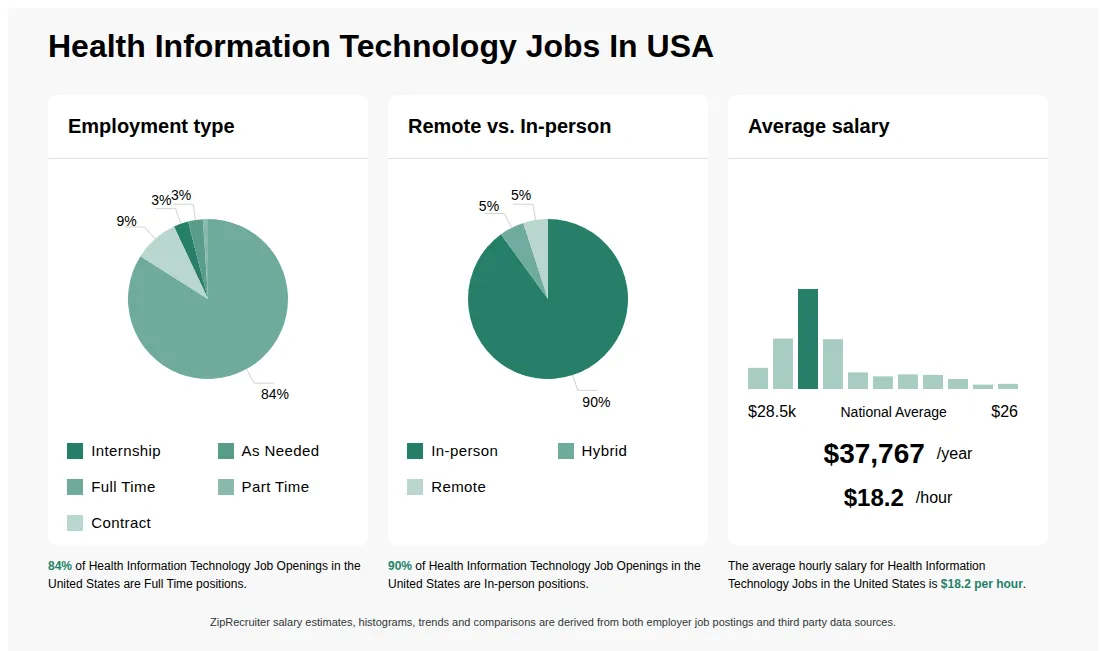
Infographic showing various Health Information Technology job openings in the United States as of June 2026, with employment types broken down into 89% Full Time, 10% Part Time, and 1% Contract. Highlights an 96% Physical, 1% Hybrid, and 3% Remote job distribution, with an average salary of $37,767 per year, or $18.2 per hour.
Senior Health IT Consultant

$120/hr

Contractor

Posted 8 days ago


Key responsibilities

  • Lead stakeholder interviews and facilitation sessions with health system leadership to inform the Healthcare Technology Execution Blueprint.

  • Drive technology prioritization, procurement sequencing, and roadmap decisions across four Year 1 workstreams.

  • Co-produce the PM-ready handoff package and lead the transition briefing with incoming project managers.


Job description

We are partnered with a large academic medical center to develop a PM-ready Healthcare Technology Execution Blueprint for Year 1 (2026 to 2027). The Senior Health IT Consultant owns the strategic and stakeholder layer -- translating an existing technology roadmap into a sequenced, dependency mapped execution plan ready for PM handoff by July 2026.
3 Month Engagement
Remote (will require travel 1-2x per month for 3-4 days per visit) in San Francisco
Pay: Starting at $120/hour
What you'll own
  • Lead all stakeholder interviews and facilitation sessions with health system leadership, including the CIO, CNIO, and Executive Director of Health Tech Solutions
  • Drive technology prioritization, procurement sequencing, and roadmap decisions across four Year 1 workstreams: Digital Infrastructure, Enterprise Platform Alignment, EHR + Integration Readiness, and Smart Room Lite Pilots
  • Own the narrative and synthesis - turn findings, assessments, and dependency analysis into the Healthcare Technology Execution Blueprint
  • Serve as the primary relationship holder with the client leadership team throughout the engagement
  • Co-produce the PM-ready handoff package and lead the transition briefing with incoming project managers
  • Collaborate daily with the Senior Solutions Architect to ensure strategic and technical work advances in parallel

Key deliverables you'll drive
  • Current state assessment across all healthcare technology domains
  • Technology prioritization by domain, grounded in Epic-first evaluation framework
  • Procurement sequencing and vendor shortlist by domain
  • Year 1 Execution Plan - sequenced, dependency-mapped, PM-ready
  • Executive Briefing Summary for leadership and board socialization
  • Years 2-3 Directional Outline as design context for Year 1 decisions

Requirements
  • 10+ years in health IT strategy, advisory, or consulting - ideally with large academic medical centers or integrated health systems
  • Demonstrated experience advising C-suite and VP-level health system executives (CIO, CNIO, CMO) on technology strategy and roadmap decisions
  • Strong familiarity with Epic and the broader health IT ecosystem - digital infrastructure, clinical communications, smart room, and inpatient technology
  • Proven ability to facilitate complex, multi-stakeholder alignment sessions and drive consensus on competing priorities
  • Experience translating ambiguous strategic intent into structured, actionable execution plans
  • Excellent written communication - able to produce executive-quality deliverables under tight timelines
  • Comfortable working fast in a fixed-timeline engagement without sacrificing rigor

Nice to have
  • Experience with smart room, RTLS, ambient clinical workflow, or inpatient experience technologies
  • Prior work at or with large academic medical centers or Magnet-designated health systems
  • PMP, FHIMSS, or equivalent credentialnt clinical workflow, or inpatient experience technologies
  • Prior work at or with large academic medical centers or Magnet-designated health systems
  • PMP, FHIMSS, or equivalent credential