Game Tester
Redmond, WA · On-site
$14/hr
Video Game Testers Needed! Multiple Roles! Compensation: $ 10/hr for English testing & $14/hr when doing Language Testing This is a seasonal on-going project with a large local software company. This ...
Redmond, WA · On-site
$14/hr
Video Game Testers Needed! Multiple Roles! Compensation: $ 10/hr for English testing & $14/hr when doing Language Testing This is a seasonal on-going project with a large local software company. This ...
Redmond, WA · On-site
$14/hr
Video Game Testers Needed! Multiple Roles! Compensation: $ 10/hr for English testing & $14/hr when doing Language Testing This is a seasonal on-going project with a large local software company. This ...
Fontana, CA · On-site
$500/wk
Become a Professional Game Tester We're looking for passionate gamers to join our elite team of mobile game testers. Get paid to play and test the latest games before they launch. $500+ Avg Monthly ...
Fontana, CA · On-site
$500/wk
Become a Professional Game Tester We're looking for passionate gamers to join our elite team of mobile game testers. Get paid to play and test the latest games before they launch. $500+ Avg Monthly ...
Palm Desert, CA · On-site
$500/wk
Become a Professional Game Tester We're looking for passionate gamers to join our elite team of mobile game testers. Get paid to play and test the latest games before they launch. $500+ Avg Monthly ...
Palm Desert, CA · On-site
$500/wk
Become a Professional Game Tester We're looking for passionate gamers to join our elite team of mobile game testers. Get paid to play and test the latest games before they launch. $500+ Avg Monthly ...
Rialto, CA · On-site
$500/wk
Become a Professional Game Tester We're looking for passionate gamers to join our elite team of mobile game testers. Get paid to play and test the latest games before they launch. $500+ Avg Monthly ...
Rialto, CA · On-site
$500/wk
Become a Professional Game Tester We're looking for passionate gamers to join our elite team of mobile game testers. Get paid to play and test the latest games before they launch. $500+ Avg Monthly ...
Rancho Cucamonga, CA · On-site
$500/wk
Become a Professional Game Tester We're looking for passionate gamers to join our elite team of mobile game testers. Get paid to play and test the latest games before they launch. $500+ Avg Monthly ...
Rancho Cucamonga, CA · On-site
$500/wk
Become a Professional Game Tester We're looking for passionate gamers to join our elite team of mobile game testers. Get paid to play and test the latest games before they launch. $500+ Avg Monthly ...
Apple Valley, CA · On-site
$500/wk
Become a Professional Game Tester We're looking for passionate gamers to join our elite team of mobile game testers. Get paid to play and test the latest games before they launch. $500+ Avg Monthly ...
Apple Valley, CA · On-site
$500/wk
Become a Professional Game Tester We're looking for passionate gamers to join our elite team of mobile game testers. Get paid to play and test the latest games before they launch. $500+ Avg Monthly ...
Indio, CA · On-site
$500/wk
Become a Professional Game Tester We're looking for passionate gamers to join our elite team of mobile game testers. Get paid to play and test the latest games before they launch. $500+ Avg Monthly ...
Indio, CA · On-site
$500/wk
Become a Professional Game Tester We're looking for passionate gamers to join our elite team of mobile game testers. Get paid to play and test the latest games before they launch. $500+ Avg Monthly ...
Hesperia, CA · On-site
$500/wk
Become a Professional Game Tester We're looking for passionate gamers to join our elite team of mobile game testers. Get paid to play and test the latest games before they launch. $500+ Avg Monthly ...
Hesperia, CA · On-site
$500/wk
Become a Professional Game Tester We're looking for passionate gamers to join our elite team of mobile game testers. Get paid to play and test the latest games before they launch. $500+ Avg Monthly ...
Redmond, WA · Hybrid
$14/hr
Job Title: Game Tester Location: Redmond, WA Schedule: 8am-4.45 pm. Tentatively 8-40hrs/week. Compensation: $11/hr for English testers & $14/hr for Language testers Joining Date: ASAP Contract ...
Redmond, WA · Hybrid
$14/hr
Job Title: Game Tester Location: Redmond, WA Schedule: 8am-4.45 pm. Tentatively 8-40hrs/week. Compensation: $11/hr for English testers & $14/hr for Language testers Joining Date: ASAP Contract ...
Redmond, WA · Hybrid
$14/hr
Game Tester Location: Redmond, WA Schedule: 8am-4.45 pm. Tentatively 8-40hrs/week. Compensation: $14/hr for Language testers Joining Date: ASAP Contract: On-call contract *This is not a work-from ...
Redmond, WA · Hybrid
$14/hr
Game Tester Location: Redmond, WA Schedule: 8am-4.45 pm. Tentatively 8-40hrs/week. Compensation: $14/hr for Language testers Joining Date: ASAP Contract: On-call contract *This is not a work-from ...
Dallas, TX · On-site
Due to continued expansion, GlobalStep is looking for a QA Game Testers who will be testing videogames in our Dallas-basee test center. Key responsibilities: * Identify issues and defects in ...
Dallas, TX · On-site
Due to continued expansion, GlobalStep is looking for a QA Game Testers who will be testing videogames in our Dallas-basee test center. Key responsibilities: * Identify issues and defects in ...
Redmond, WA · Hybrid
$14/hr
Job Title: Game Tester Location: Redmond, WA Schedule: 8am-4.45 pm. Tentatively 8-40hrs/week. Compensation: $11/hr for English testers & $14/hr for Language testers Joining Date: ASAP Contract ...
Redmond, WA · Hybrid
$14/hr
Job Title: Game Tester Location: Redmond, WA Schedule: 8am-4.45 pm. Tentatively 8-40hrs/week. Compensation: $11/hr for English testers & $14/hr for Language testers Joining Date: ASAP Contract ...
Redmond, WA · Hybrid
$14/hr
Job Title: Game Tester Location: Redmond, WA Schedule: 8am-4.45 pm. Tentatively 8-40hrs/week. Compensation: $11/hr for English testers & $14/hr for Language testers Joining Date: ASAP Contract ...
Redmond, WA · Hybrid
$14/hr
Job Title: Game Tester Location: Redmond, WA Schedule: 8am-4.45 pm. Tentatively 8-40hrs/week. Compensation: $11/hr for English testers & $14/hr for Language testers Joining Date: ASAP Contract ...
Redmond, WA · Hybrid
$14/hr
Job Title: Game Tester Location: Redmond, WA Schedule: 8am-4.45 pm. Tentatively 8-40hrs/week. Compensation: $11/hr for English testers & $14/hr for Language testers Joining Date: ASAP Contract ...
Redmond, WA · Hybrid
$14/hr
Job Title: Game Tester Location: Redmond, WA Schedule: 8am-4.45 pm. Tentatively 8-40hrs/week. Compensation: $11/hr for English testers & $14/hr for Language testers Joining Date: ASAP Contract ...
Redmond, WA · On-site
We have an urgent requirement for QA1 positions, Video Game Testers Needed! Multiple Roles! compensation: 11 $/hr - English Tester ; 14 $/hr - Language Tester This is a seasonal on-going project with ...
Redmond, WA · On-site
We have an urgent requirement for QA1 positions, Video Game Testers Needed! Multiple Roles! compensation: 11 $/hr - English Tester ; 14 $/hr - Language Tester This is a seasonal on-going project with ...
Austin, TX · On-site
Georgia IT, Inc. is a company focusing on IT services, and they are seeking a Game Tester to join their team in Austin, TX. The primary responsibility of this role is to test games, ensuring quality ...
Austin, TX · On-site
Georgia IT, Inc. is a company focusing on IT services, and they are seeking a Game Tester to join their team in Austin, TX. The primary responsibility of this role is to test games, ensuring quality ...
Due to continued expansion, GlobalStep is looking for a QA Game Testers to test Flight Simulation software in our Dallas based test center. Key responsibilities: * Identify issues and defects in ...
Due to continued expansion, GlobalStep is looking for a QA Game Testers to test Flight Simulation software in our Dallas based test center. Key responsibilities: * Identify issues and defects in ...
Dallas, TX · On-site
Due to continued expansion, GlobalStep is looking for Senior QA Game Testers to test videogames in our Dallas based test center. Key responsibilities: * Identify issues and defects in videogames ...
Dallas, TX · On-site
Due to continued expansion, GlobalStep is looking for Senior QA Game Testers to test videogames in our Dallas based test center. Key responsibilities: * Identify issues and defects in videogames ...
Due to continued expansion, GlobalStep is looking for Senior QA Game Testers to test Flight Simulation software in our Dallas based test center. Key responsibilities: * Identify issues and defects in ...
Due to continued expansion, GlobalStep is looking for Senior QA Game Testers to test Flight Simulation software in our Dallas based test center. Key responsibilities: * Identify issues and defects in ...
Over 1 million players played the browser version; we've rebuilt the entire game for PC - new ... testing * Flexible hours that fit around your studies or other commitments * Work remotely from ...
Over 1 million players played the browser version; we've rebuilt the entire game for PC - new ... testing * Flexible hours that fit around your studies or other commitments * Work remotely from ...
$14.18 - $14.90
4% of jobs
$14.90 - $15.63
13% of jobs
$16.18 is the 25th percentile. Wages below this are outliers.
$15.63 - $16.35
11% of jobs
$16.35 - $17.07
7% of jobs
$17.07 - $17.79
7% of jobs
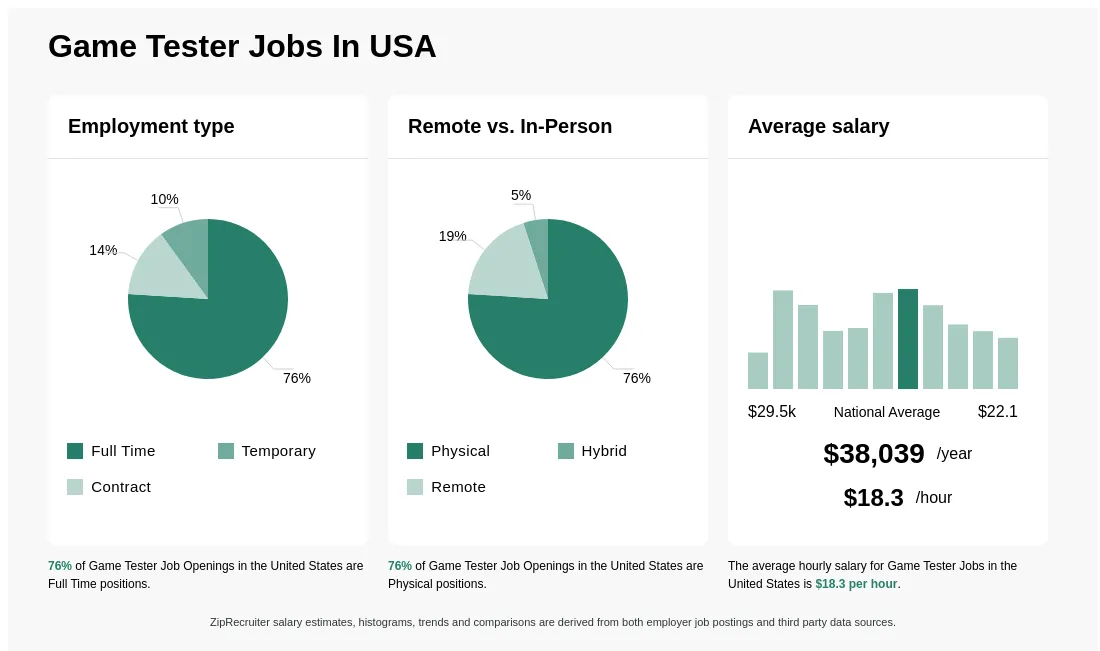
The median wage is $18.24 / hr.
$17.79 - $18.51
13% of jobs
$18.51 - $19.23
13% of jobs
$19.75 is the 75th percentile. Wages above this are outliers.
$19.23 - $19.95
11% of jobs
$19.95 - $20.67
8% of jobs
$20.67 - $21.39
7% of jobs
$21.39 - $22.12
6% of jobs
$14
$18
$22
Game testers ensure the quality and condition of video and mobile games for game production companies. Game testers also test hardware, such as gaming consoles and controllers to ensure quality, durability, and functionality. A core responsibility of a game tester is to identify bugs, glitches, and problems that potentially inhibit game operation and obstruct user experience. Also, game testers collaborate with visual designers and programmers to remedy the problems they find in games.
| Aspect | Game Tester | Quality Assurance Tester |
|---|---|---|
| Credentials | High school diploma or equivalent; some roles prefer gaming or testing certifications | High school diploma; often requires certifications in QA or related fields |
| Work Environment | Video game companies, testing labs, remote testing | Software companies, gaming studios, QA departments |
| Job Focus | Playing games to identify bugs and issues | Systematic testing to ensure overall quality and functionality |
| Common Usage | Primarily in gaming industry for testing new games | Broader software industry, including gaming, apps, and software products |
Game Testers focus on playing and identifying bugs in video games, often in a more informal setting. Quality Assurance Testers perform systematic testing to ensure the overall quality and functionality of software, including games. While both roles require attention to detail and testing skills, QA Testers typically have a broader scope and may work on various software products beyond games.
Cities with the most Game Tester job openings:
The most popular types of Game Tester jobs are:
The top employers for Game Tester jobs are:
States with the most job openings for Game Tester jobs include:
For Game Tester jobs, the most frequently searched job titles are:

Redmond, WA • On-site
$14/hr
Contractor
Re-posted 16 days ago
Blackapple Solutions Ltd (BSL) was founded in 2004 with the mission to provide best-in-class IT consultancy services across the globe. We are a specialist IT consultancy offering services through our consultants/experts on a contingency basis in the UK, Europe, USA and Asia Pacific. We work with a portfolio of high profile multinational clients across all sectors.
We have an urgent requirement for QA1 positions,
QA Testers Needed!!
Video Game Testers Needed! Multiple Roles!
Compensation: $ 10/hr for English testing & $14/hr when doing Language Testing
This is a seasonal on-going project with a large local software company. This is an excellent opportunity to get ground-floor experience in the gaming industry. Recent grads are encouraged to apply!!
REQUIREMENTS -
Be at least 18 years of age, and able to work in the US
o A passion for, and experience with, Video Games! Console gaming experience is a strong plus
o Be open to working on short notice (12 to 24 hour advance notification)
o Good at MS-Excel
o Good at reading & Writing
Please fill the below details ASAP.
Submission
Candidate Name (Full Name including Middle Name)
Present location (Full address with ZIP Code)
Work Authorization
Tel No
E-mail ID
Rate
Currently Working
Date of Birth
Languages Known:
Best Time for Interview
Availability to join
Please mention the list of games which you have played and currently playing:
This is 8 hour shift. Kindly let me know on which days are you available for 8 hrs shift. --8:00 AM - 5:00 PM
Days Mon Tue Wed Thursday Fri Sat Sun Total
Timing Availability
Number of Hours Available

Sourced by ZipRecruiter
It services
51 - 200 Employees
Somerville, NJ, US