1

Game Simulation Programming Jobs (NOW HIRING)

About the Role We are hiring a Sim Application Engineer to turn simulation systems into reliable, automated, production-quality pipelines that power model training, evaluation, and hardware-in-the ...

Create, develop, and enhance 3D game and simulation features utilizing Panda3D. * Build custom ... Work closely with developers, artists, and researchers to convert requirements into efficient and ...

next page

Showing results 1-20

People also search for

Game Simulation Programming information

See salary details

$11K

$67.6K

$121.5K

How much do game simulation programming jobs pay per year?

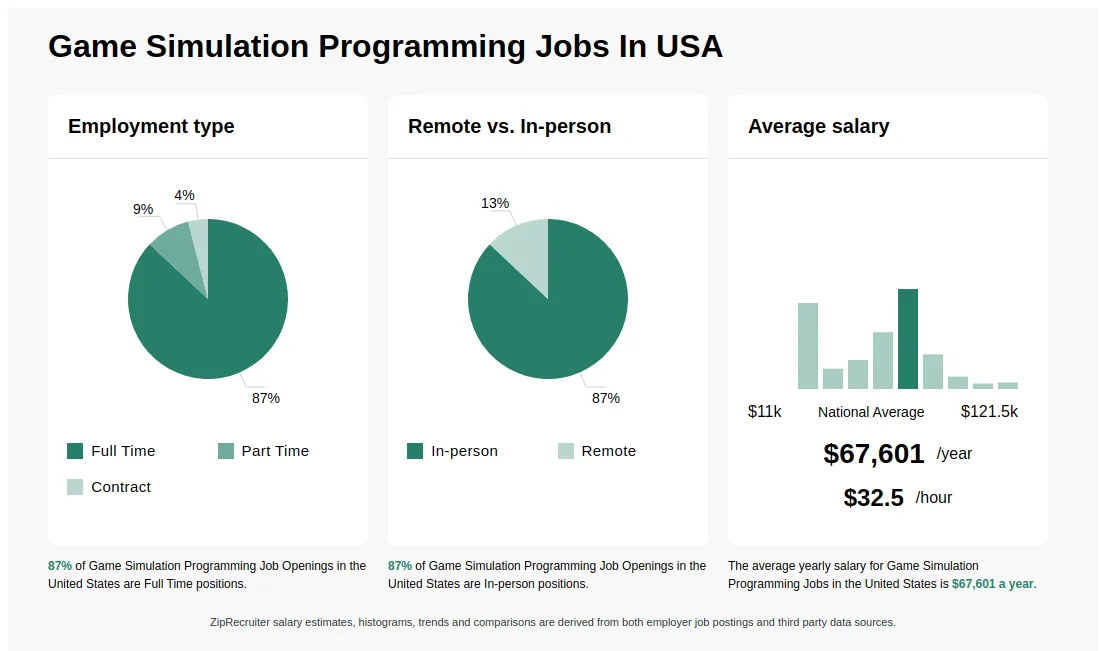
As of May 30, 2026, the average yearly pay for game simulation programming in the United States is $67,601.00, according to ZipRecruiter salary data. Most workers in this role earn between $44,000.00 and $79,500.00 per year, depending on experience, location, and employer.

What is a Game Simulation Programming job?

A Game Simulation Programming job involves developing and optimizing the systems that simulate real-world or fictional behaviors in video games. This includes physics engines, AI behaviors, game mechanics, and interactive environments to create immersive experiences. Programmers in this role use languages like C++ or Python and work closely with designers and artists to ensure realistic or stylized interactions. They may also implement algorithms for collision detection, fluid dynamics, or character decision-making. The goal is to create believable and efficient simulations that enhance gameplay.

What are the key skills and qualifications needed to thrive in the Game Simulation Programming position, and why are they important?

To thrive as a Game Simulation Programmer, you need strong skills in programming (typically C++ or C#), mathematics, and physics, along with a degree in computer science, software engineering, or a related field. Familiarity with game engines like Unity or Unreal, version control systems such as Git, and experience with simulation frameworks are often required. Creative problem-solving, teamwork, and excellent communication skills help individuals excel in fast-paced development environments. These competencies are crucial for creating realistic simulations, collaborating effectively, and ensuring the technical quality of game projects.

What kinds of daily responsibilities can I expect as a Game Simulation Programmer?

As a Game Simulation Programmer, your daily tasks typically include designing and implementing systems that simulate physics, artificial intelligence, and real-world behaviors within a game. You'll collaborate closely with designers, artists, and other programmers to integrate simulation elements and optimize performance. Debugging, testing, and refining simulation code are common, ensuring accuracy and efficiency in complex scenarios. Regular meetings and team discussions help align development goals, and you'll often have opportunities to propose improvements or new features. This role offers a dynamic environment where creativity and technical expertise are both valued.
What are the most commonly searched types of Game Simulation Programming jobs? The most popular types of Game Simulation Programming jobs are:
What states have the most Game Simulation Programming jobs? States with the most job openings for Game Simulation Programming jobs include:
Infographic showing various Game Simulation Programming job openings in the United States as of May 2026, with employment types broken down into 50% Full Time, 35% Part Time, 3% Temporary, 11% Contract, and 1% Summer. Highlights an 66% Physical, 10% Hybrid, and 24% Remote job distribution, with an average salary of $67,601 per year, or $32.5 per hour.
Simulation Applications Engineer

Simulation Applications Engineer

OpenAI

San Francisco, CA โ€ข On-site

$230K - $385K/yr

Full-time

Posted 9 days ago


Job description

About the Team
Our Robotics team is focused on unlocking general-purpose robotics and pushing towards AGI-level intelligence in dynamic, real-world settings. Working across the entire model stack, we integrate cutting-edge hardware and software to explore a broad range of robotic form factors. We strive to seamlessly blend high-level AI capabilities with the constraints of physical systems to improve peoples' lives.
About the Role
We are hiring a Sim Application Engineer to turn simulation systems into reliable, automated, production-quality pipelines that power model training, evaluation, and hardware-in-the-loop validation. This role owns the automation, orchestration, and tool integration that apply simulation to concrete robotics tasks: building CI/CD for SIL/HIL, presubmit checks, automatic model evaluation, metric computation and reporting, and the runtime infrastructure to run simulations at scale. You will collaborate closely with Sim Realism, Sim Environments, Research, and Ops to make simulation an integrated, reproducible, and measurable part of our ML and robotics workflows.
This role is based in San Francisco, CA, and requires in-person 4 days a week.
In this role, you will:
  • Build and maintain presubmit checks, continuous integration and deployment pipelines for simulation code, environments, and tasks so simulation artifacts are testable, versioned, and reproducible.
  • Implement end-to-end automation to run model evaluation in sim (SIL) and orchestrate HIL runs; compute realism and task metrics, generate dashboards and alerts, and ensure evaluation is repeatable and auditable.
  • Create robust APIs and connectors so research, training, and data-collection systems can schedule, seed, and evaluate batches of simulations; support RL rollouts, imitation-data collection, and presubmit model checks.
  • Build scheduling, batching and orchestration for running very large numbers of concurrent rollouts (target tens of thousands of rollouts / large RL workloads), solve engine-level scaling (parallelization, batching multiple runs per engine), and optimize cloud/GPU runtime reliability.
  • Produce metrics and tooling for measuring simulation health, throughput, fidelity regressions, and cost; create presubmit / canary tests that catch sim regressions early.
  • Implement artifact versioning, environment immutability (images / asset versions), experiment provenance, and policies for resource quotas and cost control across the sim farm.
  • Work closely with Sim Environments, Sim Realism, research, and ops to close the loop-ensuring simulation improvements directly translate into better model evaluation and training results.

You might thrive in this role if you:
  • Have deep software engineering & infra experience: you've built CI/CD at scale, authored reliable pipelines, and shipped production services that coordinate many moving parts.
  • Are comfortable with distributed compute and cloud GPU workloads: you know how to get many sims running concurrently (scheduling, batching, GPU orchestration) and optimize throughput/cost.
  • Have built or maintained HIL/SIL workflows or other simโ†”hardware integrations and understand the operational challenges of bridging software and hardware testbeds.
  • Are strong with automation, observability and metrics: you enjoy instrumenting systems, defining meaningful KPIs, and surfacing regressions early.
  • Can design APIs and developer ergonomics so research and SWE teams can easily submit jobs, reproduce experiments, and interpret results.
  • Have experience with Python/C++/Rust, container orchestration (Kubernetes), distributed task queues, and CI systems; bonus if you've worked with RL tooling, task generators, or large-scale data pipelines.
  • Enjoy collaborating across teams to turn experimental simulation work into dependable production tooling.

About OpenAI
OpenAI is an AI research and deployment company dedicated to ensuring that general-purpose artificial intelligence benefits all of humanity. We push the boundaries of the capabilities of AI systems and seek to safely deploy them to the world through our products. AI is an extremely powerful tool that must be created with safety and human needs at its core, and to achieve our mission, we must encompass and value the many different perspectives, voices, and experiences that form the full spectrum of humanity.
We are an equal opportunity employer, and we do not discriminate on the basis of race, religion, color, national origin, sex, sexual orientation, age, veteran status, disability, genetic information, or other applicable legally protected characteristic.
For additional information, please see OpenAI's Affirmative Action and Equal Employment Opportunity Policy Statement.
Background checks for applicants will be administered in accordance with applicable law, and qualified applicants with arrest or conviction records will be considered for employment consistent with those laws, including the San Francisco Fair Chance Ordinance, the Los Angeles County Fair Chance Ordinance for Employers, and the California Fair Chance Act, for US-based candidates. For unincorporated Los Angeles County workers: we reasonably believe that criminal history may have a direct, adverse and negative relationship with the following job duties, potentially resulting in the withdrawal of a conditional offer of employment: protect computer hardware entrusted to you from theft, loss or damage; return all computer hardware in your possession (including the data contained therein) upon termination of employment or end of assignment; and maintain the confidentiality of proprietary, confidential, and non-public information. In addition, job duties require access to secure and protected information technology systems and related data security obligations.
To notify OpenAI that you believe this job posting is non-compliant, please submit a report through this form. No response will be provided to inquiries unrelated to job posting compliance.
We are committed to providing reasonable accommodations to applicants with disabilities, and requests can be made via this link.
OpenAI Global Applicant Privacy Policy
At OpenAI, we believe artificial intelligence has the potential to help people solve immense global challenges, and we want the upside of AI to be widely shared. Join us in shaping the future of technology.