Partner with warfighters, model/sim experts, autonomy engineers, game/simulation engineers, and mission software teams to translate ambiguous planning workflows into reliable software. * Improve ...
Partner with warfighters, model/sim experts, autonomy engineers, game/simulation engineers, and mission software teams to translate ambiguous planning workflows into reliable software. * Improve ...

Software Engineer, Agentic Modeling & Simulation
Washington, DC · On-site
$200 - $250/hr
Partner with warfighters, model/sim experts, autonomy engineers, game/simulation engineers, and mission software teams to translate ambiguous planning workflows into reliable software. * Improve ...
Software Engineer, Agentic Modeling & Simulation
Washington, DC · On-site
$200 - $250/hr
Partner with warfighters, model/sim experts, autonomy engineers, game/simulation engineers, and mission software teams to translate ambiguous planning workflows into reliable software. * Improve ...
Partner with warfighters, model/sim experts, autonomy engineers, game/simulation engineers, and mission software teams to translate ambiguous planning workflows into reliable software. * Improve ...
Partner with warfighters, model/sim experts, autonomy engineers, game/simulation engineers, and mission software teams to translate ambiguous planning workflows into reliable software. * Improve ...
Software Engineer, Agentic Modeling & Simulation
Costa Mesa, CA · On-site
$200 - $250/hr
Partner with warfighters, model/sim experts, autonomy engineers, game/simulation engineers, and mission software teams to translate ambiguous planning workflows into reliable software. * Improve ...
Software Engineer, Agentic Modeling & Simulation
Costa Mesa, CA · On-site
$200 - $250/hr
Partner with warfighters, model/sim experts, autonomy engineers, game/simulation engineers, and mission software teams to translate ambiguous planning workflows into reliable software. * Improve ...
Software Engineer, Agentic Modeling & Simulation
Costa Mesa, CA · On-site
$191K - $292K/yr
Partner with warfighters, model/sim experts, autonomy engineers, game/simulation engineers, and mission software teams to translate ambiguous planning workflows into reliable software. * Improve ...
Software Engineer, Agentic Modeling & Simulation
Costa Mesa, CA · On-site
$191K - $292K/yr
Partner with warfighters, model/sim experts, autonomy engineers, game/simulation engineers, and mission software teams to translate ambiguous planning workflows into reliable software. * Improve ...
Software Engineer, Agentic Modeling & Simulation
Washington, DC · On-site
$191K - $292K/yr
Partner with warfighters, model/sim experts, autonomy engineers, game/simulation engineers, and mission software teams to translate ambiguous planning workflows into reliable software. * Improve ...
Software Engineer, Agentic Modeling & Simulation
Washington, DC · On-site
$191K - $292K/yr
Partner with warfighters, model/sim experts, autonomy engineers, game/simulation engineers, and mission software teams to translate ambiguous planning workflows into reliable software. * Improve ...
Software Engineer, Agentic Modeling & Simulation with Security Clearance
Washington, DC · On-site
$191K - $292K/yr
Partner with warfighters, model/sim experts, autonomy engineers, game/simulation engineers, and mission software teams to translate ambiguous planning workflows into reliable software. * Improve ...
Software Engineer, Agentic Modeling & Simulation with Security Clearance
Washington, DC · On-site
$191K - $292K/yr
Partner with warfighters, model/sim experts, autonomy engineers, game/simulation engineers, and mission software teams to translate ambiguous planning workflows into reliable software. * Improve ...
Software Engineer, Agentic Modeling & Simulation with Security Clearance
Costa Mesa, CA · On-site
$191K - $292K/yr
Partner with warfighters, model/sim experts, autonomy engineers, game/simulation engineers, and mission software teams to translate ambiguous planning workflows into reliable software. * Improve ...
Software Engineer, Agentic Modeling & Simulation with Security Clearance
Costa Mesa, CA · On-site
$191K - $292K/yr
Partner with warfighters, model/sim experts, autonomy engineers, game/simulation engineers, and mission software teams to translate ambiguous planning workflows into reliable software. * Improve ...
Game Math Designer (Mandarin Required)
Irvine, CA · On-site
$166K/yr
You will collaborate with game designers, product managers, and engineers in a fast-paced, on-site ... Experience with simulation/programming tools such as Python, MATLAB, R, C/C++/C#, or equivalent ...
Game Math Designer (Mandarin Required)
Irvine, CA · On-site
$166K/yr
You will collaborate with game designers, product managers, and engineers in a fast-paced, on-site ... Experience with simulation/programming tools such as Python, MATLAB, R, C/C++/C#, or equivalent ...

Software Simulation Engineer
Chicago, IL · On-site
$60 - $90/hr
Software Simulation Engineer Our Software & Digital Transformation organization is seeking an ... This position is ideal for someone with experience in video game development, game design ...
Quick apply
Software Simulation Engineer
Chicago, IL · On-site
$60 - $90/hr
Software Simulation Engineer Our Software & Digital Transformation organization is seeking an ... This position is ideal for someone with experience in video game development, game design ...
Software Simulation Engineer
Schaumburg, IL · On-site
$60 - $90/hr
Software Simulation Engineer Our Software & Digital Transformation organization is seeking an ... This position is ideal for someone with experience in video game development, game design ...
Quick apply
Software Simulation Engineer
Schaumburg, IL · On-site
$60 - $90/hr
Software Simulation Engineer Our Software & Digital Transformation organization is seeking an ... This position is ideal for someone with experience in video game development, game design ...

Software Engineer / Unity Game Developer Level 2
El Segundo, CA · On-site
$100 - $131/hr
Proven experience developing games or simulations using the Unity game engine. * Strong proficiency in C# programming for Unity development. * Experience with 2D and 3D game development.
Quick apply
Software Engineer / Unity Game Developer Level 2
El Segundo, CA · On-site
$100 - $131/hr
Proven experience developing games or simulations using the Unity game engine. * Strong proficiency in C# programming for Unity development. * Experience with 2D and 3D game development.
We are looking for candidates with diverse backgrounds, including game development, CGI artistry ... Proficiency in programming languages such as Python, C++, or similar. * Deep understanding of ...
We are looking for candidates with diverse backgrounds, including game development, CGI artistry ... Proficiency in programming languages such as Python, C++, or similar. * Deep understanding of ...
Simulation Developer
Quantico, VA · On-site
$100 - $125/hr
Minimum of 7 years of software development experience focused on simulation or game-based environments. A total of 10 years' experience without a degree. * Proficiency in programming languages such ...
Simulation Developer
Quantico, VA · On-site
$100 - $125/hr
Minimum of 7 years of software development experience focused on simulation or game-based environments. A total of 10 years' experience without a degree. * Proficiency in programming languages such ...

Simulation Developer
Quantico, VA · On-site
Minimum of 2 years of software development experience focused on simulation or game-based environments. A total of 12 years' experience without a degree. * Experience in programming languages such as ...
Simulation Developer
Quantico, VA · On-site
Minimum of 2 years of software development experience focused on simulation or game-based environments. A total of 12 years' experience without a degree. * Experience in programming languages such as ...
Simulation Developer
Quantico, VA · On-site
Minimum of 2 years of software development experience focused on simulation or game-based environments. A total of 12 years' experience without a degree. * Experience in programming languages such as ...
Simulation Developer
Quantico, VA · On-site
Minimum of 2 years of software development experience focused on simulation or game-based environments. A total of 12 years' experience without a degree. * Experience in programming languages such as ...

Simulation Engineer
San Mateo, CA · On-site
$200 - $250/hr
We are looking for candidates with diverse backgrounds, including game development, CGI artistry ... Proficiency in programming languages such as Python, C++, or similar. * Deep understanding of ...
Simulation Engineer
San Mateo, CA · On-site
$200 - $250/hr
We are looking for candidates with diverse backgrounds, including game development, CGI artistry ... Proficiency in programming languages such as Python, C++, or similar. * Deep understanding of ...

We are looking for an Instructor Digital Gaming and Simulation who will advance the institution ... These include 2D, 3D, AR/VR game development with professional experience in programming and/or ...
We are looking for an Instructor Digital Gaming and Simulation who will advance the institution ... These include 2D, 3D, AR/VR game development with professional experience in programming and/or ...
We are looking for an Instructor Digital Gaming and Simulation who will advance the institution ... These include 2D, 3D, AR/VR game development with professional experience in programming and/or ...
We are looking for an Instructor Digital Gaming and Simulation who will advance the institution ... These include 2D, 3D, AR/VR game development with professional experience in programming and/or ...
Simulation Developer
$91K - $153K/yr
Minimum of 2 years of software development experience focused on simulation or game-based environments. A total of 12 years' experience without a degree. * Experience in programming languages such as ...
Simulation Developer
$91K - $153K/yr
Minimum of 2 years of software development experience focused on simulation or game-based environments. A total of 12 years' experience without a degree. * Experience in programming languages such as ...
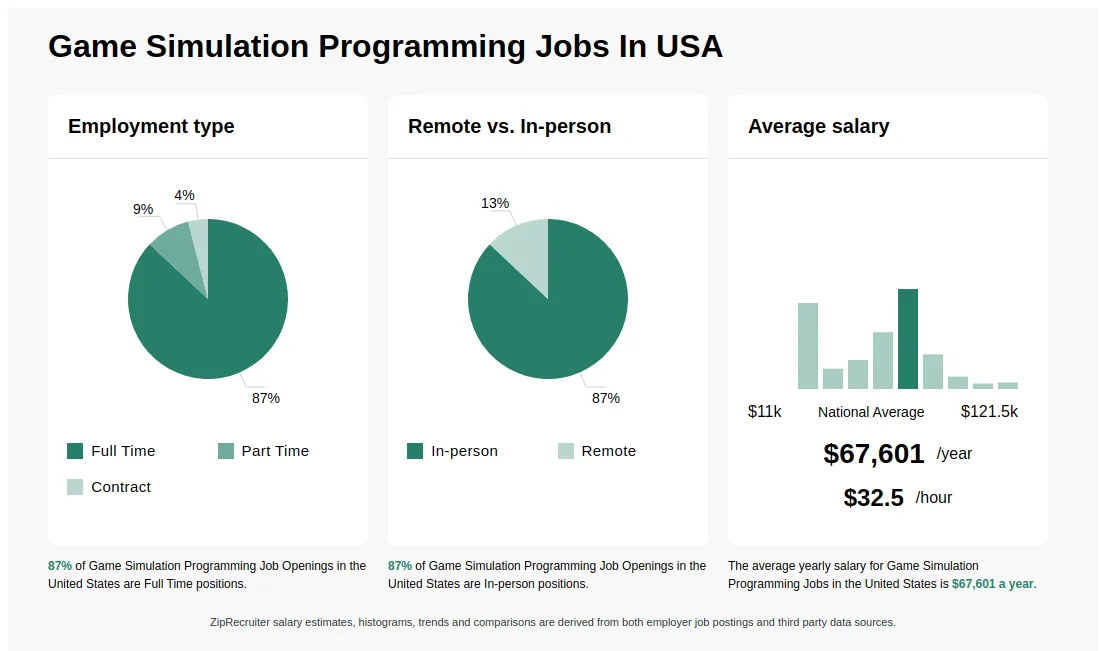
Game Simulation Programming information
See salary details
$11K - $21K
0% of jobs
$21K - $31.1K
0% of jobs
$41K is the 25th percentile. Wages below this are outliers.
$31.1K - $41.1K
25% of jobs
$41.1K - $51.2K
5% of jobs
$51.2K - $61.2K
8% of jobs
The median wage is $67.8K / yr.
$61.2K - $71.3K
17% of jobs
$77.8K is the 75th percentile. Wages above this are outliers.
$71.3K - $81.3K
29% of jobs
$81.3K - $91.4K
9% of jobs
$91.4K - $101.4K
3% of jobs
$101.4K - $111.5K
1% of jobs
$111.5K - $121.5K
1% of jobs
$11K
$67.6K
$121.5K
How much do game simulation programming jobs pay per year?
As of Sep 8, 2026, the average yearly pay for game simulation programming in the United States is $67,601.00, according to ZipRecruiter salary data. Most workers in this role earn between $44,000.00 and $79,500.00 per year, depending on experience, location, and employer.
What is game simulation programming?
A Game Simulation Programming job involves developing and optimizing the systems that simulate real-world or fictional behaviors in video games. This includes physics engines, AI behaviors, game mechanics, and interactive environments to create immersive experiences. Programmers in this role use languages like C++ or Python and work closely with designers and artists to ensure realistic or stylized interactions. They may also implement algorithms for collision detection, fluid dynamics, or character decision-making. The goal is to create believable and efficient simulations that enhance gameplay.
What kinds of daily responsibilities can I expect as a game simulation programmer?
As a Game Simulation Programmer, your daily tasks typically include designing and implementing systems that simulate physics, artificial intelligence, and real-world behaviors within a game. You'll collaborate closely with designers, artists, and other programmers to integrate simulation elements and optimize performance. Debugging, testing, and refining simulation code are common, ensuring accuracy and efficiency in complex scenarios. Regular meetings and team discussions help align development goals, and you'll often have opportunities to propose improvements or new features. This role offers a dynamic environment where creativity and technical expertise are both valued.
What are the key skills and qualifications needed to thrive in game simulation programming, and why are they important?
To thrive as a Game Simulation Programmer, you need strong skills in programming (typically C++ or C#), mathematics, and physics, along with a degree in computer science, software engineering, or a related field. Familiarity with game engines like Unity or Unreal, version control systems such as Git, and experience with simulation frameworks are often required. Creative problem-solving, teamwork, and excellent communication skills help individuals excel in fast-paced development environments. These competencies are crucial for creating realistic simulations, collaborating effectively, and ensuring the technical quality of game projects.
What is the salary for game simulation programming?
The salary for game simulation programming typically ranges from $60,000 to $120,000 annually, depending on experience, location, and company size. Entry-level positions may start lower, while experienced programmers with skills in C++, Unity, or Unreal Engine can earn higher salaries.
More about Game Simulation Programming jobs
What are the most commonly searched types of Game Simulation Programming jobs?
The most popular types of Game Simulation Programming jobs are:
What states have the most Game Simulation Programming jobs?
States with the most job openings for Game Simulation Programming jobs include:
What job categories do people searching Game Simulation Programming jobs look for?
The top searched job categories for Game Simulation Programming jobs are:

Full-time
Re-posted 28 days ago
Anduril rating

9.1
Anduril
Based on 17 frontline employees who took The Breakroom Quiz
7.4
Manufacturers average
Based on 76,845 frontline employees who took The Breakroom Quiz
Job description
ABOUT THE TEAM
Anduril's Lattice software platform integrates together many sensors into a single cohesive view of the world, providing needed context for our users. Anduril's Frontier AI team builds edge-compatible, generative AI systems into the Lattice software platform to provide features and products that improve autonomy and reduce cognitive burden on the warfighter. Specific applications include but are not limited to automating mission planning, battle-space understanding, voice-control of assets, and enabling higher-levels of autonomy.
ABOUT THE JOBAnduril is looking for a full-stack software engineer to build agentic modeling and simulation systems for operational planning. This role sits at the intersection of applied AI, backend systems, model and simulation, wargaming, and mission software. You will build the systems that let humans and AI agents author scenarios, task simulated entities, inspect simulation state, reason about human and adversary behavior, and evaluate courses of action in near real time. The goal is to shorten military planning cycles from days to minutes by putting physics-backed simulation and AI-assisted planning directly in the hands of operators.
- Build agentic workflows that make modeling and simulation capabilities accessible through natural language, structured tools, APIs, and operator-facing product experiences.
- Design multi-agent architectures that model human decision-making, adversary responses, operational constraints, and plan tradeoffs across complex military operations.
- Integrate LLM tool use, function calling, retrieval, planning loops, evaluation hooks, and guardrails with simulation engines, physics/modeling backends, and mission planning systems.
- Build backend services and interfaces for scenario creation, entity tasking, simulation state retrieval, course-of-action generation, plan comparison, and real-time analysis.
- Partner with warfighters, model/sim experts, autonomy engineers, game/simulation engineers, and mission software teams to translate ambiguous planning workflows into reliable software.
- Improve observability, reproducibility, and evaluation for agent behavior so generated scenarios and recommendations are inspectable, explainable, and operationally useful.
- Learn and apply relevant DoD modeling and simulation tools and concepts, including campaign-level simulation, mission-level simulation, wargaming workflows, and systems such as AFSIM and STORM.
- Strong production software engineering experience building backend services, APIs, platforms, or integrations around complex stateful systems.
- Hands-on experience building AI/ML or LLM-powered software, ideally including tool/function calling, RAG, structured outputs, agent orchestration, MCP-style interfaces, or model evaluation.
- Proficiency in Python, Go, or a similar backend language, with the ability to work across service boundaries and integrate with external systems.
- A degree in Computer Science, Software Engineering, Mathematics, Physics, or a related technical field.
- Ability to work directly with operators, warfighters, and technical SMEs to turn ambiguous operational planning needs into concrete product and engineering requirements.
- Strong judgment around reliability, safety, observability, and debugging for AI systems deployed in high-stakes environments.
- Eligible to obtain and maintain an active U.S. Top Secret security clearance.
- Experience with modeling and simulation, physics engines, wargaming tools, autonomy simulation, operations research, planning systems, or human/adversary behavior modeling.
- Experience with DoD modeling and simulation tools or concepts such as AFSIM, STORM, campaign-level simulation, mission-level simulation, or course-of-action analysis.
- Experience shipping production agentic systems, not only prototypes.
- Familiarity with gRPC/protobuf, Kubernetes, containerized deployments, distributed systems, observability, and secure or air-gapped environments.
- Experience in defense, aerospace, autonomy, robotics, gaming/simulation, command-and-control, or operational planning domains.
Working at Anduril
About Anduril, in their own words
From Anduril
As the world enters an era of strategic competition, Anduril delivers cutting-edge autonomy, AI, computer vision, sensor fusion, and networking technology to the warfighter in months, not years.

About Anduril Industries
Sourced by ZipRecruiter
Anduril Industries is a trailblazer in the technology industry based in Costa Mesa, CA, US. Founded in 2017 by Palmer Luckey, the creator of Oculus VR, the company focuses on developing innovative technology to equip and empower those in the defense sector. Its primary products include cutting-edge autonomous systems and AI software that assist in combating threats to national and global security. The mission of Anduril Industries is to integrate technology and defense by building transformative, scalable solutions that ensure a safer world.
Industry
Guided missile and space vehicle manufacturing
Company size
501 - 1,000 Employees
Headquarters location
Costa Mesa, CA, US
Year founded
2017