Successful completion of science-related coursework; per the Organization of Scientific Area ... Forensic Scientist II Requirements: Salary: $72,301.92 - $118,898.75 Must be a United States ...
Successful completion of science-related coursework; per the Organization of Scientific Area ... Forensic Scientist II Requirements: Salary: $72,301.92 - $118,898.75 Must be a United States ...
Forensic Scientist III OR Forensic Scientist II
Fort Lauderdale, FL · On-site
$72K - $129K/yr
Forensic Scientist III Requirements: Salary: $79,674.92 - $129,781.54 * Must be a United States ... Successful completion of science-related coursework; per the Organization of Scientific Area ...
Forensic Scientist III OR Forensic Scientist II
Fort Lauderdale, FL · On-site
$72K - $129K/yr
Forensic Scientist III Requirements: Salary: $79,674.92 - $129,781.54 * Must be a United States ... Successful completion of science-related coursework; per the Organization of Scientific Area ...
With a PhD or Master's degree in chemistry, forensic science, or a related discipline, and 8+ years of experience in forensic chemistry, you are ready to take on this challenging and rewarding role.
With a PhD or Master's degree in chemistry, forensic science, or a related discipline, and 8+ years of experience in forensic chemistry, you are ready to take on this challenging and rewarding role.
Forensic Scientist
Eddington, PA · On-site
Bachelor of Science in Clinical Laboratory Science, Chemistry, Biology, Forensic Science or another related field * Strong communications skills-written,verbal,andlistening * Strong organizational ...
Forensic Scientist
Eddington, PA · On-site
Bachelor of Science in Clinical Laboratory Science, Chemistry, Biology, Forensic Science or another related field * Strong communications skills-written,verbal,andlistening * Strong organizational ...

Forensic Science, Digital Forensics - Full-Time, Non-Tenure Track Assistant Professor
Edmond, OK · On-site
The Forensic Science Institute (FSI) at the University of Central Oklahoma is dedicated to comprehensive training and research for students, professionals, and first responders in all aspects of ...
Forensic Science, Digital Forensics - Full-Time, Non-Tenure Track Assistant Professor
Edmond, OK · On-site
The Forensic Science Institute (FSI) at the University of Central Oklahoma is dedicated to comprehensive training and research for students, professionals, and first responders in all aspects of ...
Below is a listing of current employment opportunities submitted by public institutions associated with forensic science and/or private vendors who support the ASCLD website through a sponsorship in ...
Below is a listing of current employment opportunities submitted by public institutions associated with forensic science and/or private vendors who support the ASCLD website through a sponsorship in ...
Forensic Chemist
Horsham, PA · On-site
Are you ready to dive into the dynamic world of forensic science as a Forensic Chemist at the Center for Forensic Science Research and Education (CFSRE)? This unique role is a blend of academic rigor ...
Forensic Chemist
Horsham, PA · On-site
Are you ready to dive into the dynamic world of forensic science as a Forensic Chemist at the Center for Forensic Science Research and Education (CFSRE)? This unique role is a blend of academic rigor ...

All About You The Forensic Science Program at Saint Louis University is seeking part-time adjunct faculty on an on-going basis to teach undergraduate courses in forensic science. Qualified applicants ...
All About You The Forensic Science Program at Saint Louis University is seeking part-time adjunct faculty on an on-going basis to teach undergraduate courses in forensic science. Qualified applicants ...
Forensic Toxicologist
Horsham, PA · On-site
Are you ready to dive into the dynamic world of forensic science as a Forensic Toxicologist at the Center for Forensic Science Research and Education (CFSRE)? This unique role is a blend of academic ...
Forensic Toxicologist
Horsham, PA · On-site
Are you ready to dive into the dynamic world of forensic science as a Forensic Toxicologist at the Center for Forensic Science Research and Education (CFSRE)? This unique role is a blend of academic ...

Degrees must be in the biological or chemical sciences, or in forensic science with a biology focus. Essential Duties and Responsibilities: * Help train other staff members on serology methods ...
Quick apply
Degrees must be in the biological or chemical sciences, or in forensic science with a biology focus. Essential Duties and Responsibilities: * Help train other staff members on serology methods ...
Forensic Technician IV
Austin, TX · On-site
Degrees must be in the biological or chemical sciences, or in forensic science with a biology focus. Essential Duties and Responsibilities: * Help train other staff members on serology methods ...
Forensic Technician IV
Austin, TX · On-site
Degrees must be in the biological or chemical sciences, or in forensic science with a biology focus. Essential Duties and Responsibilities: * Help train other staff members on serology methods ...
All About You The Forensic Science Program at Saint Louis University is seeking part-time adjunct faculty on an on-going basis to teach undergraduate courses in forensic science. Qualified applicants ...
All About You The Forensic Science Program at Saint Louis University is seeking part-time adjunct faculty on an on-going basis to teach undergraduate courses in forensic science. Qualified applicants ...
Below is a listing of current employment opportunities submitted by public institutions associated with forensic science and/or private vendors who support the ASCLD website through a sponsorship in ...
Below is a listing of current employment opportunities submitted by public institutions associated with forensic science and/or private vendors who support the ASCLD website through a sponsorship in ...
Below is a listing of current employment opportunities submitted by public institutions associated with forensic science and/or private vendors who support the ASCLD website through a sponsorship in ...
Below is a listing of current employment opportunities submitted by public institutions associated with forensic science and/or private vendors who support the ASCLD website through a sponsorship in ...
Forensic Technician IV
Austin, TX · On-site
$50K/yr
Degrees must be in the biological or chemical sciences, or in forensic science with a biology focus. Essential Duties and Responsibilities: * Help train other staff members on serology methods ...
Forensic Technician IV
Austin, TX · On-site
$50K/yr
Degrees must be in the biological or chemical sciences, or in forensic science with a biology focus. Essential Duties and Responsibilities: * Help train other staff members on serology methods ...

Attorney (Forensic Science)
Quantico, VA · On-site
$143K/yr
Forensic Science Law attorneys work on a day-to-day basis with renowned FBI Laboratory experts in a wide variety of forensic disciplines: DNA, explosives, trace evidence, code breaking, firearms, and ...
Attorney (Forensic Science)
Quantico, VA · On-site
$143K/yr
Forensic Science Law attorneys work on a day-to-day basis with renowned FBI Laboratory experts in a wide variety of forensic disciplines: DNA, explosives, trace evidence, code breaking, firearms, and ...

Position Information Position Title Graduate Assistant - Forensic Science Description of GA Assignment GA: Teacher - Adjunct instructor of record and assigned to teach one (half-time appointment) or ...
Position Information Position Title Graduate Assistant - Forensic Science Description of GA Assignment GA: Teacher - Adjunct instructor of record and assigned to teach one (half-time appointment) or ...

Assistant Professor of Forensic Science
$65K - $75K/yr
Assistant Professor of Forensic Science Compensation: $65,000 - $75,000 Department: Criminal Justice & Criminology Start Date: 08/16/2027 About this opportunity: The College of Sciences and ...
Assistant Professor of Forensic Science
$65K - $75K/yr
Assistant Professor of Forensic Science Compensation: $65,000 - $75,000 Department: Criminal Justice & Criminology Start Date: 08/16/2027 About this opportunity: The College of Sciences and ...

Assistant Professor of Forensic Science
State University, AR · On-site
$65K - $75K/yr
Assistant Professor of Forensic Science Compensation: $65,000 - $75,000 Department: Criminal Justice & Criminology Start Date: 08/16/2027 About this opportunity: The College of Sciences and ...
Assistant Professor of Forensic Science
State University, AR · On-site
$65K - $75K/yr
Assistant Professor of Forensic Science Compensation: $65,000 - $75,000 Department: Criminal Justice & Criminology Start Date: 08/16/2027 About this opportunity: The College of Sciences and ...

Forensic Scientist or Trainee - Firearms & Toolmarks - Northern Laboratory - CF013
Manassas, VA · On-site
$65K - $114K/yr
Department of Forensic Science Location: Northern Lab Agency Website: Recruitment Type: General Public - G Job Duties The Virginia Department of Forensic Science (DFS) is seeking a qualified ...
Forensic Scientist or Trainee - Firearms & Toolmarks - Northern Laboratory - CF013
Manassas, VA · On-site
$65K - $114K/yr
Department of Forensic Science Location: Northern Lab Agency Website: Recruitment Type: General Public - G Job Duties The Virginia Department of Forensic Science (DFS) is seeking a qualified ...
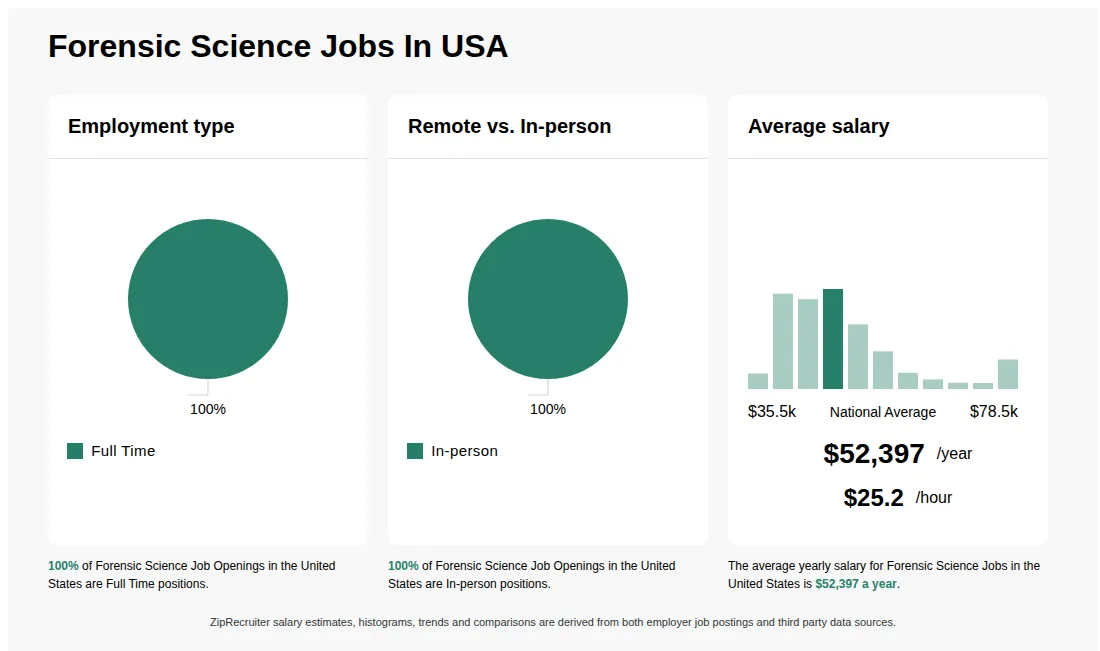
Forensic Science information
See salary details
$35.5K - $39.4K
3% of jobs
$39.4K - $43.3K
21% of jobs
$43.6K is the 25th percentile. Wages below this are outliers.
$43.3K - $47.2K
20% of jobs
The median wage is $48.4K / yr.
$47.2K - $51.1K
22% of jobs
$54.1K is the 75th percentile. Wages above this are outliers.
$51.1K - $55K
13% of jobs
$55K - $59K
8% of jobs
$59K - $62.9K
3% of jobs
$62.9K - $66.8K
2% of jobs
$66.8K - $70.7K
1% of jobs
$70.7K - $74.6K
1% of jobs
$74.6K - $78.5K
6% of jobs
$35.5K
$52.4K
$78.5K
How much do forensic science jobs pay per year?
As of Sep 13, 2026, the average yearly pay for forensic science in the United States is $52,397.00, according to ZipRecruiter salary data. Most workers in this role earn between $43,500.00 and $55,500.00 per year, depending on experience, location, and employer.
What does a forensic scientist do?
Forensic science professionals usually spend their days analyzing physical evidence from crime scenes, preparing detailed reports on their findings, and sometimes presenting results in court as expert witnesses. Their routine includes using specialized laboratory instruments, photographing and cataloging evidence, and maintaining the integrity and documentation of all samples through strict chain-of-custody procedures. Collaboration with law enforcement, attorneys, and other forensic experts is common, as is staying up-to-date with advancements in scientific analysis methods. This dynamic workflow ensures that forensic scientists contribute accurate, reliable evidence that can greatly impact the outcome of investigations.
What skills and qualifications are needed for forensic science?
To succeed in forensic science, you need a strong background in chemistry or biology, meticulous attention to detail, and at least a bachelor's degree in forensic science or a related discipline. Experience with laboratory equipment, evidence analysis software, and knowledge of chain-of-custody protocols or certifications such as ASCLD/LAB are highly valued. Critical thinking, strong written communication, and the ability to work collaboratively under pressure set top performers apart. These capabilities are essential to ensure the integrity, accuracy, and reliability of forensic findings used in legal proceedings.
What are the careers with forensic science?
Careers in forensic science include forensic scientist, crime scene investigator, forensic toxicologist, fingerprint analyst, and forensic pathologist. These roles involve analyzing physical evidence, using laboratory tools, and often require specialized certifications and training in biology, chemistry, or criminal justice.
What jobs can I do with forensic science?
Forensic science graduates can work as forensic scientists, crime scene investigators, forensic analysts, or laboratory technicians. These roles involve collecting, analyzing, and presenting physical evidence using tools like microscopes and chemical tests, often requiring attention to detail and knowledge of legal procedures.
More about Forensic Science jobs
What cities are hiring for Forensic Science jobs?
Cities with the most Forensic Science job openings:
What are the most commonly searched types of Forensic Science jobs?
The most popular types of Forensic Science jobs are:
What states have the most Forensic Science jobs?
States with the most job openings for Forensic Science jobs include:
What job categories do people searching Forensic Science jobs look for?
The top searched job categories for Forensic Science jobs are:

Forensic Scientist III OR Forensic Scientist II
Fort Lauderdale, FL
Broward County Sheriff's Office
• Police Protection • 5 - 10K employees5,001 - 10,000 employees
$72K - $129K/yr
Full-time
Re-posted 28 days ago
Broward County Sheriff's Office rating

9.0
Based on 10 frontline employees who took The Breakroom Quiz
Job description
Minimum Requirements Current vacancy is for Forensic Scientist III. Candidates who meet the qualifications for a Forensic Scientist II may also be considered if the position is not filled after processing all of the Forensic Scientist III candidates. The vacancy exists within the Crime Lab, specifically in the Latent Print Unit.
ACADEMIC TRANSCRIPTS Unofficial college transcripts are required at the time of application and must be attached to your on-line application. Applications cannot be submitted without attached transcripts. Forensic Scientist III Requirements: Salary: $79,674.92 - $129,781.54 Must be a United States Citizen at time of application
Bachelor's degree from an accredited college or university with major course work in the natural or physical sciences, forensic science, criminalistics, or closely related field. Master's degree preferred. Additional coursework may be necessary.
Minimum three (3) years at the Forensic Scientist II level; or five (5) years journey level experience in latent print examination with exposure to the administrative aspects of the work. An equivalent combination of education, training, and experience may be considered. Such must be clearly demonstrated on the application for consideration.
SPECIAL REQUIREMENTS Must possess and maintain certification by the governing board of the forensic discipline e.g., International Association for Identification (IAI). Successful completion of the ANAB Internal Auditor Training Course, or ANAB Assessor Training Course for Testing Laboratories or equivalent as determined by the Crime Lab Director. Successful completion of science-related coursework; per the Organization of Scientific Area Committees (OSAC), or NIST equivalent, to include General Biology and Advanced Latent Print Comparison Courses
Knowledge and experience of principles, methods and current techniques utilized in the forensic analysis of latent print evidence is required. Forensic Scientist II Requirements: Salary: $72,301.92 - $118,898.75 Must be a United States Citizen at time of application. Bachelor's degree from an accredited college or university with major course work in the natural or physical sciences, forensic science, or closely related field; Additional coursework may be necessary
Successful completion of an in-house training program as a Forensic Scientist I, as determined by Crime Lab Command, that incorporates progressively responsible journey level experience in area of assignment; or a minimum of two (2) years journey level experience in latent print examination, with exposure to the administrative aspects of the work. An equivalent combination of education, training, and experience may be considered. Such must be clearly demonstrated on the application for consideration.
SPECIAL REQUIREMENTS Successful completion of science-related coursework; per the Organization of Scientific Area Committees (OSAC), or NIST equivalent, to include General Biology and basic Fingerprint Classification and Comparison Courses or equivalent. Knowledge and experience of principles, methods and current techniques utilized in the forensic examination of latent print evidence is required. Nature of Work Forensic Scientist III: Under administrative direction, the purpose of the position is to prepare and analyze chemical and evidentiary samples in criminal identification and investigations in the Crime Laboratory of the Broward Sheriff's Office.
As an ISO 17025 accredited laboratory employees in this position must adhere to accreditation standards encompassing extensive case documentation, validation of procedures, technical and administrative review of reports and case notes, etc. In addition, employees are required to participate in external proficiency testing, courtroom testimony monitoring, continued technical training, quality audits, and accreditation inspections by the ANSI National Accreditation Board (ANAB), or other accrediting bodies. Employees function in a senior level status performing advanced laboratory techniques for the most complex cases.
Position exercises considerable initiative and independent judgment in the conduct of duties, referring unique or unusual, situations to the Crime Lab Technical Leader/Crime Lab Unit Manager for review and advisement. Employees in this classification may perform lead worker duties within the area of assignment under the supervision of the Crime Lab Unit Manager. Position is responsible for the formal reporting of and testifying to the findings of such analysis.
Performs related work as directed. Forensic Scientist II: Under administrative direction, the purpose of the position is to prepare and analyze chemical and evidentiary samples in criminal identification and investigations in the Crime Laboratory of the Broward Sheriff's Office. As an ISO 17025 accredited laboratory, employees in this position must adhere to accreditation standards encompassing extensive case documentation, validation of procedures, technical and administrative review of reports and case notes, etc.
In addition, employees are required to participate in external proficiency testing, courtroom testimony monitoring, continued technical training, quality audits, and accreditation inspections by ANSI National Accreditation Board (ANAB), or other accrediting bodies. Employees function in a journey level status performing moderately complex casework under the supervision of the Crime Lab Unit Manager. Position is responsible for the formal reporting of and testifying to the findings of such analysis.
Performs related work as directed. Essential Functions/Physical Requirements Forensic Scientist III: The list of essential functions, as outlined herein, is intended to be representative of the tasks performed within this classification. It is not necessarily descriptive of any one position in the class.
The omission of an essential function does not preclude management from assigning duties not listed herein if such functions are a logical assignment to the position. Involves the examination of latent print evidence; performing all work related to the analysis, comparison and evaluation of latent prints recovered from crime scenes. Conducts preliminary testing and preparation of evidence for analysis in one or more assigned areas.
Participates in the preparation of unit equipment and materials used for testing and analytical tasks. Examines materials collected for adherence to established procedures concerning collection and identification of chemical and evidentiary samples. Conducts laboratory examinations utilizing procedures applicable to the analytical task(s) assigned.
Isolates, collects, and analyzes evidentiary items as applicable. Generates data from laboratory examination and testing; reviews such for the purpose of determining findings; compiles such for reporting purposes and judicial process as applicable. Conducts administrative and/or technical review of casework.
Testifies to analytical results in depositions and court. Performs validations, routine maintenance, and troubleshooting of specialized unit equipment, to include performance checks, calibration, and sterilization procedures. Maintains current knowledge of trends and developments in the field through training, workshops, seminars, science periodicals, and other information sources; participates in annual proficiency examinations.
Provides training, guidance, and assistance to other unit personnel in procedures, methods, and unit standards. May assist in conducting internal audits within the Crime Laboratory as directed. May act in the Crime Lab Technical Leader's or Crime Lab Unit Manager's absence as directed.
Performs related duties as directed. Tasks involve the ability to exert light physical effort in sedentary to light work, but which may involve some lifting, carrying, pushing and/or pulling of objects and materials of moderate weight (up to 25 pounds). Tasks may involve extended periods of time at a keyboard or workstation.
Tasks are performed in a laboratory/forensics analysis environment where proper provisions are in place in terms of employee security and protection. Due to the nature and location of the work environment, tasks include potential for intermittent exposure to disagreeable elements consistent with routine conditions in a laboratory/forensics analysis environment, e.g., toxic agents, pathogens, chemicals, organic/inorganic agents. Spends at least 65% of time performing duties that involve the collection, examination, preservation, documentation, preparation, or analysis of human tissues or fluids or physical evidence having potential biological, chemical, or radiological hazard or contamination, or use chemicals, processes, or materials that may have carcinogenic or health-damaging properties in the analysis of evidence
Broward Sheriff's Office is an Equal Opportunity Employer. In compliance with the Americans with Disabilities Act, Broward Sheriff's Office will provide reasonable accommodations to qualified individuals with disabilities and encourages both prospective and current employees to discuss potential accommodations with the employer. Forensic Scientist II: Involves the examination of latent print evidence; performing all work related to the analysis, comparison and evaluation of latten prints recovered from crime scenes.
The list of essential functions, as outlined herein, is intended to be representative of the tasks performed within this classification. It is not necessarily descriptive of any one position in the class. The omission of an essential function does not preclude management from assigning duties not listed herein if such functions are a logical assignment to the position.
Conducts preliminary testing and preparation of evidence for analysis in one or more assigned areas. Participates in the preparation of unit equipment and materials used for testing and analytical tasks. Examines materials collected for adherence to established procedures concerning collection and identification of chemical and evidentiary samples.
Conducts laboratory examinations utilizing procedures applicable to the analytical task(s) assigned. Isolates, collects, and analyzes evidentiary items as applicable. Generates data from laboratory examination and testing; reviews such for the purpose of determining findings; compiles such for reporting purposes and judicial process as applicable.
Conducts administrative and/or technical review of casework. Testifies to analytical results in depositions and court. Performs routine maintenance and troubleshooting of specialized unit equipment, to include performance checks, calibration, and sterilization procedures.
Maintains current knowledge of trends and developments in the field through training, workshops, seminars, science periodicals, and other information sources; participates in annual proficiency examinations. May provide training, guidance, and assistance to other unit personnel in procedures, methods, and unit standards. Performs related duties as directed.
Tasks involve the ability to exert light physical effort in sedentary to light work, but which may involve some lifting, carrying, pushing and/or pulling of objects and materials of moderate weight (up to 25 pounds). Tasks may involve extended periods of time at a keyboard or workstation. Tasks are performed in a laboratory/forensics analysis environment where proper provisions are in place in terms of employee security and protection.
Due to the nature and location of the work environment, tasks include potential for intermittent exposure to disagreeable elements consistent with routine conditions in a laboratory/forensics analysis environment, e.g., toxic agents, pathogens, chemicals, organic/inorganic agents. Spends at least 65% of time performing duties that involve the collection, examination, preservation, documentation, preparation, or analysis of human tissues or fluids or physical evidence having potential biological, chemical or radiological hazard or contamination, or use chemicals, processes, or materials that may have carcinogenic or health-damaging properties in the analysis of evidence. Broward Sheriff's Office is an Equal Opportunity Employer
In compliance with the Americans with Disabilities Act, Broward Sheriff's Office will provide reasonable accommodations to qualified individuals with disabilities and encourages both prospective and current employees to discuss potential accommodations with the employer. Recruitment Information Applicants who qualify will be subject to an extensive selection process and screening program, which may include, but not be limited to evaluation of training and experience; written test; computer based test; interview; polygraph examination; psychological evaluation; employment record, fingerprint and background check; medical examination; and drug screen. The expected duration of the selection process varies by position and could last 10 to 12 weeks.
Reapplication will be determined on a case-by-case basis. BSO is an equal opportunity employer and does not discriminate on the basis of age, citizenship status, color, disability, marital status, national origin, race, religion, sex, or sexual orientation. Veterans' preference per Florida law.
If you encounter issues with your application and need technical assistance, please contact Applicant Support (GovernmentJobs.com) from 9 am to 9 pm EST, Monday - Friday. You can reach them by phone at 855-524-5627 or email support@governmentjobs.com. Once you successfully submit your application, you will receive a confirmation e-mail
If you do not receive this e-mail, please contact Applicant Support for any inquiries.
What Broward County Sheriff's Office employees say
Pay
Benefits
Hours and flexibility
Workplace
Get the full story on Breakroom

About Broward Sheriff's Office
Sourced by ZipRecruiter
Industry
Police protection
Company size
5,001 - 10,000 Employees
Headquarters location
Fort Lauderdale, FL, US
Year founded
1915