1

Flow Cytometry Analyst Jobs (NOW HIRING)

As an Associate Scientist in Flow Cytometry, you will perform regulated laboratory testing ... Analyze data, verify accuracy, and escalate atypical or outoftolerance results to senior staff.

We are seeking an Associate Manager, Flow Cytometry to join IQVIA Laboratories on site at Valencia ... Working knowledge of quality assurance, safety standards, root-cause analysis, and CAPA processes.

We are seeking an Associate Manager, Flow Cytometry to join IQVIA Laboratories on site at Valencia ... Working knowledge of quality assurance, safety standards, rootcause analysis, and CAPA processes.

We are seeking an Associate Manager, Flow Cytometry to join IQVIA Laboratories on site at Valencia ... Working knowledge of quality assurance, safety standards, rootcause analysis, and CAPA processes.

next page

Showing results 1-20

Flow Cytometry Analyst information

See salary details

$35.5K

$99.2K

$127K

How much do flow cytometry analyst jobs pay per year?

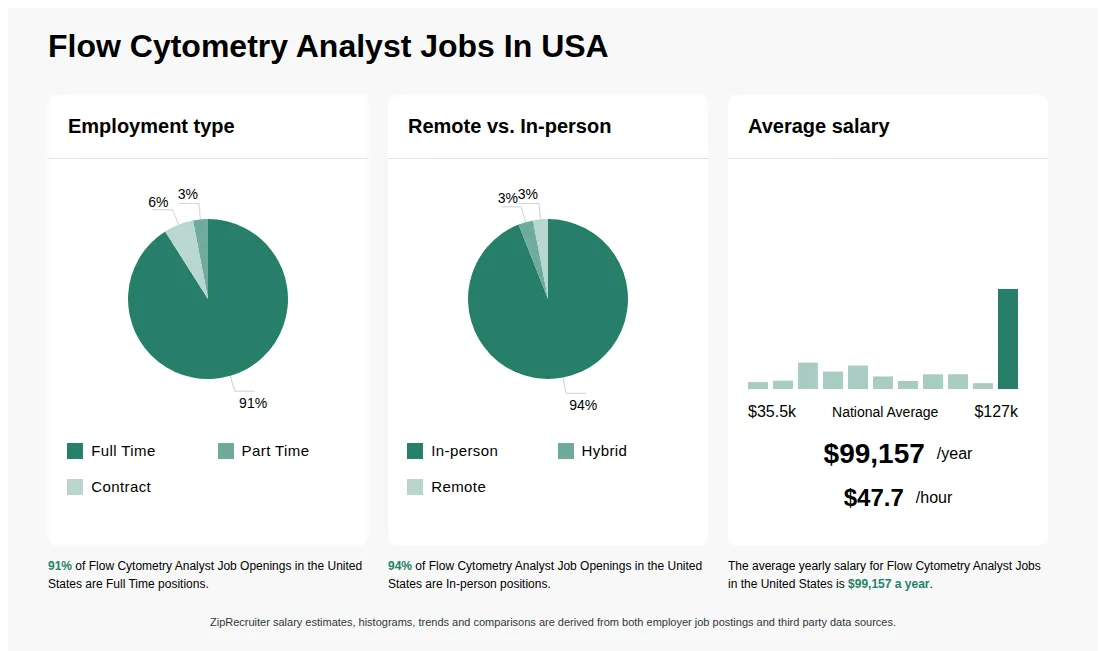
As of Jul 3, 2026, the average yearly pay for flow cytometry analyst in the United States is $99,157.00, according to ZipRecruiter salary data. Most workers in this role earn between $72,000.00 and $126,500.00 per year, depending on experience, location, and employer.

What are the typical daily responsibilities of a Flow Cytometry Analyst?

A Flow Cytometry Analyst is responsible for setting up and calibrating flow cytometers, preparing samples, acquiring data, and performing detailed analysis using specialized software. Daily tasks also include troubleshooting instrument issues, maintaining meticulous records, and collaborating with researchers or clinicians to interpret results. You’ll regularly interact with other laboratory staff to ensure experiments are performed accurately and data is shared promptly. The role often involves balancing multiple projects and adapting to changing experiment priorities, making organizational skills important. This hands-on, team-oriented work environment offers opportunities to learn from experts in immunology, oncology, and related fields.

What are the key skills and qualifications needed to thrive in the Flow Cytometry Analyst position, and why are they important?

To thrive as a Flow Cytometry Analyst, you need a strong background in biology or related sciences, experience with laboratory techniques, and specific expertise in flow cytometry data analysis. Familiarity with analytical software such as FlowJo, BD FACSDiva, and cytometers like BD LSRFortessa or Beckman Coulter systems is typically expected, and certifications in cytometry or laboratory safety can be advantageous. Attention to detail, critical thinking, and effective teamwork are standout soft skills for this position. These abilities ensure accurate data analysis, reliable results, and seamless collaboration in a laboratory environment.

What is a Flow Cytometry Analyst job?

A Flow Cytometry Analyst is responsible for operating and maintaining flow cytometry instruments to analyze cells and particles for research, clinical, or pharmaceutical applications. They prepare samples, optimize protocols, and interpret data to provide insights into cell populations and characteristics. Analysts often work in laboratories within biotechnology, healthcare, or academic settings. They ensure accuracy, troubleshoot technical issues, and collaborate with scientists to support experiments and diagnostics. Strong analytical skills and knowledge of immunology, cell biology, and data analysis are essential for this role.


More about Flow Cytometry Analyst jobs
What cities are hiring for Flow Cytometry Analyst jobs? Cities with the most Flow Cytometry Analyst job openings:
What are the most commonly searched types of Flow Cytometry Analyst jobs? The most popular types of Flow Cytometry Analyst jobs are:
What states have the most Flow Cytometry Analyst jobs? States with the most job openings for Flow Cytometry Analyst jobs include:
Infographic showing various Flow Cytometry Analyst job openings in the United States as of June 2026, with employment types broken down into 4% Internship, 74% Full Time, 4% Part Time, and 18% Temporary. Highlights an 95% Physical, 1% Hybrid, and 4% Remote job distribution, with an average salary of $99,157 per year, or $47.7 per hour.
Flow Cytometry Technician I

$23.15 - $34.73/hr

Full-time

Medical, Dental, Vision, Life, Retirement, PTO

Posted 3 hours ago


Seattle Children's rating

8.4

Company rating: 8.4 out of 10

Based on 61 frontline employees who took The Breakroom Quiz

61st of 1,004 rated hospitals


Job description

Key Responsibilities

Core Facility Operations & Maintenance

  • Flow cytometers Maintenance: Operate and maintain a diverse suite of analytical instruments (including BD Symphony A5, BD LSR Fortessa, Bio-Rad ZE5, and Beckman Coulter Cytoflex) to ensure peak performance and user readiness.
  • Sorter Operation & Service: Independently operate, calibrate, and provide expert cell sorting services using advanced cell sorters (e.g., BD S6, Bio-Sorter).
  • Quality Control (QC): Perform daily QC, preventative maintenance, and tracking for all core instrumentation; maintain detailed, accurate logs and documentation.
  • Troubleshooting: Execute first-level instrument troubleshooting to resolve common hardware and software issues. Escalate complex instrument failures to the Core Leader and coordinate service visits with external vendors.
  • Compliance & Safety: Ensure strict adherence to Core Standard Operating Procedures (SOPs) and institutional safety protocols, including EH&S and Biosafety Level 2 (BSL2+) regulatory requirements.
  • Requires some physical activity, including equipment setup, reagent handling, and light lifting (up to 50 lbs.)

Preferred Qualifications

  • Education: Bachelor’s degree in Biology, Immunology, Molecular Biology, Biochemistry, or a related scientific field.
  • Flow Cytometry Expertise: Significant hands-on experience in multi-color flow cytometry, including sample preparation, data acquisition, and data analysis using software such as FlowJo, FCS Express etc.,
  • Cell Sorting Experience: Demonstrated proficiency in the independent operation, calibration, and maintenance of cell sorters to provide reliable cell sorting services.
  • Technical Literacy: Familiarity with standard computer systems, literature search methodologies, and data plotting/statistical analysis.
  • Prior experience in spectral flow cytometry and imaging technologies is highly preferred.
  • Excellent verbal and written communication, organizational, and record-keeping skills. Proven ability to work independently, adaptable team player committed to supporting a collaborative research environment.
Required Education and Experience
Bachelor’s Degree in an Engineering or Scientific discipline. Experience in a laboratory/research setting. Demonstrated knowledge in solving technical problems such as issues with lab/flow cytometry instrumentation.
Required Credentials
N/A.
Preferred
Experience acquiring and analyzing Flow Cytometry data, preferably with BD FacsDiva software. Data entry and/or word processing experience. Experience in analyzing data using spreadsheets and statistical analysis.

Compensation Range

$23.15 - $34.73 per hour

Salary Information

This compensation range was calculated based on full-time employment (2080 hours worked per calendar year). Offers are determined by multiple factors including equity, skills, experience, and expertise, and may vary within the range provided.

Disclaimer for Out of State Applicants

This compensation range is specific to Seattle, positions located outside of Seattle may be compensated differently depending on various factors.

Benefits Information

Seattle Children’s offers a generous benefit package, including medical, dental, and vision plans, 403(b), life insurance, paid time off, tuition reimbursement, and more.  Additional details on our benefits can be found on our website www.seattlechildrens.org/careers/benefits.

About Us

Hope. Care. Cure. These three simple words capture what we do at Seattle Children’s – to help every child live the healthiest and most fulfilling life possible.  Are you ready to engage with a mission-driven organization that is life-changing to many, and touches the hearts of all? #HOPECARECURE

Our founding promise to the community is as valid today as it was over a century ago: we will care for all children in our region, regardless of the families’ ability to pay. Together, we deliver superior patient care, advance new discoveries and treatments through pediatric research, and serve as the pediatric and adolescent, academic medical center for Washington, Alaska, Montana and Idaho – the largest region of any children’s hospital in the country.
 
U.S. News & World Report consistently ranks Seattle Children’s among the nation’s best children’s hospitals. For more than a decade, Seattle Children’s has been nationally recognized in key specialty areas. We are honored to be one of the nation’s very best places to care for children and the top-ranked pediatric hospital in Washington and the Pacific Northwest.

As a Magnet designated institution, we recognize the importance of hiring and developing great talent to provide best-in-class care to the patients and families we serve. Our organizational DNA takes form in our core values: Compassion, Excellence, Integrity, Collaboration, Equity and Innovation. Whether it’s delivering frontline care to our patients in a kind and caring manner, practicing the highest standards of quality and safety, or being relentlessly curious as we work towards eradicating childhood diseases, these values are the fabric of our culture and community. The future starts here.

Our Commitment

Seattle Children’s welcomes people of all experiences, backgrounds, and thoughts as this is what drives our spirit of inquiry and allows us to better connect with our patients and families. Our organization recruits, employs, trains, compensates, and promotes based on merit without regard to race, religion, color, national origin, gender (including pregnancy, childbirth, or related medical conditions), sexual orientation, gender identity, gender expression, age, status as a protected veteran, status as an individual with a disability, or other applicable legally protected characteristics.

The people who work at Seattle Children’s are members of a community that seeks to respect and celebrate all the qualities that make each of us unique. Each of us is empowered to be ourselves.

Seattle Children’s is proud to be an Equal Opportunity Workplace and Affirmative Action Employer.


What Seattle Children's employees say

Pay

Benefits

Hours and flexibility

Workplace

Get the full story on Breakroom


Seattle Children's logo

About Seattle Children's

Sourced by ZipRecruiter

Based in Seattle, Washington, Seattle Children’s comprises a leading pediatric hospital, research institute, and foundation dedicated to the care and cure of childhood illness. The system is internationally recognized for cutting‑edge clinical care in cardiology, oncology, genetics, and rare disease, alongside world-class translational research in areas such as immunology, neuroscience, and infectious disease.

Industry

Hospitals

Company size

5,001 - 10,000 Employees

Headquarters location

Seattle, WA, US

Year founded

1907