1

Fish Hatchery Jobs (NOW HIRING)

Rock Creek Hatchery Shift : 8:00 am - 4:30 pm Duties include, but are not limited to: * Clipping adipose fins off hatchery fish * Cleaning up workspace for shift change * Tagging fish as needed * All ...

Right now, we're hiring Fin Clippers to support a respected fish hatchery in Glenwood, WA 98619 . If you enjoy hands-on work, being part of a team, and contributing to environmental sustainability ...

next page

Showing results 1-20

Fish Hatchery information

See salary details

$2.8K

$5.2K

$9K

How much do fish hatchery jobs pay per month?

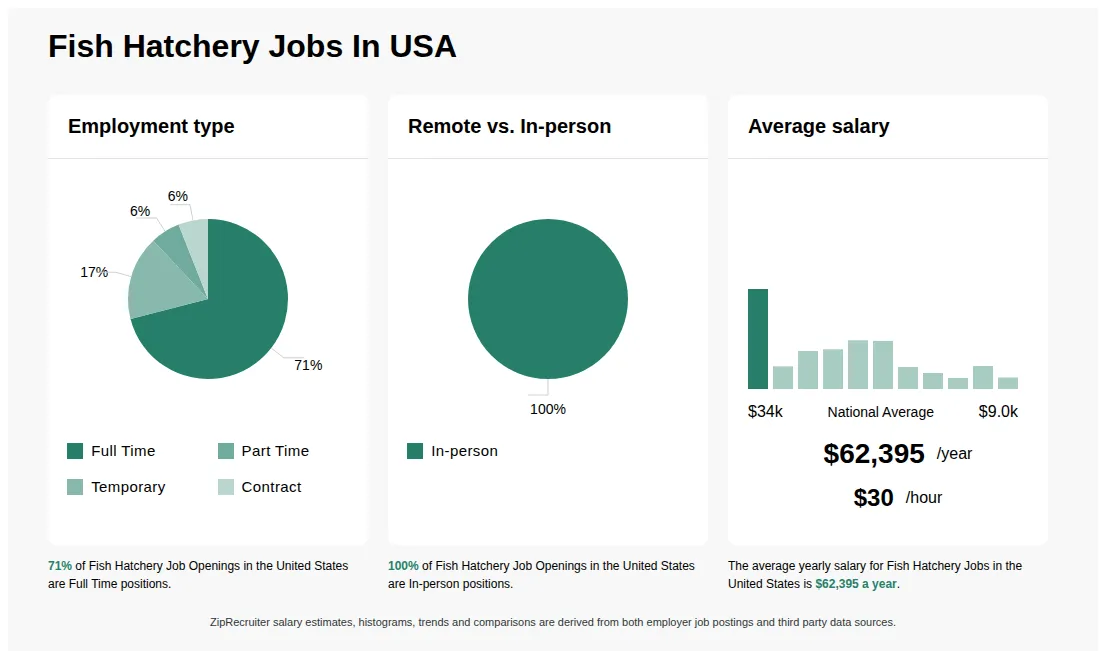
As of May 30, 2026, the average monthly pay for fish hatchery in the United States is $5,199.58, according to ZipRecruiter salary data. Most workers in this role earn between $3,333.33 and $6,208.33 per month, depending on experience, location, and employer.

What Are the Qualifications to Work in a Fish Hatchery?

The primary qualifications for fish hatchery jobs depend on the position. For example, if you want to manage a hatchery, expect employers to ask for a bachelor's degree in a relevant aquatic field and several years of experience with fish culture, including knowledge of sampling techniques and data collection. If you want to operate and maintain equipment, companies usually look for an associate degree from a technical college, one to two years of experience, and the ability to determine facility needs to meet production goals. Some companies are willing to accept additional experience in lieu of a college degree. Fulfilling the duties and responsibilities of a fish hatchery job requires excellent interpersonal and communication skills as well as the ability to work in a variety of weather conditions.

What are the key skills and qualifications needed to thrive as a Fish Hatchery Technician, and why are they important?

To thrive as a Fish Hatchery Technician, you need knowledge of aquatic biology, fish husbandry, and environmental science, often supported by a degree or relevant work experience. Familiarity with water quality testing equipment, feeding systems, and hatchery management software is commonly required. Attention to detail, problem-solving, and strong teamwork make someone stand out in this position. These skills ensure the health of fish populations, efficient hatchery operations, and compliance with environmental regulations.

What are some common challenges faced by fish hatchery technicians, and how can they be managed on the job?

Fish hatchery technicians often contend with challenges such as maintaining optimal water quality, preventing disease outbreaks among fish populations, and managing seasonal fluctuations in workload. Addressing these issues typically involves closely monitoring environmental parameters, following strict biosecurity protocols, and working collaboratively with other team members to ensure the health and productivity of the hatchery. Strong organizational skills and adaptability are essential, as daily tasks may change based on the needs of the fish stock and hatchery operations.

What are fish hatcheries?

Fish hatcheries are specialized facilities where fish are bred, hatched, and raised during their early life stages before being released into natural bodies of water or stocked for aquaculture. Their main goal is to support the conservation of fish populations, enhance recreational fishing opportunities, or provide fish for commercial purposes. Hatcheries play a crucial role in maintaining sustainable fish populations and helping to restore endangered or depleted species.

What is the difference between Fish Hatchery vs Fish Biologist?

AspectFish HatcheryFish Biologist
Required CredentialsHigh school diploma or equivalent; some roles may require technical certificationsBachelor's degree in biology, ecology, or related field; advanced roles may require a master's or PhD
Work EnvironmentFish farms, hatchery facilities, outdoor settingsResearch labs, field sites, aquatic environments
Employer & Industry UsageGovernment agencies, aquaculture companies, conservation programsResearch institutions, government agencies, environmental organizations

While both roles involve working with fish, a Fish Hatchery focuses on breeding, raising, and releasing fish in controlled environments, often for conservation or commercial purposes. A Fish Biologist conducts research, studies fish populations, and develops conservation strategies. The two roles share some credentials and work environments but differ in their primary focus and responsibilities.

What cities are hiring for Fish Hatchery jobs? Cities with the most Fish Hatchery job openings:
What are the most commonly searched types of Fish Hatchery jobs? The most popular types of Fish Hatchery jobs are:
What states have the most Fish Hatchery jobs? States with the most job openings for Fish Hatchery jobs include:
What job categories do people searching Fish Hatchery jobs look for? The top searched job categories for Fish Hatchery jobs are:
Infographic showing various Fish Hatchery job openings in the United States as of May 2026, with employment types broken down into 100% Full Time. Highlights an 60% Physical, and 40% Remote job distribution, with an average salary of $62,395 per year, or $30 per hour.

TPWD - Fish and Wildlife Technician I - II (Hatchery Technician)

Texas Parks & Wildlife

Lake Jackson, TX

Full-time

Retirement, PTO

Posted 14 days ago


Job description

TPWD MISSION

To manage and conserve the natural and cultural resources of Texas and to provide hunting, fishing and outdoor recreation opportunities for the use and enjoyment of present and future generations.

  
EXCELLENT BENEFITS:

Texas Parks and Wildlife offers a variety of benefits for employees such as generous paid time off, group insurance, retirement and pension, and frequent training and staff development opportunities.  Other benefits include longevity pay, merit pay, deferred compensation, flexible benefit plans, 401K/457 retirement plans, direct deposit, staggered work hours, Employee Assistance Program and a Return-to-Work Program. For new employees or rehires, health insurance is available on the 1st of the following month after a 60-day waiting period. Click HERE to view our Benefits page.

PLEASE NOTE: 

All applications must contain complete job histories in the WORK HISTORY SECTION to include:

  • Job Title

  • Dates of employment (month/year)

  • Name of Employer, Name of Supervisor Description of duties performed

  • Volunteer experience credit is counted toward any experience requirement.  Please list those experiences to receive credit towards meeting the minimum requirements. 

  • Omission of data can be the basis for disqualification; you may state 'unknown' for any incomplete fields.

  • College Transcripts are required at the time of interview (unless otherwise noted on the posting) if education is used to meet the minimum requirements of the job posting. A copy of a college transcript(s) issued from the registrar must be provided if you are selected for an interview. 

  • Applications with "See attached" or "See resume" will not be accepted in lieu of a completed application.

  • Resumes are encouraged as attachments but will not be used to determine eligibility

  • Work In Texas (WIT) Applications: WIT applicants are required to complete the supplemental questions to be considered for the posting. To complete the supplemental questions, login to CAPPS Recruit.

IF THIS INFORMATION IS NOT SUBMITTED, YOUR APPLICATION WILL BE CONSIDERED INCOMPLETE.


MILITARY OCCUPATIONAL SPECIALTY CODES:

Job Classification

Service

Military Specialty

Fish and Wildlife Technician I-III

Army

68T, 64A

Fish and Wildlife Technician I-III

Navy

No Military Crosswalk. Qualified veterans are encouraged to apply.

Fish and Wildlife Technician I-III

Coast Guard

MST, OAR15, SEI18

Fish and Wildlife Technician I-III

Marine Corps

No Military Crosswalk. Qualified veterans are encouraged to apply.

Fish and Wildlife Technician I-III

Air Force

No Military Crosswalk. Qualified veterans are encouraged to apply.

Fish and Wildlife Technician I-III

Space Force

No Military Crosswalk. Qualified veterans are encouraged to apply.

*More information on military occupational specialty codes can be found below:

https://www.onetonline.org/crosswalk/MOC/

https://hr.sao.texas.gov/Compensation/MilitaryCrosswalk/MilitaryCrosswalkGuide.pdf

MILITARY EMPLOYMENT PREFERENCE: 

If you choose to claim military employment preference as outlined by the State of Texas, you must attach the required documentation referenced below at the time your application is submitted. If you have questions regarding this requirement, please visit our Military Employment Reference page at https://tpwd.texas.gov/jobs/veterans/.

Required forms that will need to be attached with application for Military Employment Preference:

  • Veteran- DD214 showing honorable discharge or Statement of Service (only for transitioning service members who have not reached their date of separation).

  • Surviving spouse of a veteran who has not remarried- Marriage Certificate and DD Form 1300 or appropriate documentation.

  • Orphan of a veteran killed while on active duty- Birth Certificate and DD Form 1300 or appropriate documentation.

  • Spouse of a member of the US Armed Forces/Texas National Guard serving on Active Duty- Marriage Certificate and copy of spouses active-duty military orders.

  • Spouse of a veteran with disability and is the primary income for household- Marriage Certificate, Veterans DD214, and VA Benefits Summary Letter showing disability rating.

Documentation must be attached to the application before military preference can be granted.

HIRING CONTACT: Jennifer Butler, (979) 292-0100 ext 225, Email: jennifer.butler@tpwd.texas.gov

PHYSICAL WORK ADDRESS: Sea Center Texas - 302 Medical Dr, Lake Jackson, TX   77566

GENERAL DESCRIPTION:

Under the supervision of the Hatchery Manager, this position is responsible for fish hatchery stock enhancement. Assists Hatchery Manager in the propagation and distribution of marine finfish throughout the coastal waters of Texas. Duties include collecting, tabulating, and entry of hatchery records; fish culture operations; and stock enhancement program work. Operates equipment safely and maintains gear, equipment, and facility. May assist with training, assigning, and scheduling the work of other team members as needed. May supervise the work of volunteers and community service workers. Performs additional duties as assigned. Complies with all Agency, Division and Branch rules, regulations and procedures.

MINIMUM QUALIFICATIONS:

Education:

Graduation from High School or GED.

Experience:

FWT I: No experience required.

FWT II: Four years of relevant experience required related to the specific duties of the position.

Licensure:       

Must possess a valid class "A" Texas Commercial driver's license OR must possess or be able to obtain, within 30 days of employment, a valid class "C" Texas driver's license and convert to a class "A" Commercial driver's license within one year of employment.

NOTE: Retention of position contingent upon obtaining and maintaining required license.

ACCEPTABLE SUBSTITUTIONS:

Experience:

FWT II ONLY: Graduation from an accredited college or university with a Bachelor's, Master's or Ph.D. in Mariculture/Aquaculture, Fisheries Biology, Marine Biology or closely related field may substitute for two years of the required experience.

PREFERRED QUALIFICATIONS:

Experience:

Two years of work experience in Aquaculture/Mariculture facilities.

Experience in industrial trades such as plumbing, electrical, and carpentry and welding.

Experience in the operation of heavy equipment (tractors/mowers/forklifts).

Experience in the operation of dually pickup trucks and towing goose-neck trailers.

Licensure:      

A valid Class "A" Commercial driver's license (CDL).

KNOWLEDGE, SKILLS AND ABILITIES:

FWT I: 

Knowledge of fish culture and hatchery operations.

Knowledge of vehicle and motor mechanics and maintenance.

Knowledge of common Texas marine organisms, and fisheries.

FWT II:

Knowledge of Fish and Wildlife Technician I, PLUS:

Knowledge of purchasing procedures and quality control techniques.

FWT I:

Skill in MS Word, Excel and Outlook.

Skill in effective verbal and written communication.

Skill in operating and maintaining vehicles and trailers.

Skill in operating and maintaining small hand tools.

Skill in establishing and maintaining effective work relationships with co-workers and work-related contacts.

Skill in using standard office equipment.

Skill in demonstrating effective work habits, efficiently completing tasks, and following directions.

FWT II:

Skill in Fish and Wildlife Technician I, PLUS:

Skill in training others.

Skill in operating and maintaining farm equipment such as forklifts, skid steer, tractors etc.

Skill in providing direction and guidance to less tenured staff.

Skill in working with PVC fittings and pipes; installing electrical components (pump motors, lights, switches, etc.) and/or mechanical equipment (blowers, motors, pumps, filters).       

FWT I:

Ability to learn to identify common marine organisms.

Ability to collect and record data and maintain accurate records and reports.

Ability to learn methods employed in fish hatcheries.

Ability to accurately follow instructions.

Ability to communicate effectively with the public.

Ability to work as a member of a team.

Ability to maintain field equipment and facilities.

Ability to perform manual labor including, lifting supplies and materials up to 50 lbs.

Ability to work in heat enclosed spaces, heights, noise, dust, and fumes.

Ability to conduct work activities in accordance with TPWD safety program.

Ability to operate a vehicle and pull a gooseneck trailer.

FWT II:

Ability of Fish and Wildlife Technician I, PLUS:

Ability to maintain flexibility and work with frequent interruptions and multiple changing priorities.

Ability to prioritize tasks and schedules.

Ability to train others.

Ability to learn basic purchasing procedures.

WORKING CONDITIONS:

Required to work hours other than 8:00 a.m. to 5:00 p.m., with days off other than Saturdays, Sundays and holidays.

Required to adjust to changing schedules.

Required to work overtime as necessary.

Required to respond to emergencies and on-call situations.

Required to perform work outdoors, occasionally in adverse weather conditions.

Required to perform physical work in heat enclosed spaces, heights, noise, dust and fumes given proper safety precautions and equipment.

Required to perform work in water-based field activities, including work aboard seagoing vessels.

Required to perform manual labor including, lifting supplies and materials up to 50 lbs.

Required to operate a state vehicle.

Required to pass drug screening prior to employment.

Required to pass a previous employment drug testing history verification for all CDL positions held within the past two years.

Subject to random, post-accident and reasonable cause testing for the duration of employment.

Required to travel 10% with possible overnight stays.

Must conform to TPWD dress and grooming standards, work rules, and safety procedures.

Non-smoking work environment in State buildings and vehicles.

TPWD IS AN EQUAL OPPORTUNITY EMPLOYER