1

Fish Hatchery Jobs (NOW HIRING)

Hatchery Manager

Durant, OK · On-site

$68K/yr

Under the general supervision of the Fish Hatchery Supervisor or designated supervisor, supervises the operation of a state fish hatchery facility and directs the activities of employees engaged in ...

Hatchery Manager

Lawton, OK · On-site

$68K/yr

Under the general supervision of the Fish Hatchery Supervisor or designated supervisor, supervises the operation of a state fish hatchery facility and directs the activities of employees engaged in ...

next page

Showing results 1-20

Fish Hatchery information

See salary details

$2.8K

$5.2K

$9K

How much do fish hatchery jobs pay per month?

As of Aug 1, 2026, the average monthly pay for fish hatchery in the United States is $5,199.58, according to ZipRecruiter salary data. Most workers in this role earn between $3,333.33 and $6,208.33 per month, depending on experience, location, and employer.

What qualifications do you need to work at a fish hatchery?

To work at a fish hatchery, candidates typically need a high school diploma or equivalent. Relevant skills include knowledge of aquatic biology, experience with hatchery equipment, and the ability to perform physical tasks in a laboratory or outdoor environment. Some positions may require certifications in water safety or handling hazardous materials.

What are the key skills and qualifications needed to thrive as a Fish Hatchery Technician, and why are they important?

To thrive as a Fish Hatchery Technician, you need knowledge of aquatic biology, fish husbandry, and environmental science, often supported by a degree or relevant work experience. Familiarity with water quality testing equipment, feeding systems, and hatchery management software is commonly required. Attention to detail, problem-solving, and strong teamwork make someone stand out in this position. These skills ensure the health of fish populations, efficient hatchery operations, and compliance with environmental regulations.

How much do fish hatcheries make?

Fish hatchery workers' salaries vary depending on location, experience, and job responsibilities, but typically range from $25,000 to $50,000 annually. Entry-level positions may start lower, while experienced hatchery managers can earn over $60,000. Certifications in fish biology or aquaculture can enhance earning potential.

What is the difference between Fish Hatchery vs Fish Biologist?

AspectFish HatcheryFish Biologist
Required CredentialsHigh school diploma or equivalent; some roles may require technical certificationsBachelor's degree in biology, ecology, or related field; advanced roles may require a master's or PhD
Work EnvironmentFish farms, hatchery facilities, outdoor settingsResearch labs, field sites, aquatic environments
Employer & Industry UsageGovernment agencies, aquaculture companies, conservation programsResearch institutions, government agencies, environmental organizations

While both roles involve working with fish, a Fish Hatchery focuses on breeding, raising, and releasing fish in controlled environments, often for conservation or commercial purposes. A Fish Biologist conducts research, studies fish populations, and develops conservation strategies. The two roles share some credentials and work environments but differ in their primary focus and responsibilities.

How to get into fish hatchery work?

To work at a fish hatchery, candidates typically need a high school diploma or equivalent and may benefit from experience in biology, aquaculture, or related fields. Entry-level positions often require physical stamina, knowledge of water quality management, and sometimes certifications in first aid or safety procedures. Gaining relevant experience through internships or volunteering can improve job prospects in this field.

What are fish hatcheries?

Fish hatcheries are specialized facilities where fish are bred, hatched, and raised during their early life stages before being released into natural bodies of water or stocked for aquaculture. Their main goal is to support the conservation of fish populations, enhance recreational fishing opportunities, or provide fish for commercial purposes. Hatcheries play a crucial role in maintaining sustainable fish populations and helping to restore endangered or depleted species.

What Are the Qualifications to Work in a Fish Hatchery?

The primary qualifications for fish hatchery jobs depend on the position. For example, if you want to manage a hatchery, expect employers to ask for a bachelor's degree in a relevant aquatic field and several years of experience with fish culture, including knowledge of sampling techniques and data collection. If you want to operate and maintain equipment, companies usually look for an associate degree from a technical college, one to two years of experience, and the ability to determine facility needs to meet production goals. Some companies are willing to accept additional experience in lieu of a college degree. Fulfilling the duties and responsibilities of a fish hatchery job requires excellent interpersonal and communication skills as well as the ability to work in a variety of weather conditions.

What are some common challenges faced by fish hatchery technicians, and how can they be managed on the job?

Fish hatchery technicians often contend with challenges such as maintaining optimal water quality, preventing disease outbreaks among fish populations, and managing seasonal fluctuations in workload. Addressing these issues typically involves closely monitoring environmental parameters, following strict biosecurity protocols, and working collaboratively with other team members to ensure the health and productivity of the hatchery. Strong organizational skills and adaptability are essential, as daily tasks may change based on the needs of the fish stock and hatchery operations.

Is working at a hatchery hard?

Working at a fish hatchery can be physically demanding and requires attention to detail, as employees often handle fish, maintain equipment, and monitor water quality. The job may involve early mornings, outdoor work, and adherence to safety protocols, but it generally depends on the specific role and environment. Skills in biology, patience, and teamwork are beneficial for success in this field.
What cities are hiring for Fish Hatchery jobs? Cities with the most Fish Hatchery job openings:
What are the most commonly searched types of Fish Hatchery jobs? The most popular types of Fish Hatchery jobs are:
What states have the most Fish Hatchery jobs? States with the most job openings for Fish Hatchery jobs include:
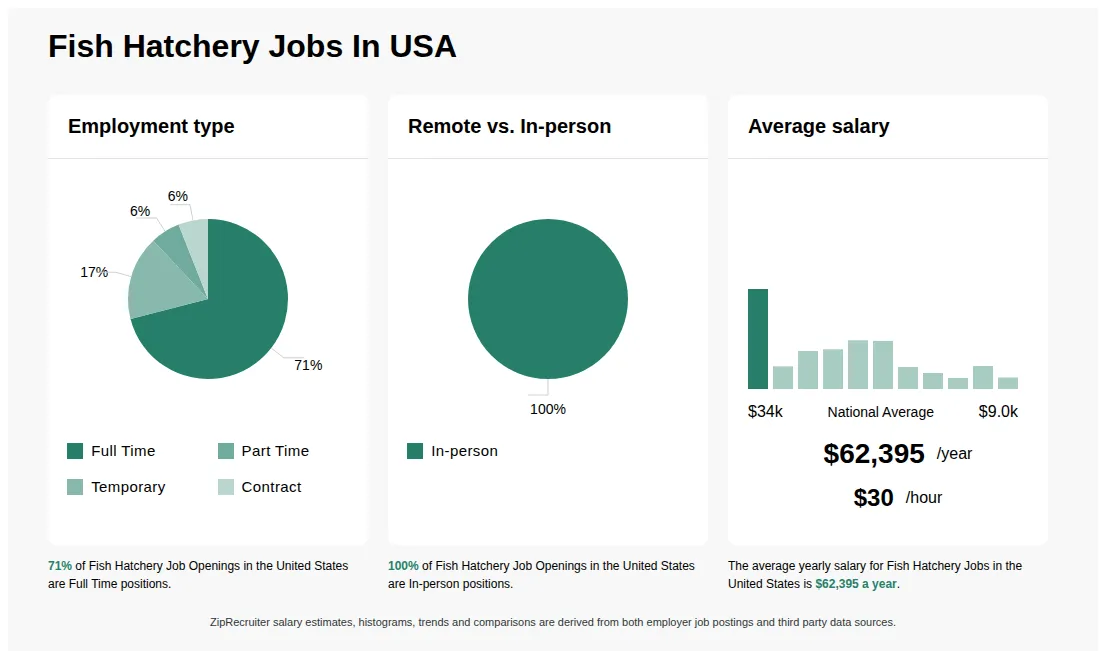
Infographic showing various Fish Hatchery job openings in the United States as of July 2026, with employment types broken down into 76% Full Time, 23% Part Time, and 1% Temporary. Highlights an 99% Physical, and 1% Remote job distribution, with an average salary of $62,395 per year, or $30 per hour.

Student Employee Fish Hatchery

Hocking College

Nelsonville, OH

$12 - $13/hr

Full-time

Re-posted 6 days ago


Job description

Fish Hatchery Student Employment
Salary: $12.00- $13.00
I. Position Purpose
The Fish Hatchery student employee assists the hatchery manager and aquatic facilities staff in the daily operation and maintenance of fish hatchery and aquatic systems. The position provides hands-on experience in fish culture, hatchery management, and aquatic animal care through activities such as feeding, monitoring fish health, collecting eggs, and maintaining production records. The intern also supports the upkeep of hatchery equipment, facilities, and surrounding grounds to ensure safe and efficient operations. This position offers practical training in fisheries management, aquaculture practices, and facility operations while contributing to the overall success of hatchery production and educational outreach activities.
II. Duties and Responsibilities
• Feed, grade, and collect eggs from hatchery-raised and wild fish.
• Care for fish fry and fingerlings during early development stages.
• Record and maintain hatchery data including fish production, pond records, feed usage, water quality measurements, and mortality rates.
• Conduct fish inventories for harvest, transfer, and population monitoring.
• Assist with the construction, repair, and maintenance of hatchery equipment such as ponds, cages, feeders, and pumps.
• Maintain hatchery grounds including mowing lawns, trimming shrubs, and maintaining roads and trails.
• Perform custodial and facility support duties at the Sauber Center at Lake Snowden.
• Conduct routine aquarium tank maintenance and aquatic animal care on campus.
• Assist with facility organization, maintenance projects, and grounds improvement initiatives.
• Support educational tours and public relations activities as needed.
III. Qualifications – Education, Experience, and Skills
• Must be currently enrolled as a full-time Hocking College student.
• Must meet federal requirements for Satisfactory Academic Progress (SAP).
• Must maintain a minimum cumulative GPA of 2.0.
• Currently enrolled in a Natural Resources (NR) program (Fisheries Management amp; Aquatic Sciences preferred).
• Willingness to work outdoors and directly with live animals.
• Ability to work in various weather conditions, including heat, rain, and wind.
• Strong communication skills and the ability to interact effectively with adults, young adults, and children.
• Ability to assist with and support educational programs.
• Ability to work independently and complete assigned tasks responsibly.
• Flexible, energetic, dependable, and maintains a positive attitude and sense of humor.
• Valid driver’s license preferred.
• Basic carpentry, mechanical, and equipment maintenance skills are beneficial.
• Ability to perform outdoor labor and assist with a variety of maintenance and operational tasks.
• Willingness and ability to complete all required training and professional development assigned by the supervisor, Human Resources, or the College.
Reasonable accommodations may be requested and reviewed according to the Americans with Disabilities Act (ADA).