Associate Field Research Photographer, Munich - Costar (M/W/D) COSTAR GROUP - ASSOCIATE FIELD RESEARCH PHOTOGRAPHER, MUNICH (M/W/D) OVERVIEW CoStar Group is a leading global provider of commercial ...
Associate Field Research Photographer, Munich - Costar (M/W/D) COSTAR GROUP - ASSOCIATE FIELD RESEARCH PHOTOGRAPHER, MUNICH (M/W/D) OVERVIEW CoStar Group is a leading global provider of commercial ...
Associate Field Research Photographer CoStar - Cologne (M/W/D) COSTAR GROUP - ASSOCIATE FIELD RESEARCH PHOTOGRAPHER, COSTAR - COLOGNE (M/W/D) OVERVIEW CoStar Group is a leading global provider of ...
Associate Field Research Photographer CoStar - Cologne (M/W/D) COSTAR GROUP - ASSOCIATE FIELD RESEARCH PHOTOGRAPHER, COSTAR - COLOGNE (M/W/D) OVERVIEW CoStar Group is a leading global provider of ...

Job Posting Information Posting Number PG195167SP Internal Recruitment No Working Title Research Technician (Lab and Field) - DEPP Anticipated Hiring Range $42,971 - $45,000 Work Schedule Monday ...
Job Posting Information Posting Number PG195167SP Internal Recruitment No Working Title Research Technician (Lab and Field) - DEPP Anticipated Hiring Range $42,971 - $45,000 Work Schedule Monday ...
Research Technician (Lab and Field) - DEPP
Raleigh, NC · On-site
$42K - $45K/yr
Posting Details Job Posting Information Posting Number PG195167SP Internal Recruitment No Working Title Research Technician (Lab and Field) - DEPP Anticipated Hiring Range $42,971 - $45,000 Work ...
Research Technician (Lab and Field) - DEPP
Raleigh, NC · On-site
$42K - $45K/yr
Posting Details Job Posting Information Posting Number PG195167SP Internal Recruitment No Working Title Research Technician (Lab and Field) - DEPP Anticipated Hiring Range $42,971 - $45,000 Work ...

Agricultural Research Station Manager
Normal, AL · On-site
$85K - $95K/yr
Winfred Thomas Ag Research Station Opening Date: 06/18/2026 Description Summary: Winfred Thomas ... K-12 school field trips (Hazel Green Middle School located southwest of WTARS); field trips for ...
Agricultural Research Station Manager
Normal, AL · On-site
$85K - $95K/yr
Winfred Thomas Ag Research Station Opening Date: 06/18/2026 Description Summary: Winfred Thomas ... K-12 school field trips (Hazel Green Middle School located southwest of WTARS); field trips for ...

Associate Field Research Photographer, Munich - Costar (M/W/D) COSTAR GROUP - ASSOCIATE FIELDRESEARCH PHOTOGRAPHER,MUNICH(M/W/D) OVERVIEW CoStar Groupis a leading global provider of commercial and ...
Associate Field Research Photographer, Munich - Costar (M/W/D) COSTAR GROUP - ASSOCIATE FIELDRESEARCH PHOTOGRAPHER,MUNICH(M/W/D) OVERVIEW CoStar Groupis a leading global provider of commercial and ...
Student Field Research Support Assistant
Auburn University, AL · On-site
$12/hr
Gain hands-on experience with advanced monitoring technology, field data collection, and scientific research methods. Ideal for students considering graduate school or careers in environmental and ...
Student Field Research Support Assistant
Auburn University, AL · On-site
$12/hr
Gain hands-on experience with advanced monitoring technology, field data collection, and scientific research methods. Ideal for students considering graduate school or careers in environmental and ...
Associate Field Research Photographer CoStar - Frankfurt (M/W/D) COSTAR GROUP - ASSOCIATE FIELD RESEARCH PHOTOGRAPHER, FRANKFURT (M/W/D) OVERVIEW CoStar Group (NASDAQ: CSGP) is a leading global ...
Associate Field Research Photographer CoStar - Frankfurt (M/W/D) COSTAR GROUP - ASSOCIATE FIELD RESEARCH PHOTOGRAPHER, FRANKFURT (M/W/D) OVERVIEW CoStar Group (NASDAQ: CSGP) is a leading global ...
Temporary Lab/Field Research Technician
Raleigh, NC · On-site
$16.50 - $22/hr
Position Information Posting Number PG195264TM Position Number 11ASO3506 Position Type Temporary Essential Job Duties Lab and field support for research trials, prepare, assemble and design online ...
Temporary Lab/Field Research Technician
Raleigh, NC · On-site
$16.50 - $22/hr
Position Information Posting Number PG195264TM Position Number 11ASO3506 Position Type Temporary Essential Job Duties Lab and field support for research trials, prepare, assemble and design online ...
Associate Field Research Photographer CoStar - Cologne (M/W/D) COSTAR GROUP - ASSOCIATE FIELD RESEARCH PHOTOGRAPHER, COSTAR - COLOGNE (M/W/D) OVERVIEW CoStar Groupis a leading global provider of ...
Associate Field Research Photographer CoStar - Cologne (M/W/D) COSTAR GROUP - ASSOCIATE FIELD RESEARCH PHOTOGRAPHER, COSTAR - COLOGNE (M/W/D) OVERVIEW CoStar Groupis a leading global provider of ...

The position combines fieldwork, data collection, and equipment operation with responsibilities in ... NWARC is one of the seven Research Centers comprising the Department of Research Centers.
The position combines fieldwork, data collection, and equipment operation with responsibilities in ... NWARC is one of the seven Research Centers comprising the Department of Research Centers.

Research Engineer - Wildfire
Richburg, SC · On-site
This position supports the design and execution of experimental, field-based, and analytical research focused on wildfire behavior, structure ignition, fire spread, building materials, and the ...
Quick apply
Research Engineer - Wildfire
Richburg, SC · On-site
This position supports the design and execution of experimental, field-based, and analytical research focused on wildfire behavior, structure ignition, fire spread, building materials, and the ...
Working with IBHS researchers and Research Center teams, this position helps plan and conduct laboratory and field research focused on structure ignition, fire spread, building materials, and ...
Working with IBHS researchers and Research Center teams, this position helps plan and conduct laboratory and field research focused on structure ignition, fire spread, building materials, and ...
$90 - $130/hr
This position supports the design and execution of experimental, field-based, and analytical research focused on wildfire behavior, structure ignition, fire spread, building materials, and the ...
$90 - $130/hr
This position supports the design and execution of experimental, field-based, and analytical research focused on wildfire behavior, structure ignition, fire spread, building materials, and the ...
Associate Field Research Photographer, Stuttgart - Costar (M/W/D) COSTAR GROUP - ASSOCIATE FIELD RESEARCH PHOTOGRAPHER, STUTTGART (M/W/D) OVERVIEW CoStar Group is a leading global provider of ...
Associate Field Research Photographer, Stuttgart - Costar (M/W/D) COSTAR GROUP - ASSOCIATE FIELD RESEARCH PHOTOGRAPHER, STUTTGART (M/W/D) OVERVIEW CoStar Group is a leading global provider of ...
Research Engineer - Wildfire
Richburg, SC · On-site
This position supports the design and execution of experimental, field-based, and analytical research focused on wildfire behavior, structure ignition, fire spread, building materials, and the ...
Research Engineer - Wildfire
Richburg, SC · On-site
This position supports the design and execution of experimental, field-based, and analytical research focused on wildfire behavior, structure ignition, fire spread, building materials, and the ...
Research Project Scientist/Engineer
Richburg, SC · On-site
$70 - $95/hr
Working with IBHS researchers and Research Center teams, this position helps plan and conduct laboratory and field research focused on structure ignition, fire spread, building materials, and ...
Research Project Scientist/Engineer
Richburg, SC · On-site
$70 - $95/hr
Working with IBHS researchers and Research Center teams, this position helps plan and conduct laboratory and field research focused on structure ignition, fire spread, building materials, and ...
Research Engineer - Wildfire
Richburg, SC · On-site
$90 - $130/hr
This position supports the design and execution of experimental, field-based, and analytical research focused on wildfire behavior, structure ignition, fire spread, building materials, and the ...
Research Engineer - Wildfire
Richburg, SC · On-site
$90 - $130/hr
This position supports the design and execution of experimental, field-based, and analytical research focused on wildfire behavior, structure ignition, fire spread, building materials, and the ...
Working with IBHS researchers and Research Center teams, this position helps plan and conduct laboratory and field research focused on structure ignition, fire spread, building materials, and ...
Quick apply
Working with IBHS researchers and Research Center teams, this position helps plan and conduct laboratory and field research focused on structure ignition, fire spread, building materials, and ...
$55 - $75/hr
Support the field crop physiology research program. * Assist in the design, establishment, and maintenance of field research studies. * Apply treatments such as irrigation and nutrient applications.
$55 - $75/hr
Support the field crop physiology research program. * Assist in the design, establishment, and maintenance of field research studies. * Apply treatments such as irrigation and nutrient applications.
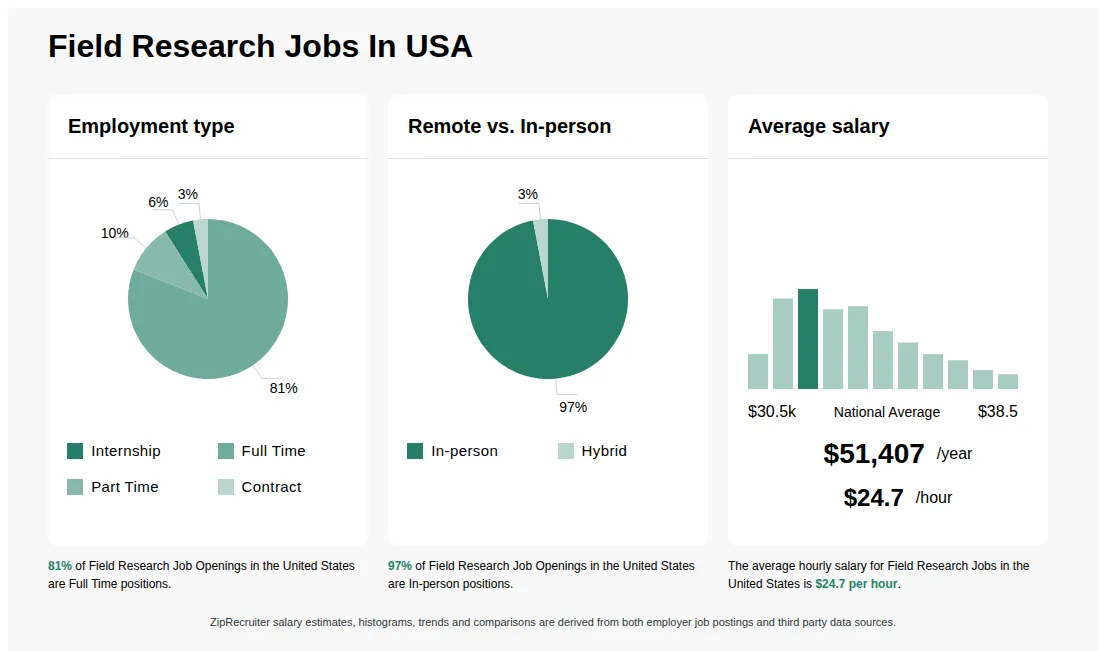
Field Research information
See salary details
$14.66 - $16.83
5% of jobs
$16.83 - $18.99
16% of jobs
$19.43 is the 25th percentile. Wages below this are outliers.
$18.99 - $21.15
17% of jobs
The median wage is $22.90 / hr.
$21.15 - $23.32
14% of jobs
$23.32 - $25.48
15% of jobs
$27.10 is the 75th percentile. Wages above this are outliers.
$25.48 - $27.64
10% of jobs
$27.64 - $29.81
8% of jobs
$29.81 - $31.97
5% of jobs
$31.97 - $34.13
4% of jobs
$34.13 - $36.30
3% of jobs
$36.30 - $38.46
2% of jobs
$14
$24
$38
How much do field research jobs pay per hour?
As of Sep 6, 2026, the average hourly pay for field research in the United States is $24.71, according to ZipRecruiter salary data. Most workers in this role earn between $19.23 and $28.61 per hour, depending on experience, location, and employer.
What is a field research?
A Field Research job involves collecting and analyzing data outside of a traditional office or laboratory setting. Researchers conduct surveys, interviews, or experiments in real-world environments such as natural habitats, urban areas, or industrial sites. The role often requires travel, observation, and data recording to support scientific, social, or market research studies. Field researchers must be detail-oriented, adaptable, and skilled in data collection methods relevant to their specific field of study.
What does a typical day look like for someone working in field research?
A typical day for a field researcher often includes planning research activities, collecting data on-site, coordinating with team members, and carefully documenting findings. Fieldwork may be conducted outdoors in various weather conditions, or at different sites depending on the project. You may also spend part of your day entering and analyzing data, communicating with stakeholders, or preparing reports. Collaboration with other researchers and local contacts is common, and the dynamic nature of the job means each day can bring new challenges and learning opportunities.
What are the key skills and qualifications needed to thrive in the field research position, and why are they important?
To excel in Field Research, you need strong analytical skills, attention to detail, and a relevant academic background such as a degree in environmental science, sociology, or biology. Familiarity with data collection tools, GPS devices, statistical analysis software, and sometimes certifications in research methodologies are often required. Excellent communication, problem-solving, and adaptability in varied environments are standout soft skills for this role. These qualifications ensure accurate data gathering, effective collaboration, and the ability to handle the unpredictable challenges encountered in the field.
How much does a field researcher make?
The average salary for a field researcher varies by experience and location but typically ranges from $40,000 to $70,000 annually. Entry-level positions may start around $30,000, while experienced researchers with specialized skills can earn over $80,000. Compensation often includes fieldwork, data collection, and analysis responsibilities, sometimes requiring travel and outdoor work.
What is the work of a field researcher?
A field researcher collects data and observes subjects in their natural environment to gather information for studies or projects. They often use tools like surveys, interviews, and recording devices, and may work outdoors or in specific locations depending on the research focus.
More about Field Research jobs
What cities are hiring for Field Research jobs?
Cities with the most Field Research job openings:
What are the most commonly searched types of Field Research jobs?
The most popular types of Field Research jobs are:
What states have the most Field Research jobs?
States with the most job openings for Field Research jobs include:
What job categories do people searching Field Research jobs look for?
The top searched job categories for Field Research jobs are:
- Biostatistics Internships Summer
- Biology Research
- Entry Level Good Molecules
- Research And Development Analyst
- Research Python
- Entry Level Neuroscience Data Scientist
- Addiction Neuroscience Research
- Part Time Research Scientist Mechanical Engineering
- Junior Biology Research Scientist
- Neurodegeneration Research

Full-time
Life, Retirement, PTO
Re-posted 29 days ago
CoStar Group rating

8.2
Based on 13 frontline employees who took The Breakroom Quiz
55th of 209 rated real estate companies
Job description
Associate Field Research Photographer, Munich - Costar (M/W/D)
Job Description
COSTAR GROUP - ASSOCIATE FIELD RESEARCH PHOTOGRAPHER, MUNICH (M/W/D) OVERVIEW CoStar Group is a leading global provider of commercial and residential real estate information, analytics, and online marketplaces.Included in the S&P 500 Index CoStar Group is on a mission to digitise the world's real estate, empowering all people to discover properties, insights and connections that improve their businesses and lives. We have been living and breathing the world of real estate information and online marketplaces for over 35 years, giving us the perspective to create truly unique and valuable offerings to our customers.We've continually refined, transformed and perfected our approach to our business, creating a language that has become standard in our industry, for our customers, and even our competitors.We continue that effort today and are always working to improve and drive innovation.This is how we deliver for our customers, our employees, and investors.By equipping the brightest minds with the best resources available, we provide an invaluable edge in real estate. Learn more about CoStar. ROLE DESCRIPTION We are looking for Associate Research Photographers who will support us as we build out an in-depth understanding of the commercial real estate of Munich and surrounding areas. This role will be offered on a 2-year fixed term contract basis. The Research Photographer is responsible for ensuring that the CoStar products are representing the most current and accurate information and photographs on commercial properties and listings through on-site inspections within the assigned geography. Equipped with state-of-the-art equipment (Canon R6, tilt-shift lens and 17-35mm lens, drone where applicable, iPad, laptop, smartphone, mobile wi-fi and traveling via foot/public transport or hybrid research vehicle when necessary) our Associate Research Photographers canvass the market to identify and capture commercial listings, properties, building attributes, tenants and photographs not represented in the CoStar database. Associate Research Photographers are remotely managed by a Photography Manager. ***Please ensure that your application includes either a link to your portfolio of real estate/architectural photography, or an upload of your real estate/architectural photography portfolio.*** RESPONSIBILITIES Support the collection of imagery, property information, and market updates across assigned submarkets and core territories by driving or walking designated areas. Assist with identifying new availabilities, missing inventory, construction updates, and required image updates within assigned territories. Capture high-quality exterior property images and collect visible building information for commercial properties, including properties with for lease and for sale signage. Collect basic property attribute data while in front of targeted buildings, including address, building type, number of stories, general building size, visible occupier information, and other key observable details. Support the Research team by cross-checking new leads against existing CoStar database information and escalating potential new or updated information where required. Gather building data and contact information where available and submit findings into our own Field Research App. Support the creation and update of building footprints and geocodes using CoStar field mapping tools, following training and internal guidance. Use Adobe software, primarily Lightroom and Photoshop, to complete basic post-processing of digital images in line with CoStar quality standards. Assist with associating assigned tenant locations to properties and photographing tenant spaces where required. Follow daily Research procedures, including regular communication with the Photography Manager, accurate logging of working time, and providing clear production updates. Upload collected data and images on the same day where possible, ensuring work is submitted accurately and within agreed timeframes. Photograph and collect imagery on assigned properties each day, based on targets and priorities set by the manager. Visually scan commercial properties in assigned submarkets while driving or walking to identify potential leasing and sale signs, supporting lead generation projects. Support drone-based imagery capture where trained, licensed, and approved to do so, following all local regulations and CoStar safety procedures. Communicate professionally with property managers, customers, and internal teams by phone, email, and in person when required. Follow CoStar safety standards and escalate any field safety concerns promptly. Maintain company vehicle, camera equipment, drone equipment where applicable, and other assigned tools in good working order. Represent CoStar in a professional manner while working in the field. Participate in regular team calls, training sessions, and updates with Photography, Research teams. Support Research participation at occasional trade functions or market-related events where required. PHYSICAL REQUIREMENTS Ability to stand, sit, walk, and work in the field for extended periods, up to 8 hours per day. Ability to carry camera equipment and field gear during the working day. Ability to hold equipment weighing approximately 2kg in one hand for short periods when required. Repetitive hand and arm movements needed for typing, writing, image capture, and equipment handling. Comfortable working outdoors and being exposed to different weather conditions throughout the year. Comfortable working around normal traffic, vehicle noise, and possible vehicle exhaust fumes. Ability to travel safely between assigned locations by car, public transport, walking, or other approved methods. QUALIFICATIONS A full local driving licence is essential; a clean driving record is preferred. Good written and spoken communication skills in German and English. Developing technical knowledge of digital photography, with the ability to capture clear, well-composed images. Basic experience with Adobe software such as Lightroom and Photoshop. Photography education, training, or relevant practical experience is preferred. An interest in commercial real estate, urban environments, architecture, property research, or field-based work. Basic knowledge of Mac OS, Microsoft Office, and internet-based applications. A photography portfolio is preferred, particularly including property, architecture, street, landscape, or urban imagery. Good organizational skills with the ability to follow daily instructions, complete assigned work, and provide timely updates. Flexible and open to learning new systems, processes, and field research methods. Willingness to travel within assigned territories and occasionally support field projects in other locations. Drone experience and a valid European A2 drone licence are desirable. Ability to learn commercial real estate terminology, mapping tools, and CoStar data collection processes. Comfortable working independently in the field while receiving regular remote support from a manager or team lead. Able to follow CoStar protocols, safety procedures, and quality standards with guidance and supervision. Comfortable working alone during the day while staying connected with the team via phone, email, and internal communication tools. CoStar Group is a US-headquartered business and our corporate language is English. You may be asked to provide an English version of your CV/resume and may conduct part of your interview in English. WHAT'S IN IT FOR YOU? Working at CoStar Group means you'll enjoy a culture of collaboration and innovation that attracts the best and brightest across a broad range of disciplines. As well as having a fantastic pathway to develop professionally within CoStar, other perks include 29 days annual leave, pension, life assurance, and competitive remuneration packages! At CoStar, we recognise the positive value of diversity and promote equality. We aim at all times to recruit the person who is most suited to the job and welcome applications from people of all backgrounds including but not limited to; people of all genders, of all ages, sexual orientations, ethnicities, nationalities, religions and beliefs. #CoStar COSTAR GROUP - ASSOCIATE FIELD RESEARCH PHOTOGRAPHER, MUNCHEN (M/W/D) UBERBLICK Die CoStar Group ist ein weltweit fuhrender Anbieter von Marktinformationen, Analysen und Online-Marktplatzen fur Gewerbe- und Wohnimmobilien. Als im S&P 500 Index gelistetes Unternehmen verfolgt die CoStar Group das Ziel, die Immobilienbranche zu digitalisieren und Menschen dabei zu unterstutzen, Immobilien, Markteinblicke und Kontakte zu entdecken, die ihre geschaftlichen Entscheidungen und ihr Leben verbessern. Seit uber 35 Jahren pragen wir die Welt der Immobilieninformationen und Online-Marktplatze. Diese Erfahrung ermoglicht es uns, unseren Kunden einzigartige und wertvolle Losungen anzubieten. Wir entwickeln unseren Geschaftsansatz kontinuierlich weiter, treiben Innovationen voran und haben Standards geschaffen, die in unserer Branche, bei unseren Kunden / Kundinnen und selbst bei Wettbewerbern etabliert sind. So schaffen wir Mehrwert fur unsere Kunden / Kundinnen, Mitarbeitenden und Investoren / Investorinnen. Indem wir talentierte Menschen mit den besten verfugbaren Ressourcen ausstatten, verschaffen wir ihnen einen entscheidenden Vorteil im Immobilienmarkt. Erfahren Sie mehr uber CoStar. STELLENBESCHREIBUNG Wir suchen Associate Research Fotografen/-in, die uns beim Aufbau eines umfassenden Verstandnisses des Gewerbeimmobilienmarktes in Munchen und den umliegenden Regionen unterstutzen. Die Position wird zunachst im Rahmen eines auf zwei Jahre befristeten Arbeitsvertrags angeboten. Als Associate Research Fotograf/-in stellen Sie sicher, dass die CoStar-Produkte stets aktuelle und prazise Informationen sowie hochwertiges Bildmaterial zu Gewerbeimmobilien und verfugbaren Flachen enthalten. Grundlage hierfur sind Vor-Ort-Begehungen innerhalb des zugewiesenen Gebiets. Ausgestattet mit moderner Technik - darunter Canon R6, Tilt-Shift-Objektiv und 17-35-mm-Objektiv oder vergleichbare Ausrustung, sowie, je nach Bedarf, ggf. Drohne, iPad, Laptop, Smartphone, mobiles WLAN erfassen unsere Associate Research Fotografen / Fotografinnen ihren Markt vor Ort durch verschiedene Fortbewegungs moglichkeiten zB. zu Fuss, mit offentlichen Verkehrsmitteln oder mit einem Fahrzeug aus unserer Fahrzeugflotte. Dabei identifizieren und dokumentieren sie gewerbliche Angebote, Immobilien, Gebaudemerkmale, Mieterinformationen und Bildmaterial, das noch nicht in der CoStar-Datenbank enthalten ist. Die Associate Research Fotografen werden remote durch einen Photography Manager gefuhrt. *Bitte stellen Sie sicher, dass Ihre Bewerbung entweder einen Link zu Ihrem Portfolio im Bereich Immobilien- und Architekturfotografie enthalt oder dass Sie ein entsprechendes Portfolio hochladen.* AUFGABEN Unterstutzung bei der Erfassung von Bildmaterial, Objektinformationen und Marktaktualisierungen in zugewiesenen Teilmarkten und Kerngebieten durch das Befahren oder Begehen definierter Bereiche. Unterstutzung bei der Identifizierung neuer Verfugbarkeiten, fehlender Bestande, Baufortschritte sowie erforderlicher Bildaktualisierungen innerhalb der zugewiesenen Gebiete. Erstellung hochwertiger Auenaufnahmen von Immobilien sowie Erfassung sichtbarer Gebaudeinformationen fur Gewerbeimmobilien, einschlielich Objekten mit Vermietungs- oder Verkaufsschildern. Erfassung grundlegender objektspezifischer Merkmale direkt vor Ort, einschlielich Adresse, Gebaudetyp, Anzahl der Stockwerke, ungefahre Gebaudegroe, sichtbare Nutzerinformationen sowie weiterer relevanter und erkennbarer Merkmale. Unterstutzung des Research-Teams durch den Abgleich neuer Hinweise mit bestehenden Informationen in der CoStar-Datenbank sowie Weiterleitung potenziell neuer oder aktualisierter Informationen bei Bedarf. Erfassung von Gebaude- und Kontaktinformationen, sofern verfugbar, und Einreichung der Ergebnisse uber unsere eigene Field Research App. Unterstutzung bei der Erstellung und Aktualisierung von Gebaudegrundrissen und Geocodes mithilfe der CoStar Field-Mapping-Tools, gema Schulung und internen Vorgaben. Nutzung von Adobe-Software, insbesondere Lightroom und Photoshop, zur grundlegenden Nachbearbeitung digitaler Bilder gema den Qualitatsstandards von CoStar. Unterstutzung bei der Zuordnung zugewiesener Mieterstandorte zu Immobilien sowie bei der fotografischen Erfassung von Mieterflachen, sofern erforderlich. Einhaltung der taglichen Research-Prozesse, einschlielich regelmaiger Kommunikation mit dem Photography Manager, genauer Zeiterfassung sowie klarer Produktions- und Fortschrittsupdates. Hochladen der erfassten Daten und Bilder moglichst am selben Tag, um eine korrekte Einreichung innerhalb der vereinbarten Fristen sicherzustellen. Fotografieren und Erfassen von Bildmaterial zu zugewiesenen Objekten pro Tag, basierend auf den vom Manager festgelegten Zielen und Prioritaten. Visuelle Prufung von Gewerbeimmobilien in zugewiesenen Teilmarkten beim Fahren oder Gehen, um potenzielle Vermietungs- und Verkaufsschilder zu identifizieren und Lead-Generation-Projekte zu unterstutzen. Unterstutzung bei der Erstellung von Drohnenaufnahmen, sofern entsprechend geschult, lizenziert und freigegeben, unter Einhaltung aller lokalen Vorschriften sowie der CoStar-Sicherheitsrichtlinien. Professionelle Kommunikation mit Property Managern, Kunden und internen Teams per Telefon, E-Mail und personlich, sofern erforderlich. Einhaltung der CoStar-Sicherheitsstandards sowie umgehende Eskalation moglicher Sicherheitsbedenken im Auendienst. Pflege des Firmenfahrzeugs, der Kameraausrustung, gegebenenfalls der Drohnenausrustung sowie weiterer zur Verfugung gestellter Arbeitsmittel. Professionelle Reprasentation von CoStar wahrend der Tatigkeit im Auendienst. Teilnahme an regelmaigen Team-Calls, Schulungen und Updates mit den Photography- und Research-Teams. Unterstutzung des Research-Bereichs bei gelegentlichen Fachveranstaltungen oder marktbezogenen Events, sofern erforderlich. KORPERLICHE ANFORDERUNGEN Haufiges und wiederholtes Stehen, Sehen, Sitzen und Gehen uber einen Zeitraum von bis zu 8 Stunden taglich. Halten von 2 kg in einer Hand fur bis zu 5 Minuten sowie Tragen der Kameraausrustung uber einen Zeitraum von bis zu 8 Stunden taglich. Haufig wiederkehrende Hand- und Armbewegungen Tagliche Arbeit unter wechselnden Wetterbedingungen. Gelegentlich mogliche Aussetzung gegenuber Fahrzeuggerauschen und Abgasen. QUALIFIKATIONEN Ein in Deutschland gultiger Fuhrerschein ; ein eintragsfreies Fuhrungszeugnis bzw. Fahrregister ist von Vorteil. Sehr gute Deutsch- und Englischkenntnisse in Wort und Schrift. Technische Kenntnisse in digitaler Fotografie und Bildnachbearbeitung mit Adobe Lightroom und Photoshop . Abgeschlossenes Hochschulstudium oder verg...
Job Description
COSTAR GROUP - ASSOCIATE FIELD RESEARCH PHOTOGRAPHER, MUNICH (M/W/D) OVERVIEW CoStar Group is a leading global provider of commercial and residential real estate information, analytics, and online marketplaces.Included in the S&P 500 Index CoStar Group is on a mission to digitise the world's real estate, empowering all people to discover properties, insights and connections that improve their businesses and lives. We have been living and breathing the world of real estate information and online marketplaces for over 35 years, giving us the perspective to create truly unique and valuable offerings to our customers.We've continually refined, transformed and perfected our approach to our business, creating a language that has become standard in our industry, for our customers, and even our competitors.We continue that effort today and are always working to improve and drive innovation.This is how we deliver for our customers, our employees, and investors.By equipping the brightest minds with the best resources available, we provide an invaluable edge in real estate. Learn more about CoStar. ROLE DESCRIPTION We are looking for Associate Research Photographers who will support us as we build out an in-depth understanding of the commercial real estate of Munich and surrounding areas. This role will be offered on a 2-year fixed term contract basis. The Research Photographer is responsible for ensuring that the CoStar products are representing the most current and accurate information and photographs on commercial properties and listings through on-site inspections within the assigned geography. Equipped with state-of-the-art equipment (Canon R6, tilt-shift lens and 17-35mm lens, drone where applicable, iPad, laptop, smartphone, mobile wi-fi and traveling via foot/public transport or hybrid research vehicle when necessary) our Associate Research Photographers canvass the market to identify and capture commercial listings, properties, building attributes, tenants and photographs not represented in the CoStar database. Associate Research Photographers are remotely managed by a Photography Manager. ***Please ensure that your application includes either a link to your portfolio of real estate/architectural photography, or an upload of your real estate/architectural photography portfolio.*** RESPONSIBILITIES Support the collection of imagery, property information, and market updates across assigned submarkets and core territories by driving or walking designated areas. Assist with identifying new availabilities, missing inventory, construction updates, and required image updates within assigned territories. Capture high-quality exterior property images and collect visible building information for commercial properties, including properties with for lease and for sale signage. Collect basic property attribute data while in front of targeted buildings, including address, building type, number of stories, general building size, visible occupier information, and other key observable details. Support the Research team by cross-checking new leads against existing CoStar database information and escalating potential new or updated information where required. Gather building data and contact information where available and submit findings into our own Field Research App. Support the creation and update of building footprints and geocodes using CoStar field mapping tools, following training and internal guidance. Use Adobe software, primarily Lightroom and Photoshop, to complete basic post-processing of digital images in line with CoStar quality standards. Assist with associating assigned tenant locations to properties and photographing tenant spaces where required. Follow daily Research procedures, including regular communication with the Photography Manager, accurate logging of working time, and providing clear production updates. Upload collected data and images on the same day where possible, ensuring work is submitted accurately and within agreed timeframes. Photograph and collect imagery on assigned properties each day, based on targets and priorities set by the manager. Visually scan commercial properties in assigned submarkets while driving or walking to identify potential leasing and sale signs, supporting lead generation projects. Support drone-based imagery capture where trained, licensed, and approved to do so, following all local regulations and CoStar safety procedures. Communicate professionally with property managers, customers, and internal teams by phone, email, and in person when required. Follow CoStar safety standards and escalate any field safety concerns promptly. Maintain company vehicle, camera equipment, drone equipment where applicable, and other assigned tools in good working order. Represent CoStar in a professional manner while working in the field. Participate in regular team calls, training sessions, and updates with Photography, Research teams. Support Research participation at occasional trade functions or market-related events where required. PHYSICAL REQUIREMENTS Ability to stand, sit, walk, and work in the field for extended periods, up to 8 hours per day. Ability to carry camera equipment and field gear during the working day. Ability to hold equipment weighing approximately 2kg in one hand for short periods when required. Repetitive hand and arm movements needed for typing, writing, image capture, and equipment handling. Comfortable working outdoors and being exposed to different weather conditions throughout the year. Comfortable working around normal traffic, vehicle noise, and possible vehicle exhaust fumes. Ability to travel safely between assigned locations by car, public transport, walking, or other approved methods. QUALIFICATIONS A full local driving licence is essential; a clean driving record is preferred. Good written and spoken communication skills in German and English. Developing technical knowledge of digital photography, with the ability to capture clear, well-composed images. Basic experience with Adobe software such as Lightroom and Photoshop. Photography education, training, or relevant practical experience is preferred. An interest in commercial real estate, urban environments, architecture, property research, or field-based work. Basic knowledge of Mac OS, Microsoft Office, and internet-based applications. A photography portfolio is preferred, particularly including property, architecture, street, landscape, or urban imagery. Good organizational skills with the ability to follow daily instructions, complete assigned work, and provide timely updates. Flexible and open to learning new systems, processes, and field research methods. Willingness to travel within assigned territories and occasionally support field projects in other locations. Drone experience and a valid European A2 drone licence are desirable. Ability to learn commercial real estate terminology, mapping tools, and CoStar data collection processes. Comfortable working independently in the field while receiving regular remote support from a manager or team lead. Able to follow CoStar protocols, safety procedures, and quality standards with guidance and supervision. Comfortable working alone during the day while staying connected with the team via phone, email, and internal communication tools. CoStar Group is a US-headquartered business and our corporate language is English. You may be asked to provide an English version of your CV/resume and may conduct part of your interview in English. WHAT'S IN IT FOR YOU? Working at CoStar Group means you'll enjoy a culture of collaboration and innovation that attracts the best and brightest across a broad range of disciplines. As well as having a fantastic pathway to develop professionally within CoStar, other perks include 29 days annual leave, pension, life assurance, and competitive remuneration packages! At CoStar, we recognise the positive value of diversity and promote equality. We aim at all times to recruit the person who is most suited to the job and welcome applications from people of all backgrounds including but not limited to; people of all genders, of all ages, sexual orientations, ethnicities, nationalities, religions and beliefs. #CoStar COSTAR GROUP - ASSOCIATE FIELD RESEARCH PHOTOGRAPHER, MUNCHEN (M/W/D) UBERBLICK Die CoStar Group ist ein weltweit fuhrender Anbieter von Marktinformationen, Analysen und Online-Marktplatzen fur Gewerbe- und Wohnimmobilien. Als im S&P 500 Index gelistetes Unternehmen verfolgt die CoStar Group das Ziel, die Immobilienbranche zu digitalisieren und Menschen dabei zu unterstutzen, Immobilien, Markteinblicke und Kontakte zu entdecken, die ihre geschaftlichen Entscheidungen und ihr Leben verbessern. Seit uber 35 Jahren pragen wir die Welt der Immobilieninformationen und Online-Marktplatze. Diese Erfahrung ermoglicht es uns, unseren Kunden einzigartige und wertvolle Losungen anzubieten. Wir entwickeln unseren Geschaftsansatz kontinuierlich weiter, treiben Innovationen voran und haben Standards geschaffen, die in unserer Branche, bei unseren Kunden / Kundinnen und selbst bei Wettbewerbern etabliert sind. So schaffen wir Mehrwert fur unsere Kunden / Kundinnen, Mitarbeitenden und Investoren / Investorinnen. Indem wir talentierte Menschen mit den besten verfugbaren Ressourcen ausstatten, verschaffen wir ihnen einen entscheidenden Vorteil im Immobilienmarkt. Erfahren Sie mehr uber CoStar. STELLENBESCHREIBUNG Wir suchen Associate Research Fotografen/-in, die uns beim Aufbau eines umfassenden Verstandnisses des Gewerbeimmobilienmarktes in Munchen und den umliegenden Regionen unterstutzen. Die Position wird zunachst im Rahmen eines auf zwei Jahre befristeten Arbeitsvertrags angeboten. Als Associate Research Fotograf/-in stellen Sie sicher, dass die CoStar-Produkte stets aktuelle und prazise Informationen sowie hochwertiges Bildmaterial zu Gewerbeimmobilien und verfugbaren Flachen enthalten. Grundlage hierfur sind Vor-Ort-Begehungen innerhalb des zugewiesenen Gebiets. Ausgestattet mit moderner Technik - darunter Canon R6, Tilt-Shift-Objektiv und 17-35-mm-Objektiv oder vergleichbare Ausrustung, sowie, je nach Bedarf, ggf. Drohne, iPad, Laptop, Smartphone, mobiles WLAN erfassen unsere Associate Research Fotografen / Fotografinnen ihren Markt vor Ort durch verschiedene Fortbewegungs moglichkeiten zB. zu Fuss, mit offentlichen Verkehrsmitteln oder mit einem Fahrzeug aus unserer Fahrzeugflotte. Dabei identifizieren und dokumentieren sie gewerbliche Angebote, Immobilien, Gebaudemerkmale, Mieterinformationen und Bildmaterial, das noch nicht in der CoStar-Datenbank enthalten ist. Die Associate Research Fotografen werden remote durch einen Photography Manager gefuhrt. *Bitte stellen Sie sicher, dass Ihre Bewerbung entweder einen Link zu Ihrem Portfolio im Bereich Immobilien- und Architekturfotografie enthalt oder dass Sie ein entsprechendes Portfolio hochladen.* AUFGABEN Unterstutzung bei der Erfassung von Bildmaterial, Objektinformationen und Marktaktualisierungen in zugewiesenen Teilmarkten und Kerngebieten durch das Befahren oder Begehen definierter Bereiche. Unterstutzung bei der Identifizierung neuer Verfugbarkeiten, fehlender Bestande, Baufortschritte sowie erforderlicher Bildaktualisierungen innerhalb der zugewiesenen Gebiete. Erstellung hochwertiger Auenaufnahmen von Immobilien sowie Erfassung sichtbarer Gebaudeinformationen fur Gewerbeimmobilien, einschlielich Objekten mit Vermietungs- oder Verkaufsschildern. Erfassung grundlegender objektspezifischer Merkmale direkt vor Ort, einschlielich Adresse, Gebaudetyp, Anzahl der Stockwerke, ungefahre Gebaudegroe, sichtbare Nutzerinformationen sowie weiterer relevanter und erkennbarer Merkmale. Unterstutzung des Research-Teams durch den Abgleich neuer Hinweise mit bestehenden Informationen in der CoStar-Datenbank sowie Weiterleitung potenziell neuer oder aktualisierter Informationen bei Bedarf. Erfassung von Gebaude- und Kontaktinformationen, sofern verfugbar, und Einreichung der Ergebnisse uber unsere eigene Field Research App. Unterstutzung bei der Erstellung und Aktualisierung von Gebaudegrundrissen und Geocodes mithilfe der CoStar Field-Mapping-Tools, gema Schulung und internen Vorgaben. Nutzung von Adobe-Software, insbesondere Lightroom und Photoshop, zur grundlegenden Nachbearbeitung digitaler Bilder gema den Qualitatsstandards von CoStar. Unterstutzung bei der Zuordnung zugewiesener Mieterstandorte zu Immobilien sowie bei der fotografischen Erfassung von Mieterflachen, sofern erforderlich. Einhaltung der taglichen Research-Prozesse, einschlielich regelmaiger Kommunikation mit dem Photography Manager, genauer Zeiterfassung sowie klarer Produktions- und Fortschrittsupdates. Hochladen der erfassten Daten und Bilder moglichst am selben Tag, um eine korrekte Einreichung innerhalb der vereinbarten Fristen sicherzustellen. Fotografieren und Erfassen von Bildmaterial zu zugewiesenen Objekten pro Tag, basierend auf den vom Manager festgelegten Zielen und Prioritaten. Visuelle Prufung von Gewerbeimmobilien in zugewiesenen Teilmarkten beim Fahren oder Gehen, um potenzielle Vermietungs- und Verkaufsschilder zu identifizieren und Lead-Generation-Projekte zu unterstutzen. Unterstutzung bei der Erstellung von Drohnenaufnahmen, sofern entsprechend geschult, lizenziert und freigegeben, unter Einhaltung aller lokalen Vorschriften sowie der CoStar-Sicherheitsrichtlinien. Professionelle Kommunikation mit Property Managern, Kunden und internen Teams per Telefon, E-Mail und personlich, sofern erforderlich. Einhaltung der CoStar-Sicherheitsstandards sowie umgehende Eskalation moglicher Sicherheitsbedenken im Auendienst. Pflege des Firmenfahrzeugs, der Kameraausrustung, gegebenenfalls der Drohnenausrustung sowie weiterer zur Verfugung gestellter Arbeitsmittel. Professionelle Reprasentation von CoStar wahrend der Tatigkeit im Auendienst. Teilnahme an regelmaigen Team-Calls, Schulungen und Updates mit den Photography- und Research-Teams. Unterstutzung des Research-Bereichs bei gelegentlichen Fachveranstaltungen oder marktbezogenen Events, sofern erforderlich. KORPERLICHE ANFORDERUNGEN Haufiges und wiederholtes Stehen, Sehen, Sitzen und Gehen uber einen Zeitraum von bis zu 8 Stunden taglich. Halten von 2 kg in einer Hand fur bis zu 5 Minuten sowie Tragen der Kameraausrustung uber einen Zeitraum von bis zu 8 Stunden taglich. Haufig wiederkehrende Hand- und Armbewegungen Tagliche Arbeit unter wechselnden Wetterbedingungen. Gelegentlich mogliche Aussetzung gegenuber Fahrzeuggerauschen und Abgasen. QUALIFIKATIONEN Ein in Deutschland gultiger Fuhrerschein ; ein eintragsfreies Fuhrungszeugnis bzw. Fahrregister ist von Vorteil. Sehr gute Deutsch- und Englischkenntnisse in Wort und Schrift. Technische Kenntnisse in digitaler Fotografie und Bildnachbearbeitung mit Adobe Lightroom und Photoshop . Abgeschlossenes Hochschulstudium oder verg...
What CoStar Group employees say
Pay
Benefits
Hours and flexibility
Workplace
Get the full story on Breakroom