1

Ethnography Jobs (NOW HIRING)

Execute research programs drawing from established methodologies for ethnography, remote research, evaluative testing, and co-creation. * Translate research into actionable recommendations and ...

Strong understanding of qualitative methods including usability testing, interviews, ethnography, and task analysis. * Experience with digital product research (mobile apps, responsive web, kiosks ...

Execute research programs drawing from established methodologies for ethnography, remote research, evaluative testing, and co-creation. * Translate research into actionable recommendations and ...

Strong understanding of qualitative methods including usability testing, interviews, ethnography, and task analysis. * Experience with digital product research (mobile apps, responsive web, kiosks ...

Execute research programs drawing from established methodologies for ethnography, remote research, evaluative testing, and co-creation. * Translate research into actionable recommendations and ...

Execute research programs drawing from established methodologies for ethnography, remote research, evaluative testing, and co-creation. * Translate research into actionable recommendations and ...

$150 - $200/hr

Apply advanced research methodologies including conjoint analysis, choice‑based conjoint, MaxDiff, ethnography, online communities, usability testing, and emotion‑based research techniques.

$150 - $200/hr

Apply advanced research methodologies including conjoint analysis, choice-based conjoint, MaxDiff, ethnography, online communities, usability testing, and emotion-based research techniques.

next page

Showing results 1-20

Ethnography information

See salary details

$29K

$117.6K

$227.5K

How much do ethnography jobs pay per year?

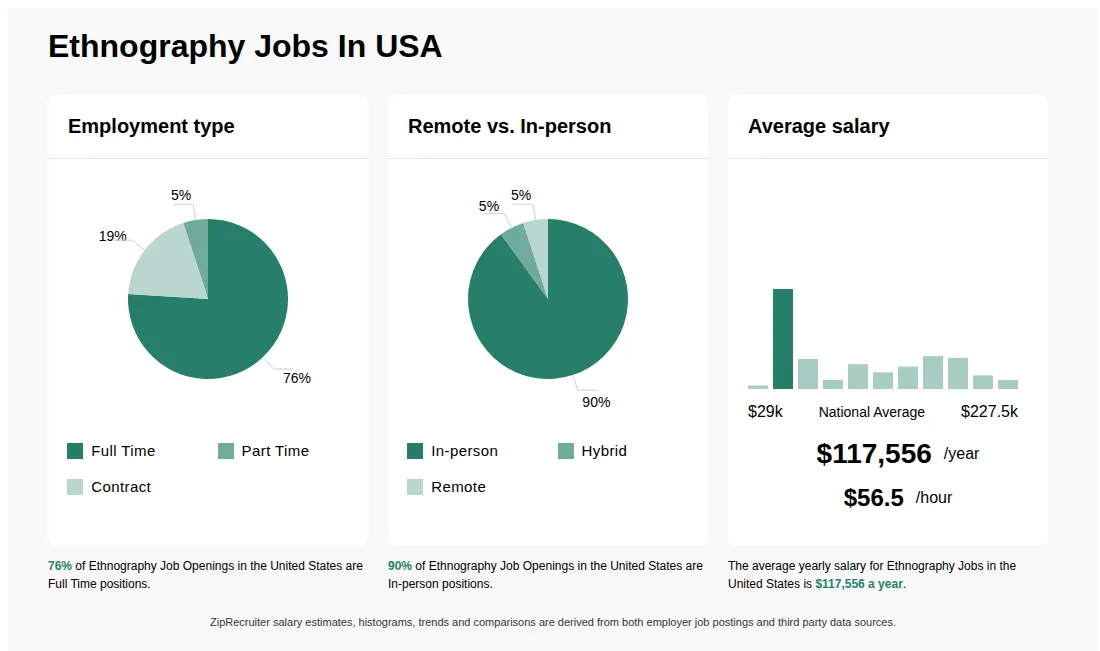
As of Sep 8, 2026, the average yearly pay for ethnography in the United States is $117,556.00, according to ZipRecruiter salary data. Most workers in this role earn between $60,000.00 and $169,000.00 per year, depending on experience, location, and employer.

What is ethnography?

An ethnography job involves studying and analyzing cultural behaviors, social interactions, and everyday practices of specific groups or communities. Ethnographers conduct fieldwork, participate in observations, and engage in interviews to understand people’s lived experiences. This qualitative research helps businesses, organizations, and academics gain insights into human behavior for applications in marketing, product design, social policy, and anthropology.

What are the key skills and qualifications needed to thrive in ethnography?

To thrive in ethnography, you need a background in anthropology or social sciences, strong observational and analytical skills, and experience in qualitative research methods. Proficiency in qualitative data analysis tools like NVivo or Atlas.ti, and formal training in research ethics protocols, are highly beneficial. Excellent interpersonal skills, cultural sensitivity, and adaptability are crucial for building trust and gathering meaningful insights in diverse environments. These competencies enable effective, ethical research that provides deep understanding of human behaviors and societal trends.

What are the typical work environments and collaboration opportunities for professionals in ethnography?

Ethnography professionals often work in varied environments, including field sites, communities, corporate offices, or academic settings, depending on the focus of their research. Collaboration is a key aspect of the role; ethnographers frequently partner with interdisciplinary teams such as product designers, market researchers, sociologists, or community stakeholders to interpret findings and apply insights. You'll regularly interact with research participants and may also present your results to clients or organizational leadership. This diversity in work setting and teamwork provides valuable learning experiences and opportunities for career growth in research, consulting, and human-centered design.

How do you become an ethnographer?

To become an ethnographer, typically a person earns a bachelor's degree in anthropology, sociology, or a related field, followed by a master's or Ph.D. in anthropology or ethnography. Gaining fieldwork experience through internships or research projects and developing skills in qualitative research, observation, and interviewing are essential steps in the process.

What does an ethnography researcher do?

An ethnography researcher studies cultures, behaviors, and social interactions by observing and engaging with communities in their natural environments. They collect qualitative data through methods like interviews, participant observation, and field notes to understand people's perspectives and social dynamics. This work often involves detailed analysis and reporting to inform research, product design, or social programs.
More about Ethnography jobs

What cities are hiring for Ethnography jobs?

Cities with the most Ethnography job openings:

What are the most commonly searched types of Ethnography jobs?

The most popular types of Ethnography jobs are:

What states have the most Ethnography jobs?

States with the most job openings for Ethnography jobs include:

Infographic showing various Ethnography job openings in the United States as of August 2026, with employment types broken down into 6% Internship, 66% Full Time, 11% Part Time, and 17% Contract. Highlights an 83% In-person, and 17% Remote job distribution, with an average salary of $117,556 per year, or $56.5 per hour.

Experience Researcher Senior Associate

JPMorgan Chase & Co.

Columbus, OH • On-site

$100 - $125/hr

Other

Re-posted 29 days ago


JPMorgan Chase & Co. rating

7.9

Company rating: 7.9 out of 10

Based on 500 frontline employees who took The Breakroom Quiz

77th of 175 rated banks


Job description

Bring your industry trends and knowledge to our team and shape exceptional user experiences through cutting-edge research, influencing product design and functionality.

As an Experience Research Senior Associate in CAO, Supplier Services, you will play a pivotal role in shaping user experiences across our products and services. Leveraging advanced proficiency in research methods, analysis, and both quantitative and qualitative techniques, identify customer needs and translate them into actionable insights and recommendations. You will act as a core contributor to aid in developing research studies that answer user needs. Your work will directly impact the design, architecture, and functionality of our offerings, collaborating with cross-functional teams to contribute to discussions on design and research, and leading the decision on which methods best suit key design questions.

Job responsibilities
  • Conduct and execute research studies using advanced research methods, such as surveys, interviews, ethnography, and quantitative and qualitative techniques, to gather customer insights
  • Analyze and interpret data, identify patterns and trends, and provide actionable recommendations to inform user experience design decisions and facilitate improvements in customer satisfaction and engagement
  • Collaborate with cross‑functional teams to ensure the integration of user insights into product development processes based on research findings
  • Contribute to the creation and refinement of experience research strategies and connect craft work to business goals and success metrics, taking into consideration downstream implications
  • Stay current with industry trends and incorporate knowledge into team insights
Required qualifications, capabilities, and skills
  • 3+ years of experience or equivalent expertise in generative and evaluative user experience research, employing advanced research methods and techniques
  • Demonstrated proficiency in both quantitative and qualitative research methods, including survey and interview design, ethnography, and data analysis
  • Advanced knowledge of user experience design principles and practices, with a focus on how ethnographic principles influence effective user experiences
  • Advanced understanding of current research methodologies, with the ability to review and understand how to apply current research practices to better inform experience designs
Preferred qualifications, capabilities, and skills
  • Service design experience and experience with complex, technical systems preferred.
#J-18808-Ljbffr

What JPMorgan Chase & Co. employees say

Pay

Benefits

Hours and flexibility

Workplace

Get the full story on Breakroom