This is an entry-level role, so we don't specify a degree, your age, or your background. We care ... What This Is (And What It Isn't) This is your foot in the door in the games industry with real QA ...
This is an entry-level role, so we don't specify a degree, your age, or your background. We care ... What This Is (And What It Isn't) This is your foot in the door in the games industry with real QA ...

Sales Representative - Entry Level
Cleveland, OH · On-site
$800 - $1.2K/wk
Updated on industry knowledge and effectively apply it in the field * Follow all company policies ... Fun team events including bowling, Top Golf, game nights, and dinners. * Management bonuses, such ...
Quick apply
Sales Representative - Entry Level
Cleveland, OH · On-site
$800 - $1.2K/wk
Updated on industry knowledge and effectively apply it in the field * Follow all company policies ... Fun team events including bowling, Top Golf, game nights, and dinners. * Management bonuses, such ...
Game Technician
Fredericksburg, VA · On-site
$17 - $19/hr
Five Star Parks & Attractions, a trailblazer in the amusement and hospitality industry, is more ... This is an entry level technical position, so many of the skills can be taught, however these ...
Game Technician
Fredericksburg, VA · On-site
$17 - $19/hr
Five Star Parks & Attractions, a trailblazer in the amusement and hospitality industry, is more ... This is an entry level technical position, so many of the skills can be taught, however these ...

Game Technician
Fredericksburg, VA · On-site
$17 - $19/hr
Five Star Parks & Attractions, a trailblazer in the amusement and hospitality industry, is more ... This is an entry level technical position, so many of the skills can be taught, however these ...
Game Technician
Fredericksburg, VA · On-site
$17 - $19/hr
Five Star Parks & Attractions, a trailblazer in the amusement and hospitality industry, is more ... This is an entry level technical position, so many of the skills can be taught, however these ...
Game Technician
Fredericksburg, VA · On-site
$17 - $19/hr
Five Star Parks & Attractions, a trailblazer in the amusement and hospitality industry, is more ... This is an entry level technical position, so many of the skills can be taught, however these ...
Quick apply
Game Technician
Fredericksburg, VA · On-site
$17 - $19/hr
Five Star Parks & Attractions, a trailblazer in the amusement and hospitality industry, is more ... This is an entry level technical position, so many of the skills can be taught, however these ...

Baseball Test Analyst
San Diego, CA · On-site
$17.75 - $18/hr
This is an entry level role and great for a recent grad! Game Testers at PlayStation for The Show ... Quality Assurance is a great way to get into the Gaming Industry and possibly grow into other ...
Baseball Test Analyst
San Diego, CA · On-site
$17.75 - $18/hr
This is an entry level role and great for a recent grad! Game Testers at PlayStation for The Show ... Quality Assurance is a great way to get into the Gaming Industry and possibly grow into other ...

Baseball Test Analyst
$17.75 - $18/hr
This is an entry level role and great for a recent grad! Game Testers at PlayStation for The Show ... Quality Assurance is a great way to get into the Gaming Industry and possibly grow into other ...
Baseball Test Analyst
$17.75 - $18/hr
This is an entry level role and great for a recent grad! Game Testers at PlayStation for The Show ... Quality Assurance is a great way to get into the Gaming Industry and possibly grow into other ...

... entry-level and experienced Gaming Associates at The Gardens Casino -- and the best part? No ... industry -- no experience needed, just motivation and a willingness to learn!
Quick apply
... entry-level and experienced Gaming Associates at The Gardens Casino -- and the best part? No ... industry -- no experience needed, just motivation and a willingness to learn!
... entry-level and experienced Gaming Associates at The Gardens Casino -- and the best part? No ... industry -- no experience needed, just motivation and a willingness to learn!
Quick apply
... entry-level and experienced Gaming Associates at The Gardens Casino -- and the best part? No ... industry -- no experience needed, just motivation and a willingness to learn!
Dish Machine Operator (Entry Level)
Kingston, WA · On-site
$16.50 - $20.25/hr
Ability to obtain Gaming License. * Must be at least 18 years old to apply. (Enrolled tribal youth ... Previous experience working in the Food & Beverage Industry at a Casino and/or Hotel. * Washington ...
Dish Machine Operator (Entry Level)
Kingston, WA · On-site
$16.50 - $20.25/hr
Ability to obtain Gaming License. * Must be at least 18 years old to apply. (Enrolled tribal youth ... Previous experience working in the Food & Beverage Industry at a Casino and/or Hotel. * Washington ...

Dish Machine Operator (Entry Level)
Kingston, WA · On-site
$18 - $18.50/hr
Ability to obtain Gaming License. * Must be at least 18 years old to apply. (Enrolled tribal youth ... Previous experience working in the Food & Beverage Industry at a Casino and/or Hotel. * Washington ...
Dish Machine Operator (Entry Level)
Kingston, WA · On-site
$18 - $18.50/hr
Ability to obtain Gaming License. * Must be at least 18 years old to apply. (Enrolled tribal youth ... Previous experience working in the Food & Beverage Industry at a Casino and/or Hotel. * Washington ...
Dish Machine Operator (Entry Level)
Kingston, WA · On-site
$18 - $18.50/hr
Ability to obtain Gaming License.Must be at least 18 years old to apply. (Enrolled tribal youth at ... Previous experience working in the Food & Beverage Industry at a Casino and/or Hotel.Washington ...
Quick apply
Dish Machine Operator (Entry Level)
Kingston, WA · On-site
$18 - $18.50/hr
Ability to obtain Gaming License.Must be at least 18 years old to apply. (Enrolled tribal youth at ... Previous experience working in the Food & Beverage Industry at a Casino and/or Hotel.Washington ...
Entry Level Automotive Salesperson
Wernersville, PA · On-site
$34K - $46K/yr
As an Entry Level Salesperson, you can learn the automotive industry and grow as a professional ... Help with lot maintenance * Bring your 'A game' and positive attitude with you every day ...
Entry Level Automotive Salesperson
Wernersville, PA · On-site
$34K - $46K/yr
As an Entry Level Salesperson, you can learn the automotive industry and grow as a professional ... Help with lot maintenance * Bring your 'A game' and positive attitude with you every day ...
Entry Level Automotive Salesperson
Wernersville, PA · On-site
$34K - $46K/yr
As an Entry Level Salesperson, you can learn the automotive industry and grow as a professional ... Help with lot maintenance * Bring your 'A game' and positive attitude with you every day ...
Entry Level Automotive Salesperson
Wernersville, PA · On-site
$34K - $46K/yr
As an Entry Level Salesperson, you can learn the automotive industry and grow as a professional ... Help with lot maintenance * Bring your 'A game' and positive attitude with you every day ...
Entry Level Automotive Salesperson
Wernersville, PA · On-site
$34K - $46K/yr
As an Entry Level Salesperson, you can learn the automotive industry and grow as a professional ... Help with lot maintenance * Bring your 'A game' and positive attitude with you every day ...
Entry Level Automotive Salesperson
Wernersville, PA · On-site
$34K - $46K/yr
As an Entry Level Salesperson, you can learn the automotive industry and grow as a professional ... Help with lot maintenance * Bring your 'A game' and positive attitude with you every day ...
Entry Level Automotive Salesperson
Wernersville, PA · On-site
$34K - $46K/yr
As an Entry Level Salesperson, you can learn the automotive industry and grow as a professional ... Help with lot maintenance * Bring your 'A game' and positive attitude with you every day ...
Entry Level Automotive Salesperson
Wernersville, PA · On-site
$34K - $46K/yr
As an Entry Level Salesperson, you can learn the automotive industry and grow as a professional ... Help with lot maintenance * Bring your 'A game' and positive attitude with you every day ...

Senior Credit Analyst, Gaming
Las Vegas, NV · On-site
$66K - $66K/yr
Senior Credit Analyst, Gaming Location: West Sahara What you'll do: As a Senior Credit Analyst you ... regulations, industry standards and practices. * Entry level to intermediate knowledge and ...
Senior Credit Analyst, Gaming
Las Vegas, NV · On-site
$66K - $66K/yr
Senior Credit Analyst, Gaming Location: West Sahara What you'll do: As a Senior Credit Analyst you ... regulations, industry standards and practices. * Entry level to intermediate knowledge and ...
Senior Credit Analyst, Gaming
Las Vegas, NV · On-site
$66K - $66K/yr
Senior Credit Analyst, Gaming Location: West Sahara What you'll do: As a Senior Credit Analyst you ... regulations, industry standards and practices. * Entry level to intermediate knowledge and ...
Senior Credit Analyst, Gaming
Las Vegas, NV · On-site
$66K - $66K/yr
Senior Credit Analyst, Gaming Location: West Sahara What you'll do: As a Senior Credit Analyst you ... regulations, industry standards and practices. * Entry level to intermediate knowledge and ...
Game Tech
Romeoville, IL · On-site
$16.50 - $22.32/hr
As a leader in the amusement and hospitality industry, Five Star Parks & Attractions brings energy ... This is an entry level technical position, so many of the skills can be taught, however these ...
Game Tech
Romeoville, IL · On-site
$16.50 - $22.32/hr
As a leader in the amusement and hospitality industry, Five Star Parks & Attractions brings energy ... This is an entry level technical position, so many of the skills can be taught, however these ...
Minimum of 2 years of experience in a scheduling or administrative role, preferably in the gaming industry * Proficient in Microsoft Office Suite with entry-level Excel knowledge * Excellent ...
Minimum of 2 years of experience in a scheduling or administrative role, preferably in the gaming industry * Proficient in Microsoft Office Suite with entry-level Excel knowledge * Excellent ...
Entry Level Gaming Industry information
See salary details
$12.98 - $13.81
3% of jobs
$13.81 - $14.64
10% of jobs
$14.64 - $15.47
10% of jobs
$15.62 is the 25th percentile. Wages below this are outliers.
$15.47 - $16.30
15% of jobs
The median wage is $16.78 / hr.
$16.30 - $17.13
22% of jobs
$17.94 is the 75th percentile. Wages above this are outliers.
$17.13 - $17.96
16% of jobs
$17.96 - $18.79
15% of jobs
$18.79 - $19.62
5% of jobs
$19.62 - $20.45
1% of jobs
$20.45 - $21.28
2% of jobs
$21.28 - $22.12
1% of jobs
$12
$16
$22
How much do entry level gaming industry jobs pay per hour?
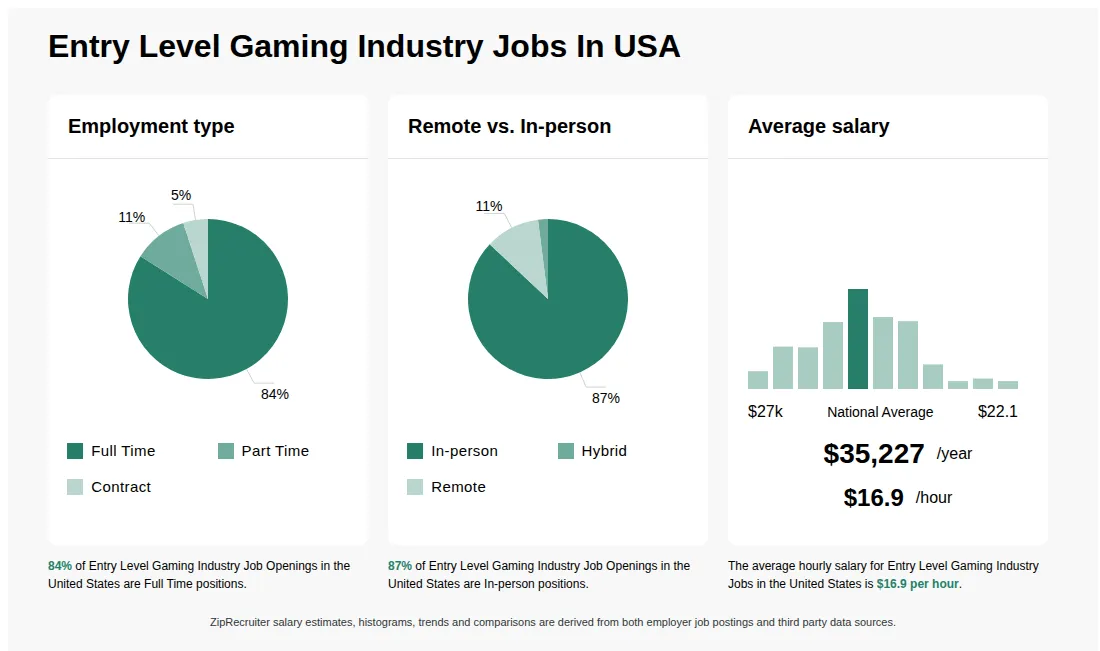
As of Sep 8, 2026, the average hourly pay for entry level gaming industry in the United States is $16.94, according to ZipRecruiter salary data. Most workers in this role earn between $15.62 and $18.03 per hour, depending on experience, location, and employer.
What are entry-level gaming industry jobs?
Entry-level gaming industry jobs focus on different aspects of the video game industry. The duties and responsibilities of these jobs vary, but most require you to work under the direction of a higher level staff member. Quality assurance workers test games during the development cycle, while graphic designers and animators design the visual elements and animation for a game. As an entry-level game developer, you program the game using coding languages and test and troubleshoot during the development process. Some entry-level game programmers adapt the game for a specific operating system or console.
What types of entry-level roles are available in the gaming industry, and how do they typically collaborate with other teams?
Entry-level roles in the gaming industry can include positions such as QA tester, community manager, junior game designer, and customer support specialist. These roles often work closely with other departments—for example, QA testers regularly communicate with developers to report bugs and ensure quality, while community managers collaborate with marketing and development teams to relay player feedback. Teamwork and communication are essential, as projects typically involve cross-functional collaboration to meet deadlines and deliver engaging experiences. Understanding how your responsibilities fit into the bigger picture is key to success and growth in these roles.
What are the key skills and qualifications needed to thrive in an entry-level position in the gaming industry, and why are they important?
To thrive in an entry-level gaming industry role, you generally need a basic understanding of game design concepts, strong problem-solving skills, and often a relevant degree or portfolio of work. Familiarity with game engines like Unity or Unreal Engine and proficiency in programming languages such as C# or C++ are commonly required technical skills. Strong communication, creativity, and teamwork abilities help candidates stand out in collaborative and fast-paced production environments. These skills and qualities are important because they enable you to contribute effectively to game development projects and adapt to the dynamic nature of the industry.
What is the difference between Entry Level Gaming Industry vs Entry Level Game Tester?
| Aspect | Entry Level Gaming Industry | Entry Level Game Tester |
|---|---|---|
| Required Credentials | High school diploma or equivalent; some roles may prefer related certifications | High school diploma; basic understanding of gaming and attention to detail |
| Work Environment | Game development studios, publishers, or remote | Game testing labs, studios, or remote |
| Employer & Industry Usage | Used broadly across gaming companies for various roles | Specific role within game development focused on quality assurance |
Entry Level Gaming Industry encompasses a range of beginner roles in game development, design, and support, while Entry Level Game Tester specifically focuses on testing games for bugs and quality assurance. Both roles often require similar basic qualifications, but game testers are specialized in quality control tasks. Understanding these differences helps job seekers target the right positions within the gaming industry.
How to start a career in the entry level gaming industry?
To start a career in the entry level gaming industry, gaining relevant skills such as programming, art, or design through online courses or a degree is essential. Building a portfolio with personal projects or modding existing games can demonstrate your abilities, and internships or entry-level positions often require familiarity with game engines like Unity or Unreal Engine.
What is the easiest job in the entry level gaming industry?
An entry-level game tester is often considered one of the easiest jobs in the gaming industry, as it typically requires minimal experience and involves playing games to identify bugs and issues. This role usually involves following specific testing procedures and can be part-time or full-time, with some companies offering on-the-job training.
More about Entry Level Gaming Industry jobs
What cities are hiring for Entry Level Gaming Industry jobs?
Cities with the most Entry Level Gaming Industry job openings:
What are the most commonly searched types of Gaming Industry jobs?
The most popular types of Gaming Industry jobs are:
What states have the most Entry Level Gaming Industry jobs?
States with the most job openings for Entry Level Gaming Industry jobs include:
What job categories do people searching Entry Level Gaming Industry jobs look for?
The top searched job categories for Entry Level Gaming Industry jobs are:
Job description
Soulbound (https://soulbound.game/) is a top-down pixel-art MMO launching on Steam. Over 1 million players played the browser version; we've rebuilt the entire game for PC - new engine, new progression, new narrative framework. We're a remote team of ~20, we hire from anywhere in the world, and we care about one thing above all: passion.
Forget everything you think QA is. This is not a role where you log bugs and toss them over a wall. At Spiderware, QA means finding, understanding, and solving. When something breaks, you're the detective: you work out exactly how it broke, chase down why, and then help drive the fix by pulling in engineers, designers, whoever it takes, until it's actually solved. You'll be the person who protects what a million players see, on a game that ships changes in real time. It's the most hands-on QA role you will find anywhere. This is an entry-level role, so we don't specify a degree, your age, or your background. We care about three things:
1. You solve problems, not just spot them. When a quest snags or a number looks wrong, you can't let it go, and you can't stop at "it's broken." You want to know why. You form a theory, test it, narrow it down, and hand the team a solved case.
2. You're a gamer. You play RPGs, MMORPGs and indie games, and you understand how they're meant to feel. You know the difference between "annoying" and "broken," and you can say why. If you don't play games in this genre, this isn't the role for you.
3. You learn fast and take feedback. You write clearly, follow a repro step-by-step, and turn "it's weird" into something an engineer can act on in minutes. When someone shows you a better way, you use it the same day.
What You'll Actually Do
What This Is (And What It Isn't)
This is your foot in the door in the games industry with real QA experience on a shipping MMO with a proven player base, direct access to the people building it, and a genuine path to ongoing roles.
Where This Leads
Almost everyone who joins Spiderware at junior level starts in QA or Support, by design. It's the fastest way to learn the game inside out: you play it, you test it, you see exactly where players get stuck. It's also how you learn the studio, how we operate, who does what, how it all fits together. From there the path is wide open: QA and Support people here have become quest designers, narrative writers, game designers, and heads of department, some within six months. If you're passionate and dedicated, the opportunity is enormous.
Requirements
Nice to Have
Benefits
Forget everything you think QA is. This is not a role where you log bugs and toss them over a wall. At Spiderware, QA means finding, understanding, and solving. When something breaks, you're the detective: you work out exactly how it broke, chase down why, and then help drive the fix by pulling in engineers, designers, whoever it takes, until it's actually solved. You'll be the person who protects what a million players see, on a game that ships changes in real time. It's the most hands-on QA role you will find anywhere. This is an entry-level role, so we don't specify a degree, your age, or your background. We care about three things:
1. You solve problems, not just spot them. When a quest snags or a number looks wrong, you can't let it go, and you can't stop at "it's broken." You want to know why. You form a theory, test it, narrow it down, and hand the team a solved case.
2. You're a gamer. You play RPGs, MMORPGs and indie games, and you understand how they're meant to feel. You know the difference between "annoying" and "broken," and you can say why. If you don't play games in this genre, this isn't the role for you.
3. You learn fast and take feedback. You write clearly, follow a repro step-by-step, and turn "it's weird" into something an engineer can act on in minutes. When someone shows you a better way, you use it the same day.
What You'll Actually Do
- Playtest new quests, systems and builds before players ever see them
- Break the game on purpose then investigate why it broke, isolate the cause, and propose the fix
- Work directly with engineers and designers to get problems actually solved, not just filed
- Verify fixes and run regression passes on a live, fast-moving game
- Stress-test around the big moments like launches, events, updates
- Feed patterns back to the whole team: you're the player's early-warning system
- Feedback what feels fun, and what doesn't, working with designers to improve the experience.
- Have a space to propose your ideas and improvement designs to the design team.
What This Is (And What It Isn't)
This is your foot in the door in the games industry with real QA experience on a shipping MMO with a proven player base, direct access to the people building it, and a genuine path to ongoing roles.
Where This Leads
Almost everyone who joins Spiderware at junior level starts in QA or Support, by design. It's the fastest way to learn the game inside out: you play it, you test it, you see exactly where players get stuck. It's also how you learn the studio, how we operate, who does what, how it all fits together. From there the path is wide open: QA and Support people here have become quest designers, narrative writers, game designers, and heads of department, some within six months. If you're passionate and dedicated, the opportunity is enormous.
Requirements
- A genuine passion for gaming especially RPGs, MMORPGs, indie and top-down/pixel-art games
- Sharp attention to detail
- Clear written communication, you can describe a problem so someone else can reproduce it
- You must be self-motivated and proactive, working remote, you don't wait to be told what to test, you think ahead and work without being directed.
- Thick skin, you can take direct, sometimes brutal feedback and use it to improve.
- Available to commit meaningful hours, night shifts or weekends. this isn't a "check in once a week" role.
- English speaking at native level, reading and writing.
- A steam profile with a strong playtime record.
Nice to Have
- Experience filing bugs (any tracker)
- Modding or running game servers
- A basic feel for how games are built
- Familiarity with test cases or checklists
Benefits
- You'll learn faster here than at any studio you could join, because we ship to a live game in real time and you see the results the same day
- Real QA experience on a live game with 1M+ players
- Direct access to the studio founder, design and engineering, with no layers between you and the people who fix things
- Learn professional QA end to end: repro, triage, root-cause investigation, regression, release testing
- Flexible hours that fit around your studies or other commitments
- Work remotely from anywhere in the world
- Genuine path to ongoing roles for standout performers
- Small, fast-moving indie studio where your work protects what millions of players see