This entry-level position is responsible for evidence intake, case administration, documentation ... The position does not perform independent forensic analysis or issue investigative conclusions.
This entry-level position is responsible for evidence intake, case administration, documentation ... The position does not perform independent forensic analysis or issue investigative conclusions.

2027 Entry Level Consultant - Technology Recruitment began on July 27, 2026 and the job listing ... digital forensics, data privacy, document review consulting as well as project management.
2027 Entry Level Consultant - Technology Recruitment began on July 27, 2026 and the job listing ... digital forensics, data privacy, document review consulting as well as project management.
2027 Entry Level Consultant - Technology Recruitment began on July 27, 2026 and the job listing ... digital forensics, data privacy, document review consulting as well as project management.
2027 Entry Level Consultant - Technology Recruitment began on July 27, 2026 and the job listing ... digital forensics, data privacy, document review consulting as well as project management.
This is an entry-level role working in support of the Digital Forensics and Incident Response ("DFIR") group in a diverse consulting and managed services organization. The successful candidate will ...
New
This is an entry-level role working in support of the Digital Forensics and Incident Response ("DFIR") group in a diverse consulting and managed services organization. The successful candidate will ...
New

Cyber Security Lab Technician ( On site in New York Office)
New York, NY · On-site
$90K - $115K/yr
This is an entry-level role working in support of the Digital Forensics and Incident Response ("DFIR") group in a diverse consulting and managed services organization. The successful candidate will ...
New
Cyber Security Lab Technician ( On site in New York Office)
New York, NY · On-site
$90K - $115K/yr
This is an entry-level role working in support of the Digital Forensics and Incident Response ("DFIR") group in a diverse consulting and managed services organization. The successful candidate will ...
New

2027 Intern - Technology
$14.25 - $19/hr
The internship program at FTI Consulting serves as a key pathway to entry-level consultant ... Business, Computer Forensics, Cybersecurity, Data Analytics, Data Science, Digital Forensics ...
2027 Intern - Technology
$14.25 - $19/hr
The internship program at FTI Consulting serves as a key pathway to entry-level consultant ... Business, Computer Forensics, Cybersecurity, Data Analytics, Data Science, Digital Forensics ...
2027 Intern - Technology
$13.75 - $18.50/hr
The internship program at FTI Consulting serves as a key pathway to entry-level consultant ... Business, Computer Forensics, Cybersecurity, Data Analytics, Data Science, Digital Forensics ...
2027 Intern - Technology
$13.75 - $18.50/hr
The internship program at FTI Consulting serves as a key pathway to entry-level consultant ... Business, Computer Forensics, Cybersecurity, Data Analytics, Data Science, Digital Forensics ...
$15 - $20.25/hr
The internship program at FTI Consulting serves as a key pathway to entry-level consultant ... Business, Computer Forensics, Cybersecurity, Data Analytics, Data Science, Digital Forensics ...
$15 - $20.25/hr
The internship program at FTI Consulting serves as a key pathway to entry-level consultant ... Business, Computer Forensics, Cybersecurity, Data Analytics, Data Science, Digital Forensics ...
2027 Intern - Technology
$13 - $17.50/hr
The internship program at FTI Consulting serves as a key pathway to entry-level consultant ... Business, Computer Forensics, Cybersecurity, Data Analytics, Data Science, Digital Forensics ...
2027 Intern - Technology
$13 - $17.50/hr
The internship program at FTI Consulting serves as a key pathway to entry-level consultant ... Business, Computer Forensics, Cybersecurity, Data Analytics, Data Science, Digital Forensics ...
2027 Intern - Technology
$14.25 - $19/hr
The internship program at FTI Consulting serves as a key pathway to entry-level consultant ... Business, Computer Forensics, Cybersecurity, Data Analytics, Data Science, Digital Forensics ...
2027 Intern - Technology
$14.25 - $19/hr
The internship program at FTI Consulting serves as a key pathway to entry-level consultant ... Business, Computer Forensics, Cybersecurity, Data Analytics, Data Science, Digital Forensics ...
2027 Intern - Technology
Plymouth, MN · On-site
$15.75 - $21/hr
The internship program at FTI Consulting serves as a key pathway to entry-level consultant ... Business, Computer Forensics, Cybersecurity, Data Analytics, Data Science, Digital Forensics ...
2027 Intern - Technology
Plymouth, MN · On-site
$15.75 - $21/hr
The internship program at FTI Consulting serves as a key pathway to entry-level consultant ... Business, Computer Forensics, Cybersecurity, Data Analytics, Data Science, Digital Forensics ...
2027 Intern - Technology
Reading, PA · On-site
$14.50 - $19.25/hr
The internship program at FTI Consulting serves as a key pathway to entry-level consultant ... Business, Computer Forensics, Cybersecurity, Data Analytics, Data Science, Digital Forensics ...
2027 Intern - Technology
Reading, PA · On-site
$14.50 - $19.25/hr
The internship program at FTI Consulting serves as a key pathway to entry-level consultant ... Business, Computer Forensics, Cybersecurity, Data Analytics, Data Science, Digital Forensics ...
2027 Intern - Technology
Owensboro, KY · On-site
$14.75 - $19.75/hr
The internship program at FTI Consulting serves as a key pathway to entry-level consultant ... Business, Computer Forensics, Cybersecurity, Data Analytics, Data Science, Digital Forensics ...
2027 Intern - Technology
Owensboro, KY · On-site
$14.75 - $19.75/hr
The internship program at FTI Consulting serves as a key pathway to entry-level consultant ... Business, Computer Forensics, Cybersecurity, Data Analytics, Data Science, Digital Forensics ...
2027 Intern - Technology
Honolulu, HI · On-site
$14.75 - $19.75/hr
The internship program at FTI Consulting serves as a key pathway to entry-level consultant ... Business, Computer Forensics, Cybersecurity, Data Analytics, Data Science, Digital Forensics ...
2027 Intern - Technology
Honolulu, HI · On-site
$14.75 - $19.75/hr
The internship program at FTI Consulting serves as a key pathway to entry-level consultant ... Business, Computer Forensics, Cybersecurity, Data Analytics, Data Science, Digital Forensics ...
$13.75 - $18.25/hr
The internship program at FTI Consulting serves as a key pathway to entry-level consultant ... Business, Computer Forensics, Cybersecurity, Data Analytics, Data Science, Digital Forensics ...
$13.75 - $18.25/hr
The internship program at FTI Consulting serves as a key pathway to entry-level consultant ... Business, Computer Forensics, Cybersecurity, Data Analytics, Data Science, Digital Forensics ...
2027 Intern - Technology
Rapid City, SD · On-site
$14.75 - $19.75/hr
The internship program at FTI Consulting serves as a key pathway to entry-level consultant ... Business, Computer Forensics, Cybersecurity, Data Analytics, Data Science, Digital Forensics ...
2027 Intern - Technology
Rapid City, SD · On-site
$14.75 - $19.75/hr
The internship program at FTI Consulting serves as a key pathway to entry-level consultant ... Business, Computer Forensics, Cybersecurity, Data Analytics, Data Science, Digital Forensics ...
$9.50 - $12.75/hr
The internship program at FTI Consulting serves as a key pathway to entry-level consultant ... Business, Computer Forensics, Cybersecurity, Data Analytics, Data Science, Digital Forensics ...
$9.50 - $12.75/hr
The internship program at FTI Consulting serves as a key pathway to entry-level consultant ... Business, Computer Forensics, Cybersecurity, Data Analytics, Data Science, Digital Forensics ...
2027 Intern - Technology
Atlanta, GA · On-site
$14.50 - $19.25/hr
The internship program at FTI Consulting serves as a key pathway to entry-level consultant ... Business, Computer Forensics, Cybersecurity, Data Analytics, Data Science, Digital Forensics ...
2027 Intern - Technology
Atlanta, GA · On-site
$14.50 - $19.25/hr
The internship program at FTI Consulting serves as a key pathway to entry-level consultant ... Business, Computer Forensics, Cybersecurity, Data Analytics, Data Science, Digital Forensics ...
$13.75 - $18.50/hr
The internship program at FTI Consulting serves as a key pathway to entry-level consultant ... Business, Computer Forensics, Cybersecurity, Data Analytics, Data Science, Digital Forensics ...
$13.75 - $18.50/hr
The internship program at FTI Consulting serves as a key pathway to entry-level consultant ... Business, Computer Forensics, Cybersecurity, Data Analytics, Data Science, Digital Forensics ...
$15.25 - $20.25/hr
The internship program at FTI Consulting serves as a key pathway to entry-level consultant ... Business, Computer Forensics, Cybersecurity, Data Analytics, Data Science, Digital Forensics ...
$15.25 - $20.25/hr
The internship program at FTI Consulting serves as a key pathway to entry-level consultant ... Business, Computer Forensics, Cybersecurity, Data Analytics, Data Science, Digital Forensics ...
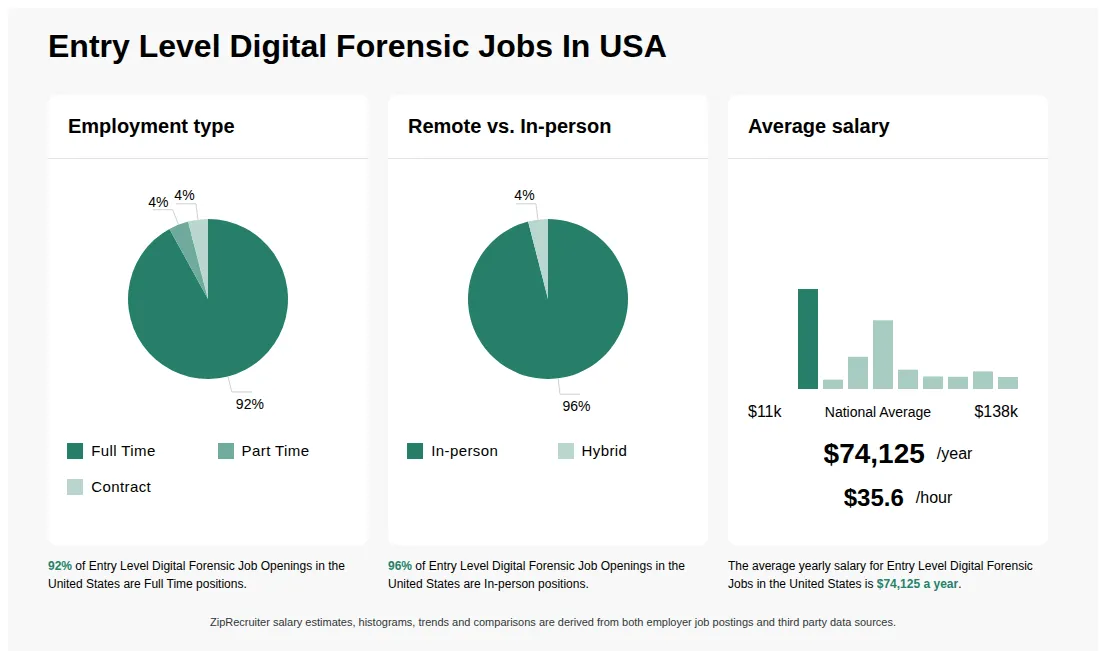
Entry Level Digital Forensic information
See salary details
$11K - $22.5K
0% of jobs
$22.5K - $34.1K
0% of jobs
$42.1K is the 25th percentile. Wages below this are outliers.
$34.1K - $45.6K
36% of jobs
$45.6K - $57.2K
3% of jobs
The median wage is $68.2K / yr.
$57.2K - $68.7K
11% of jobs
$80.2K is the 75th percentile. Wages above this are outliers.
$68.7K - $80.3K
25% of jobs
$80.3K - $91.8K
6% of jobs
$91.8K - $103.4K
4% of jobs
$103.4K - $114.9K
4% of jobs
$114.9K - $126.5K
6% of jobs
$126.5K - $138K
4% of jobs
$11K
$74.1K
$138K
How much do entry level digital forensic jobs pay per year?
As of Sep 7, 2026, the average yearly pay for entry level digital forensic in the United States is $74,125.00, according to ZipRecruiter salary data. Most workers in this role earn between $40,000.00 and $91,500.00 per year, depending on experience, location, and employer.
What is an entry level digital forensic?
An Entry Level Digital Forensic job involves assisting in the investigation and analysis of digital evidence related to cybercrimes, data breaches, or other incidents. Professionals in this role use forensic tools to recover, preserve, and examine digital data from various devices. They may work with law enforcement, private firms, or government agencies to support legal cases. Strong analytical skills, attention to detail, and familiarity with cybersecurity principles are essential. This role provides foundational experience for advancing in digital forensics and cybersecurity fields.
What does an entry level digital forensic do?
As an entry level digital forensic specialist, your day often involves collecting, preserving, and analyzing digital evidence from computers, mobile devices, or networks. You might assist in preparing reports of your findings, documenting your process to maintain a clear evidence chain, and supporting senior forensic analysts during more complex investigations. Teamwork is common, as you'll frequently collaborate with IT professionals, law enforcement, or legal teams, and may occasionally need to explain technical findings to non-technical stakeholders. While the pace can vary depending on ongoing cases, expect a mix of routine analysis and new learning opportunities as technology evolves.
What are the key skills and qualifications needed to thrive in an entry level digital forensic position?
Entry Level Digital Forensic professionals need foundational knowledge of computer systems, networks, and forensic methodologies, often supported by a degree in computer science, cybersecurity, or a related field. Familiarity with forensic software such as EnCase, FTK, or Autopsy and, in some positions, certifications like CompTIA Security+ or GIAC Certified Forensic Analyst (GCFA), is highly valued. Strong attention to detail, analytical thinking, and the ability to communicate findings clearly help candidates excel in this role. These skills are essential to ensure the integrity of digital evidence and to support effective investigations in legal or corporate environments.
More about Entry Level Digital Forensic jobs
What cities are hiring for Entry Level Digital Forensic jobs?
Cities with the most Entry Level Digital Forensic job openings:
What are the most commonly searched types of Digital Forensic jobs?
The most popular types of Digital Forensic jobs are:
What states have the most Entry Level Digital Forensic jobs?
States with the most job openings for Entry Level Digital Forensic jobs include:
What job categories do people searching Entry Level Digital Forensic jobs look for?
The top searched job categories for Entry Level Digital Forensic jobs are:

Full-time
Medical, Retirement, PTO
Posted 9 days ago
MUFG rating

8.1
Based on 7 frontline employees who took The Breakroom Quiz
Job description
Do you want your voice heard and your actions to count?
Discover your opportunity with Mitsubishi UFJ Financial Group (MUFG), one of the world's leading financial groups. Across the globe, we're 150,000 colleagues, striving to make a difference for every client, organization, and community we serve. We stand for our values, building long-term relationships, serving society, and fostering shared and sustainable growth for a better world.
With a vision to be the world's most trusted financial group, it's part of our culture to put people first, listen to new and diverse ideas and collaborate toward greater innovation, speed and agility. This means investing in talent, technologies, and tools that empower you to own your career.
Join MUFG, where being inspired is expected and making a meaningful impact is rewarded.
The selected colleague will work at an MUFG office or client sites four days per week and work remotely one day. A member of our recruitment team will provide more details.In this role, you will focus on researching potential cybersecurity threats to various systems, technologies, operations, and programs throughout multiple environments. You will perform analysis based on this research to determine the risk to the organization. Responsibilities include assisting in rapidly responding to potential incidents and events to minimize risk exposure and ensure confidentiality, integrity, and availability of assets and business processes. Additionally, the Digital Forensics & eDiscovery analyst assists Digital Forensics Examiners and eDiscovery professionals. This entry-level position is responsible for evidence intake, case administration, documentation, data handling, chain-of-custody maintenance, equipment management, and other support functions that enable forensic and eDiscovery investigations.
The role is designed for individuals beginning a career in digital forensics, cybersecurity, legal technology, or eDiscovery. The Assistant performs structured and repeatable tasks under supervision while developing knowledge of forensic processes, evidence handling procedures, legal hold requirements, data preservation practices, and investigative workflows.
The position does not perform independent forensic analysis or issue investigative conclusions. Instead, it serves as a foundational role supporting examiners and investigators throughout the lifecycle of a case.
Major Responsibilities
- Assist in performing cybersecurity threat detection, assessment, and mitigation efforts as part of a 24/7 global team
- Assist with investigations of potential cybersecurity events across multiple environments using various tools and techniques
- Conduct analysis of artifacts to determine methods of intrusion and best course of resolution while driving security improvement
- Support the development of information security policies, standards, and procedures
- Help create reports analyzing activities or trends both within and outside of the organization
- Support the development of security operations detections, playbooks, and automations to ensure threat detection, monitoring, response, and forensics activities align with best practices, minimize gaps in detection and response, and provide comprehensive mitigation of threats
- Support incident response activities across MUFG's global network
- Assist in the production of various reports which identify and analyze relevant upcoming and ongoing threats to the enterprise
- Research evolving threats, techniques, tools, and vulnerabilities in support of information security efforts
- Stay current with information security program developments, industry frameworks, changes in the company, industry trends, and current security practices
- Support inquiries from compliance teams such as IT risk management and internal and external auditors to ensure documentation is complete and processes are in compliance with information security policies
Qualifications
- Bachelor's degree in Cyber Security, Computer Science, or related discipline or equivalent work experience
- Experience in one or more security domains including Security Governance and Oversight, Security Risk Management, Network Security, Threat and Vulnerability Management, or Incident Response and Forensics preferred
Desired Skills
- Experience with security data collection, analysis and correlation
- Well-developed analytic, qualitative, and quantitative reasoning skills
- Demonstrated creative problem-solving abilities
- Security event monitoring, investigation, and overall incident response process
- Strong time management skills to balance multiple activities and lead junior analysts as needed
- Understanding of how to pivot across multiple datasets to correlate artifacts for a single security event
- Experienced with Endpoint Detection & Response, email security, web application firewall, an cloud security tooling.
- Ability to perform risk analysis utilizing logs and other information compiled from various sources
- Understanding of network protocols, operating systems (Windows, Unix, Linux, MacOS, databases), and mobile device security
- Knowledge of the various types of cyber-attacks and their implementations
- A fundamental understanding of enterprise cybersecurity frameworks such as MITRE ATT&CK and Cyber Kill Chain
- Ability to document and explain technical details in a concise, understandable manner
- Experience in operational processes such as security monitoring, data correlation, troubleshooting, security operations, etc.
Education
Bachelor's degree in Computer Science or a closely-related discipline, or an equivalent combination of formal education and experience
Visa sponsorship/support is based on business needs. We do not anticipate providing visa sponsorship/support for this position.
The typical base pay range for this role is as follows:
- New York / New Jersey: $85k-$123k
- Non-New York / New Jersey: $85k-$107k
depending on job-related knowledge, skills, experience and location. This role may also be eligible for certain discretionary performance-based bonus and/or incentive compensation. Additionally, our Total Rewards program provides colleagues with a competitive benefits package (in accordance with the eligibility requirements and respective terms of each) that includes comprehensive health and wellness benefits, retirement plans, educational assistance and training programs, income replacement for qualified employees with disabilities, paid maternity and parental bonding leave, and paid vacation, sick days, and holidays. For more information on our Total Rewards package, please click the link below.
Our hybrid work schedule is four days on-site and work remotely one day per week.
MUFG Benefits Summary
We will consider for employment all qualified applicants, including those with criminal histories, in a manner consistent with the requirements of applicable state and local laws (including (i) the San Francisco Fair Chance Ordinance, (ii) the City of Los Angeles' Fair Chance Initiative for Hiring Ordinance, (iii) the Los Angeles County Fair Chance Ordinance, and (iv) the California Fair Chance Act) to the extent that (a) an applicant is not subject to a statutory disqualification pursuant to Section 3(a)(39) of the Securities and Exchange Act of 1934 or Section 8a(2) or 8a(3) of the Commodity Exchange Act, and (b) they do not conflict with the background screening requirements of the Financial Industry Regulatory Authority (FINRA) and the National Futures Association (NFA). The major responsibilities listed above are the material job duties of this role for which the Company reasonably believes that criminal history may have a direct, adverse and negative relationship potentially resulting in the withdrawal of conditional offer of employment, if any.The above statements are intended to describe the general nature and level of work being performed. They are not intended to be construed as an exhaustive list of all responsibilities duties and skills required of personnel so classified.We are proud to be an Equal Opportunity Employer and committed to leveraging the diverse backgrounds, perspectives and experience of our workforce to create opportunities for our colleagues and our business. We do not discriminate on the basis of race, color, national origin, religion, gender expression, gender identity, sex, age, ancestry, marital status, protected veteran and military status, disability, medical condition, sexual orientation, genetic information, or any other status of an individual or that individual's associates or relatives that is protected under applicable federal, state, or local law.
About MUFG
Sourced by ZipRecruiter
Discover your opportunity with Mitsubishi UFJ Financial Group (MUFG), the 6th largest financial group in the world. Across the globe, we're 160,000 colleagues, striving to make a difference for every client, organization, and community we serve. We stand for our values, building long-term relationships, serving society, and fostering shared and sustainable growth for a better world. With a vision to be the world's most trusted financial group, it's part of our culture to put people first, listen to new and diverse ideas and collaborate toward greater innovation, speed and agility. This means investing in talent, technologies, and tools that empower you to own your career.
Industry
Banking and credit intermediation
Company size
10,000+ Employees
Headquarters location
New York, NY, US