We are recruiting across a wide range of experience levels from entry level engineers to senior and staff engineers. * Embedded Systems: Experience with embedded platforms (Jetson, Raspberry Pi, x86 ...
We are recruiting across a wide range of experience levels from entry level engineers to senior and staff engineers. * Embedded Systems: Experience with embedded platforms (Jetson, Raspberry Pi, x86 ...
Embedded Systems Engineer 3
Tualatin, OR · On-site
$90 - $130/hr
Embedded Systems Engineer 3 Date: Jul 25, 2026 Location: Tualatin, OR, US 97062 Worker Category: On-site Flex The group you'll be a part of In the Global Products Group, we are dedicated to ...
Embedded Systems Engineer 3
Tualatin, OR · On-site
$90 - $130/hr
Embedded Systems Engineer 3 Date: Jul 25, 2026 Location: Tualatin, OR, US 97062 Worker Category: On-site Flex The group you'll be a part of In the Global Products Group, we are dedicated to ...
Embedded Systems Engineer, Autonomous Vehicles - Federal
Irvine, CA · On-site
$100K - $240K/yr
We are recruiting across a wide range of experience levels from entry level engineers to senior and staff engineers. * Embedded Systems: Experience with embedded platforms (Jetson, Raspberry Pi, x86 ...
Embedded Systems Engineer, Autonomous Vehicles - Federal
Irvine, CA · On-site
$100K - $240K/yr
We are recruiting across a wide range of experience levels from entry level engineers to senior and staff engineers. * Embedded Systems: Experience with embedded platforms (Jetson, Raspberry Pi, x86 ...
We are recruiting across a wide range of experience levels from entry level engineers to senior and staff engineers. * Embedded Systems: Experience with embedded platforms (Jetson, Raspberry Pi, x86 ...
Quick apply
We are recruiting across a wide range of experience levels from entry level engineers to senior and staff engineers. * Embedded Systems: Experience with embedded platforms (Jetson, Raspberry Pi, x86 ...

Senior Embedded Systems Engineer
San Diego, CA · On-site
$120K - $200K/yr
About this position We are looking for a hands-on Senior Embedded Systems Engineer to join our team. You will work in the domain where software meets hardware, from troubleshooting hardware during ...
Senior Embedded Systems Engineer
San Diego, CA · On-site
$120K - $200K/yr
About this position We are looking for a hands-on Senior Embedded Systems Engineer to join our team. You will work in the domain where software meets hardware, from troubleshooting hardware during ...
Embedded Systems Engineer, Robotics Hardware
Irvine, CA · On-site
$120K - $200K/yr
We are recruiting across a wide range of experience levels from entry level engineers to senior and staff engineers. * Embedded Systems: Experience with embedded platforms (Jetson, Raspberry Pi, x86 ...
Embedded Systems Engineer, Robotics Hardware
Irvine, CA · On-site
$120K - $200K/yr
We are recruiting across a wide range of experience levels from entry level engineers to senior and staff engineers. * Embedded Systems: Experience with embedded platforms (Jetson, Raspberry Pi, x86 ...
We are recruiting across a wide range of experience levels from entry level engineers to senior and staff engineers. * Embedded Systems: Experience with embedded platforms (Jetson, Raspberry Pi, x86 ...
We are recruiting across a wide range of experience levels from entry level engineers to senior and staff engineers. * Embedded Systems: Experience with embedded platforms (Jetson, Raspberry Pi, x86 ...
What You Will Do Firmware, Networking & Gateway Systems * Develop andmaintainproduction embedded ... Practical electrical engineering experience, including reading schematics, reviewing PCB layouts ...
What You Will Do Firmware, Networking & Gateway Systems * Develop andmaintainproduction embedded ... Practical electrical engineering experience, including reading schematics, reviewing PCB layouts ...
Embedded Systems Engineer, Robotics Hardware
$120K - $200K/yr
We are recruiting across a wide range of experience levels from entry level engineers to senior and staff engineers. * Embedded Systems: Experience with embedded platforms (Jetson, Raspberry Pi, x86 ...
Quick apply
Embedded Systems Engineer, Robotics Hardware
$120K - $200K/yr
We are recruiting across a wide range of experience levels from entry level engineers to senior and staff engineers. * Embedded Systems: Experience with embedded platforms (Jetson, Raspberry Pi, x86 ...

The impact you'll make As an Embedded HW/FW Engineer at Lam, you'll design complex systems, or products for our wafer fabrication equipment. You will define system specifications, requirements ...
The impact you'll make As an Embedded HW/FW Engineer at Lam, you'll design complex systems, or products for our wafer fabrication equipment. You will define system specifications, requirements ...
What You Will Do Firmware, Networking & Gateway Systems * Develop andmaintainproduction embedded ... Practical electrical engineering experience, including reading schematics, reviewing PCB layouts ...
Quick apply
What You Will Do Firmware, Networking & Gateway Systems * Develop andmaintainproduction embedded ... Practical electrical engineering experience, including reading schematics, reviewing PCB layouts ...
Embedded Systems Engineer 3
Tualatin, OR · On-site
The impact you'll make As an Embedded HW/FW Engineer at Lam, you'll design complex systems, or products for our wafer fabrication equipment. You will define system specifications, requirements ...
Embedded Systems Engineer 3
Tualatin, OR · On-site
The impact you'll make As an Embedded HW/FW Engineer at Lam, you'll design complex systems, or products for our wafer fabrication equipment. You will define system specifications, requirements ...

Cleared System Engineer (Entry Level)
Hanover, MD · On-site
$85K/yr
System Engineer (Entry Level) Summary Join a team supporting the engineering and development of ... embedded systems, data science, DevSecOps, and more. We believe exceptional people deserve ...
Cleared System Engineer (Entry Level)
Hanover, MD · On-site
$85K/yr
System Engineer (Entry Level) Summary Join a team supporting the engineering and development of ... embedded systems, data science, DevSecOps, and more. We believe exceptional people deserve ...
System Engineer (Entry Level) Summary Join a team supporting the engineering and development of ... embedded systems, data science, DevSecOps, and more. We believe exceptional people deserve ...
Quick apply
System Engineer (Entry Level) Summary Join a team supporting the engineering and development of ... embedded systems, data science, DevSecOps, and more. We believe exceptional people deserve ...

C++ Embedded systems Engineer
Franksville, WI · On-site
$129K - $170K/yr
The interviewers will ask technical questions about C++ and object oriented programming and understanding of embedded systems 2.) RTOS experience and multithreading...understanding concepts of ...
C++ Embedded systems Engineer
Franksville, WI · On-site
$129K - $170K/yr
The interviewers will ask technical questions about C++ and object oriented programming and understanding of embedded systems 2.) RTOS experience and multithreading...understanding concepts of ...

Software Engineer - Embedded Systems (Entry Level)
Columbus, OH · On-site
$71K - $101K/yr
Job Summary We are currently seeking a Software Engineer - Embedded Systems (Entry Level). This position is a full-time opportunity located in Columbus, OH. The selected candidate will assist in the ...
Software Engineer - Embedded Systems (Entry Level)
Columbus, OH · On-site
$71K - $101K/yr
Job Summary We are currently seeking a Software Engineer - Embedded Systems (Entry Level). This position is a full-time opportunity located in Columbus, OH. The selected candidate will assist in the ...

As a Junior Embedded Systems Developer, you will work alongside experienced vulnerability researchers, reverse engineers, and embedded developers who analyze embedded platforms across a wide range of ...
As a Junior Embedded Systems Developer, you will work alongside experienced vulnerability researchers, reverse engineers, and embedded developers who analyze embedded platforms across a wide range of ...
Programming: Python (Medium/High), C++ (Medium/High), ROS/ROS2 (Low/Medium/High). * Tools & DevOps: ... Embedded Systems: ARM architectures, IoT platforms/services, firmware management, OTA updates.
Programming: Python (Medium/High), C++ (Medium/High), ROS/ROS2 (Low/Medium/High). * Tools & DevOps: ... Embedded Systems: ARM architectures, IoT platforms/services, firmware management, OTA updates.
As a Junior Embedded Systems Developer, you will work alongside experienced vulnerability researchers, reverse engineers, and embedded developers who analyze embedded platforms across a wide range of ...
As a Junior Embedded Systems Developer, you will work alongside experienced vulnerability researchers, reverse engineers, and embedded developers who analyze embedded platforms across a wide range of ...
C++ Embedded systems Engineer
Franksville, WI · On-site
$129K - $170K/yr
The interviewers will ask technical questions about C++ and object oriented programming and understanding of embedded systems 2.) RTOS experience and multithreading...understanding concepts of ...
C++ Embedded systems Engineer
Franksville, WI · On-site
$129K - $170K/yr
The interviewers will ask technical questions about C++ and object oriented programming and understanding of embedded systems 2.) RTOS experience and multithreading...understanding concepts of ...
Embedded Systems Engineer Entry Level information
See salary details
$62.5K - $74.3K
1% of jobs
$74.3K - $86K
2% of jobs
$86K - $97.8K
6% of jobs
$97.8K - $109.6K
13% of jobs
$112.1K is the 25th percentile. Wages below this are outliers.
$109.6K - $121.4K
14% of jobs
$121.4K - $133.1K
12% of jobs
The median wage is $135.6K / yr.
$133.1K - $144.9K
13% of jobs
$144.9K - $156.7K
12% of jobs
$160.2K is the 75th percentile. Wages above this are outliers.
$156.7K - $168.5K
12% of jobs
$168.5K - $180.2K
11% of jobs
$180.2K - $192K
6% of jobs
$62.5K
$137.3K
$192K
How much do embedded systems engineer entry level jobs pay per year?
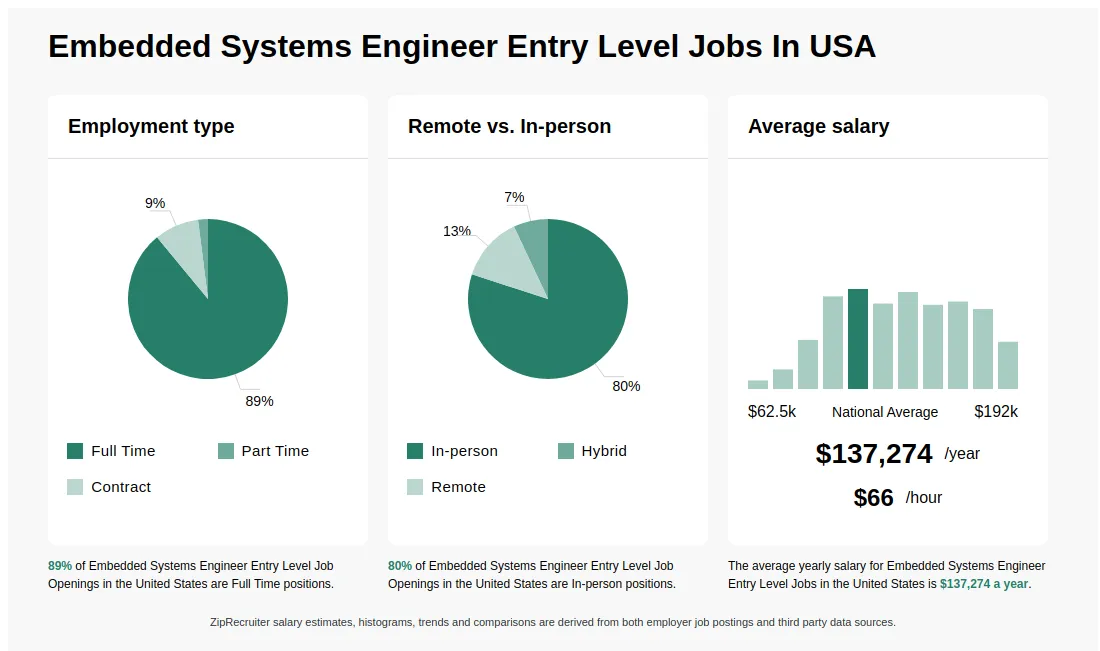
As of Sep 7, 2026, the average yearly pay for embedded systems engineer entry level in the United States is $137,274.00, according to ZipRecruiter salary data. Most workers in this role earn between $111,500.00 and $163,500.00 per year, depending on experience, location, and employer.
What does an entry-level embedded systems engineer do?
As an entry-level embedded systems engineer, you carry out your duties under the supervision of an experienced embedded systems engineer to learn the necessary responsibilities and skills for the job. Entry-level embedded systems jobs include tasks that focus on hardware and software design and the components that go along with them. You design, troubleshoot, and test hardware and software, electronic circuits, mechanical equipment and machines, and other systems related to computers and computer equipment. Entry-level embedded systems engineer roles are usually for recent or soon-to-be graduates of a bachelor’s degree program in computer science, computer engineering, or a similar field.
What are the key skills and qualifications needed to thrive as an entry-level embedded systems engineer?
To thrive as an Entry-Level Embedded Systems Engineer, you need a solid understanding of C/C++ programming, microcontroller architectures, and basic electronics, usually backed by a bachelor's degree in electrical engineering, computer engineering, or a related field. Familiarity with tools such as oscilloscopes, debuggers, integrated development environments (IDEs) like Keil or Eclipse, and version control systems like Git is typical. Strong problem-solving skills, attention to detail, and effective teamwork help you excel in this collaborative and detail-oriented environment. These competencies are crucial for developing reliable embedded solutions that meet technical requirements and project deadlines.
More about Embedded Systems Engineer Entry Level jobs
What cities are hiring for Embedded Systems Engineer Entry Level jobs?
Cities with the most Embedded Systems Engineer Entry Level job openings:
What are the most commonly searched types of Embedded Systems Engineer jobs?
The most popular types of Embedded Systems Engineer jobs are:
What states have the most Embedded Systems Engineer Entry Level jobs?
States with the most job openings for Embedded Systems Engineer Entry Level jobs include:
What job categories do people searching Embedded Systems Engineer Entry Level jobs look for?
The top searched job categories for Embedded Systems Engineer Entry Level jobs are:

Full-time
Re-posted 28 days ago
Job description
Who are We?
Field AI is transforming how robots interact with the real world. We are building risk-aware, reliable, and field-ready AI systems that address the most complex challenges in robotics, unlocking the full potential of embodied intelligence. We go beyond typical data-driven approaches or pure transformer-based architectures, and are charting a new course, with already-globally-deployed solutions delivering real-world results and rapidly improving models through real-field applications.
Learn more at https://fieldai.com.
About the Job
At FieldAI, we build autonomous robotic systems that operate in demanding, real-world environments where tight integration between hardware and software is critical. We're looking for an Embedded Systems Engineer to support design, implementation, integration, and , deployment of wheeled robotic platforms across both federal and commercial programs
Embedded Systems Role:
As an Embedded Systems Engineer on the Federal Team at Field AI, you will contribute to the architecture, configuration, and validation of the compute systems that serve as the backbone for our robotic platforms. Your work will span low-level firmware, Linux-based configuration, and system performance analysis across ARM and x86 SBC platforms. From firmware on microcontrollers to ROS data streams on SBCs, you'll ensure the entire compute stack is optimized, reliable, and robust under field conditions. You will collaborate closely with the sensor, electrical, and autonomy teams to build tightly integrated solutions ready for deployment in challenging field environments. Additionally, while your focus will be on computing systems you will likely contribute across all hardware domains.
What You Will Get To Do
1. Compute System Design
Compute Architecture: Architect and configure embedded compute platforms (ARM/x86, SBCs) for robotic applications including evaluation, testing and selection.
Firmware & Software: Set up and customize Linux environments (Ubuntu, Yocto, JetPack), middleware (ROS), and I/O interfaces.
Systems Integration: Integrate compute with sensing and robotic systems. Analyze thermal, power, and bandwidth constraints to meet deployment and runtime requirements.
2. Compute System Implementation
Communications: Bring up sensors and peripherals using a range of protocols (USB, Ethernet, GMSL, IC, SPI, CAN).
Data Pipelines: Build and maintain drivers, ROS nodes, and data acquisition pipelines for new hardware components.
Systems Configuration: Create configuration files, launch scripts, and firmware update workflows.
Testing: Conduct system-level tests such as thermal profiling, latency measurement, and power draw analysis.
Documentation & Budgets: Maintain flashing procedures, I/O maps, and debug kits. Manage compute and I/O budgets.
3. Compute System Production & Servicing
Build: Work with vendors to procure compute hardware. Develop QA checks for incoming units. Support payload integration and scaling.
Debug: Support root-cause analysis for boot, connectivity, and throughput issues.
Diagnostics Monitoring: Implement watchdogs, health checks, and other evaluation tools. Monitor compute system performance across CPU, GPU, memory, I/O, and networking.
What You Have
Education: B.S., M.S., or Ph.D. in Computer Engineering, Robotics, Electrical Engineering, or a related field.
Experience Level: We are recruiting across a wide range of experience levels from entry level engineers to senior and staff engineers.
Embedded Systems: Experience with embedded platforms (Jetson, Raspberry Pi, x86 NUCs, custom SBCs).
Linux: Proficiency with Linux system configuration, scripting, and headless deployment tools.
Firmware: Strong skills in firmware development for microcontrollers, including bare-metal and RTOS environments.
Programming: Proficient in C++ and Python for embedded and application-level development.
Communication Protocols: Experience with USB, Ethernet, IC, SPI, CAN, GMSL, and similar interfaces.
ROS Ecosystem: Familiarity with ROS, device drivers, TF, and data streaming/publishing.
Debugging: Comfort with hardware/software debugging tools (oscilloscopes, logs, power monitors, analyzers).
Systems Thinking: Ability to diagnose and optimize across compute, thermal, timing, and I/O layers.
What Will Set You Apart
Scaling: Experience taking systems from prototype to large scale production.
Field Environments: Experience developing systems for harsh field environments.
Deployed Robotics: Experience working on robotics deployed in real world settings such as autonomous vehicles, drones, or ruggedized robots.
Systems Level Robotics: Fluency across software, electrical, and mechanical systems.
Autonomy Software: Knowledge of autonomy stacks used in robotics. As well as how compute performance impacts autonomy algorithms.
This position is for our FieldAI Federal Team. This team works on projects connected to the U.S. government which requires U.S. Person eligibility. A U.S. Person as defined by 22 C.F.R 120.62 includes U.S. Citizen, U.S. National, lawful permanent residents (green card holders) refugee or asylee.
Compensation
The salary range for this role is $70,000-$300,000. The actual offer for this position will be based on factors such as relevant experience, competencies, certifications, and how well the candidate meets the qualifications outlined above. Part of our compensation package also includes full benefits, equity, and generous time off.
Field AI Onsite Work Philosophy
At Field AI, we believe the most effective way to collaborate and solve complex challenges is by working together in person. This is a fully onsite role, and candidates will be expected to work from our Mission Viejo, CA office. In-person engagement is essential to our success, and we offer flexible working hours to support focus and work-life balance.
$100,000 - $240,000 a year
This position is for our FieldAI Federal Team. This team works on projects connected to the U.S. government which requires U.S. Person eligibility. A U.S. Person as defined by 22 C.F.R 120.62 includes U.S. Citizen, U.S. National, lawful permanent residents (green card holders) refugee or asylee.
Why Join Field AI?
We are solving one of the world's most complex challenges: deploying robots in unstructured, previously unknown environments. Our Field Foundational Models set a new standard in perception, planning, localization, and manipulation, ensuring our approach is explainable and safe for deployment.
You will have the opportunity to work with a world-class team that thrives on creativity, resilience, and bold thinking. With a decade-long track record of deploying solutions in the field, winning DARPA challenge segments, and bringing expertise from organizations like DeepMind, NASA JPL, Boston Dynamics, NVIDIA, Amazon, Tesla Autopilot, Cruise Self-Driving, Zoox, Toyota Research Institute, and SpaceX, we are set to achieve our ambitious goals.
Be Part of the Next Robotics Revolution
To tackle such ambitious challenges, we need a team as unique as our vision - innovators who go beyond conventional methods and are eager to tackle tough, uncharted questions. We're seeking individuals who challenge the status quo, dive into uncharted territory, and bring interdisciplinary expertise. Our team requires not only top AI talent but also exceptional software developers, engineers, product designers, field deployment experts, and communicators.
We are headquartered in always-sunny Irvine, Southern California and have US based and global teammates.
Join us, shape the future, and be part of a fun, close-knit team on an exciting journey!
We celebrate diversity and are committed to creating an inclusive environment for all employees. Candidates and employees are always evaluated based on merit, qualifications, and performance. We will never discriminate on the basis of race, color, gender, national origin, ethnicity, veteran status, disability status, age, sexual orientation, gender identity, marital status, mental or physical disability, or any other legally protected status.
We may use artificial intelligence (AI) tools to support parts of the hiring process, such as reviewing applications, analyzing resumes, or assessing responses and identifying potential inconsistencies or verification signals in application materials based on available information. These tools assist our recruitment team but do not replace human judgment. Final hiring decisions are ultimately made by humans. If you would like more information about how your data is processed, please contact us.
apply for this job

About Field AI
Sourced by ZipRecruiter