1

Electronics Repair Technician Jobs (NOW HIRING)

Description As an Electronics Repair Technician , you will diagnose, troubleshoot, repair, calibrate, and test a wide variety of electronic equipment used in marine survey and underwater technology ...

Be Seen First

Our business continues to grow and we are looking to add additional Electronic Repair Technicians to our team to keep up with demand! In search of one "in-shop" Repair Technician, and one ...

Electronics Repair Tech

Dallas, TX · On-site

$26 - $30/hr

1st & 2nd Shift Available Electronics Repair Technician Job Duties: * Performs the set-up, testing, calibration, and troubleshooting of SMRT products. Electronics Repair Technician Required Skills:

next page

Showing results 1-20

Electronics Repair Technician information

See salary details

$12

$24

$39

How much do electronics repair technician jobs pay per hour?

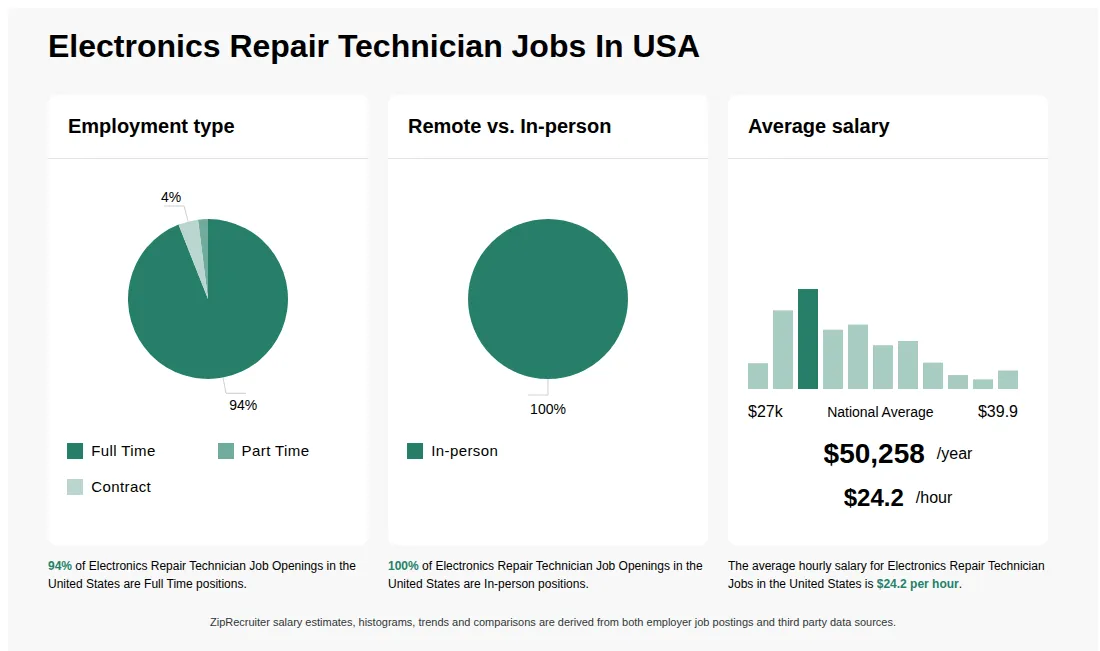
As of Jul 29, 2026, the average hourly pay for electronics repair technician in the United States is $24.16, according to ZipRecruiter salary data. Most workers in this role earn between $18.27 and $28.61 per hour, depending on experience, location, and employer.

What is the highest paid job in electronics?

In the electronics field, senior engineering roles such as Electronics Engineering Managers or Systems Engineers tend to be the highest paid, often earning six-figure salaries. These positions typically require advanced technical skills, certifications, and experience in designing, developing, or managing electronic systems.

What is the difference between Electronics Repair Technician vs Electronics Assembler?

AspectElectronics Repair TechnicianElectronics Assembler
Required CredentialsHigh school diploma, technical certifications, troubleshooting skillsHigh school diploma, basic technical knowledge
Work EnvironmentRepair shops, manufacturing facilities, electronics labsAssembly lines, manufacturing plants
Job FocusDiagnosing and repairing electronic devicesAssembling electronic components and devices
Common EmployersElectronics repair shops, consumer electronics companiesElectronics manufacturing companies, assembly plants

Electronics Repair Technicians focus on diagnosing and fixing electronic devices, requiring troubleshooting skills and certifications. In contrast, Electronics Assemblers primarily work on putting together electronic components on production lines. Both roles are essential in the electronics industry but differ in responsibilities and work environments.

What are some common challenges Electronics Repair Technicians face when troubleshooting complex devices?

Electronics Repair Technicians often encounter challenges such as diagnosing intermittent faults, interpreting schematics for unfamiliar or proprietary equipment, and sourcing obsolete or hard-to-find components. Effective troubleshooting requires patience, strong analytical skills, and sometimes collaboration with engineers or manufacturers for technical support. Staying current with new technologies is also essential, as devices frequently incorporate updated circuitry and diagnostic protocols.

What does an Electronics Repair Technician do?

An Electronics Repair Technician is responsible for diagnosing, troubleshooting, and repairing electronic equipment and devices such as computers, televisions, smartphones, and industrial machinery. They use specialized tools and testing equipment to identify problems, replace faulty components, and ensure devices function properly. These technicians often work in repair shops, manufacturing facilities, or on-site at customer locations, keeping up-to-date with the latest electronic systems and repair techniques.

Is electronics repair a good career?

Electronics repair is a stable career that involves diagnosing and fixing electronic devices, often requiring technical skills and certifications. It offers opportunities in various industries such as consumer electronics, telecommunications, and manufacturing, with job prospects influenced by technological advancements and demand for repair services.

Is electronics technician a good career?

Electronics technicians install, repair, and maintain electronic equipment, often working in industries such as telecommunications, manufacturing, or consumer electronics. The career offers steady employment opportunities, requires technical skills, and may require certifications or an associate degree. Job prospects are generally favorable with experience and specialized knowledge.

What are the key skills and qualifications needed to thrive as an Electronics Repair Technician, and why are they important?

To thrive as an Electronics Repair Technician, you need a solid understanding of electronic principles, circuit analysis, and troubleshooting, typically supported by a technical diploma or associate degree in electronics. Familiarity with diagnostic tools such as multimeters, oscilloscopes, soldering equipment, and relevant certifications like IPC or ETA can be crucial. Attention to detail, problem-solving, and effective communication help technicians accurately diagnose issues and interact with clients or team members. These skills and qualities are essential for ensuring precise repairs, maintaining safety standards, and delivering reliable service in a technology-driven environment.

What Are the Duties and Responsibilities of a Electronics Repair Technician?

The duties and responsibilities of an electronics repair technician revolve around working to repair electronic equipment in a variety of different settings. In addition to repair, in this career, you may work on the calibration of equipment, or you may perform tests to assess the performance of an electronic system or device and replace a component if necessary. While working in the field, you need the skills to troubleshoot and solve unexpected problems. A good repair technician adjusts their repair plans to address all issues related to the equipment that they are repairing.

What does an electronic repair technician do?

An electronic repair technician diagnoses, repairs, and maintains electronic devices and systems, such as computers, circuit boards, and consumer electronics. They use tools like multimeters and soldering equipment, often working in repair shops or service centers, and may need certifications like CompTIA A+ or IPC certifications to demonstrate their skills.
What cities are hiring for Electronics Repair Technician jobs? Cities with the most Electronics Repair Technician job openings:
What are the most commonly searched types of Electronics Repair Technician jobs? The most popular types of Electronics Repair Technician jobs are:
Who are the top companies hiring for Electronics Repair Technician jobs? The top employers for Electronics Repair Technician jobs are:
What states have the most Electronics Repair Technician jobs? States with the most job openings for Electronics Repair Technician jobs include:
Infographic showing various Electronics Repair Technician job openings in the United States as of July 2026, with employment types broken down into 93% Full Time, 6% Part Time, and 1% Contract. Highlights an 97% Physical, 1% Hybrid, and 2% Remote job distribution, with an average salary of $50,258 per year, or $24.2 per hour.

Electronics Repair Technician

Orion Talent

Katy, TX • On-site

Full-time

Posted 16 days ago


Job description

Description
As an Electronics Repair Technician, you will diagnose, troubleshoot, repair, calibrate, and test a wide variety of electronic equipment used in marine survey and underwater technology applications, including Unmanned Surface Vehicles (USVs) and Remotely Operated Vehicles (ROVs). You'll ensure repaired and rental equipment meets operational and quality standards before being returned to service.
This is an excellent opportunity for technicians with military electronics experience or commercial electronics repair backgrounds who enjoy hands-on troubleshooting, component-level repair, and working with sophisticated electronic systems. You'll support repair operations, equipment testing, inventory, and occasional field service while working independently and as part of a technical team.
Responsibilities
  • Diagnose, troubleshoot, and repair electronic equipment and assemblies.
  • Inspect and test electronic systems to identify faults and failures.
  • Read and interpret electrical schematics, wiring diagrams, and technical manuals.
  • Perform component-level soldering and electronic repairs.
  • Utilize multimeters and other electronic diagnostic equipment.
  • Calibrate, configure, and functionally test repaired equipment.
  • Inspect, test, and document returned rental equipment before restocking.
  • Maintain accurate repair documentation and service records.
  • Support equipment installation, setup, and occasional field service.
  • Assist with inventory management and procurement of repair parts.
  • Coordinate occasional equipment pickups and deliveries.
  • Communicate repair findings and recommendations with customers and internal personnel.
Must-Have Skills, Experience, and Education
  • Associate degree or technical certification in Electronics, Electrical Engineering Technology, or a related technical field OR equivalent military or commercial electronics experience.
  • Two or more years of experience troubleshooting, diagnosing, repairing, or maintaining electronic equipment preferred.
  • Strong understanding of analog and digital electronic circuits.
  • Ability to read and interpret electrical schematics and wiring diagrams.
  • Experience using multimeters and electronic diagnostic equipment.
  • Proficiency with soldering, including surface-mount and through-hole components.
  • Strong troubleshooting, analytical, and problem-solving skills.
  • Ability to work independently with minimal supervision.
  • Strong organizational and communication skills.
  • Valid driver's license with a clean driving record preferred.
  • Ability to lift up to 60 pounds.
Nice-to-Have Skills
  • Marine electronics experience.
  • Experience with Remotely Operated Vehicles (ROVs) or Autonomous Underwater Vehicles (AUVs).
  • Sonar or marine positioning systems.
  • Computer networking knowledge.
  • Firmware installation and software updates.
  • Circuit board, sensor, and power supply repair.
  • Equipment calibration and functional testing.
  • Field service or customer support experience.
  • Inventory management and repair parts procurement.
  • Experience supporting technical equipment rentals and inspections.