1

Electrical Engineer Navy Jobs (NOW HIRING)

Applicants must be willing to learn about Navy equipment and processes, and leverage past ... Electrical engineering and electronics design skills * Organization skills, tracking various ...

Electrical Engineer

Norfolk, VA · On-site

$100K - $110K/yr

Applicants must be willing to learn about Navy equipment and processes, and leverage past ... Electrical engineering and electronics design skills * Organization skills, tracking various ...

next page

Showing results 1-20

Electrical Engineer Navy information

See salary details

$50.5K

$111.1K

$168K

How much do electrical engineer navy jobs pay per year?

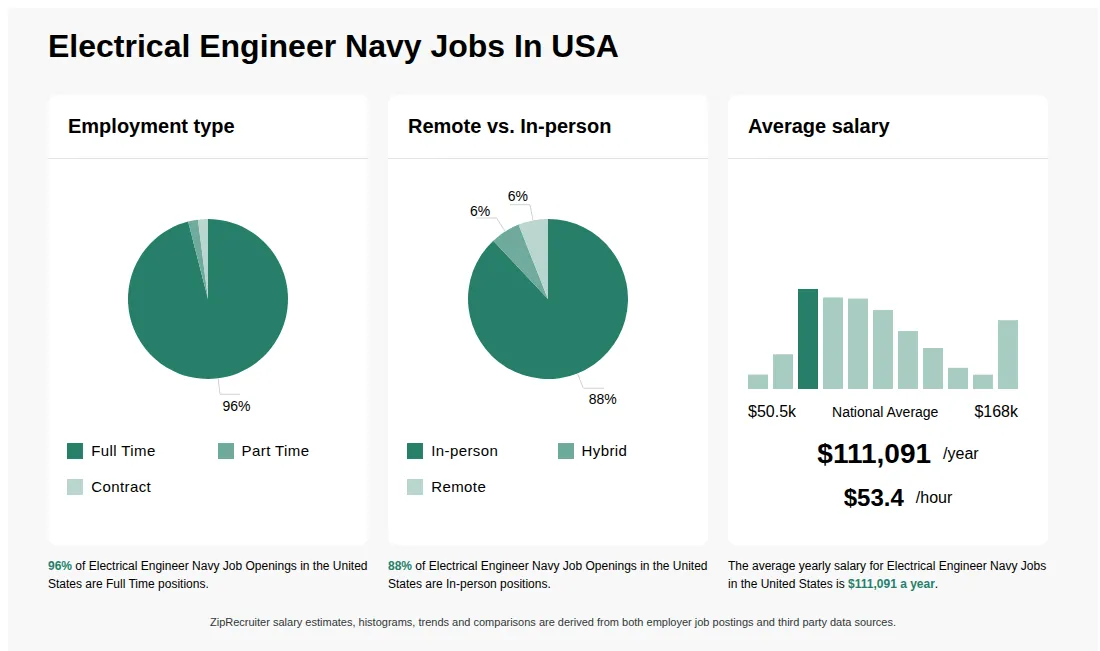
As of Jun 14, 2026, the average yearly pay for electrical engineer navy in the United States is $111,091.00, according to ZipRecruiter salary data. Most workers in this role earn between $83,000.00 and $132,000.00 per year, depending on experience, location, and employer.

Can you make $500,000 as an Electrical Engineer?

Electrical engineers, including those in the Navy, typically earn salaries below $500,000 annually. High earnings are usually associated with senior roles, specialized skills, management positions, or consulting work, which can significantly increase income but are less common in standard engineering roles.

What engineers make $500,000?

Highly experienced engineers in specialized fields such as aerospace, petroleum, or certain senior roles in software engineering can earn $500,000 or more annually. These positions often require advanced skills, certifications, and leadership responsibilities, and compensation may include bonuses and stock options.

What do electrical engineers do in the navy?

Electrical engineers in the navy design, develop, and maintain electrical systems and equipment used on ships, submarines, and aircraft. They work with power distribution, communication systems, radar, and navigation technology, often using tools like circuit analyzers and simulation software. Their role ensures the reliability and safety of critical electronic systems in a military environment.

What types of projects or systems do Electrical Engineers typically work on in the Navy?

Electrical Engineers in the Navy commonly work on a wide range of projects, including shipboard electrical power systems, navigation and radar systems, communications infrastructure, and weapons control circuits. You may be involved in both the design and maintenance of these systems, collaborating closely with other engineers, technicians, and operational personnel to ensure mission readiness. The work environment is often dynamic and can include both office-based design tasks and hands-on troubleshooting aboard ships or at shipyards. This variety allows engineers to develop specialized expertise in military technology and offers excellent growth prospects as you gain experience and take on increasing responsibilities.

What are the key skills and qualifications needed to thrive in the Electrical Engineer Navy position, and why are they important?

To thrive as an Electrical Engineer in the Navy, you need a solid background in electrical engineering principles, a relevant degree, and, often, a Professional Engineer (PE) license. Familiarity with Navy-specific systems, electrical modeling software, and adherence to military standards like MIL-STD is essential. Strong problem-solving skills, teamwork, adaptability, and effective communication set candidates apart. These competencies are crucial for maintaining operational readiness, ensuring compliance with safety standards, and supporting complex mission-critical systems.

What does an Electrical Engineer do in the Navy?

An Electrical Engineer in the Navy is responsible for designing, maintaining, and troubleshooting electrical systems on naval ships, submarines, and shore facilities. They work with power distribution, communications, radar, and weapon systems to ensure operational readiness. Their duties may include testing new technologies, overseeing repairs, and ensuring compliance with safety regulations. This role requires strong problem-solving skills and a solid understanding of electrical engineering principles.

What engineers make $300,000 a year?

Senior electrical engineers, especially those in specialized fields such as aerospace, semiconductor, or power systems, can earn $300,000 or more annually with experience, advanced skills, and often in leadership roles. High-level positions may also include project managers or engineering directors with extensive expertise and certifications like PE (Professional Engineer).
More about Electrical Engineer Navy jobs
What cities are hiring for Electrical Engineer Navy jobs? Cities with the most Electrical Engineer Navy job openings:
What are the most commonly searched types of Electrical Engineer Navy jobs? The most popular types of Electrical Engineer Navy jobs are:
Infographic showing various Electrical Engineer Navy job openings in the United States as of June 2026, with employment types broken down into 92% Full Time, 7% Part Time, and 1% Contract. Highlights an 87% Physical, 5% Hybrid, and 8% Remote job distribution, with an average salary of $111,091 per year, or $53.4 per hour.
Electrical Engineer

$100K - $110K/yr

Full-time

Posted 13 days ago


Job description

SALARY RANGE: $100K - $110K per year

In determining compensation, various factors will be considered, including but not limited to, educational background; relevant experience, knowledge, skills, and abilities, market factors; and geographic location.

GENERAL SUMMARY: Delphinus Engineering is seeking an Electrical Engineer to support our customers with US Navy tasking. This position will support the Naval Surface Warfare Center Philadelphia Division (NSWCPD) with various Hull, Mechanical, & Electrical (HM&E) systems. Applicants should possess skills in engineering project support and have strong electrical engineering experience. Applicants must be willing to learn about Navy equipment and processes, and leverage past experience into design, development, test, and life-cycle support. Applicants will also support design, qualification, verification and validation testing, maintenance processes, Technical Manual development, drawings and schematics, logistics support systems and reliability support of shipboard equipment. Applicants should possess the ability to work with teams, communicate with professionals in other disciplines, and navy personnel. The position will complete assigned tasking and work with teams including Navy customer personnel and other organizations to provide solutions to the fleet.

LOCATION: Norfolk, VA.

PRINCIPAL DUTIES & RESPONSIBILITIES:

  • Collaborate with personnel supporting various aspects of the machinery information systems teams at NSWCPD to assist with program execution.
  • Support existing systems delivered to the Navy and advise Navy personnel on strategies for upgrading, life cycle support, and maintenance of battery systems aboard Navy ships.
  • Advise Navy teams on system architecture, design and development strategies, and optimize development, test, and fielding plans.
  • Generate, modify, and review requirements and design specifications and assist with the Navy’s systems engineering process for development and test of shipboard systems.
  • Generate and execute test plans and procedures. Support performance of validation and verification testing of shipboard HM&E systems.
  • Troubleshoot, modify, construct and test various types of electrical and/or Navy shipboard equipment.
  • Create and update technical documentation such as users’ manuals, product specifications, and training materials.
  • Apply technical knowledge of batteries, power management, safety systems, and engineering principles in order to support shipboard and lab operations and solve complex problems.
  • Troubleshoot and correct malfunctions using specialized test and diagnostic equipment such as network traffic analyzers, digital multi-meters, or oscilloscopes
  • Make recommendations for improvements or modifications to correct problems.
  • Track issues identified in test or deployment to resolution through the product lifecycle.
  • Prepare operating and malfunction reports and related documentation.
  • Assist with quality assurance testing of assemblies and equipment fabricated by other technicians.
  • Participate in special projects as required.

REQUIRED EDUCATION & EXPERIENCE:

  • Bachelor’s Degree in Electrical Engineering
  • 5 or more years of experience in engineering experience

SKILLS / REQUIREMENTS:

  • Electrical engineering and electronics design skills
  • Organization skills, tracking various efforts, tasks, and people progressing on project activities
  • Ability to understand priorities and anticipate project risks and needs
  • Effective time management skills.
  • Ability to identify risks to deadlines and communicate plans to avoid / mitigate risks and deliver on-time
  • Ability to collaborate on a large, geographically distributed, cross functional team
  • Ability to work independently
  • Strong written and verbal communication skills
  • Understanding of process definition and frameworks (such as ISO, CMMI, etc.)
  • Familiarity with collaboration tools such as JIRA, Confluence, ClearQuest
  • Familiarity with software such as AutoDesk / AutoCAD, Microsoft Project, Visio
  • Familiarity with PLCs preferred

SPECIAL REQUIREMENTS:

  • Candidates must have an active government security clearance or the ability to obtain security clearance
  • Travel may be up to 40% at times, but will typically average less. Work will be executed at Delphinus offices, customer sites, and remotely.

WORKING CONDITIONS:

  • The work is often performed at client site locations in an office and lab environments. Additional work may be performed onboard US Navy Ships (pier side and at sea), which requires proper safety precautions and ability to go up and down shipboard stairways (ladders); work may require some physical effort in the handling of light materials, boxes, or equipment.
  • Requests for reasonable accommodations will be considered to enable individuals with disabilities to perform the principal (essential) functions of this job.
  • The above job description is not intended to be, nor should it be construed as exhaustive of all responsibilities, skills, efforts, or working conditions associated with this job.