The EEG Monitor Watcher observes patients and EEG studies via the use of technology under the close ... Provides virtual continual observation and monitoring of multiple patients at a time using SLUHN ...
The EEG Monitor Watcher observes patients and EEG studies via the use of technology under the close ... Provides virtual continual observation and monitoring of multiple patients at a time using SLUHN ...
The EEG Monitor Watcher observes patients and EEG studies via the use of technology under the close ... Provides virtual continual observation and monitoring of multiple patients at a time using SLUHN ...
The EEG Monitor Watcher observes patients and EEG studies via the use of technology under the close ... Provides virtual continual observation and monitoring of multiple patients at a time using SLUHN ...
The EEG Monitor Watcher observes patients and EEG studies via the use of technology under the close ... Provides virtual continual observation and monitoring of multiple patients at a time using SLUHN ...
The EEG Monitor Watcher observes patients and EEG studies via the use of technology under the close ... Provides virtual continual observation and monitoring of multiple patients at a time using SLUHN ...

Registration in EEG, evoked potentials, Long-term monitoring and/or polysomnography through the professional credentialing body. American Board of EEG Technologist (ABRET) or Board of Registered ...
Registration in EEG, evoked potentials, Long-term monitoring and/or polysomnography through the professional credentialing body. American Board of EEG Technologist (ABRET) or Board of Registered ...
The EEG Monitor Watcher observes patients and EEG studies via the use of technology under the close ... Provides virtual continual observation and monitoring of multiple patients at a time using SLUHN ...
The EEG Monitor Watcher observes patients and EEG studies via the use of technology under the close ... Provides virtual continual observation and monitoring of multiple patients at a time using SLUHN ...

Registration in EEG, evoked potentials, Long-term monitoring and/or polysomnography through the professional credentialing body. American Board of EEG Technologist (ABRET) or Board of Registered ...
Registration in EEG, evoked potentials, Long-term monitoring and/or polysomnography through the professional credentialing body. American Board of EEG Technologist (ABRET) or Board of Registered ...
Per Diem Remote LTM EEG Specialist
$29 - $43.50/hr
EEG Technologists nationwide for remote, per diem continuous EEG monitoring (with FT/PT potential). Pay: $29.00-$43.50/hour, based on ABRET credentials, EEG experience, and specific shift type. INN ...
Per Diem Remote LTM EEG Specialist
$29 - $43.50/hr
EEG Technologists nationwide for remote, per diem continuous EEG monitoring (with FT/PT potential). Pay: $29.00-$43.50/hour, based on ABRET credentials, EEG experience, and specific shift type. INN ...
Per Diem Remote LTM EEG Specialist
Colorado Springs, CO · On-site
$29 - $43.50/hr
EEG Technologists nationwide for remote, per diem continuous EEG monitoring (with FT/PT potential). Pay: $29.00-$43.50/hour, based on ABRET credentials, EEG experience, and specific shift type. INN ...
Per Diem Remote LTM EEG Specialist
Colorado Springs, CO · On-site
$29 - $43.50/hr
EEG Technologists nationwide for remote, per diem continuous EEG monitoring (with FT/PT potential). Pay: $29.00-$43.50/hour, based on ABRET credentials, EEG experience, and specific shift type. INN ...

Description Job Summary Performs Long Term Video-EEG monitoring on patients with scalp or intra-cranially placed electrodes. Responsible for intra-operative monitoring with subdural and depth ...
Description Job Summary Performs Long Term Video-EEG monitoring on patients with scalp or intra-cranially placed electrodes. Responsible for intra-operative monitoring with subdural and depth ...
Be Seen First
EEG Tech - Salt Lake City
Salt Lake City, UT · On-site
$25 - $35/hr
This position requires daily travel to patients' homes and clinical sites to deploy ambulatory and video EEG monitoring equipment. Benefits & Perks For All Employees (Full-Time & PRN): * Employee ...
Quick apply
Be Seen First
EEG Tech - Salt Lake City
Salt Lake City, UT · On-site
$25 - $35/hr
This position requires daily travel to patients' homes and clinical sites to deploy ambulatory and video EEG monitoring equipment. Benefits & Perks For All Employees (Full-Time & PRN): * Employee ...

The EEG Monitor Watcher observes patients and EEG studies via the use of technology under the close ... Provides virtual continual observation and monitoring of multiple patients at a time using SLUHN ...
The EEG Monitor Watcher observes patients and EEG studies via the use of technology under the close ... Provides virtual continual observation and monitoring of multiple patients at a time using SLUHN ...

EEG Field Tech - Salt Lake City
Vineyard, UT · On-site +1
$25 - $35/hr
Travel daily to patients' homes and clinical sites to deploy and manage ambulatory and video EEG monitoring equipment * Maintain patient safety throughout clinical and non-clinical events ...
EEG Field Tech - Salt Lake City
Vineyard, UT · On-site +1
$25 - $35/hr
Travel daily to patients' homes and clinical sites to deploy and manage ambulatory and video EEG monitoring equipment * Maintain patient safety throughout clinical and non-clinical events ...

Description Job Summary Performs Long Term Video-EEG monitoring on patients with scalp or intra-cranially placed electrodes. Responsible for intra-operative monitoring with subdural and depth ...
Description Job Summary Performs Long Term Video-EEG monitoring on patients with scalp or intra-cranially placed electrodes. Responsible for intra-operative monitoring with subdural and depth ...
EEG Field Tech - Salt Lake City
$25 - $35/hr
Travel daily to patients' homes and clinical sites to deploy and manage ambulatory and video EEG monitoring equipment * Maintain patient safety throughout clinical and non-clinical events ...
EEG Field Tech - Salt Lake City
$25 - $35/hr
Travel daily to patients' homes and clinical sites to deploy and manage ambulatory and video EEG monitoring equipment * Maintain patient safety throughout clinical and non-clinical events ...

EEG Technologist DT
Naples, FL · On-site
Testing may include but is not limited to the set up and monitoring of routine (basic) EEG testing, ambulatory EEG monitoring, intra-operative monitoring, nerve conduction studies, assistance with ...
EEG Technologist DT
Naples, FL · On-site
Testing may include but is not limited to the set up and monitoring of routine (basic) EEG testing, ambulatory EEG monitoring, intra-operative monitoring, nerve conduction studies, assistance with ...
Testing may include but is not limited to the set up and monitoring of routine (basic) EEG testing, ambulatory EEG monitoring, intra-operative monitoring, nerve conduction studies, assistance with ...
Testing may include but is not limited to the set up and monitoring of routine (basic) EEG testing, ambulatory EEG monitoring, intra-operative monitoring, nerve conduction studies, assistance with ...

Neurophysiologic Monitoring Technologist-Neurology EEG Lab Location: METROHEALTH MEDICAL CENTER Biweekly Hours: 40.00 Shift: 8a-430p, 2-3 days per week The MetroHealth System is redefining health ...
Neurophysiologic Monitoring Technologist-Neurology EEG Lab Location: METROHEALTH MEDICAL CENTER Biweekly Hours: 40.00 Shift: 8a-430p, 2-3 days per week The MetroHealth System is redefining health ...
The EEG Monitor Watcher observes patients and EEG studies via the use of technology under the close ... Provides virtual continual observation and monitoring of multiple patients at a time using SLUHN ...
The EEG Monitor Watcher observes patients and EEG studies via the use of technology under the close ... Provides virtual continual observation and monitoring of multiple patients at a time using SLUHN ...
EEG Technologist DT
Naples, FL · On-site
Testing may include but is not limited to the set up and monitoring of routine (basic) EEG testing, ambulatory EEG monitoring, intra-operative monitoring, nerve conduction studies, assistance with ...
EEG Technologist DT
Naples, FL · On-site
Testing may include but is not limited to the set up and monitoring of routine (basic) EEG testing, ambulatory EEG monitoring, intra-operative monitoring, nerve conduction studies, assistance with ...

EEG Tech I
Clinton Township, MI · On-site
The technician will maintain patient safety while patients are being monitored in the EMU (Epilepsy Monitoring Unit) or while undergoing an 8-hour VEEG (video EEG). Key responsibilities include:
EEG Tech I
Clinton Township, MI · On-site
The technician will maintain patient safety while patients are being monitored in the EMU (Epilepsy Monitoring Unit) or while undergoing an 8-hour VEEG (video EEG). Key responsibilities include:
Eeg Monitoring information
See salary details
$17.55 - $20.89
4% of jobs
$20.89 - $24.24
11% of jobs
$26.74 is the 25th percentile. Wages below this are outliers.
$24.24 - $27.58
13% of jobs
$27.58 - $30.92
17% of jobs
The median wage is $32.32 / hr.
$30.92 - $34.27
13% of jobs
$34.27 - $37.61
13% of jobs
$39.28 is the 75th percentile. Wages above this are outliers.
$37.61 - $40.95
10% of jobs
$40.95 - $44.30
6% of jobs
$44.30 - $47.64
8% of jobs
$47.64 - $50.98
2% of jobs
$50.98 - $54.33
3% of jobs
$17
$34
$54
How much do eeg monitoring jobs pay per hour?
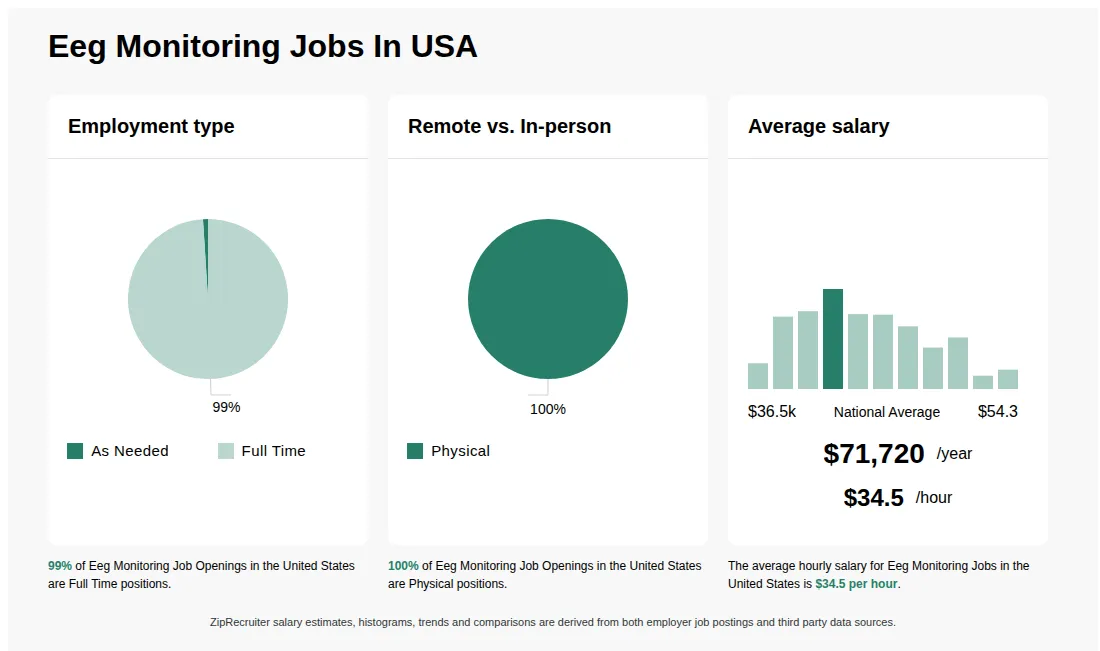
As of Sep 13, 2026, the average hourly pay for eeg monitoring in the United States is $34.48, according to ZipRecruiter salary data. Most workers in this role earn between $26.44 and $40.38 per hour, depending on experience, location, and employer.
What is EEG monitoring?
An EEG Monitoring job involves observing and analyzing electroencephalogram (EEG) recordings to track brain activity. Professionals in this role, such as EEG technologists or neurodiagnostic technicians, place electrodes on patients, operate EEG machines, and monitor for abnormalities that may indicate neurological conditions like epilepsy or seizure disorders. They work closely with neurologists to ensure accurate data collection and interpretation. This job requires attention to detail, technical skills, and often certification in EEG technology.
What are the typical daily responsibilities for someone working in EEG monitoring?
As an EEG Monitoring professional, your daily responsibilities often include preparing patients for EEG tests, placing electrodes accurately, monitoring and recording brain activity, and ensuring patient comfort during procedures. You may also review data for quality assurance, maintain equipment, and communicate findings with neurologists or other healthcare providers. The role requires working closely with both patients and medical staff in hospitals, clinics, or specialized neurodiagnostic centers. This hands-on position offers the chance to play a critical part in diagnosing and managing neurological conditions.
What are the key skills and qualifications needed to thrive in the EEG monitoring position, and why are they important?
To excel in EEG Monitoring, you need a solid understanding of neurophysiology, EEG procedures, and medical terminology, often supported by an associate degree or completion of a neurodiagnostic technologist program. Familiarity with EEG machines, monitoring software, and certifications such as R.EEG T. (Registered EEG Technologist) are highly valued. Attention to detail, effective communication, and the ability to remain calm under pressure are important soft skills in this position. These competencies ensure accurate data collection, patient safety, and clear coordination with healthcare teams.
More about Eeg Monitoring jobs
What cities are hiring for Eeg Monitoring jobs?
Cities with the most Eeg Monitoring job openings:
What are the most commonly searched types of Eeg Monitoring jobs?
The most popular types of Eeg Monitoring jobs are:
What states have the most Eeg Monitoring jobs?
States with the most job openings for Eeg Monitoring jobs include:
What job categories do people searching Eeg Monitoring jobs look for?
The top searched job categories for Eeg Monitoring jobs are:
What other helpful pages are available for Eeg Monitoring?
Other pages related to Eeg Monitoring:

EEG Monitor Watcher, Full Time, Night Shift
Allentown, PA • On-site
St. Luke's University Health Network
Full-time
Posted 13 days ago
St. Luke's University Health Network rating

7.0
Based on 274 frontline employees who took The Breakroom Quiz
Job description
St. Luke's is proud of the skills, experience and compassion of its employees. The employees of St. Luke's are our most valuable asset! Individually and together, our employees are dedicated to satisfying the mission of our organization which is an unwavering commitment to excellence as we care for the sick and injured; educate physicians, nurses and other health care providers; and improve access to care in the communities we serve, regardless of a patient's ability to pay for health care.The EEG Monitor Watcher observes patients and EEG studies via the use of technology under the close supervision and direction of the registered nurse and designated clinical staff.
JOB DUTIES AND RESPONSIBILITIES:
Reports on/off duty to the Registered Nurse/Neurodiagnostic Team assigned to care for patients.
Receives specific observation guidelines from the registered nurse and/or neurodiagnostic clinical staff for each patient/shift/assignment.
Ensures a safe environment for monitored patients, under the direction of a registered nurse.
Remains in visual contact with patients at all times via the designated SLUHN technology platform, as directed by the registered nurse.
Provides virtual continual observation and monitoring of multiple patients at a time using SLUHN-designated IT platforms. Identifies self to patients and/or family members or significant others when appropriate.
Reports behavior changes, safety concerns, clinical changes, and patient requests to the assigned nurses promptly.
Continuously observes EEG waveforms and corresponding video for seizure activity or concerning neurological events, recognizes and reports abnormal EEG patterns, potential seizure activity, loss of signal, artifact, or equipment concerns immediately.
Documents observed EEG events per departmental standards.
Alerts appropriate clinical staff when patient behaviors affect EEG quality or safety (such as removing leads or excessive movement).
PHYSICAL AND SENSORY REQUIREMENTS:
Sit up to 8 hours per day. Stand for up to 8 hours per day. Occasionally lift, carry, and push objects up to 10 pounds. Must be able to hear as it relates to normal conversation and high/low frequencies. Must be able to see as it relates to general, near, far, color, and peripheral vision to observe EEG waveforms and patient video accurately.
EDUCATION:
High school graduate or equivalent required.
TRAINING AND EXPERIENCE:
Previous healthcare experience preferred. Must complete mandatory education and competencies required for EEG monitoring and virtual patient observation. Must demonstrate proficiency in the use of SLUHN-designated EEG monitoring and virtual patient observation platforms.
Please complete your application using your full legal name andcurrent home address. Be sure toincludeemployment history forthe past seven (7) years, including your present employer. Additionally, you areencouraged to upload a current resume, including all work history, education, and/or certifications andlicenses, if applicable. It is highly recommended that you create a profile at the conclusion of submitting your first application. Thank you for your interest in St. Luke's!!
St. Luke's University Health Network is an Equal Opportunity Employer.What St. Luke's University Health Network employees say
Pay
Benefits
Hours and flexibility
Workplace
Get the full story on Breakroom