The Remote EEG Monitoring Technologist will function independently by connecting remotely to multiple continuously monitored patients, evaluate data, detect EEG abnormalities, and notify oversight ...
The Remote EEG Monitoring Technologist will function independently by connecting remotely to multiple continuously monitored patients, evaluate data, detect EEG abnormalities, and notify oversight ...
Intermittent Monitoring EEG Technologist
Chandler, AZ · Remote
$20 - $27/hr
Intermittent Monitoring Technologist (Remote) Nuronz | Ambulatory EEG Services About Us Nuronz is a rapidly growing provider of ambulatory EEG monitoring services, helping physician practices deliver ...
Quick apply
Intermittent Monitoring EEG Technologist
Chandler, AZ · Remote
$20 - $27/hr
Intermittent Monitoring Technologist (Remote) Nuronz | Ambulatory EEG Services About Us Nuronz is a rapidly growing provider of ambulatory EEG monitoring services, helping physician practices deliver ...
Intermittent Monitoring EEG Technologist
Chandler, AZ · Remote
$20 - $27/hr
Intermittent Monitoring Technologist (Remote) Nuronz | Ambulatory EEG Services About Us Nuronz is a rapidly growing provider of ambulatory EEG monitoring services, helping physician practices deliver ...
Quick apply
Intermittent Monitoring EEG Technologist
Chandler, AZ · Remote
$20 - $27/hr
Intermittent Monitoring Technologist (Remote) Nuronz | Ambulatory EEG Services About Us Nuronz is a rapidly growing provider of ambulatory EEG monitoring services, helping physician practices deliver ...
The EEG Monitoring Technologist is responsible for remotely monitoring EEG studies in progress, ensuring the integrity of EEG data and equipment. Responsible for troubleshooting any problems that may ...
The EEG Monitoring Technologist is responsible for remotely monitoring EEG studies in progress, ensuring the integrity of EEG data and equipment. Responsible for troubleshooting any problems that may ...
Intermittent Monitoring EEG Technologist
Chandler, AZ · Remote
$20 - $27/hr
Intermittent Monitoring Technologist (Remote) Nuronz | Ambulatory EEG Services About Us Nuronz is a rapidly growing provider of ambulatory EEG monitoring services, helping physician practices deliver ...
Quick apply
Intermittent Monitoring EEG Technologist
Chandler, AZ · Remote
$20 - $27/hr
Intermittent Monitoring Technologist (Remote) Nuronz | Ambulatory EEG Services About Us Nuronz is a rapidly growing provider of ambulatory EEG monitoring services, helping physician practices deliver ...
EEG Technician [Syracuse, NY] - EEGTECH 26-11215
$2.2K - $2.6K/wk
Experience in an Epilepsy Monitoring Unit (EMU) is preferred. Key Responsibilities * Perform routine EEG studies in accordance with established ASET guidelines . * Conduct EEG procedures on patients ...
Quick apply
EEG Technician [Syracuse, NY] - EEGTECH 26-11215
$2.2K - $2.6K/wk
Experience in an Epilepsy Monitoring Unit (EMU) is preferred. Key Responsibilities * Perform routine EEG studies in accordance with established ASET guidelines . * Conduct EEG procedures on patients ...
EEG Technician [Syracuse, NY] - EEGTECH 26-11215
New York, NY · On-site
$2.2K - $2.6K/wk
Experience in an Epilepsy Monitoring Unit (EMU) is preferred. Key Responsibilities * Perform routine EEG studies in accordance with established ASET guidelines . * Conduct EEG procedures on patients ...
Quick apply
EEG Technician [Syracuse, NY] - EEGTECH 26-11215
New York, NY · On-site
$2.2K - $2.6K/wk
Experience in an Epilepsy Monitoring Unit (EMU) is preferred. Key Responsibilities * Perform routine EEG studies in accordance with established ASET guidelines . * Conduct EEG procedures on patients ...
EEG Technician [Syracuse, NY] - EEGTECH 26-11215
$2.2K - $2.6K/wk
Experience in an Epilepsy Monitoring Unit (EMU) is preferred. Key Responsibilities * Perform routine EEG studies in accordance with established ASET guidelines . * Conduct EEG procedures on patients ...
Quick apply
EEG Technician [Syracuse, NY] - EEGTECH 26-11215
$2.2K - $2.6K/wk
Experience in an Epilepsy Monitoring Unit (EMU) is preferred. Key Responsibilities * Perform routine EEG studies in accordance with established ASET guidelines . * Conduct EEG procedures on patients ...

Monitor and record brain wave activity while ensuring high-quality diagnostic data. * Identify and ... Conduct continuous EEG monitoring in ICU and critical care settings. * Apply head wraps and ...
Quick apply
Monitor and record brain wave activity while ensuring high-quality diagnostic data. * Identify and ... Conduct continuous EEG monitoring in ICU and critical care settings. * Apply head wraps and ...
EEG Technician [Syracuse, NY] - EEGTECH 26-11215
Buffalo, NY · On-site
$2.2K - $2.6K/wk
Experience in an Epilepsy Monitoring Unit (EMU) is preferred. Key Responsibilities * Perform routine EEG studies in accordance with established ASET guidelines . * Conduct EEG procedures on patients ...
Quick apply
EEG Technician [Syracuse, NY] - EEGTECH 26-11215
Buffalo, NY · On-site
$2.2K - $2.6K/wk
Experience in an Epilepsy Monitoring Unit (EMU) is preferred. Key Responsibilities * Perform routine EEG studies in accordance with established ASET guidelines . * Conduct EEG procedures on patients ...

Pool EEG Technician
Crystal River, FL · On-site
Perform routine, portable, and 24-hour EEG monitoring procedures * Conduct evoked potential studies and assist in intraoperative monitoring * Assist in long-term video EEG monitoring (LTVM) set up ...
Pool EEG Technician
Crystal River, FL · On-site
Perform routine, portable, and 24-hour EEG monitoring procedures * Conduct evoked potential studies and assist in intraoperative monitoring * Assist in long-term video EEG monitoring (LTVM) set up ...
EEG Technician [Syracuse, NY] - EEGTECH 26-11215
Albany, NY · On-site
$2.2K - $2.6K/wk
Experience in an Epilepsy Monitoring Unit (EMU) is preferred. Key Responsibilities * Perform routine EEG studies in accordance with established ASET guidelines . * Conduct EEG procedures on patients ...
Quick apply
EEG Technician [Syracuse, NY] - EEGTECH 26-11215
Albany, NY · On-site
$2.2K - $2.6K/wk
Experience in an Epilepsy Monitoring Unit (EMU) is preferred. Key Responsibilities * Perform routine EEG studies in accordance with established ASET guidelines . * Conduct EEG procedures on patients ...

Seizure (EEG) Diagnostic Technician
White Plains, NY · On-site
$37.60 - $56.40/hr
Performs long-term video-EEG monitoring on an epilepsy unit. Interacts with the patient during seizures, interviews the patients and performs tests of cognitive, memory and speech function during and ...
Seizure (EEG) Diagnostic Technician
White Plains, NY · On-site
$37.60 - $56.40/hr
Performs long-term video-EEG monitoring on an epilepsy unit. Interacts with the patient during seizures, interviews the patients and performs tests of cognitive, memory and speech function during and ...

The EEG Monitor Watcher observes patients and EEG studies via the use of technology under the close ... Provides virtual continual observation and monitoring of multiple patients at a time using SLUHN ...
The EEG Monitor Watcher observes patients and EEG studies via the use of technology under the close ... Provides virtual continual observation and monitoring of multiple patients at a time using SLUHN ...
The EEG Monitor Watcher observes patients and EEG studies via the use of technology under the close ... Provides virtual continual observation and monitoring of multiple patients at a time using SLUHN ...
The EEG Monitor Watcher observes patients and EEG studies via the use of technology under the close ... Provides virtual continual observation and monitoring of multiple patients at a time using SLUHN ...
Pool EEG Technician
Crystal River, FL · On-site
Perform routine, portable, and 24-hour EEG monitoring procedures * Conduct evoked potential studies and assist in intraoperative monitoring * Assist in long-term video EEG monitoring (LTVM) set up ...
Pool EEG Technician
Crystal River, FL · On-site
Perform routine, portable, and 24-hour EEG monitoring procedures * Conduct evoked potential studies and assist in intraoperative monitoring * Assist in long-term video EEG monitoring (LTVM) set up ...
Job Summary The EEG Technical Operations Specialist has a strong background in EEG monitoring and technical troubleshooting. The role requires a person who can effectively address technical issues ...
Job Summary The EEG Technical Operations Specialist has a strong background in EEG monitoring and technical troubleshooting. The role requires a person who can effectively address technical issues ...
The EEG Monitor Watcher observes patients and EEG studies via the use of technology under the close ... Provides virtual continual observation and monitoring of multiple patients at a time using SLUHN ...
The EEG Monitor Watcher observes patients and EEG studies via the use of technology under the close ... Provides virtual continual observation and monitoring of multiple patients at a time using SLUHN ...
The EEG Monitor Watcher observes patients and EEG studies via the use of technology under the close ... Provides virtual continual observation and monitoring of multiple patients at a time using SLUHN ...
The EEG Monitor Watcher observes patients and EEG studies via the use of technology under the close ... Provides virtual continual observation and monitoring of multiple patients at a time using SLUHN ...
Med Inst Tech(Eeg)
Syracuse, NY · On-site
They operate, monitor, and collect data from instruments used in procedures such as cardiac catheterization, angiography, angioplasty, or Neurology procedures (such as continuous video EEG monitoring ...
New
Med Inst Tech(Eeg)
Syracuse, NY · On-site
They operate, monitor, and collect data from instruments used in procedures such as cardiac catheterization, angiography, angioplasty, or Neurology procedures (such as continuous video EEG monitoring ...
New
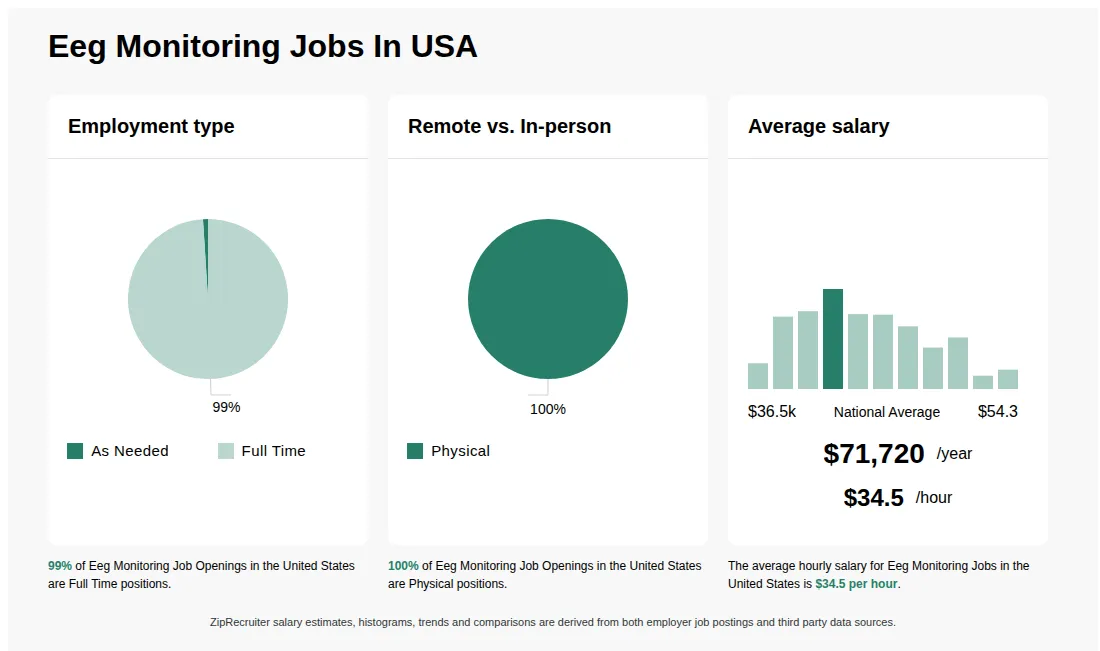
Eeg Monitoring information
See salary details
$17.55 - $20.89
4% of jobs
$20.89 - $24.24
11% of jobs
$26.74 is the 25th percentile. Wages below this are outliers.
$24.24 - $27.58
13% of jobs
$27.58 - $30.92
17% of jobs
The median wage is $32.32 / hr.
$30.92 - $34.27
13% of jobs
$34.27 - $37.61
13% of jobs
$39.28 is the 75th percentile. Wages above this are outliers.
$37.61 - $40.95
10% of jobs
$40.95 - $44.30
6% of jobs
$44.30 - $47.64
8% of jobs
$47.64 - $50.98
2% of jobs
$50.98 - $54.33
3% of jobs
$17
$34
$54
How much do eeg monitoring jobs pay per hour?
As of Sep 13, 2026, the average hourly pay for eeg monitoring in the United States is $34.48, according to ZipRecruiter salary data. Most workers in this role earn between $26.44 and $40.38 per hour, depending on experience, location, and employer.
What is EEG monitoring?
An EEG Monitoring job involves observing and analyzing electroencephalogram (EEG) recordings to track brain activity. Professionals in this role, such as EEG technologists or neurodiagnostic technicians, place electrodes on patients, operate EEG machines, and monitor for abnormalities that may indicate neurological conditions like epilepsy or seizure disorders. They work closely with neurologists to ensure accurate data collection and interpretation. This job requires attention to detail, technical skills, and often certification in EEG technology.
What are the typical daily responsibilities for someone working in EEG monitoring?
As an EEG Monitoring professional, your daily responsibilities often include preparing patients for EEG tests, placing electrodes accurately, monitoring and recording brain activity, and ensuring patient comfort during procedures. You may also review data for quality assurance, maintain equipment, and communicate findings with neurologists or other healthcare providers. The role requires working closely with both patients and medical staff in hospitals, clinics, or specialized neurodiagnostic centers. This hands-on position offers the chance to play a critical part in diagnosing and managing neurological conditions.
What are the key skills and qualifications needed to thrive in the EEG monitoring position, and why are they important?
To excel in EEG Monitoring, you need a solid understanding of neurophysiology, EEG procedures, and medical terminology, often supported by an associate degree or completion of a neurodiagnostic technologist program. Familiarity with EEG machines, monitoring software, and certifications such as R.EEG T. (Registered EEG Technologist) are highly valued. Attention to detail, effective communication, and the ability to remain calm under pressure are important soft skills in this position. These competencies ensure accurate data collection, patient safety, and clear coordination with healthcare teams.
More about Eeg Monitoring jobs
What cities are hiring for Eeg Monitoring jobs?
Cities with the most Eeg Monitoring job openings:
What are the most commonly searched types of Eeg Monitoring jobs?
The most popular types of Eeg Monitoring jobs are:
What states have the most Eeg Monitoring jobs?
States with the most job openings for Eeg Monitoring jobs include:
What job categories do people searching Eeg Monitoring jobs look for?
The top searched job categories for Eeg Monitoring jobs are:
What other helpful pages are available for Eeg Monitoring?
Other pages related to Eeg Monitoring:
Remote EEG Monitoring Technologist
Remote
Specialy Care
Full-time
Re-posted 4 days ago
Job description
The Remote EEG Monitoring Technologist will function independently by connecting remotely to multiple continuously monitored patients, evaluate data, detect EEG abnormalities, and notify oversight neurologists and other designated care providers of findings for timely interventions. The technologist will analyze patient EEG recordings, both in real-time and previous data history, annotating the record and eliminating recording artifacts. They are also responsible for equipment and lead troubleshooting, as well as other actions typically encountered in the normal course of EEG monitoring.
KEY SKILLS & RESPONSIBILITIES
SpecialtyCare is an Equal Opportunity and Affirmative Action Employer. All qualified applicants will receive consideration for employment without regard to race, color, religion, sex, sexual orientation, gender identity, national origin, disability or protected veteran status.
KEY SKILLS & RESPONSIBILITIES
- Competence in deciphering artifacts from cortical activity
- Proficient in operating and troubleshooting multiple EEG instruments and software
- Pruning EEG studies
- Archiving appropriate records of all studies and file locations and maintaining clinical databases
- Documents appropriately to meet industry standards and company policies
- Serve as contact with any technical aspects that may interfere with EEG interpretation/report generation
- Ability to work remotely, and independently, without distraction
- Excellent computer and technological skills
- Strong communication skills and professional demeanor, able to interact well with hospital staff, neurologists and other remote technologists
- Lives the SpecialtyCare Values- Integrity, Care, Urgency, and Improvement.
- Graduation from an accredited EEG Program with registration eligibility
- Registered EEG T. and/or CLTM preferred
- Minimum of 1 year of long-term monitoring (cEEG) experience in ICU EEG and EMU (epilepsy) monitoring in all patient populations
- All technologists must demonstrate knowledge of normal and abnormal adult, pediatric, and neonatal EEG patterns
- Full understanding of HIPAA and ability to remain compliant at all times.
- Must have a secure, compliant workspace that is free from unauthorized viewing
- Knowledge of Nihon Kohden, Cadwell, and Xltek EEG equipment preferred
- Ability to perform tasks within EHR systems (i.e. Epic)
- Reliable high-speed internet and cell phone coverage required
SpecialtyCare is an Equal Opportunity and Affirmative Action Employer. All qualified applicants will receive consideration for employment without regard to race, color, religion, sex, sexual orientation, gender identity, national origin, disability or protected veteran status.