1

Educational Sign Language Interpreter Jobs (NOW HIRING)

next page

Showing results 1-20

Educational Sign Language Interpreter information

See salary details

$7

$23

$48

How much do educational sign language interpreter jobs pay per hour?

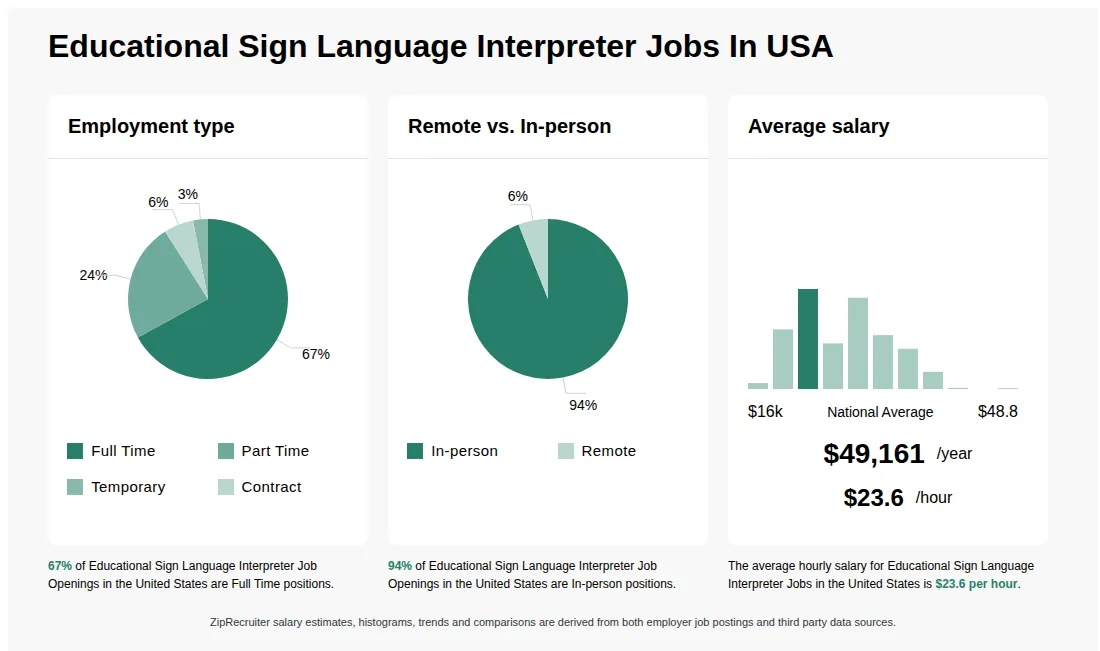
As of Jun 6, 2026, the average hourly pay for educational sign language interpreter in the United States is $23.64, according to ZipRecruiter salary data. Most workers in this role earn between $15.87 and $27.16 per hour, depending on experience, location, and employer.

What are the key skills and qualifications needed to thrive as an Educational Sign Language Interpreter, and why are they important?

To thrive as an Educational Sign Language Interpreter, you need fluency in American Sign Language (ASL), a thorough understanding of educational terminology, and typically an associate's or bachelor's degree in interpreting or a related field. Mastery of video relay systems, familiarity with assistive listening devices, and possession of certifications such as the Educational Interpreter Performance Assessment (EIPA) or Registry of Interpreters for the Deaf (RID) are highly valued. Strong soft skills include cultural sensitivity, adaptability, and excellent communication to effectively support students and collaborate with educators. These competencies are essential to facilitate clear communication, promote inclusion, and ensure students who are deaf or hard of hearing fully access educational content.

What Does an Educational Sign Language Interpreter Do?

An educational sign language interpreter works with deaf students to help them function and communicate in a mainstream classroom. Your responsibilities as an educational sign language interpreter are to assist deaf students with understanding and responding to their teachers and classmates using American Sign Language (ASL). You may also interpret for your student, discuss learning materials and lessons with teachers, and update teachers, parents, and the school with each student’s progress. Your duties may also include hosting assemblies or meetings to encourage other students and faculty to become more fluent in ASL. These positions are usually in school districts during regular school hours.

What is the difference between Educational Sign Language Interpreter vs Sign Language Interpreter?

AspectEducational Sign Language InterpreterSign Language Interpreter
CredentialsTypically requires RID certification, state licensure, and specialized training in educational settingsRequires RID certification, general sign language proficiency, and may include state licensure
Work EnvironmentSchools, classrooms, and educational programs for students with hearing impairmentsVaries from healthcare, legal, to community settings, not limited to education
Employer & Industry UsageSchools, educational agencies, and special education programsHospitals, courts, community organizations, and private clients

Educational Sign Language Interpreters specialize in working within educational settings, focusing on supporting students with hearing impairments. Sign Language Interpreters have a broader scope, working across various industries and environments. While both roles require similar certifications, the context and work environment distinguish them.

How does an Educational Sign Language Interpreter typically collaborate with teachers and other school staff?

Educational Sign Language Interpreters work closely with classroom teachers, special education staff, and administrators to ensure that deaf or hard-of-hearing students have full access to classroom instruction and activities. They often participate in planning meetings to discuss lesson content, clarify terminology, and prepare for upcoming assignments or events. Effective communication and teamwork are essential, as interpreters may provide feedback on student engagement and help teachers adapt their communication style to enhance understanding. This collaborative approach supports both the academic and social success of students who rely on interpreting services.

What are educational sign language interpreters?

Educational sign language interpreters are professionals who facilitate communication between deaf or hard-of-hearing students and others in educational settings, such as schools or universities. They use sign language to interpret spoken language during classes, lectures, and school activities, ensuring students have equal access to information. Interpreters also help bridge communication between students and their peers, teachers, and staff. Their role is crucial for promoting inclusion and supporting the educational success of students who use sign language.
What cities are hiring for Educational Sign Language Interpreter jobs? Cities with the most Educational Sign Language Interpreter job openings:
Who are the top companies hiring for Educational Sign Language Interpreter jobs? The top employers for Educational Sign Language Interpreter jobs are:
What states have the most Educational Sign Language Interpreter jobs? States with the most job openings for Educational Sign Language Interpreter jobs include:
What are popular job titles related to Educational Sign Language Interpreter jobs? For Educational Sign Language Interpreter jobs, the most frequently searched job titles are:
Infographic showing various Educational Sign Language Interpreter job openings in the United States as of May 2026, with employment types broken down into 69% Full Time, 27% Part Time, and 4% Contract. Highlights an 96% Physical, 1% Hybrid, and 3% Remote job distribution, with an average salary of $49,161 per year, or $23.6 per hour.

Itinerant Educational Sign Language Interpreter

Kanawha County Public Schools

Charleston, WV

Other

Posted 5 days ago


Job description

POSITION: Educational Sign Language Interpreter
IMMEDIATE SUPERVISOR: Principal
FLSA STATUS: Non-exempt
EMPLOYMENT TERM:  Minimum 200 days annually
SALARY: Pursuant to WV Code 18A-4-8a, in accordance with Kanawha County Salary Scale, Pay Grade E, F, G, commensurate with experience and education level.
EVALUATION: Performance in this position will be evaluated annually by the building principal/immediate supervisor and in accordance with WV State Code 18A-2-12, WV State Board Policy 5314, and KCS's Guide to Performance Evaluation for Service Personnel.
JOB SUMMARY: Responsible for providing communication access through sign language in a wide range of instructional and extra-curricular activities within an educational program. Notetaking support for a student may be considered necessary when not interpreting but is not a primary responsibility of the interpreter. Works cooperatively with school personnel to provide coordinated interpreting services to students.  An Educational Sign Language Interpreter is a qualified interpreter who is able to provide communication access to students, teachers, and staff in settings requiring sign language, both receptively and expressively in a pre-K through 12 public school setting.
GENERAL PERFORMANCE REQUIREMENTS AND RESPONSIBILITIES: 
An employee working for Kanawha County Schools is expected to comply with all the Kanawha County Schools Policies and Procedures, including maintaining regular attendance and completing all required training.  Employees are required to follow all safety rules to maintain a safe workplace.
PERFORMANCE RESPONSIBILITIES:  Essential Job Duties.


  • Work under the direction and supervision of the teacher to whom assigned
  • Interpret for students utilizing the student's preferred mode of communications
  • Provide interpreting during the school day in academic and non-academic settings with staff, peers and other students who are deaf or hard of hearing
  • Confer with educators to plan for interpreting
  • Demonstrate and understand the educational process of interpreting by attending county-provided interpreter training during staff development
  • Assist students who are deaf or hard of hearing and perform other related duties which benefit the students
  • Demonstrate professionalism in all interactions with individuals unfamiliar with the educational setting
  • Interpret auditory and signed information which includes environmental sounds, teacher instruction, student questions and peer communication as described in the Code of Ethics for Educational Interpreters
  • Attend student's IEP Team meeting in order to provide information about the student's communication abilities and needs.
  • Receives permission from building principal/supervisor to work in excess of 40 hours per week.
  • Works cooperatively with school personnel and students to provide coordinated interpreting services to students.
  • Work under the direction and supervision of the teacher/professional to whom assigned.
  • Interpret for students utilizing the students preferred mode of communications.
  • Provide interpreting during the school day in academic and non-academic settings with staff, peers, and other hearing impaired and deaf students.
  • Confer with educators to plan for interpreting services.
  • Demonstrate self-improvement in signing ability, interpreting skills, communications with school personnel, and understanding the educational process by attending staff meetings.
  • To assist students and perform other related duties as indicated by teachers and administrators.
  • Receives close supervision and verbal instruction.
  • To provide an appropriate role model for students.
  • To maintain positive work habits, to perform duties efficiently and productively and to maintain and upgrade skills.
  • To fulfill duties as described in IEP.
  • To provide interpreting in other capacities to include communication with deaf parents, committee meetings, PTA, conferences, and other situations as needed.
  • To act as liaison between educators.
  • To assist teachers and bus drivers in monitoring student's activities
  • To perform basic clerical assistance.
  • Attends meeting/training as requested by supervisor.
  • To participate in other duties and responsibilities as assigned by the principal or building supervisor.
  • Will be trained in Cardiac Pulmonary Resuscitation
  • All Other duties as assigned.

To perform this job successfully, an individual must be able to perform each essential duty satisfactorily. However, accommodations as provided below may be provided to help you perform essential job duties. 
QUALIFICATIONS: 
 

  • Applicant must have a high school diploma or general education development (GED), pursuant to WV Code 18A-2-5;
  • Criminal background check conducted pursuant to WV Code 18-5-15c;
  • Meet the definition of "Qualifications" in WV Code 18A-4-8b and WV Board of Education Policy 5202; demonstrated competency, pursuant to WV Code 18A-4-8e (state-approved competency test) as required.
    • Certificate and meet the requirements for a WVDE Paraprofessional Certificate: Educational Sign Language Interpreter I or II. This includes the ability to qualify for the West Virginia Paraprofessional Certificate, a score of at least 3.0 on the Educational Interpreter Proficiency Assessment (EIPA) for Interpreter I certification or 3.5 and pass the EIPA Written Performance Assessment for Interpreter II certification. Applicant must be registered with the West Virginia Commission for the Deaf and Hard of Hearing.
  • Applicant must be able to interpret effectively, accurately, and impartially both receptively and expressively, using any necessary specialized vocabulary and must have knowledge of deafness and Deaf culture.
  • The interpreter must have knowledge of hearing loss and other conditions and their effect on early development of language.
  • An interpreter should have knowledge of speech, motor, adaptive skills, and social-emotional development of the student who is deaf or hard of hearing.

 
NOTE:  An Educational Sign Language Interpreter I holds the Initial Paraprofessional Certificate Educational Interpreter pursuant to state board policy.  An Educational Sign Language Interpreter II holds the Permanent Paraprofessional Certificate Educational Interpreter, pursuant to state board policy. 
PRINCIPAL ACCOUNTABILITY:


  • Interpreters shall accept the same responsibility and authority as other members of the educational staff. They will abide by and enforce federal, state, school district, and individual school laws and rules.
  • Interpreters shall provide communication access in the wide range of instructional activities within the educational program.
  • Interpreters shall interpret effectively, accurately, and impartially both receptively and expressively using any necessary specialized vocabulary.
  • Interpreters shall have the ability to interpret a variety of instructions furnished in written, oral, or scheduled form. 

PHYSICAL DEMANDS: The physical demands described are representative of those that must be met by an employee to successfully perform the essential functions of this job. Reasonable accommodations may be made to enable individuals with disabilities to perform the essential functions. While performing the duties of this job, the employee is frequently required to stoop, reach, stand, walk, lift, push, pull, grasp, talk, hear, see and use repetitive motions. While performing the duties of this job, the employee may frequently lift and/or move at least 50 of materials, children, etc. Specific vision abilities required by this job include close vision such as to read handwritten or typed material.
WORK ENVIRONMENT: The work environment characteristics described here are representative of those an employee encounters while performing the essential functions of this job. Reasonable accommodations may be made to enable individuals with disabilities to perform the essential functions. 
The information contained in the job description is for compliance with the Americans with Disabilities Act (ADA) and is not an exhaustive list of duties performed by this position. Additional duties are performed by the individuals currently holding this
position and additional duties may be assigned by the Superintendent or his/her designee.
REVISED 2APRIL2025
Â