Works effectively as a team with other sign language interpreters. * Provides interpreting for situations that are part of the educational program that occur outside of the school environment (i.e ...
Works effectively as a team with other sign language interpreters. * Provides interpreting for situations that are part of the educational program that occur outside of the school environment (i.e ...
Educational Sign Language Interpreter IMMEDIATE SUPERVISOR: Principal FLSA STATUS: Non-exempt EMPLOYMENT TERM: Minimum 200 days annually SALARY : Pursuant to WV Code 18A-4-8a, in accordance with ...
Educational Sign Language Interpreter IMMEDIATE SUPERVISOR: Principal FLSA STATUS: Non-exempt EMPLOYMENT TERM: Minimum 200 days annually SALARY : Pursuant to WV Code 18A-4-8a, in accordance with ...
Educational Sign Language Interpreter IMMEDIATE SUPERVISOR: Principal FLSA STATUS: Non-exempt EMPLOYMENT TERM: Minimum 200 days annually SALARY : Pursuant to WV Code 18A-4-8a, in accordance with ...
Educational Sign Language Interpreter IMMEDIATE SUPERVISOR: Principal FLSA STATUS: Non-exempt EMPLOYMENT TERM: Minimum 200 days annually SALARY : Pursuant to WV Code 18A-4-8a, in accordance with ...
Educational Sign Language Interpreter IMMEDIATE SUPERVISOR: Principal FLSA STATUS: Non-exempt EMPLOYMENT TERM: Minimum 200 days annually SALARY : Pursuant to WV Code 18A-4-8a, in accordance with ...
Educational Sign Language Interpreter IMMEDIATE SUPERVISOR: Principal FLSA STATUS: Non-exempt EMPLOYMENT TERM: Minimum 200 days annually SALARY : Pursuant to WV Code 18A-4-8a, in accordance with ...
Substitute Sign Support Specialist/Educational Sign Language Interpreter I and II
Charleston, WV · On-site
Sign Support Specialist, Educational Sign Language Interpreter I & II IMMEDIATE SUPERVISOR: Principal FLSA STATUS: Non-exempt EMPLOYMENT TERM: No guaranteed days or hours. Work as needed. SALARY
Substitute Sign Support Specialist/Educational Sign Language Interpreter I and II
Charleston, WV · On-site
Sign Support Specialist, Educational Sign Language Interpreter I & II IMMEDIATE SUPERVISOR: Principal FLSA STATUS: Non-exempt EMPLOYMENT TERM: No guaranteed days or hours. Work as needed. SALARY
Substitute Sign Support Specialist/Educational Sign Language Interpreter I and II
Charleston, WV · On-site
Sign Support Specialist, Educational Sign Language Interpreter I & II IMMEDIATE SUPERVISOR: Principal FLSA STATUS: Non-exempt EMPLOYMENT TERM: No guaranteed days or hours. Work as needed. SALARY
Substitute Sign Support Specialist/Educational Sign Language Interpreter I and II
Charleston, WV · On-site
Sign Support Specialist, Educational Sign Language Interpreter I & II IMMEDIATE SUPERVISOR: Principal FLSA STATUS: Non-exempt EMPLOYMENT TERM: No guaranteed days or hours. Work as needed. SALARY
Substitute Sign Support Specialist/Educational Sign Language Interpreter I and II
Charleston, WV · On-site
Sign Support Specialist, Educational Sign Language Interpreter I & II IMMEDIATE SUPERVISOR: Principal FLSA STATUS: Non-exempt EMPLOYMENT TERM: No guaranteed days or hours. Work as needed. SALARY
Substitute Sign Support Specialist/Educational Sign Language Interpreter I and II
Charleston, WV · On-site
Sign Support Specialist, Educational Sign Language Interpreter I & II IMMEDIATE SUPERVISOR: Principal FLSA STATUS: Non-exempt EMPLOYMENT TERM: No guaranteed days or hours. Work as needed. SALARY

Sign Language Interpreter Educational
Fremont, NE · On-site
$66K/yr
The Educational Sign Language Interpreter is a trained professional who facilities communication between deaf or hard-of-hearing students and others within an educational setting. Often, American ...
Sign Language Interpreter Educational
Fremont, NE · On-site
$66K/yr
The Educational Sign Language Interpreter is a trained professional who facilities communication between deaf or hard-of-hearing students and others within an educational setting. Often, American ...

Ed Sign Language Interpreter
Chicago, IL · On-site
$71K/yr
The Educational Sign Language Interpreter is a school-based position responsible for sign language interpretation duties in connection with the CPS Deaf or Hard-of-Hearing program. This position will ...
Ed Sign Language Interpreter
Chicago, IL · On-site
$71K/yr
The Educational Sign Language Interpreter is a school-based position responsible for sign language interpretation duties in connection with the CPS Deaf or Hard-of-Hearing program. This position will ...
The Educational Sign Language Interpreter is a trained professional who facilities communication between deaf or hard-of-hearing students and others within an educational setting. Often, American ...
The Educational Sign Language Interpreter is a trained professional who facilities communication between deaf or hard-of-hearing students and others within an educational setting. Often, American ...
Sign Language Interpreter Educational
Statesville, NC · On-site
$65K/yr
The Educational Sign Language Interpreter is a trained professional who facilities communication between deaf or hard-of-hearing students and others within an educational setting. Often, American ...
Sign Language Interpreter Educational
Statesville, NC · On-site
$65K/yr
The Educational Sign Language Interpreter is a trained professional who facilities communication between deaf or hard-of-hearing students and others within an educational setting. Often, American ...
Sign Language Interpreter Educational
Fremont, NE · On-site
$66K/yr
The Educational Sign Language Interpreter is a trained professional who facilities communication between deaf or hard-of-hearing students and others within an educational setting. Often, American ...
Sign Language Interpreter Educational
Fremont, NE · On-site
$66K/yr
The Educational Sign Language Interpreter is a trained professional who facilities communication between deaf or hard-of-hearing students and others within an educational setting. Often, American ...
Sign Language Interpreter Educational
Chehalis, WA · On-site
$70K/yr
The Educational Sign Language Interpreter is a trained professional who facilities communication between deaf or hard-of-hearing students and others within an educational setting. Often, American ...
Sign Language Interpreter Educational
Chehalis, WA · On-site
$70K/yr
The Educational Sign Language Interpreter is a trained professional who facilities communication between deaf or hard-of-hearing students and others within an educational setting. Often, American ...
The Educational Sign Language Interpreter is a trained professional who facilities communication between deaf or hard-of-hearing students and others within an educational setting. Often, American ...
The Educational Sign Language Interpreter is a trained professional who facilities communication between deaf or hard-of-hearing students and others within an educational setting. Often, American ...
Sign Language Interpreter Educational
Fremont, NE · On-site
$66K/yr
The Educational Sign Language Interpreter is a trained professional who facilities communication between deaf or hard-of-hearing students and others within an educational setting. Often, American ...
Sign Language Interpreter Educational
Fremont, NE · On-site
$66K/yr
The Educational Sign Language Interpreter is a trained professional who facilities communication between deaf or hard-of-hearing students and others within an educational setting. Often, American ...
The Educational Sign Language Interpreter is a trained professional who facilities communication between deaf or hard-of-hearing students and others within an educational setting. Often, American ...
The Educational Sign Language Interpreter is a trained professional who facilities communication between deaf or hard-of-hearing students and others within an educational setting. Often, American ...

Educational Sign Language Interpreter III
Redding, CA · On-site
$30.73 - $41.38/hr
Educational Sign Language Interpreter III Purpose The job of Educational Sign Language Interpreter III is done for the purpose/s of providing support to the instructional program with specific ...
Educational Sign Language Interpreter III
Redding, CA · On-site
$30.73 - $41.38/hr
Educational Sign Language Interpreter III Purpose The job of Educational Sign Language Interpreter III is done for the purpose/s of providing support to the instructional program with specific ...
Ed Sign Language Interpreter
Chicago, IL · On-site
$71K/yr
The Educational Sign Language Interpreter is a school-based position responsible for sign language interpretation duties in connection with the CPS Deaf or Hard-of-Hearing program. This position will ...
Ed Sign Language Interpreter
Chicago, IL · On-site
$71K/yr
The Educational Sign Language Interpreter is a school-based position responsible for sign language interpretation duties in connection with the CPS Deaf or Hard-of-Hearing program. This position will ...
Ed Sign Language Interpreter
Chicago, IL · On-site
$71K/yr
The Educational Sign Language Interpreter is a school-based position responsible for sign language interpretation duties in connection with the CPS Deaf or Hard-of-Hearing program. This position will ...
Ed Sign Language Interpreter
Chicago, IL · On-site
$71K/yr
The Educational Sign Language Interpreter is a school-based position responsible for sign language interpretation duties in connection with the CPS Deaf or Hard-of-Hearing program. This position will ...
Ed Sign Language Interpreter
Chicago, IL · On-site
$71K/yr
The Educational Sign Language Interpreter is a school-based position responsible for sign language interpretation duties in connection with the CPS Deaf or Hard-of-Hearing program. This position will ...
Ed Sign Language Interpreter
Chicago, IL · On-site
$71K/yr
The Educational Sign Language Interpreter is a school-based position responsible for sign language interpretation duties in connection with the CPS Deaf or Hard-of-Hearing program. This position will ...
Educational Sign Language Interpreter information
See salary details
$7.69 - $11.43
1% of jobs
$11.43 - $15.17
15% of jobs
$16.53 is the 25th percentile. Wages below this are outliers.
$15.17 - $18.90
25% of jobs
The median wage is $22.08 / hr.
$18.90 - $22.64
11% of jobs
$22.64 - $26.38
22% of jobs
$26.77 is the 75th percentile. Wages above this are outliers.
$26.38 - $30.11
13% of jobs
$30.11 - $33.85
9% of jobs
$33.85 - $37.59
4% of jobs
$37.59 - $41.32
0% of jobs
$41.32 - $45.06
0% of jobs
$45.06 - $48.80
0% of jobs
$7
$23
$48
How much do educational sign language interpreter jobs pay per hour?
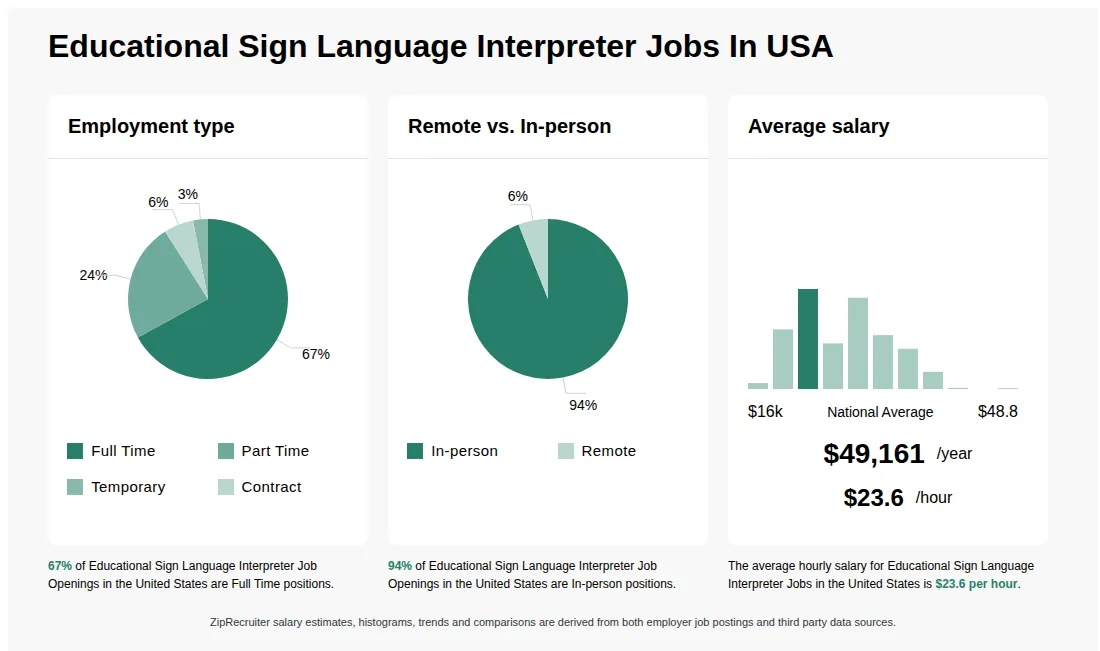
As of Sep 4, 2026, the average hourly pay for educational sign language interpreter in the United States is $23.64, according to ZipRecruiter salary data. Most workers in this role earn between $15.87 and $27.16 per hour, depending on experience, location, and employer.
What is an educational sign language interpreter?
Educational sign language interpreters are professionals who facilitate communication between deaf or hard-of-hearing students and others in educational settings, such as schools or universities. They use sign language to interpret spoken language during classes, lectures, and school activities, ensuring students have equal access to information. Interpreters also help bridge communication between students and their peers, teachers, and staff. Their role is crucial for promoting inclusion and supporting the educational success of students who use sign language.
What does an educational sign language interpreter do?
An educational sign language interpreter works with deaf students to help them function and communicate in a mainstream classroom. Your responsibilities as an educational sign language interpreter are to assist deaf students with understanding and responding to their teachers and classmates using American Sign Language (ASL). You may also interpret for your student, discuss learning materials and lessons with teachers, and update teachers, parents, and the school with each student’s progress. Your duties may also include hosting assemblies or meetings to encourage other students and faculty to become more fluent in ASL. These positions are usually in school districts during regular school hours.
What are the key skills and qualifications needed to thrive as an educational sign language interpreter, and why are they important?
To thrive as an Educational Sign Language Interpreter, you need fluency in American Sign Language (ASL), a thorough understanding of educational terminology, and typically an associate's or bachelor's degree in interpreting or a related field. Mastery of video relay systems, familiarity with assistive listening devices, and possession of certifications such as the Educational Interpreter Performance Assessment (EIPA) or Registry of Interpreters for the Deaf (RID) are highly valued. Strong soft skills include cultural sensitivity, adaptability, and excellent communication to effectively support students and collaborate with educators. These competencies are essential to facilitate clear communication, promote inclusion, and ensure students who are deaf or hard of hearing fully access educational content.
How does an educational sign language interpreter typically collaborate with teachers and other school staff?
Educational Sign Language Interpreters work closely with classroom teachers, special education staff, and administrators to ensure that deaf or hard-of-hearing students have full access to classroom instruction and activities. They often participate in planning meetings to discuss lesson content, clarify terminology, and prepare for upcoming assignments or events. Effective communication and teamwork are essential, as interpreters may provide feedback on student engagement and help teachers adapt their communication style to enhance understanding. This collaborative approach supports both the academic and social success of students who rely on interpreting services.
What is the difference between Educational Sign Language Interpreter vs Sign Language Interpreter?
| Aspect | Educational Sign Language Interpreter | Sign Language Interpreter |
|---|---|---|
| Credentials | Typically requires RID certification, state licensure, and specialized training in educational settings | Requires RID certification, general sign language proficiency, and may include state licensure |
| Work Environment | Schools, classrooms, and educational programs for students with hearing impairments | Varies from healthcare, legal, to community settings, not limited to education |
| Employer & Industry Usage | Schools, educational agencies, and special education programs | Hospitals, courts, community organizations, and private clients |
Educational Sign Language Interpreters specialize in working within educational settings, focusing on supporting students with hearing impairments. Sign Language Interpreters have a broader scope, working across various industries and environments. While both roles require similar certifications, the context and work environment distinguish them.
More about Educational Sign Language Interpreter jobs
What cities are hiring for Educational Sign Language Interpreter jobs?
Cities with the most Educational Sign Language Interpreter job openings:
Who are the top companies hiring for Educational Sign Language Interpreter jobs?
The top employers for Educational Sign Language Interpreter jobs are:
What states have the most Educational Sign Language Interpreter jobs?
States with the most job openings for Educational Sign Language Interpreter jobs include:
What job categories do people searching Educational Sign Language Interpreter jobs look for?
The top searched job categories for Educational Sign Language Interpreter jobs are:
What are popular job titles related to Educational Sign Language Interpreter jobs?
For Educational Sign Language Interpreter jobs, the most frequently searched job titles are:
Full-time
Re-posted 9 days ago
Job description
QUALIFICATIONS:
JOB GOAL: To facilitate communication, and make cultural adjustments when necessary, between students who are deaf/hard-of-hearing (D/HH) and their hearing peers, teachers, and other personnel involved in the students' education, using American Sign Language (ASL) or Conceptually Accurate Signed English (CASE) to convey spoken communication and intent, and to serve as a resource to other school personnel requiring assistance with the D/HH student.
PERFORMANCE RESPONSIBILITIES:
- High school diploma or GED required
- Prefer BA degree or AA in interpreting, or completion of an interpreter training program, or equivalent experience.
- Preferred certification: Level 3 or above on the EIPA or RID
- Competency in understanding and expressing ASL and/or Manually Coded English systems.
JOB GOAL: To facilitate communication, and make cultural adjustments when necessary, between students who are deaf/hard-of-hearing (D/HH) and their hearing peers, teachers, and other personnel involved in the students' education, using American Sign Language (ASL) or Conceptually Accurate Signed English (CASE) to convey spoken communication and intent, and to serve as a resource to other school personnel requiring assistance with the D/HH student.
PERFORMANCE RESPONSIBILITIES:
- Interprets lectures, discussions, announcements, conversations, meetings, events, and other spoken word situations, using a manual sign language or system appropriate for the language and the cultural background of D/HH student and staff.
- Accurately interprets D/HH students' signs into voiced fluent English for other students and staff.
- If needed, provides some tutoring and instructional support to the D/HH students to assist them in their classes to support the goals and objectives of the educational program.
- Assists in providing clarification of the interpreter's role to all students and staff/faculty.
- Participates in IEP meetings as a team member providing insight on the student's use of communication strategies, or as the interpreter for the meeting, but not both roles at the same time.
- Interprets at meetings attended by parents who are deaf/hard-of-hearing.
- Provides information and orientation to the D/HH students in emergency situations.
- Works effectively as a team with other sign language interpreters.
- Provides interpreting for situations that are part of the educational program that occur outside of the school environment (i.e. field trips).
- May interpret for extracurricular school activities in which the D/HH student is involved (sports, drama, etc.).
- Completes continuing education to maintain or work toward interpreter certification (EIPA or RID).