Cybersecurity Internships 2027 Application Deadline: October 1st Schedule: Full-time, onsite, Monday through Friday As a Cybersecurity Intern, you will contribute to protecting our critical ...
Cybersecurity Internships 2027 Application Deadline: October 1st Schedule: Full-time, onsite, Monday through Friday As a Cybersecurity Intern, you will contribute to protecting our critical ...
Cybersecurity Internships 2027 Application Deadline: October 1st Schedule: Full-time, onsite, Monday through Friday As a Cybersecurity Intern, you will contribute to protecting our critical ...
Cybersecurity Internships 2027 Application Deadline: October 1st Schedule: Full-time, onsite, Monday through Friday As a Cybersecurity Intern, you will contribute to protecting our critical ...
Cybersecurity Internships 2027 Application Deadline: October 1st Schedule: Full-time, onsite, Monday through Friday As a Cybersecurity Intern, you will contribute to protecting our critical ...
Cybersecurity Internships 2027 Application Deadline: October 1st Schedule: Full-time, onsite, Monday through Friday As a Cybersecurity Intern, you will contribute to protecting our critical ...

Cybersecurity Specialist
Athens, WV · On-site
Relevant experience may include cybersecurity internships, student employment, or other professional experien Amount of Experience Needed (Months/Years) More than 1 year Posting Detail Information ...
Cybersecurity Specialist
Athens, WV · On-site
Relevant experience may include cybersecurity internships, student employment, or other professional experien Amount of Experience Needed (Months/Years) More than 1 year Posting Detail Information ...

Cyber Security Internship
Raleigh, NC · On-site
Furthermore, our internships are designed to provide each participant the opportunity to network ... This role supports the IAT Cybersecurity Team and provides the intern an opportunity to gain ...
Cyber Security Internship
Raleigh, NC · On-site
Furthermore, our internships are designed to provide each participant the opportunity to network ... This role supports the IAT Cybersecurity Team and provides the intern an opportunity to gain ...

Preference will be given to applicants with relevant work experience, internships, cybersecurity projects, student organizations, or other related activities What You're Good At: * Strong interest in ...
Preference will be given to applicants with relevant work experience, internships, cybersecurity projects, student organizations, or other related activities What You're Good At: * Strong interest in ...

We are seeking motivated and enthusiastic Cybersecurity Interns to join our dynamic IT department. This internship offers a unique opportunity to gain hands-on experience in the field of ...
We are seeking motivated and enthusiastic Cybersecurity Interns to join our dynamic IT department. This internship offers a unique opportunity to gain hands-on experience in the field of ...
Cyber Security Internship
Raleigh, NC · Hybrid
Furthermore, our internships are designed to provide each participant the opportunity to network ... This role supports the IAT Cybersecurity Team and provides the intern an opportunity to gain ...
Cyber Security Internship
Raleigh, NC · Hybrid
Furthermore, our internships are designed to provide each participant the opportunity to network ... This role supports the IAT Cybersecurity Team and provides the intern an opportunity to gain ...
Preference will be given to applicants with relevant work experience, internships, cybersecurity projects, student organizations, or other related activities What You're Good At: * Strong interest in ...
Quick apply
Preference will be given to applicants with relevant work experience, internships, cybersecurity projects, student organizations, or other related activities What You're Good At: * Strong interest in ...

... internship with us! What's Cyber Security in our Technology Division? At Wellmark we take a holistic approach to Cybersecurity. Identify and create risk management strategy and governance tools ...
... internship with us! What's Cyber Security in our Technology Division? At Wellmark we take a holistic approach to Cybersecurity. Identify and create risk management strategy and governance tools ...

Cybersecurity Internship
Columbus, IN · On-site
$20 - $30/hr
The Role: We're seeking a motivated Cybersecurity Intern to join our Enterprise Cybersecurity team in Summer 2027 ! This internship offers hands-on experience protecting one of North America ...
Cybersecurity Internship
Columbus, IN · On-site
$20 - $30/hr
The Role: We're seeking a motivated Cybersecurity Intern to join our Enterprise Cybersecurity team in Summer 2027 ! This internship offers hands-on experience protecting one of North America ...
Preference will be given to applicants with relevant work experience, internships, cybersecurity projects, student organizations, or other related activities What You're Good At: * Strong interest in ...
Preference will be given to applicants with relevant work experience, internships, cybersecurity projects, student organizations, or other related activities What You're Good At: * Strong interest in ...
Cybersecurity Internship
Columbus, IN · On-site
$20 - $30/hr
The Role: We're seeking a motivated Cybersecurity Intern to join our Enterprise Cybersecurity team in Summer 2027 ! This internship offers hands-on experience protecting one of North America ...
Cybersecurity Internship
Columbus, IN · On-site
$20 - $30/hr
The Role: We're seeking a motivated Cybersecurity Intern to join our Enterprise Cybersecurity team in Summer 2027 ! This internship offers hands-on experience protecting one of North America ...
Cyber Security Internship
Alexandria, VA · On-site
We are seeking motivated and enthusiastic Cybersecurity Interns to join our dynamic IT department. This internship offers a unique opportunity to gain hands-on experience in the field of ...
Cyber Security Internship
Alexandria, VA · On-site
We are seeking motivated and enthusiastic Cybersecurity Interns to join our dynamic IT department. This internship offers a unique opportunity to gain hands-on experience in the field of ...
Cyber Security Internship
Des Moines, IA · On-site
... internship with us! What's Cyber Security in our Technology Division? At Wellmark we take a holistic approach to Cybersecurity. Identify and create risk management strategy and governance tools ...
Quick apply
Cyber Security Internship
Des Moines, IA · On-site
... internship with us! What's Cyber Security in our Technology Division? At Wellmark we take a holistic approach to Cybersecurity. Identify and create risk management strategy and governance tools ...
Cyber Security Internship
Des Moines, IA · On-site
... internship with us! What's Cyber Security in our Technology Division? At Wellmark we take a holistic approach to Cybersecurity. Identify and create risk management strategy and governance tools ...
Cyber Security Internship
Des Moines, IA · On-site
... internship with us! What's Cyber Security in our Technology Division? At Wellmark we take a holistic approach to Cybersecurity. Identify and create risk management strategy and governance tools ...
Cybersecurity Internship 2027 Application Deadline: October 1st Schedule: Full-time, onsite, Monday through Friday As a Cybersecurity Intern, you will contribute to protecting our critical ...
Cybersecurity Internship 2027 Application Deadline: October 1st Schedule: Full-time, onsite, Monday through Friday As a Cybersecurity Intern, you will contribute to protecting our critical ...
Cybersecurity Internship
Columbus, IN · On-site
$20 - $30/hr
The Role: We're seeking a motivated Cybersecurity Intern to join our Enterprise Cybersecurity team in Summer 2027 ! This internship offers hands-on experience protecting one of North America ...
Cybersecurity Internship
Columbus, IN · On-site
$20 - $30/hr
The Role: We're seeking a motivated Cybersecurity Intern to join our Enterprise Cybersecurity team in Summer 2027 ! This internship offers hands-on experience protecting one of North America ...

2027 Summer Internship - Cybersecurity
Atlanta, GA · On-site +1
$24 - $27/hr
Cybersecurity Interns will gain a combination of technical and analytical skills that help detect cybersecurity threats in real time environments. Interns will have the opportunity to focus in one or ...
2027 Summer Internship - Cybersecurity
Atlanta, GA · On-site +1
$24 - $27/hr
Cybersecurity Interns will gain a combination of technical and analytical skills that help detect cybersecurity threats in real time environments. Interns will have the opportunity to focus in one or ...

Cybersecurity Engineering Co-op
Indianola, PA · On-site
$24 - $45.50/hr
Prior internship experience at Bayer; Prior cybersecurity internship experience; Familiarity, experience, or coursework with cybersecurity incident response and investigations; Familiarity ...
Cybersecurity Engineering Co-op
Indianola, PA · On-site
$24 - $45.50/hr
Prior internship experience at Bayer; Prior cybersecurity internship experience; Familiarity, experience, or coursework with cybersecurity incident response and investigations; Familiarity ...
Cyber Security Internships information
See salary details
$40.5K - $53.2K
0% of jobs
$53.2K - $65.9K
0% of jobs
$65.9K - $78.5K
4% of jobs
$78.5K - $91.2K
9% of jobs
$103.4K is the 25th percentile. Wages below this are outliers.
$91.2K - $103.9K
13% of jobs
$103.9K - $116.6K
20% of jobs
The median wage is $120K / yr.
$116.6K - $129.3K
16% of jobs
$139.2K is the 75th percentile. Wages above this are outliers.
$129.3K - $142K
17% of jobs
$142K - $154.6K
12% of jobs
$154.6K - $167.3K
6% of jobs
$167.3K - $180K
3% of jobs
$40.5K
$122.9K
$180K
How much do cyber security internships jobs pay per year?
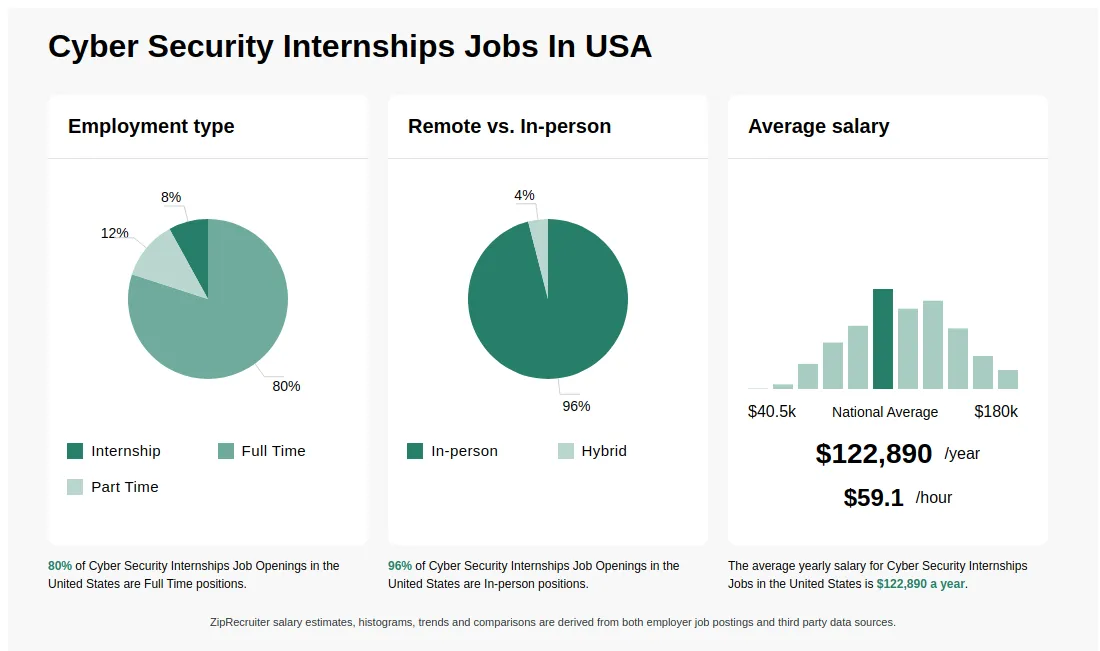
As of Sep 15, 2026, the average yearly pay for cyber security internships in the United States is $122,890.00, according to ZipRecruiter salary data. Most workers in this role earn between $102,000.00 and $142,000.00 per year, depending on experience, location, and employer.
What is a cyber security internship?
A Cyber Security Internship is a temporary position where students or entry-level professionals gain hands-on experience in protecting networks, systems, and data from cyber threats. Interns typically assist with tasks such as vulnerability assessments, security monitoring, and incident response under the guidance of experienced cybersecurity professionals. These internships help develop technical skills, familiarize interns with industry tools, and provide valuable exposure to real-world security challenges. Many cybersecurity internships are offered by government agencies, corporations, and tech companies, and they often serve as a pathway to full-time cybersecurity roles.
What types of projects or tasks are typically assigned to cyber security interns?
Cyber Security Interns commonly assist with monitoring network traffic for suspicious activity, analyzing security logs, performing vulnerability assessments, and helping respond to incidents under guidance from senior team members. Interns may also participate in policy reviews, support the implementation of security tools, or contribute to employee security training initiatives. The workload often provides a mix of hands-on technical experience and exposure to the daily operations of the organization’s security team. This hands-on involvement helps interns develop practical skills, deepen their understanding of cyber threats, and build valuable professional relationships that can aid in future career advancement.
What are the key skills and qualifications needed to thrive in a cyber security internship?
To thrive in a Cyber Security Internship, you need a foundational understanding of information security principles, networking, and familiarity with operating systems such as Windows and Linux, typically gained through coursework or IT-related degrees. Experience with security tools like Wireshark, Nessus, or Splunk and basic certifications such as CompTIA Security+ or Cisco’s CCNA are highly beneficial. Strong analytical thinking, attention to detail, adaptability, and effective communication are key soft skills that help interns excel. These abilities are crucial for identifying vulnerabilities, working within teams, and communicating technical issues clearly in a fast-evolving cybersecurity landscape.
More about Cyber Security Internships jobs
What cities are hiring for Cyber Security Internships jobs?
Cities with the most Cyber Security Internships job openings:
What are the most commonly searched types of Cyber Security Internships jobs?
The most popular types of Cyber Security Internships jobs are:
What states have the most Cyber Security Internships jobs?
States with the most job openings for Cyber Security Internships jobs include:
What job categories do people searching Cyber Security Internships jobs look for?
The top searched job categories for Cyber Security Internships jobs are:

Cybersecurity Internship 2027
Greenwich, CT
Interactive Brokers
• 1 - 5K employees1,001 - 5,000 employees
Full-time, Internship
Re-posted 8 days ago
Job description
About the Company
Interactive Brokers Group, Inc. (NASDAQ: IBKR), a member of the S&P 500, is a global financial services company headquartered in Greenwich, Connecticut, with offices in over 15 countries. Through its affiliates, Interactive Brokers provides automated trade execution and custody of securities, commodities, foreign exchange, and prediction markets on over 170 markets in numerous countries and currencies.
For more than four decades, Interactive Brokers has focused on technology, automation, and innovation to provide clients worldwide with a sophisticated, unified platform to manage their investment portfolios. We serve individual investors, hedge funds, proprietary trading groups, financial advisors, and introducing brokers.
Our culture is driven by problem-solving, efficiency, and continuous improvement. We look for individuals who are intellectually curious, collaborative, and motivated to contribute to technology that helps simplify and enhance access to global financial markets. Interactive Brokers has consistently been recognized as a top broker by respected industry sources including Barron's, Investopedia, Stockbrokers.com, and others.
Cybersecurity Internships 2027
Application Deadline: October 1st
Schedule: Full-time, onsite, Monday through Friday
As a Cybersecurity Intern, you will contribute to protecting our critical infrastructure and sensitive data across back, middle and front office operations. This 9-week onsite program offers hands-on experience in cybersecurity practices, mentorship from industry professionals, and exposure to multiple areas of security operations at a leading global brokerage firm.
As an intern, you will:
- Work closely with our experienced security engineers to design, implement, and maintain cybersecurity solutions
- Own security projects while collaborating with team members for guidance and updates
- Participate in security assessments, vulnerability scanning, and threat monitoring activities
What You Gain from the IBKR Experience
- Assist in impromptu threat modelling preparation for penetration tests
- Support penetration testing and execution of test cases
- Help compile penetration testing reports
- Participate in testing tools to help improve the penetration testing process
- Learn the basics of Red Teaming and AI Testing
- Contribute to setting up infrastructure for penetration testing and red teaming
- Learn how to conduct penetration testing against both web applications and mobile applications.
Position Requirements
- Required on-site 9-week program commitment.
- Currently pursuing a degree in Cybersecurity, Computer Science, or a related field.
- Students graduating between Dec 2027 and May 2028 (preferred)
- Have a minimum GPA of 3.5
- Basic understanding of network and application security concepts. Familiarity with common security tools and technologies.
- Excellent attention to detail and documentation skills, with strong analytical and problem-solving abilities.
- Interest in financial technology security challenges.
- This internship provides valuable exposure to enterprise cybersecurity in a regulated financial environment.
Intern Benefits & Perks
- Daily company lunch allowance provided.
- Access to free all-day sodas, juices, snacks, and fresh organic fruits
- Free shuttle service from the train station.
- Access to a Wellness room.
- Gym access on subsides rates.
- Lunch and Learn sessions for networking.
- Team building outing

About Interactive Brokers
Sourced by ZipRecruiter
Company size
1,001 - 5,000 Employees
Headquarters location
Greenwich, CT, US
Year founded
1977