1

Cryptography Jobs (NOW HIRING)

Cryptography Engineer At BNY, our culture allows us to run our company better and enables employees' growth and success. As a leading global financial services company at the heart of the global ...

The Post-Quantum Cryptography (PQC) Engineer will play a key role in a groundbreaking federal cybersecurity modernization effort, joining the project at its inception to help design and deliver the ...

next page

Showing results 1-20

Cryptography information

See salary details

$14

$23

$31

How much do cryptography jobs pay per hour?

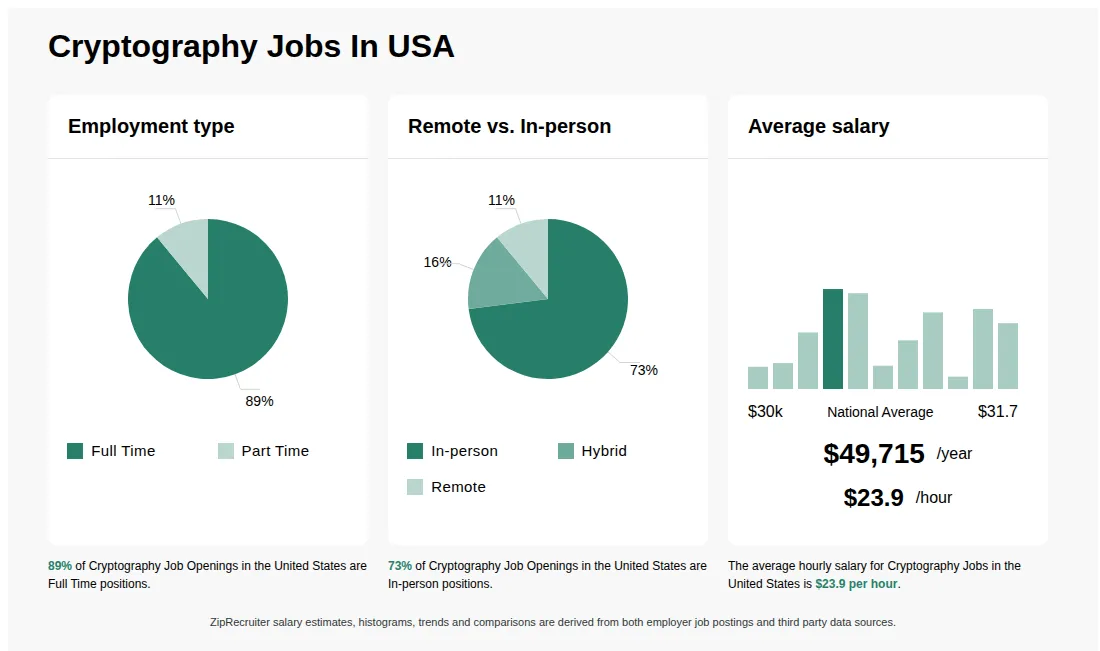
As of Jun 12, 2026, the average hourly pay for cryptography in the United States is $23.90, according to ZipRecruiter salary data. Most workers in this role earn between $19.71 and $29.09 per hour, depending on experience, location, and employer.

What Are Cryptography Jobs?

Jobs in cryptography include cryptographer, cipher, and other positions that work to ensure data security. As a cryptographer, your responsibilities are to develop new algorithms, convert information, study cryptographic technologies, search for weaknesses that would leave information unprotected, and build a better design for encrypted data. You can also work as a cipher and use cryptanalytic techniques to decrypt information as well as test for weaknesses in networks, phones, and emails. In cryptography, you are both the code maker and the code breaker so you can ensure information is protected. You can find cryptography jobs that handle personal information, finances, national security, and other valuable information.

Can I make $200 a year in cyber security?

Cryptography is a specialized field within cybersecurity that often requires advanced skills and certifications. Entry-level positions typically pay more than $200 annually, with salaries increasing with experience, certifications, and job complexity. Earning $200 a year is generally not realistic for a professional in this field, as most roles offer significantly higher compensation.

What is cryptography and what do cryptographers do?

Cryptography is the science of securing information by transforming it into a format that only authorized parties can understand. Cryptographers are professionals who develop and analyze algorithms, protocols, and systems to protect data from unauthorized access, tampering, and misuse. Their work includes designing encryption methods, securing communication channels, and ensuring data integrity and authentication for various digital systems. They play a vital role in cybersecurity, financial systems, and any area that requires confidential information to be kept safe.

What jobs pay $500,000 a year?

In the field of cryptography, senior roles such as Chief Security Officer, Chief Cryptographer, or senior cybersecurity executives can reach or exceed $500,000 annually, especially in large corporations or tech firms. These positions typically require extensive experience, advanced certifications, and expertise in encryption, security protocols, and risk management.

What is the average salary of a cryptologist?

The average salary of a cryptologist in the United States typically ranges from $70,000 to $130,000 annually, depending on experience, education, and security clearance levels. Professionals with advanced skills in cryptography, often working in government or cybersecurity firms, tend to earn higher salaries. Certifications such as CISSP or CISA can also influence earning potential.

What are the key skills and qualifications needed to thrive as a Cryptographer, and why are they important?

To thrive as a Cryptographer, you need a strong background in mathematics, computer science, and information security, often supported by a relevant degree or advanced coursework. Familiarity with cryptographic algorithms, programming languages (such as Python, C++, or Java), and tools like OpenSSL or PGP, along with certifications like CISSP or CEH, is highly beneficial. Analytical thinking, problem-solving skills, and meticulous attention to detail are crucial soft skills for designing secure systems and identifying vulnerabilities. These skills ensure the creation and maintenance of robust cryptographic solutions that protect sensitive data in a constantly evolving threat landscape.

What are some common challenges faced by professionals working in cryptography roles?

Professionals in cryptography often encounter challenges such as staying current with rapidly evolving security threats and cryptographic algorithms, ensuring the secure implementation of complex protocols, and balancing security with system performance. Collaboration with software engineers, security analysts, and other stakeholders is crucial to integrate cryptographic solutions effectively. Additionally, cryptographers must remain vigilant about regulatory compliance and the potential impact of quantum computing on current encryption methods.

How much does a CIA cryptographer make?

CIA cryptographers are federal employees who typically earn salaries based on the General Schedule (GS) pay scale, with salaries ranging from approximately $50,000 to over $150,000 annually depending on experience, education, and security clearance level. Advanced skills in cryptography, security clearances, and specialized training can lead to higher compensation within government agencies.

What is the difference between Cryptography vs Network Security Specialist?

AspectCryptographyNetwork Security Specialist
Required CredentialsCryptography certifications (e.g., CISSP, GIAC), degrees in computer science or cybersecurityCertifications like CISSP, CEH, CompTIA Security+; degrees in cybersecurity or related fields
Work EnvironmentResearch labs, security teams, software development environmentsCorporate networks, security operations centers, IT departments
Employer & Industry UsageTech companies, government agencies, cybersecurity firmsFinancial institutions, government agencies, large corporations
Common Search & Comparison IntentUnderstanding cryptographic techniques and algorithmsProtecting network infrastructure and preventing cyber threats

Cryptography focuses on designing and analyzing secure communication methods through encryption algorithms, while Network Security Specialists implement and manage security measures to protect network infrastructure from threats. Both roles require cybersecurity certifications and often work together within cybersecurity teams to ensure data confidentiality and integrity.

What cities are hiring for Cryptography jobs? Cities with the most Cryptography job openings:
What are the most commonly searched types of Cryptography jobs? The most popular types of Cryptography jobs are:
What states have the most Cryptography jobs? States with the most job openings for Cryptography jobs include:
Cryptography - Consultant

Cryptography - Consultant

Veterans Sourcing Group, LLC

Manhattan, NY • Hybrid

Other

Posted 6 days ago


Job description

Post-Quantum Cryptography (PQC) Consultant New York, NY - Hybrid 12 Months+

Supports enterprise readiness for post-quantum cryptography by identifying cryptographic risk, inventorying quantum-vulnerable algorithms, and enabling a structured transition to quantum-resistant cryptography across security, infrastructure, and application environments.

1) Assess PQC readiness across PKI, IAM, applications, infrastructure, and data-in-transit use cases. 2) Validate cryptographic assets (certificates, keys, cipher suites) vulnerable to quantum threats. Work alongside the Centralized Encryption Key project members. 3) Support development of PQC roadmaps, crypto-agility strategies, and prioritized remediation plans. 4) Assist with PQC vendor evaluations, requirements definition, and comparative analysis. Translate technical findings into risk-based insights for security leadership and governance forums. 5) Align PQC activities with security architecture, risk management, and regulatory expectations.

1) Strong foundation in applied cryptography (PKI, TLS, key management, certificates). 2) Working knowledge of post-quantum cryptography concepts and NIST PQC standards. 3) Experience with enterprise security architecture, cryptographic inventory, or certificate lifecycle management. 4) Ability to operate in complex, regulated environments and communicate clearly with technical and non-technical stakeholders. 5) Experience supporting risk-based prioritization of cryptographic remediation Familiarity with aligning PQC initiatives to security policies, cryptographic standards, and change management processes 6) Awareness of third-party and supply-chain cryptographic risk considerations


Veterans Sourcing Group logo

About Veterans Sourcing Group

Sourced by ZipRecruiter

Veterans Sourcing Group is a renowned company headquartered in New York, NY, US and is committed to providing high-quality, reliable staffing solutions and advisory services. The company operates in the human resources and staffing industry, specializing in veteran hiring. They offer various solutions to meet client needs, including strategic consultancy, professional search, and contract staffing. The company was founded by Beth Vines and Bruce Madnick, respected professionals who recognized a gap in the market for veteran-focused staffing services which prompted them to establish Veterans Sourcing Group in 2011.

Industry

Recruiting and staffing services

Company size

51 - 200 Employees

Headquarters location

New York, NY, US

Social media