1

Conservation Social Science Jobs (NOW HIRING)

Scientific Aide

Oakland, CA ยท On-site

$20.43/hr

... Care, Conservation and Research (ACCR). The Scientific Aide provides technical assistance for ... social science research as it relates to species coexistence and human-wildlife interactions ...

... Care, Conservation and Research (ACCR). The Scientific Aide provides technical assistance for ... social science research as it relates to species coexistence and human-wildlife interactions ...

Application of sociological theories about society and nature from the fields of environmental sociology, conservation social sciences, science and technology studies, the sociology of consumption ...

Scientific Aide

Oakland, CA ยท On-site

$20.43/hr

... Care, Conservation and Research (ACCR). The Scientific Aide provides technical assistance for ... social science research as it relates to species coexistence and human-wildlife interactions ...

next page

Showing results 1-20

Conservation Social Science information

See salary details

$18K

$65.2K

$144.5K

How much do conservation social science jobs pay per year?

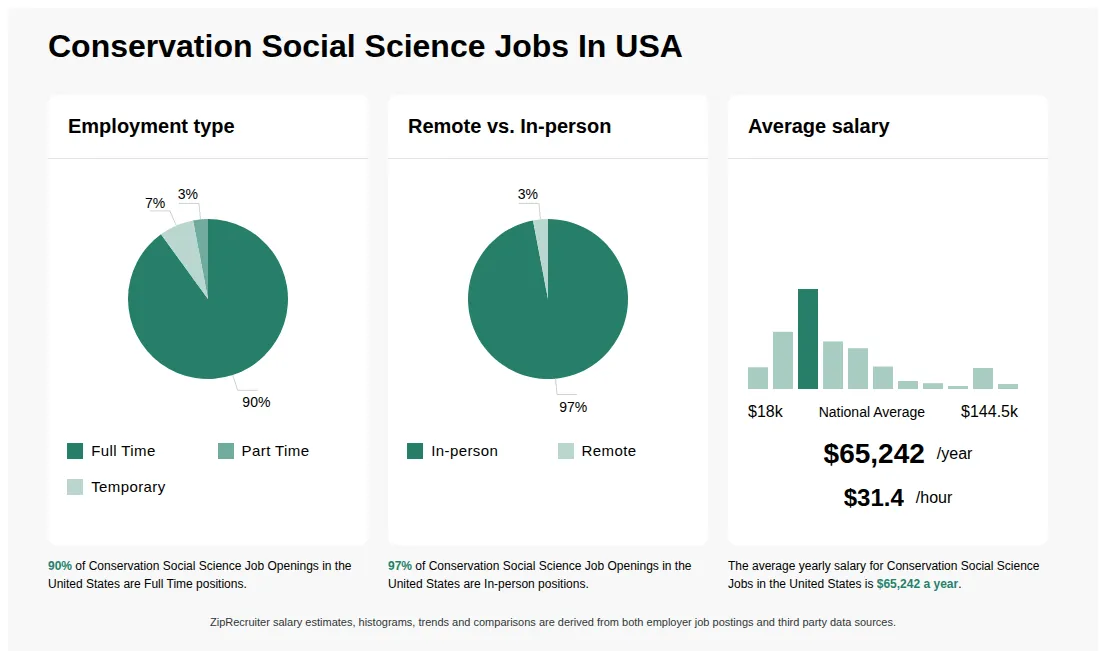
As of Jun 25, 2026, the average yearly pay for conservation social science in the United States is $65,242.00, according to ZipRecruiter salary data. Most workers in this role earn between $41,500.00 and $73,500.00 per year, depending on experience, location, and employer.

What are the key skills and qualifications needed to thrive in the Conservation Social Science position, and why are they important?

To thrive in Conservation Social Science, you need a strong background in social science research methods, environmental studies, and frequently a relevant graduate degree. Experience with qualitative and quantitative data analysis tools (such as NVivo or SPSS), GIS mapping, and knowledge of ethics review processes is often expected. Excellent communication, cross-cultural competency, and stakeholder engagement skills are highly valued. These abilities are vital for effectively understanding and influencing human dimensions of conservation, building partnerships, and supporting evidence-based environmental management.

What can you do with a conservation science degree?

A conservation social science degree prepares individuals for roles that involve studying human behaviors and social factors affecting environmental conservation. Careers include environmental policy analyst, community outreach coordinator, conservation program manager, and research associate, often requiring skills in data analysis, stakeholder engagement, and knowledge of ecological issues. These roles are found in government agencies, non-profit organizations, research institutions, and environmental consulting firms.

What jobs can you do in conservation?

Conservation social science offers roles such as conservation coordinator, community outreach specialist, policy analyst, and environmental educator. These jobs often involve stakeholder engagement, data collection, and communication skills, and may require knowledge of environmental policies and social science methods.

What is a Conservation Social Science job?

A Conservation Social Science job applies social science theories and methods to understand human dimensions of conservation. Professionals in this field analyze how people perceive, engage with, and are affected by environmental and conservation policies. They work in areas such as community engagement, policy development, behavioral research, and natural resource management to create strategies that promote both ecological and social well-being. Roles can exist in government agencies, nonprofits, academia, or private organizations, informing decision-making and encouraging sustainable practices.

What is the highest paying conservation job?

The highest paying conservation jobs are often senior roles such as Conservation Directors or Chief Conservation Officers, who oversee large programs and budgets. These positions typically require extensive experience, advanced degrees, and leadership skills, with salaries reaching six figures or more in some organizations.

What is conservation in social science?

In conservation social science, the field focuses on understanding human behaviors, values, and social systems that influence natural resource management and environmental protection. Conservation social scientists use qualitative and quantitative methods to develop strategies that promote sustainable practices and effective policy implementation.

What types of organizations typically employ Conservation Social Science professionals, and how does the team structure support collaboration?

Conservation Social Science professionals are often employed by government agencies, non-profit organizations, research institutions, and environmental consulting firms. Teams are usually interdisciplinary, including ecologists, biologists, policy analysts, and community outreach specialists, allowing for comprehensive approaches to conservation challenges. Collaboration is a core aspect of the role, with professionals frequently engaging in joint projects, community-based initiatives, and participatory research. This team structure encourages knowledge sharing and collective problem-solving, making the work environment dynamic and impactful for people seeking meaningful, collaborative careers.


More about Conservation Social Science jobs
What cities are hiring for Conservation Social Science jobs? Cities with the most Conservation Social Science job openings:
What are the most commonly searched types of Conservation Social Science jobs? The most popular types of Conservation Social Science jobs are:
What states have the most Conservation Social Science jobs? States with the most job openings for Conservation Social Science jobs include:
Infographic showing various Conservation Social Science job openings in the United States as of June 2026, with employment types broken down into 81% Full Time, 14% Part Time, and 5% Temporary. Highlights an 95% In-person, and 5% Hybrid job distribution, with an average salary of $65,242 per year, or $31.4 per hour.
Conservation Policy Graduate Student Intern

Conservation Policy Graduate Student Intern

Point Blue Conservation Science

Cotati, CA โ€ข On-site

$25/hr

Other

Posted 2 days ago


Job description

Location: Hybrid/Remote (must reside within the United States)
Duration: Estimated duration is July 13, 2026 โ€“ Sept. 1, 2026
Start Date: July 13, 2026 (flexible)
Deadline to Apply: June 25, 2026
Position Type: Seasonal, full or part time (20-40 hours/week, 145 hours maximum)
Compensation and Benefits:ย 
This position is funded for a maximum of 145 hours at the rate of $25.00 per hour; benefits are limited to up to 40 hours of paid sick time that accrues every biโ€‘weekly pay period
About Point Blue:
Point Blue Conservation Scienceโ€™s mission is to conserve birds, other wildlife, and ecosystems through science, partnerships, and outreach. We use longโ€‘term ecological data and collaborative fieldwork to develop natureโ€‘based solutions to climate change, habitat loss, and other environmental threats to benefit wildlife and people. Based in Petaluma, California, we work from the Sierra to the sea, across the Western Hemisphere and as far away as Antarctica, to connect science to practical guidance, policy discussions, and tangible outcomes. As part of this work, Point Blue engages in policy at local, state, national, and global levels to ensure that science, longโ€‘term data, and field research inform conservation decisions.
We are committed to removing barriers based on racial, gender, cultural, and other factors and believe that equal representation is essential to the success of Point Blue's mission and vision. We seek and strongly encourage applicants from all backgrounds to join our team.
Job Summary:
Point Blue Conservation Science seeks a Conservation Policy Graduate Student Intern to support a state conservation policy engagement project and to gain training in policy-oriented social science coding skills. The graduate student intern will work with Point Blue staff to research, design and support the development of a policy-oriented white paper that reviews key issues from the California conservation and stewardship communities. The report will cover various biodiversity stewardship sectors including stewardship in agricultural, fire, freshwater, urban, and marine contexts. With guidance from their advisors, theย  intern will review roundtable notes and materials to help create the structure for the report, and help coordinate author contributions. In addition, the intern will work with Point Blueโ€™s Conservation Social Scientist to analyze existing interview data on working land stewardship motivations. Emergent themes may feed into the policy white paper and other products. The intern may conduct additional literature reviews, reach out to roundtable participants to follow up on discussion points, and is invited to make their own contributions to the authorship of the report.ย  Policy research and coordination will help advance our partnerships with stateโ€‘level and global biodiversity coalitions and local government partners. This summer internship role offers hands-on experience with policy processes, qualitative data analysis, and coalition engagement, with additional opportunities to contribute to project areas across local, state, national, and international scales.
Essential Functions:
  • Support the development of a stewardship-related white paper with policy recommendations
  • With the collaboration of advisors, create an outline for a report that will communicate stewardship priorities to the incoming California state administration and public agencies
  • With the collaboration of advisors, conduct an emergent thematic coding process on existing qualitative data.
  • Review best practices for the ethical handling and interpretation of human subjects data.
  • Review meeting notes, presentation slides, and recordings to capture key messaging
  • Follow up with external partners in the stewardship community as needed to clarify points and messaging
  • ย Conduct literature reviews
  • Draft and/or lead report sections as desired; with the ability to focus on areas of interest
  • Opportunity to participate in additional policy projects and engagements as they arise, including the California Global Biodiversity Alliance and International Union for the Conservation of Nature events.
Supervisory Responsibility:
None
Knowledge, Skills, and Abilities:
  • Understanding of state-wide public policy issues related toย  and conservation (or a willingness to learn this area) is preferred
  • Accountability and ability to meet deadlines
  • Ability to collaborate and work respectfully with people with a variety of perspectives
  • Ability to seek, accept, and incorporate feedback is necessary
  • ย Ability to conduct independent research and apply findings to practical projects
  • ย Ability to manage and prioritize tasks to meet project deadlines
  • Strong written and verbal communication skills
  • Skills to use basic computer programs (Microsoft Office spreadsheets, word processing, presentation and email programs; skills operating Google Drive programs including Google Sheets, Docs, and Slides)
Preferred Education and Experience:
This position requires that the applicant is currently enrolled in a graduate college program in a relevant field.
Work Environment & Physical Requirements:
  • This position operates in a remote or hybrid environment between a home office and professional office setting
  • Work environment is primarily indoors with the majority of time spent at a desk
  • Routinely uses standard office equipment such as computers, phones, photocopiers, scanners, and filing cabinets
  • Ability to move up to 20 pounds occasionally
  • Ability to use a computer, keyboard, and calculator
Position Type, Expected Hours of Work, and Travel:
  • Days and hours of work meetings are generally within Monday through Friday, 8am to 5pm, but specific hours will be flexible depending on the successful candidates and Point Blueโ€™s needs.
  • ย Remote/hybrid employees should choose a work environment that is free from distractions, has a reliable internet connection, and supports the employeeโ€™s ability to dedicate their full attention to their job duties during work hours.
If you have difficulty with the application process, please contact Liz Chamberlin at lchamberlin@pointblue.org.ย 
Point Blue is an equal employment opportunity employer and does not discriminate against applicants or employees because of race, color, religion, national origin, sex, sexual orientation, age, citizenship status, disability status of an otherwise qualified individual, membership or application for membership in an uniformed service, or membership in any other class protected by applicable law and will make reasonable accommodation for applicants with disabilities to complete the application and/or participate in the interview process.

Powered by JazzHR

uKA3va5Xa0