Core One is currently seeking a Linguist that has experience in one of the following languages: (Albanian, Amharic, Armenian (Eastern and Western), Azerbaijani, Baluchi, Bengali, Bosnian (Croatian ...
Core One is currently seeking a Linguist that has experience in one of the following languages: (Albanian, Amharic, Armenian (Eastern and Western), Azerbaijani, Baluchi, Bengali, Bosnian (Croatian ...

$80 - $100/hr
We prioritize linguists who understand the nuances of patient communications, clinical documentation, and healthcare terminology . Your specialized expertise will contribute to high-stakes medical ...
$80 - $100/hr
We prioritize linguists who understand the nuances of patient communications, clinical documentation, and healthcare terminology . Your specialized expertise will contribute to high-stakes medical ...

Linguist - (Hindi)
Houston, TX · On-site
$35/hr
Linguist - (Hindi) Location: Houston, TX Security Clearance: Public Trust (or ability to obtain) Schedule: This is an as-needed, part-time essential services position with work contingent upon ...
Linguist - (Hindi)
Houston, TX · On-site
$35/hr
Linguist - (Hindi) Location: Houston, TX Security Clearance: Public Trust (or ability to obtain) Schedule: This is an as-needed, part-time essential services position with work contingent upon ...
Linguist (Albanian, Bengali, Finnish, Greek, Hindi, Turkish, and with Security Clearance
Fairfax, VA · On-site
Core One is currently seeking a Linguist that has experience in one of the following languages: (Albanian, Amharic, Armenian (Eastern and Western), Azerbaijani, Baluchi, Bengali, Bosnian (Croatian ...
Linguist (Albanian, Bengali, Finnish, Greek, Hindi, Turkish, and with Security Clearance
Fairfax, VA · On-site
Core One is currently seeking a Linguist that has experience in one of the following languages: (Albanian, Amharic, Armenian (Eastern and Western), Azerbaijani, Baluchi, Bengali, Bosnian (Croatian ...
Computational Fluid Dynamics Analyst
San Marcos, TX · On-site
$60 - $80/hr
The Role Under supervision, provides Finite Element Analysis (FEA) and Computational Fluid Dynamics (CFD) analysis to support heat tracing projects, R&D verification, product development, field ...
Computational Fluid Dynamics Analyst
San Marcos, TX · On-site
$60 - $80/hr
The Role Under supervision, provides Finite Element Analysis (FEA) and Computational Fluid Dynamics (CFD) analysis to support heat tracing projects, R&D verification, product development, field ...
We prioritize linguists who understand the nuances of patient communications, clinical documentation, and healthcare terminology . Your specialized expertise will contribute to high-stakes medical ...
Quick apply
We prioritize linguists who understand the nuances of patient communications, clinical documentation, and healthcare terminology . Your specialized expertise will contribute to high-stakes medical ...

The Role Under supervision, provides Finite Element Analysis (FEA) and Computational Fluid Dynamics (CFD) analysis to support heat tracing projects, R&D verification, product development, field ...
The Role Under supervision, provides Finite Element Analysis (FEA) and Computational Fluid Dynamics (CFD) analysis to support heat tracing projects, R&D verification, product development, field ...
AST, LLC is currently seeking CAT III - Acholi linguist / translator candidates to be considered for employment. Summary of duties include: * Provide foreign language support services, including ...
Quick apply
AST, LLC is currently seeking CAT III - Acholi linguist / translator candidates to be considered for employment. Summary of duties include: * Provide foreign language support services, including ...
Core One is currently seeking a Linguist that has experience in one of the following languages: (Albanian, Amharic, Armenian (Eastern and Western), Azerbaijani, Baluchi, Bengali, Bosnian (Croatian ...
Core One is currently seeking a Linguist that has experience in one of the following languages: (Albanian, Amharic, Armenian (Eastern and Western), Azerbaijani, Baluchi, Bengali, Bosnian (Croatian ...

Senior Arabic Linguists
Chantilly, VA · On-site
Arabic Linguist with a polygraph Make a Global Impact - Join the Mission at Leidos Are you ready to apply your linguistic expertise to impactful work that directly supports the Intelligence Community?
Senior Arabic Linguists
Chantilly, VA · On-site
Arabic Linguist with a polygraph Make a Global Impact - Join the Mission at Leidos Are you ready to apply your linguistic expertise to impactful work that directly supports the Intelligence Community?
AST, LLC is currently seeking CAT III -Chechen linguist / translator candidates to be considered for employment. Summary of duties include: * Provide foreign language support services, including ...
Quick apply
AST, LLC is currently seeking CAT III -Chechen linguist / translator candidates to be considered for employment. Summary of duties include: * Provide foreign language support services, including ...
The Role Under supervision, provides Finite Element Analysis (FEA) and Computational Fluid Dynamics (CFD) analysis to support heat tracing projects, R&D verification, product development, field ...
The Role Under supervision, provides Finite Element Analysis (FEA) and Computational Fluid Dynamics (CFD) analysis to support heat tracing projects, R&D verification, product development, field ...

The Unconventional, LLC (TU) is seeking a highly qualified Japanese Senior Linguist (CAT II) to provide professional interpretation, translation, transcription, and reporting support for military ...
The Unconventional, LLC (TU) is seeking a highly qualified Japanese Senior Linguist (CAT II) to provide professional interpretation, translation, transcription, and reporting support for military ...

Posting Summary Logo Posting Number FAC00136PO25 Advertised Title Assistant Professor of Computational Linguistics and AI Campus Columbia College/Division College of Arts and Sciences Department CAS ...
Posting Summary Logo Posting Number FAC00136PO25 Advertised Title Assistant Professor of Computational Linguistics and AI Campus Columbia College/Division College of Arts and Sciences Department CAS ...

Somali CAT III Linguist
Augusta, GA · On-site
Valiant is seeking skilled CAT III Somali Linguists to provide interpretation and translation services in support of ongoing and new U.S. operations and mission requirements. RESPONSIBILITIES AND ...
Somali CAT III Linguist
Augusta, GA · On-site
Valiant is seeking skilled CAT III Somali Linguists to provide interpretation and translation services in support of ongoing and new U.S. operations and mission requirements. RESPONSIBILITIES AND ...
Japanese Senior Linguist (CAT III), Exercise Support (Temporary Duty)
Monterey, CA · On-site
$125 - $150/hr
Japanese Senior Linguist (CAT III), Exercise Support (Temporary Duty) - (2588) ABOUT THE ORGANIZATION Yorktown Systems Group, Inc., and its wholly-owned subsidiaries, are a committed team of ...
Japanese Senior Linguist (CAT III), Exercise Support (Temporary Duty)
Monterey, CA · On-site
$125 - $150/hr
Japanese Senior Linguist (CAT III), Exercise Support (Temporary Duty) - (2588) ABOUT THE ORGANIZATION Yorktown Systems Group, Inc., and its wholly-owned subsidiaries, are a committed team of ...

Bachelor's degree in linguistics, language technologies, computational linguistics, speech science, or related field. About PROLIM PROLIM is a leading provider of PLM, IoT and Digital transformation ...
Quick apply
Bachelor's degree in linguistics, language technologies, computational linguistics, speech science, or related field. About PROLIM PROLIM is a leading provider of PLM, IoT and Digital transformation ...

Japanese Senior Linguist (CAT II), Exercise Support (Temporary Duty)
Monterey, CA · On-site
$100 - $125/hr
Japanese Senior Linguist (CAT III), Exercise Support (Temporary Duty) - (2588) Share this job as a link in your status update to LinkedIn. ABOUT THE ORGANIZATION Yorktown Systems Group, Inc., and its ...
Japanese Senior Linguist (CAT II), Exercise Support (Temporary Duty)
Monterey, CA · On-site
$100 - $125/hr
Japanese Senior Linguist (CAT III), Exercise Support (Temporary Duty) - (2588) Share this job as a link in your status update to LinkedIn. ABOUT THE ORGANIZATION Yorktown Systems Group, Inc., and its ...
Education/ Experience: • Bachelor's degree in linguistics, language technologies, computational linguistics, speech science, or related field. About PROLIM PROLIM is a leading provider of PLM, IoT ...
Education/ Experience: • Bachelor's degree in linguistics, language technologies, computational linguistics, speech science, or related field. About PROLIM PROLIM is a leading provider of PLM, IoT ...
The Unconventional, LLC (TU) is seeking a highly qualified Japanese Senior Linguist (CAT II) to provide professional interpretation, translation, transcription, and reporting support for military ...
The Unconventional, LLC (TU) is seeking a highly qualified Japanese Senior Linguist (CAT II) to provide professional interpretation, translation, transcription, and reporting support for military ...
Computational Linguist information
See salary details
$40.87 - $43.88
4% of jobs
$46.79 is the 25th percentile. Wages below this are outliers.
$43.88 - $46.90
22% of jobs
The median wage is $49.73 / hr.
$46.90 - $49.91
26% of jobs
$49.91 - $52.93
23% of jobs
$53.31 is the 75th percentile. Wages above this are outliers.
$52.93 - $55.94
6% of jobs
$55.94 - $58.96
3% of jobs
$58.96 - $61.98
0% of jobs
$61.98 - $64.99
0% of jobs
$64.99 - $68.01
0% of jobs
$68.01 - $71.02
0% of jobs
$71.02 - $74.04
16% of jobs
$40
$54
$74
How much do computational linguist jobs pay per hour?
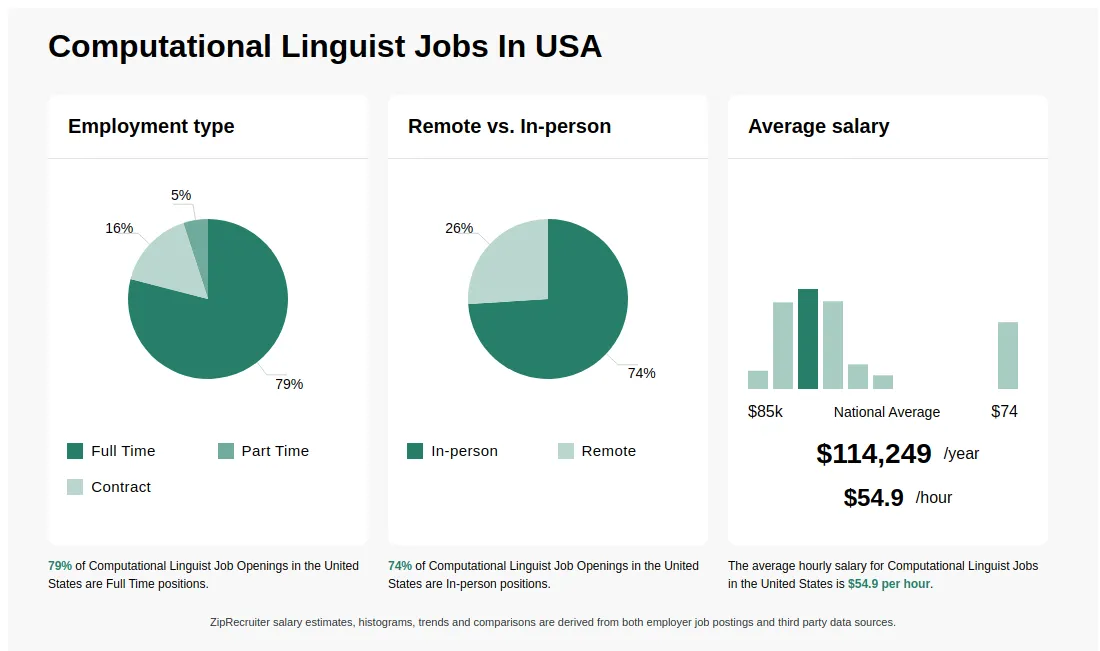
As of Sep 9, 2026, the average hourly pay for computational linguist in the United States is $54.93, according to ZipRecruiter salary data. Most workers in this role earn between $46.88 and $73.56 per hour, depending on experience, location, and employer.
What is a computational linguist?
A computational linguist is a type of computer professional who develops programs that help computers create human language. You must be experienced with programming artificial intelligence (AI) to translate typed words into corresponding linguistics. In this career, you develop programming that can translate data into a variety of languages. You may even work on computer programming that can translate data from one human language to another. As a computational linguist, you are skilled in natural language processing (NLP) and the use of programming languages like Java.
What is a computational linguist?
A computational linguist is a professional who applies computer science and linguistic principles to develop technologies that process and understand human language. This can include building speech recognition systems, machine translation tools, chatbots, and natural language processing (NLP) applications. Computational linguists often work at the intersection of linguistics, computer programming, and data science to help computers interpret and generate human language in meaningful ways.
What are the key skills and qualifications needed to thrive as a computational linguist, and why are they important?
To thrive as a Computational Linguist, you need a strong background in linguistics, computer science, and programming languages like Python, often supported by an advanced degree in computational linguistics or a related field. Familiarity with natural language processing (NLP) frameworks such as NLTK, spaCy, or TensorFlow, and experience with machine learning algorithms and corpus analysis tools are typically required. Strong analytical thinking, problem-solving skills, and effective communication are essential soft skills for interpreting data and collaborating with multidisciplinary teams. These skills are crucial for developing language technologies that accurately process and analyze human language data in real-world applications.
What are some common challenges faced by computational linguists when integrating language models into real-world applications?
Computational linguists often encounter challenges such as handling ambiguous language, adapting models to domain-specific jargon, and ensuring consistent performance across multiple languages or dialects. Additionally, integrating language models into production systems requires close collaboration with software engineers and data scientists to ensure scalability and efficiency. Keeping up with rapid advancements in natural language processing technologies also demands continuous learning and adaptation.
What is the difference between Computational Linguist vs Data Scientist?
| Aspect | Computational Linguist | Data Scientist |
|---|---|---|
| Required Credentials | Degree in linguistics, computer science, or related fields; knowledge of NLP tools | Degree in statistics, computer science, or related fields; proficiency in programming and analytics |
| Work Environment | Research labs, tech companies, AI firms focusing on language processing | Business analytics, tech companies, finance, healthcare analyzing large datasets |
| Employer & Industry Usage | Tech companies, research institutions, AI startups | Tech firms, finance, consulting, healthcare |
| Common Search & Comparison Intent | Understanding roles in NLP and language tech | Analyzing data-driven roles in tech and business |
Computational Linguists focus on developing algorithms for language understanding, often working on NLP projects. Data Scientists analyze large datasets to extract insights across various industries. While both roles require programming skills, Computational Linguists specialize in language and linguistics, whereas Data Scientists focus on data analysis and modeling.
How much do computational linguists make?
Computational linguists typically earn a median annual salary of around $80,000 to $120,000, depending on experience, education, and location. Salaries can be higher in tech hubs or for those with specialized skills in natural language processing and machine learning tools.
Is computational linguistics a good major?
Computational linguistics is a relevant major for roles like computational linguist, combining linguistics, computer science, and machine learning. It prepares students for careers in natural language processing, speech recognition, and AI applications, often requiring programming skills and knowledge of algorithms. Graduates can find opportunities in tech companies, research institutions, and startups working on language technologies.
What kind of jobs are in computational linguistics?
Computational linguists work in roles such as natural language processing engineer, speech recognition specialist, language data analyst, and machine learning researcher. These jobs involve developing algorithms, models, and tools to process and understand human language, often requiring programming skills and knowledge of linguistics or AI frameworks.
More about Computational Linguist jobs
What cities are hiring for Computational Linguist jobs?
Cities with the most Computational Linguist job openings:
What are the most commonly searched types of Computational Linguist jobs?
The most popular types of Computational Linguist jobs are:
What states have the most Computational Linguist jobs?
States with the most job openings for Computational Linguist jobs include:
What are popular job titles related to Computational Linguist jobs?
For Computational Linguist jobs, the most frequently searched job titles are:

Linguist (Albanian, Bengali, Finnish, Greek, Hindi, Turkish, and more.)
Mclean, VA • On-site
Core One •
Guided Missile and Space Vehicle Manufacturing • 51 - 200 employees51 - 200 employees
Full-time
Re-posted 18 days ago
Job description
Core One is currently seeking a Linguist that has experience in one of the following languages: (Albanian, Amharic, Armenian (Eastern and Western), Azerbaijani, Baluchi, Bengali, Bosnian (Croatian, Serbian), Bulgarian (Macedonian), Burmese, Cambodian (Khmer), Cebuano, Chechen, Croatian (Bosnian, Serbian), Czech (Slovak), Dari, Estonian, Ewe, Finnish, Georgian, German, Greek, Gujarati, Hausa, Hebrew, Hindi, Hungarian, Igbo (Ibo), Indonesian, Javanese, Kazakh, Kirghiz, Kissi, Kurdish, Lao, Lithuanian, Macedonian (Bulgarian), Malay, Malayalam, Marathi, Mongolian, Nepali, Panjabi (Punjabi), Pashto, Polish, Serbian (Bosnian, Croatian), Sindhi, Slovak (Czech), Slovenian, Somali, Tagalog, Tajik, Tamil, Tausug, Telugu, Thai, Tibetian, Tigrinya, Turkish, Turkmen, Uygur, Ukrainian, Urdu, Uzbek, Vietnamese, Yoruba, Zulu) to support our Intelligence Community customer.
**THIS IS FOR FUTURE CONSIDERATION ONLY**
**THIS POSITION REQUIRES A CURRENT TS/SCI WITH POLYGRAPH CLEARANCE**
Responsibilities:
Requirements:
Journeyman Linguist:
Primary Linguist:
Senior Linguist:
Expert Linguist:
About Core One
Our mission is to be at the forefront of devising analytical, operational and technical solutions to our Nation's most complex national security challenges. In order to achieve our mission, Core One values people first and is comprised of outstanding professionals from the national security community. Because Core One is committed to seeking top talent, we offer competitive compensation and benefits packages. In addition, Core One is a team-oriented, dynamic and growing company that values exceptional performance.
Core One is an Equal Opportunity Employer. All qualified applicants will receive consideration for employment without regard to race, color, religion, sex, gender identity, sexual orientation, national origin, or protected veteran status and will not be discriminated against on the basis of disability.
**THIS IS FOR FUTURE CONSIDERATION ONLY**
**THIS POSITION REQUIRES A CURRENT TS/SCI WITH POLYGRAPH CLEARANCE**
Responsibilities:
- Depending upon Linguist level, and language test scores, you will be responsible for performing different ranges of activities in processing material for translation and interpretation.
- Depending upon Linguist level, you may be asked to provide interim or short term support to the Sponsor.
- Using translation methodology to translate a wide variety of complex texts that often contain difficult and abstract writing.
Requirements:
Journeyman Linguist:
- Performs a limited range of activities in processing material (level 2-2+ for translation, interpretation, speaking/listening, on the Interagency Language Roundtable (ILR) scale).
- Journeyman shall not complete finished translations or transcriptions. Journeyman may provide interim, or short term, support to the sponsor.
- Active TS/SCI with Poly clearance.
Primary Linguist:
- Performs full range of activities in processing material or participating in situations requiring a general professional capability (level 3-3+ for translation or interpretation on the ILR scale).
- Must be able to translate texts that contain not only facts but also abstract language, and must evidence a fundamental ability to capture their intended implications and many nuances.
- Active TS/SCI with Poly clearance.
Senior Linguist:
- Performs full range of activities in processing material or participating in situations requiring an advanced professional capability (level 4-4+ for translation or interpretation on ILR scale).
- Must be able to successfully apply a translation methodology to translate a wide variety of complex texts that contain difficult, abstract, idiomatic, highly technical, and colloquial writing.
- Active TS/SCI with Poly clearance.
Expert Linguist:
- Performs full range of activities in processing material or participating in situations requiring a superior professional capability (level 5 for translation or interpretation on the ILR scale).
- Must be able to successfully translate virtually all texts, including those where lack of linguistic and cultural parallelism between the source language and the target language requires precise congruity judgments and the ability to apply a translation methodology.
- Active TS/CI with Poly clearance.
About Core One
Our mission is to be at the forefront of devising analytical, operational and technical solutions to our Nation's most complex national security challenges. In order to achieve our mission, Core One values people first and is comprised of outstanding professionals from the national security community. Because Core One is committed to seeking top talent, we offer competitive compensation and benefits packages. In addition, Core One is a team-oriented, dynamic and growing company that values exceptional performance.
Core One is an Equal Opportunity Employer. All qualified applicants will receive consideration for employment without regard to race, color, religion, sex, gender identity, sexual orientation, national origin, or protected veteran status and will not be discriminated against on the basis of disability.

About Core One
Sourced by ZipRecruiter
Industry
Guided missile and space vehicle manufacturing
Company size
51 - 200 Employees
Headquarters location
Sterling, VA, US