... and Behavioral Neuroscience, Rutgers University-Newark ( ). Applicants would join the Benasich lab ( ) that conducts studies on the early neural processes necessary for normative cognitive and ...
... and Behavioral Neuroscience, Rutgers University-Newark ( ). Applicants would join the Benasich lab ( ) that conducts studies on the early neural processes necessary for normative cognitive and ...

Utilize rodent behavioral paradigms to assess emotional, cognitive, and motor functions, supporting ... D. in Neuroscience, Neuropharmacology, Physiology, Molecular Biology, or a closely related ...
Utilize rodent behavioral paradigms to assess emotional, cognitive, and motor functions, supporting ... D. in Neuroscience, Neuropharmacology, Physiology, Molecular Biology, or a closely related ...
Utilize rodent behavioral paradigms to assess emotional, cognitive, and motor functions, supporting ... D. in Neuroscience, Neuropharmacology, Physiology, Molecular Biology, or a closely related ...
Utilize rodent behavioral paradigms to assess emotional, cognitive, and motor functions, supporting ... D. in Neuroscience, Neuropharmacology, Physiology, Molecular Biology, or a closely related ...

Behavioral Neurologist - Dementia Specialist
Minneapolis, MN · On-site
$338K - $375K/yr
April 30, 2026 Department: 31009906 AHNSPI Neuroscience ANW Shift: Day (United States of America ... We are seeking a Neurologist with fellowship training in Dementia, Cognitive Neurology, Geriatric ...
Behavioral Neurologist - Dementia Specialist
Minneapolis, MN · On-site
$338K - $375K/yr
April 30, 2026 Department: 31009906 AHNSPI Neuroscience ANW Shift: Day (United States of America ... We are seeking a Neurologist with fellowship training in Dementia, Cognitive Neurology, Geriatric ...

Assistant Teaching Professor - Psychology and Neuroscience
Boulder, CO · On-site
$73K - $77K/yr
Behavioral, Psychiatric, and Statistical Genetics; Clinical Psychology; Cognitive Psychology; and ... The CU Boulder neuroscience course catalog may be found here: What We Can Offer $73,000-$77,000 ...
Assistant Teaching Professor - Psychology and Neuroscience
Boulder, CO · On-site
$73K - $77K/yr
Behavioral, Psychiatric, and Statistical Genetics; Clinical Psychology; Cognitive Psychology; and ... The CU Boulder neuroscience course catalog may be found here: What We Can Offer $73,000-$77,000 ...
$338K - $375K/yr
April 30, 2026 Department: 31009906 AHNSPI Neuroscience ANW Shift: Day (United States of America ... We are seeking a Neurologist with fellowship training in Dementia, Cognitive Neurology, Geriatric ...
$338K - $375K/yr
April 30, 2026 Department: 31009906 AHNSPI Neuroscience ANW Shift: Day (United States of America ... We are seeking a Neurologist with fellowship training in Dementia, Cognitive Neurology, Geriatric ...
Behavioral Neurologist - Dementia Specialist
Minneapolis, MN · On-site
$338K - $375K/yr
April 30, 2026 Department: 31009906 AHNSPI Neuroscience ANW Shift: Day (United States of America ... We are seeking a Neurologist with fellowship training in Dementia, Cognitive Neurology, Geriatric ...
Behavioral Neurologist - Dementia Specialist
Minneapolis, MN · On-site
$338K - $375K/yr
April 30, 2026 Department: 31009906 AHNSPI Neuroscience ANW Shift: Day (United States of America ... We are seeking a Neurologist with fellowship training in Dementia, Cognitive Neurology, Geriatric ...

Post-Doctoral Associate - Human Cognitive Neuroscience, Computational Psychiatry, and Brain Stimulat
Minneapolis, MN · On-site
$63K - $74K/mo
... cognitive, or clinical neuroscience. Work Schedule: In-person (Hybrid flexibility possible), M-F ... Analyze human behavioral, electrophysiological, neuroimaging, and brain stimulation datasets.
Post-Doctoral Associate - Human Cognitive Neuroscience, Computational Psychiatry, and Brain Stimulat
Minneapolis, MN · On-site
$63K - $74K/mo
... cognitive, or clinical neuroscience. Work Schedule: In-person (Hybrid flexibility possible), M-F ... Analyze human behavioral, electrophysiological, neuroimaging, and brain stimulation datasets.

Medical Education Coordinator
Chicago, IL · On-site
$100/hr
Its faculty bring expertise across the psychiatric subspecialties and in behavioral neuroscience ... cognitive disorders, eating and weight disorders, including obesity, substance use disorders, and ...
Medical Education Coordinator
Chicago, IL · On-site
$100/hr
Its faculty bring expertise across the psychiatric subspecialties and in behavioral neuroscience ... cognitive disorders, eating and weight disorders, including obesity, substance use disorders, and ...

Lecturer - Neuroscience Department
Berkeley, CA · On-site
$70K - $199K/yr
Circuit, systems, and behavioral neuroscience * Cognitive neuroscience * Computational neuroscience * Neurotechnology * Laboratory courses in the above areas * Scientific communication and writing ...
Lecturer - Neuroscience Department
Berkeley, CA · On-site
$70K - $199K/yr
Circuit, systems, and behavioral neuroscience * Cognitive neuroscience * Computational neuroscience * Neurotechnology * Laboratory courses in the above areas * Scientific communication and writing ...
Assistant Teaching Professor - Psychology and Neuroscience
Boulder, CO · On-site
$73K - $77K/yr
Behavioral, Psychiatric, and Statistical Genetics; Clinical Psychology; Cognitive Psychology; and ... The CU Boulder neuroscience course catalog may be found here: What We Can Offer $73,000-$77,000 ...
Assistant Teaching Professor - Psychology and Neuroscience
Boulder, CO · On-site
$73K - $77K/yr
Behavioral, Psychiatric, and Statistical Genetics; Clinical Psychology; Cognitive Psychology; and ... The CU Boulder neuroscience course catalog may be found here: What We Can Offer $73,000-$77,000 ...

The broad research foci of the department include child and family, cognitive and behavioral neuroscience, quantitative psychology, school psychology, and clinical community psychology with an ...
The broad research foci of the department include child and family, cognitive and behavioral neuroscience, quantitative psychology, school psychology, and clinical community psychology with an ...

... and Behavioral Neurobiology Assignment Category Full-Time Rank Open Rank Tenure Status Non-Tenure ... cognitive, and psychological challenges. Responsibilities include establishing a service-based ...
... and Behavioral Neurobiology Assignment Category Full-Time Rank Open Rank Tenure Status Non-Tenure ... cognitive, and psychological challenges. Responsibilities include establishing a service-based ...
... and Behavioral Neurobiology Assignment Category Full-Time Rank Open Rank Tenure Status Non-Tenure ... cognitive, and psychological challenges. Responsibilities include establishing a service-based ...
... and Behavioral Neurobiology Assignment Category Full-Time Rank Open Rank Tenure Status Non-Tenure ... cognitive, and psychological challenges. Responsibilities include establishing a service-based ...
Medical Education Coordinator
Chicago, IL · On-site
$100/hr
Its faculty bring expertise across the psychiatric subspecialties and in behavioral neuroscience ... cognitive disorders, eating and weight disorders, including obesity, substance use disorders, and ...
Medical Education Coordinator
Chicago, IL · On-site
$100/hr
Its faculty bring expertise across the psychiatric subspecialties and in behavioral neuroscience ... cognitive disorders, eating and weight disorders, including obesity, substance use disorders, and ...

Cognitive Neurologist - Alzheimer's and Dementia Program
Owosso, MI · On-site
$288K - $359K/yr
A growing neuroscience institute in Michigan is seeking a physician with fellowship training in behavioral neurology or a strong clinical interest in cognitive neurology to join its expanding ...
Cognitive Neurologist - Alzheimer's and Dementia Program
Owosso, MI · On-site
$288K - $359K/yr
A growing neuroscience institute in Michigan is seeking a physician with fellowship training in behavioral neurology or a strong clinical interest in cognitive neurology to join its expanding ...
Post-Doctoral Associate
Newark, NJ · On-site
$51K - $69K/yr
... Behavioral Neuroscience (CMBN), at Rutgers University-Newark seeks a Post-Doctoral Associate with training in neuroscience, cognitive science, psychology, public health, kinesiology, or a related ...
Post-Doctoral Associate
Newark, NJ · On-site
$51K - $69K/yr
... Behavioral Neuroscience (CMBN), at Rutgers University-Newark seeks a Post-Doctoral Associate with training in neuroscience, cognitive science, psychology, public health, kinesiology, or a related ...

Neurology job in Mechanicsburg PA
Mechanicsburg, PA · On-site
$303K - $379K/yr
UPMC Central PA - Cognitive Behavioral Neurologist (West Shore/Mechanicsburg) UPMC Neurosciences Institute in Mechanicsburg, PA has an exciting opportunity for a Cognitive Behavioral Neurologist ...
Neurology job in Mechanicsburg PA
Mechanicsburg, PA · On-site
$303K - $379K/yr
UPMC Central PA - Cognitive Behavioral Neurologist (West Shore/Mechanicsburg) UPMC Neurosciences Institute in Mechanicsburg, PA has an exciting opportunity for a Cognitive Behavioral Neurologist ...

Assistant Professor in Cognitive and Computational Neuroscience - Department of Psychology and Neuro
Knoxville, TN · On-site
We invite applications from individuals who use behavioral, computational, and/or neuroscience approaches to study cognitive processes including perception, attention, learning, memory systems ...
Assistant Professor in Cognitive and Computational Neuroscience - Department of Psychology and Neuro
Knoxville, TN · On-site
We invite applications from individuals who use behavioral, computational, and/or neuroscience approaches to study cognitive processes including perception, attention, learning, memory systems ...

Faculty Professor
Albuquerque, NM · On-site
Sleep, circadian rhythms, and brain health * Psychiatric and behavioral neuroscience ... Cognitive Science, Public Health, or a related field and 12+ years of experience or an equivalent ...
Faculty Professor
Albuquerque, NM · On-site
Sleep, circadian rhythms, and brain health * Psychiatric and behavioral neuroscience ... Cognitive Science, Public Health, or a related field and 12+ years of experience or an equivalent ...
Cognitive Behavioral Neuroscience information
See salary details
$47.5K - $56.7K
1% of jobs
$56.7K - $66K
5% of jobs
$73K is the 25th percentile. Wages below this are outliers.
$66K - $75.2K
24% of jobs
The median wage is $80.2K / yr.
$75.2K - $84.4K
35% of jobs
$89K is the 75th percentile. Wages above this are outliers.
$84.4K - $93.6K
18% of jobs
$93.6K - $102.9K
5% of jobs
$102.9K - $112.1K
1% of jobs
$112.1K - $121.3K
1% of jobs
$121.3K - $130.5K
3% of jobs
$130.5K - $139.8K
3% of jobs
$139.8K - $149K
2% of jobs
$47.5K
$89.1K
$149K
How much do cognitive behavioral neuroscience jobs pay per year?
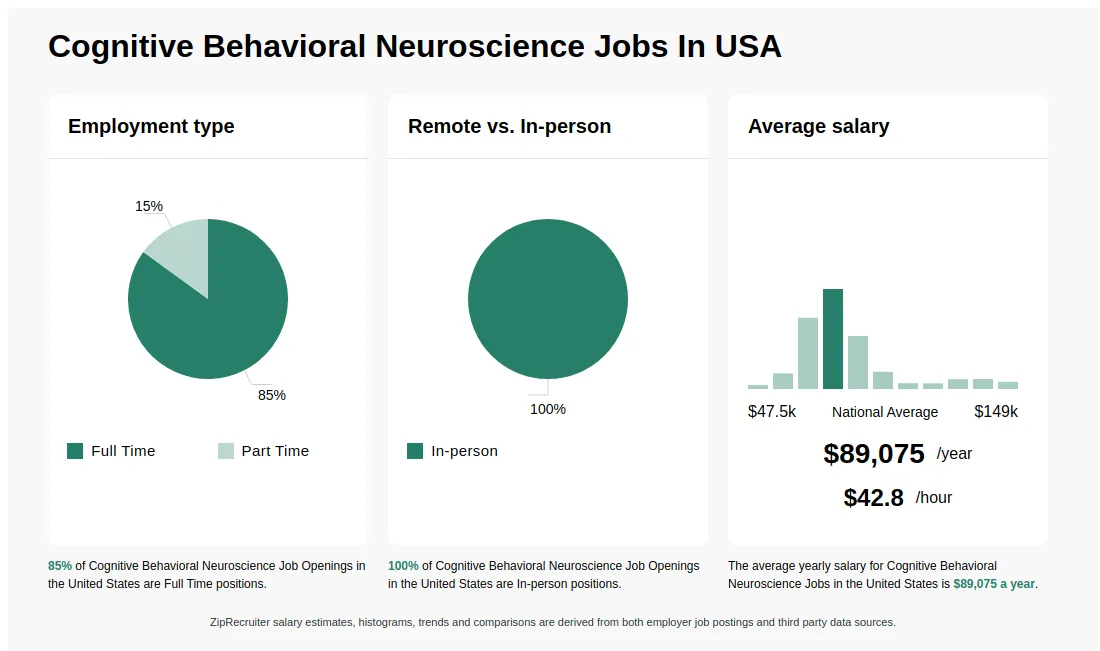
As of Sep 3, 2026, the average yearly pay for cognitive behavioral neuroscience in the United States is $89,075.00, according to ZipRecruiter salary data. Most workers in this role earn between $74,000.00 and $90,500.00 per year, depending on experience, location, and employer.
What is a cognitive behavioral neuroscience?
A Cognitive Behavioral Neuroscience job involves studying how brain function influences thoughts, emotions, and behaviors. Professionals in this field conduct research, analyze cognitive processes, and apply findings to areas such as mental health, artificial intelligence, or neurorehabilitation. They may work in academic settings, healthcare, or industry, using neuroimaging, behavioral experiments, and computational models to understand brain-behavior relationships.
What are the typical daily responsibilities of someone working in cognitive behavioral neuroscience?
Professionals in Cognitive Behavioral Neuroscience typically spend their days designing and conducting experiments, collecting and analyzing data using neuroimaging or behavioral assessment tools, and preparing research findings for publication. They often collaborate with other neuroscientists, psychologists, and research assistants both in laboratory settings and through interdisciplinary team meetings. Additional responsibilities may include applying for research grants, mentoring students or junior researchers, and staying updated on the latest scientific literature. This role requires balancing independent research tasks with group collaboration to drive meaningful advances in understanding the relationship between brain function and behavior.
What are the key skills and qualifications needed to thrive in cognitive behavioral neuroscience, and why are they important?
To excel in Cognitive Behavioral Neuroscience, a deep understanding of neuroscience, psychology, and behavioral research methods is typically required, often supported by an advanced degree (PhD or master's) in a related field. Familiarity with neuroimaging techniques (such as fMRI and EEG), statistical analysis software (like SPSS or MATLAB), and research protocols is crucial. Strong analytical thinking, attention to detail, and the ability to collaborate within multidisciplinary research teams are valuable soft skills for this role. These competencies enable effective research, accurate data interpretation, and productive teamwork in advancing scientific knowledge underlying cognitive and behavioral processes.
Is cognitive behavioral neuroscience a good career?
Cognitive behavioral neuroscience is a specialized field that involves studying the brain mechanisms underlying cognition and behavior, often requiring advanced degrees such as a Ph.D. or neuroscience-related certifications. It offers opportunities in research, academia, and healthcare, with a focus on experimental work and data analysis, but job availability can be competitive and typically requires strong analytical and technical skills.
What can I do with a cognitive behavioral neuroscience degree?
A degree in cognitive behavioral neuroscience prepares individuals for careers in research, clinical settings, or academia, focusing on understanding brain functions related to behavior and cognition. Graduates can work as research scientists, neuropsychologists, or in roles involving data analysis, experimental design, and neuroimaging techniques. Additional certifications or advanced degrees may be required for clinical practice or specialized research positions.
What jobs can I get with cognitive behavioral neuroscience?
With a background in cognitive behavioral neuroscience, common jobs include research scientist, neuropsychologist, clinical psychologist, or neuroscience technician. These roles often require skills in data analysis, experimental design, and understanding of brain-behavior relationships, and may involve working in academic, clinical, or research settings.
More about Cognitive Behavioral Neuroscience jobs
What cities are hiring for Cognitive Behavioral Neuroscience jobs?
Cities with the most Cognitive Behavioral Neuroscience job openings:
What are the most commonly searched types of Cognitive Behavioral Neuroscience jobs?
The most popular types of Cognitive Behavioral Neuroscience jobs are:
What states have the most Cognitive Behavioral Neuroscience jobs?
States with the most job openings for Cognitive Behavioral Neuroscience jobs include:
What job categories do people searching Cognitive Behavioral Neuroscience jobs look for?
The top searched job categories for Cognitive Behavioral Neuroscience jobs are:

$63K/yr
Full-time
Medical, Dental, Life, Retirement, PTO
Re-posted yesterday
Key responsibilities
Perform EEG/ERP recordings in infants and children.
Analyze EEG data using BESA, MATLAB, or FieldTrip and prepare research results for publication.
Contribute to the ongoing longitudinal studies, collaborate on additional projects, and assist in supervising students and lab members.
Rutgers University rating

7.7
Based on 68 frontline employees who took The Breakroom Quiz
265th of 628 rated colleges and universities
Job description
Position Information
Recruitment/Posting Title Post-Doctoral Associate Department SASN - Center for Molecular & Behavioral Neuroscience (CMBN) Salary Details A minimum of $63,968 Offer Information The final salary offer may be determined by several factors, including, but not limited to, the candidate's qualifications, experience, and expertise, and availability of department or grant funds to support the position. We also take into consideration market benchmarks, if and when appropriate, and internal equity to ensure fair compensation relative to the university's broader compensation structure. We are committed to offering competitive and flexible compensation packages to attract and retain top talent.
Benefits Rutgers offers a comprehensive benefits package to eligible employees, based on position, which includes:
- Medical, prescription drug, and dental coverage
- Paid vacation, holidays, and various leave programs
- Competitive retirement benefits, including defined contribution plans and voluntary tax-deferred savings options
- Employee and dependent educational benefits
- Life insurance coverage
- Employee discounts programs
For detailed information on benefits and eligibility, please visit: http://uhr.rutgers.edu/benefits/benefits-overview.
Posting Summary A Post-Doctoral Associate position is available at the Center for Molecular and Behavioral Neuroscience, Rutgers University-Newark (https://sasn.rutgers.edu/center-molecular-and-behavioral-neuroscience). Applicants would join the Benasich lab (https://www.babylab.rutgers.edu) that conducts studies on the early neural processes necessary for normative cognitive and language development as well as the impact of disordered processing on infant neurocognitive outcomes using converging paradigms and prospective longitudinal studies.
The lab collects dense-array EEG (dEEG) in awake and sleeping infants, auditory evoked response potentials (AERPs) and cABR as well as traditional infant behavioral paradigms, including operantly-conditioned head-turn, auditory and visual habituation and recognition memory tasks, and an array of standardized developmental cognitive and language assessments.
For informal inquiries please contact Dr. April A. Benasich (benasich@rutgers.edu)
Responsibilities include, but are not limited to:
- Performing EEG/ERP recordings in infants and children
- Analyzing EEG data using BESA, MATLab or FieldTrip and prepare the research results for publication
- Collaborating on manuscript preparation
- Contributing to the ongoing longitudinal studies and the daily operations of the lab
- Collaborating on additional laboratory projects
- Contributing to the supervision of students and other lab members
Anticipated start date: September 1, 2025.
Qualifications
Minimum Education and Experience The candidate should have a PhD in Cognitive Neuroscience, Developmental Cognitive Neuroscience, or related fields. The ideal candidate will have experience with dEEG and a focus on early brain development and plasticity.
Certifications/Licenses Required Knowledge, Skills, and Abilities Preferred Qualifications Knowledge of the MagStim EEG HydroCel Sensor system and Net Station software and interest in the microstructure of infant sleep would be a plus. The successful candidate is expected to lead their own project, support other ongoing research projects in the lab, and contribute to the training and supervision of graduate students.
Equipment Utilized Physical Demands and Work Environment Overview Statement Posting Details
Special Instructions to Applicants Applicants should submit a curriculum vitae, statement of research interests and the names and contact information of three professional references.
Quick Link to Posting https://rutgers-sb.peopleadmin.com/postings/251853 Campus Rutgers University-Newark Home Location Campus Rutgers University-Newark City Newark State NJ Location Details Pre-employment Screenings
All offers of employment are contingent upon successful completion of all pre-employment screenings.
Immunization Requirements
Under Policy 100.3.1 Immunization Policy for Covered Individuals, if employment will commence during Flu Season, Rutgers University may require certain prospective employees to provide proof that they are vaccinated against Seasonal Influenza for the current Flu Season, unless the University has granted the individual a medical or religious exemption. Additional infection control and safety policies may apply. Prospective employees should speak with their hiring manager to determine which policies apply to the role or position for which they are applying. Failure to provide proof of vaccination for any required vaccines or obtain a medical or religious exemption from the University will result in rescission of a candidate's offer of employment or disciplinary action up to and including termination.
Affirmative Action/Equal Employment Opportunity Statement
It is university policy to provide equal employment opportunity to all its employees and applicants for employment regardless of their race, creed, color, national origin, age, ancestry, nationality, marital or domestic partnership or civil union status, sex, pregnancy, gender identity or expression, disability status, liability for military service, protected veteran status, affectional or sexual orientation, atypical cellular or blood trait, genetic information (including the refusal to submit to genetic testing), or any other category protected by law. As an institution, we value diversity of background and opinion, and prohibit discrimination or harassment on the basis of any legally protected class in the areas of hiring, recruitment, promotion, transfer, demotion, training, compensation, pay, fringe benefits, layoff, termination or any other terms and conditions of employment. For additional information please see the Non-Discrimination Statement at the following web address: http://uhr.rutgers.edu/non-discrimination-statement
What Rutgers University employees say
Pay
Benefits
Hours and flexibility
Workplace
Get the full story on Breakroom

About Rutgers
Sourced by ZipRecruiter
Industry
Education programs administration
Company size
1 - 10 Employees
Headquarters location
Piscataway, NJ, US