$55 - $75/hr
Registered Clinical Exercise Physiologist (RCEP) - ACSM * Certified Exercise Specialist * Certified Cardiac Rehab Professional (CCRP) Educación Obligatorio BS Experiencia * Pulmonary Rehabilitation ...
$55 - $75/hr
Registered Clinical Exercise Physiologist (RCEP) - ACSM * Certified Exercise Specialist * Certified Cardiac Rehab Professional (CCRP) Educación Obligatorio BS Experiencia * Pulmonary Rehabilitation ...
$55 - $75/hr
Registered Clinical Exercise Physiologist (RCEP) - ACSM * Certified Exercise Specialist * Certified Cardiac Rehab Professional (CCRP) Educación Obligatorio BS Experiencia * Pulmonary Rehabilitation ...
NY · On-site
$55 - $75/hr
Registered Clinical Exercise Physiologist (RCEP) - ACSM * Certified Exercise Specialist * Certified Cardiac Rehab Professional (CCRP) Educación Obligatorio BS Experiencia * Pulmonary Rehabilitation ...
NY · On-site
$55 - $75/hr
Registered Clinical Exercise Physiologist (RCEP) - ACSM * Certified Exercise Specialist * Certified Cardiac Rehab Professional (CCRP) Educación Obligatorio BS Experiencia * Pulmonary Rehabilitation ...
Clinical Exercise Physiologist - Henry Ford Health Job Title Clinical Exercise Physiologist - Part Time - 20 Hours About the Department Join the Henry Ford Medical Group, one of Michigan's largest ...
New
Quick apply
Clinical Exercise Physiologist - Henry Ford Health Job Title Clinical Exercise Physiologist - Part Time - 20 Hours About the Department Join the Henry Ford Medical Group, one of Michigan's largest ...
New
We are seeking a Clinical Exercise Physiologist (CEP, Exercise Physiologist, Exercise Specialist, Cardiac Rehab Therapist) to: * Develop and coordinate individualized treatment plans that address the ...
We are seeking a Clinical Exercise Physiologist (CEP, Exercise Physiologist, Exercise Specialist, Cardiac Rehab Therapist) to: * Develop and coordinate individualized treatment plans that address the ...
We are seeking a Clinical Exercise Physiologist (CEP, Exercise Physiologist, Exercise Specialist, Cardiac Rehab Therapist) to: * Develop and coordinate individualized treatment plans that address the ...
We are seeking a Clinical Exercise Physiologist (CEP, Exercise Physiologist, Exercise Specialist, Cardiac Rehab Therapist) to: * Develop and coordinate individualized treatment plans that address the ...
Madison, WI · On-site
$27.33 - $41/hr
We are seeking a Clinical Exercise Physiologist (CEP, Exercise Physiologist, Exercise Specialist, Cardiac Rehab Therapist) to: * Develop and coordinate individualized treatment plans that address the ...
Madison, WI · On-site
$27.33 - $41/hr
We are seeking a Clinical Exercise Physiologist (CEP, Exercise Physiologist, Exercise Specialist, Cardiac Rehab Therapist) to: * Develop and coordinate individualized treatment plans that address the ...
Leonardtown, MD · On-site
$22.48 - $39.75/hr
About the Job MedStar Health is looking for a Clinical Exercise Physiologist to join our team in Leonardtown, Maryland! As an Exercise Physiologist, you will provide office stress testing support to ...
Leonardtown, MD · On-site
$22.48 - $39.75/hr
About the Job MedStar Health is looking for a Clinical Exercise Physiologist to join our team in Leonardtown, Maryland! As an Exercise Physiologist, you will provide office stress testing support to ...
Okatie, SC · On-site
Req Number HEA-26-00072 Position Clinical Exercise Physiologist Location Okatie Medical Pavillion Full-Time/Part-Time Full-Time Shift First Exempt/Non-Exempt Non-Exempt Description The Clinical ...
Okatie, SC · On-site
Req Number HEA-26-00072 Position Clinical Exercise Physiologist Location Okatie Medical Pavillion Full-Time/Part-Time Full-Time Shift First Exempt/Non-Exempt Non-Exempt Description The Clinical ...
Master's Degree in Clinical Exercise Physiology or related field is required. * Requires 1-2 years of experience in cardiopulmonary rehabilitation. * ACSM Certified Clinical Exercise Physiologist ...
Master's Degree in Clinical Exercise Physiology or related field is required. * Requires 1-2 years of experience in cardiopulmonary rehabilitation. * ACSM Certified Clinical Exercise Physiologist ...
Baltimore, MD · On-site
$22.48 - $39.75/hr
As a Clinical Exercise Physiologist, you will assess patients' physical and functional capacity and implement activities. Join one of the largest healthcare systems in the Baltimore-Washington metro ...
Baltimore, MD · On-site
$22.48 - $39.75/hr
As a Clinical Exercise Physiologist, you will assess patients' physical and functional capacity and implement activities. Join one of the largest healthcare systems in the Baltimore-Washington metro ...
Sequim, WA · On-site
$23.49 - $33.81/hr
No The Clinical Exercise Physiologist I (CEP) works with patients and clients challenged with cardiovascular, pulmonary, and metabolic diseases and disorders, as well as with healthy populations in ...
New
Sequim, WA · On-site
$23.49 - $33.81/hr
No The Clinical Exercise Physiologist I (CEP) works with patients and clients challenged with cardiovascular, pulmonary, and metabolic diseases and disorders, as well as with healthy populations in ...
New
Port Angeles, WA · On-site
$23.49 - $33.81/hr
No The Clinical Exercise Physiologist I (CEP) works with patients and clients challenged with cardiovascular, pulmonary, and metabolic diseases and disorders, as well as with healthy populations in ...
New
Port Angeles, WA · On-site
$23.49 - $33.81/hr
No The Clinical Exercise Physiologist I (CEP) works with patients and clients challenged with cardiovascular, pulmonary, and metabolic diseases and disorders, as well as with healthy populations in ...
New
Tipton, IN · On-site
Master's Degree in Clinical Exercise Physiology or related field is required. * Requires 1-2 years of experience in cardiopulmonary rehabilitation. * ACSM Certified Clinical Exercise Physiologist ...
Tipton, IN · On-site
Master's Degree in Clinical Exercise Physiology or related field is required. * Requires 1-2 years of experience in cardiopulmonary rehabilitation. * ACSM Certified Clinical Exercise Physiologist ...
Warren, MI · On-site
$20 - $30/hr
BSN, ACSM Certified clinical exercise physiologist eligible * 3 to 6 month clinical internship in stress testing * ACLS certification by the American Heart Association and proof of Arrhythmia ...
Quick apply
Warren, MI · On-site
$20 - $30/hr
BSN, ACSM Certified clinical exercise physiologist eligible * 3 to 6 month clinical internship in stress testing * ACLS certification by the American Heart Association and proof of Arrhythmia ...
Warren, MI · On-site
$20 - $30/hr
BSN, ACSM Certified clinical exercise physiologist eligible * 3 to 6 month clinical internship in stress testing * ACLS certification by the American Heart Association and proof of Arrhythmia ...
Quick apply
Warren, MI · On-site
$20 - $30/hr
BSN, ACSM Certified clinical exercise physiologist eligible * 3 to 6 month clinical internship in stress testing * ACLS certification by the American Heart Association and proof of Arrhythmia ...
Baptist Health is currently seeking a Clinical Exercise Physiologist (CEP) to join our Cardiac Rehabilitation team at Baptist Nassau. This is a PRN opportunity with flexible day shift hours, ideal ...
Baptist Health is currently seeking a Clinical Exercise Physiologist (CEP) to join our Cardiac Rehabilitation team at Baptist Nassau. This is a PRN opportunity with flexible day shift hours, ideal ...
Clinical Exercise Physiologist The UnityPoint - Meriter Clinical Exercise Physiologist is responsible for performing diagnostic cardiac procedures/tests by use of electrocardiogram, application of ...
Clinical Exercise Physiologist The UnityPoint - Meriter Clinical Exercise Physiologist is responsible for performing diagnostic cardiac procedures/tests by use of electrocardiogram, application of ...
Clinical Exercise Physiologist The UnityPoint - Meriter Clinical Exercise Physiologist is responsible for performing diagnostic cardiac procedures/tests by use of electrocardiogram, application of ...
Clinical Exercise Physiologist The UnityPoint - Meriter Clinical Exercise Physiologist is responsible for performing diagnostic cardiac procedures/tests by use of electrocardiogram, application of ...
Baptist Health is currently seeking a Clinical Exercise Physiologist (CEP) to join our Cardiac Rehabilitation team at Baptist Clay in Fleming Island, FL. This is a PRN opportunity with flexible day ...
Baptist Health is currently seeking a Clinical Exercise Physiologist (CEP) to join our Cardiac Rehabilitation team at Baptist Clay in Fleming Island, FL. This is a PRN opportunity with flexible day ...
Okatie, SC · On-site
The Clinical Exercise Physiologist (CEP) has the primary role of daily coordination of care delivery for patients undergoing cardiac and pulmonary rehabilitation, PVD Rehabilitation, and High Risk ...
Quick apply
Okatie, SC · On-site
The Clinical Exercise Physiologist (CEP) has the primary role of daily coordination of care delivery for patients undergoing cardiac and pulmonary rehabilitation, PVD Rehabilitation, and High Risk ...
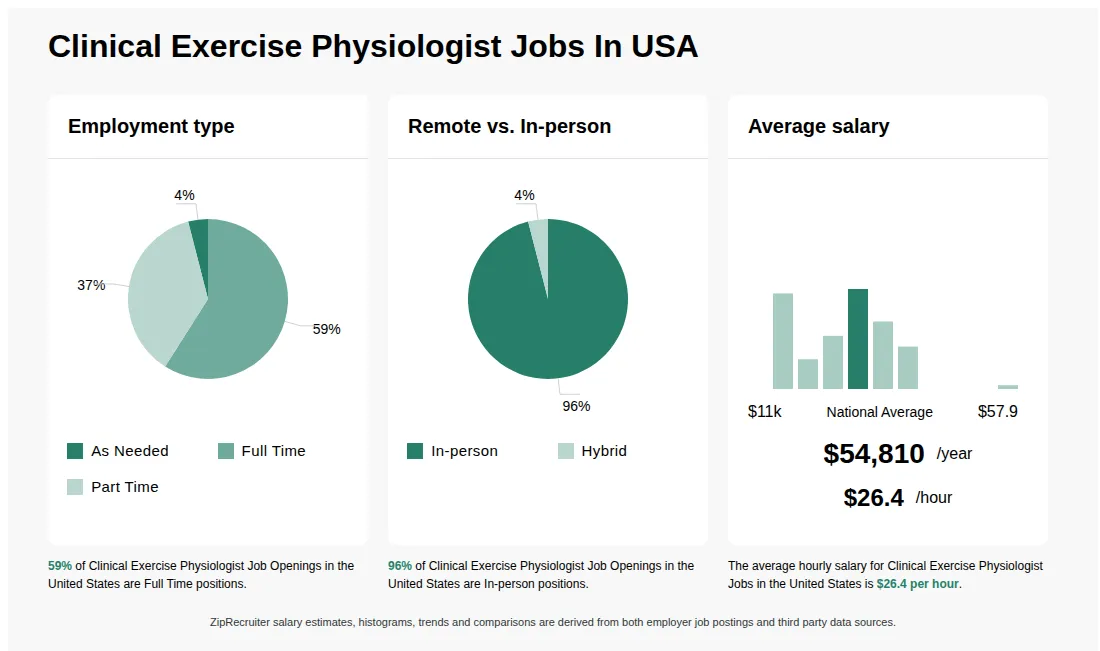
$5.29 - $10.07
0% of jobs
$14.86 is the 25th percentile. Wages below this are outliers.
$10.07 - $14.86
25% of jobs
$14.86 - $19.65
7% of jobs
$19.65 - $24.43
14% of jobs
The median wage is $25.20 / hr.
$24.43 - $29.22
26% of jobs
$30.06 is the 75th percentile. Wages above this are outliers.
$29.22 - $34
18% of jobs
$34 - $38.79
10% of jobs
$38.79 - $43.58
0% of jobs
$43.58 - $48.36
0% of jobs
$48.36 - $53.15
0% of jobs
$53.15 - $57.93
0% of jobs
$5
$26
$57
A clinical exercise physiologist works with a variety of patients to maintain or improve their health through physical activity. In this career, your duties may involve working with people with chronic medical conditions such as heart or lung disease, asthma, or diabetes. Your responsibilities may include assessing their needs, monitoring their exercise, and ensuring that they are following safe exercise practices. A certified exercise physiologist, also known as a CEP, may also work with patients who are recovering from a medical emergency or need to regain physical strength following surgery.
| Aspect | Clinical Exercise Physiologist | Cardiac Rehabilitation Specialist |
|---|---|---|
| Credentials | Certified Clinical Exercise Physiologist (ACSM-CEP), CPR certification | Certified Cardiac Rehabilitation Professional (CCRP), CPR certification |
| Work Environment | Hospitals, clinics, rehab centers, fitness facilities | Hospitals, outpatient cardiac rehab programs, clinics |
| Employer & Industry | Healthcare, sports medicine, rehab centers | Cardiology clinics, hospitals, rehab centers |
| Primary Focus | Designing exercise programs for patients with chronic diseases | Managing and guiding patients through cardiac rehab programs |
The main difference between a Clinical Exercise Physiologist and a Cardiac Rehabilitation Specialist lies in their focus and certification. Clinical Exercise Physiologists develop exercise plans for various chronic conditions, while Cardiac Rehabilitation Specialists specifically focus on recovery for cardiac patients. Both roles work in healthcare settings and require similar certifications, but their primary patient populations and program goals differ.
Cities with the most Clinical Exercise Physiologist job openings:
The top employers for Clinical Exercise Physiologist jobs are:
States with the most job openings for Clinical Exercise Physiologist jobs include:
The top searched job categories for Clinical Exercise Physiologist jobs are:
For Clinical Exercise Physiologist jobs, the most frequently searched job titles are:
$55 - $75/hr
Other
Posted 4 days ago
6.1
Based on 19 frontline employees who took The Breakroom Quiz
Responsible for Clinical patient treatment for Cardiac and Pulmonary Rehab patients involved in Phase I-III. Specific duties include new patient assessment, on-going patient assessment, development of Individual Treatment Plan(goal setting, education, exercise prescription/progression, and discharge planning),exercise supervision, and EKG monitoring/interpretation. Completes appropriate documentation/charges and communicates to physician as needed.
Must have at least one of the certifications below, within 1 year of employment:
BS
ExperienciaNassau - Office Building B
1348 S 18th St
Fernandina Beach, Florida, 32034
Chosen as the area's “Most Preferred” healthcare provider every year since 1990 according to theannual National Research Corporation study of Jacksonville area residents, Baptist Health rankshighest in the categories of Best Doctors, Best Nurses, Best Quality and Best Reputation.
Get the full story on Breakroom