1

Building Inspector Jobs in Virginia (NOW HIRING)

Building Official

Stafford, VA · On-site

$111.68K - $177.67K/yr

Work includes daily oversight and supervision of building permitting, plan review and inspection functions for all building-related activities and operations within the Department of Development ...

Building Official

Stafford, VA · On-site

$111.68K - $177.67K/yr

Oversees the building permitting, plan review and inspections for Stafford County to ensure compliance with the requirements of the VUSBC and related codes; coordinates work with county staff and ...

Building Engineer

Chantilly, VA · On-site

$38 - $44/hr

Accountable for infrastructure systems uptime, monitoring critical systems within tolerances, frequent building inspections while providing reliable service delivery to colocation customers.

Building Engineer

Ashburn, VA · On-site

$30 - $38/hr

Accountable for infrastructure systems uptime, monitoring critical systems within tolerances, frequent building inspections while providing reliable service delivery to colocation customers.

Take measurements with a measuring wheel or with online tools as needed. • Interviews the Insured for operations information, ages of the building systems, etc. • Communicates inspection status ...

next page

Showing results 1-20

Building Inspector information

See Virginia salary details

$35.7K

$68.3K

$102.1K

How much do building inspector jobs pay per year?

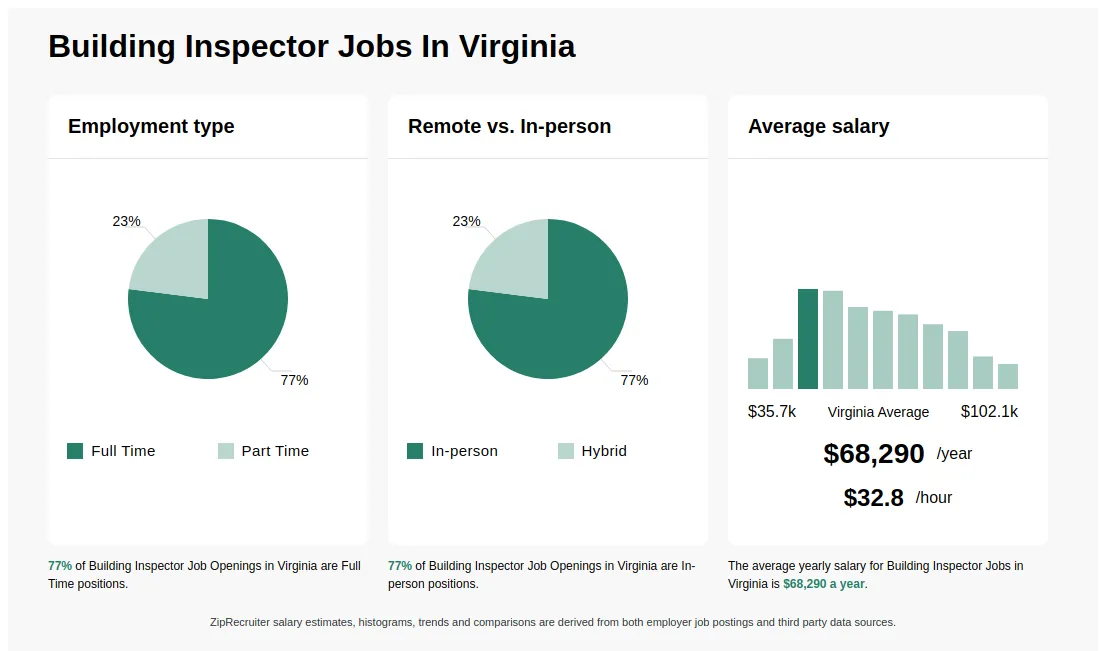
As of May 28, 2026, the average yearly pay for building inspector in Virginia is $68,290.00, according to ZipRecruiter salary data. Most workers in this role earn between $53,500.00 and $80,300.00 per year, depending on experience, location, and employer.

What Is a Building Inspector?

A building inspector’s primary job responsibilities are to look at public buildings and ensure they are up to federal, state, and local codes. In this job, your duties are to look at the structural integrity, electrical wiring, water connections, and other aspects of the construction and make sure that everything works as it should and complies with all safety regulations. Inspectors have to know a variety of building disciplines and trades, or at least the laws related to them. For example, you have to know basic wiring codes and how to recognize a dangerous situation, such as broken or loose wiring, as well as general building hazards.

What are the key skills and qualifications needed to thrive as a Building Inspector, and why are they important?

To thrive as a Building Inspector, you need in-depth knowledge of building codes, construction practices, and safety regulations, typically backed by relevant certifications or formal education in construction or engineering. Familiarity with inspection management software, digital reporting tools, and sometimes licensing such as ICC certification is usually required. Attention to detail, strong communication, and impartial judgment are essential soft skills for ensuring accurate inspections and clear interactions with contractors and property owners. These skills and qualities are crucial because they help maintain safety standards, regulatory compliance, and trust in the built environment.

What are some common challenges faced by Building Inspectors during site inspections?

Building Inspectors often encounter challenges such as managing tight inspection schedules, staying updated with evolving building codes, and effectively communicating compliance issues to contractors and property owners. They may also have to navigate difficult weather conditions or access hard-to-reach areas on construction sites. Successfully balancing these demands requires strong organizational skills, attention to detail, and the ability to work collaboratively with various stakeholders to resolve compliance issues efficiently.

What does a Building Inspector do?

A Building Inspector is responsible for examining buildings, structures, and construction sites to ensure they comply with local, state, and federal codes and regulations. They review plans, issue permits, and conduct on-site inspections at various stages of construction or renovation. Their main goal is to ensure the safety, structural integrity, and accessibility of buildings for occupants and the public. Building Inspectors may also investigate complaints, issue violation notices, and advise on necessary corrections to bring properties up to code.

What is the difference between Building Inspector vs Construction Inspector?

AspectBuilding InspectorConstruction Inspector
Required CredentialsState or local licensing, certifications in building codesSimilar licensing, often with additional construction-specific certifications
Work EnvironmentInspecting residential, commercial, and public buildingsMonitoring construction sites, ensuring compliance during building phases
Employer & IndustryGovernment agencies, private firms, construction companiesConstruction firms, government agencies, project developers

Building Inspectors primarily review completed structures for code compliance, while Construction Inspectors oversee ongoing construction projects to ensure standards are met during building. Both roles require similar credentials and often work in overlapping environments, but their focus differs in timing and scope.

What are the most commonly searched types of Building Inspector jobs in Virginia? The most popular types of Building Inspector jobs in Virginia are:
What are popular job titles related to Building Inspector jobs in Virginia? For Building Inspector jobs in Virginia, the most frequently searched job titles are:
What cities in Virginia are hiring for Building Inspector jobs? Cities in Virginia with the most Building Inspector job openings:
What are popular job titles related to Building Inspector jobs in VA? For Building Inspector jobs in VA, the most frequently searched job titles are:
Infographic showing various Building Inspector job openings in Virginia as of May 2026, with employment types broken down into 1% As Needed, 96% Full Time, and 3% Contract. Highlights an 28% Physical, 14% Hybrid, and 58% Remote job distribution, with an average salary of $68,290 per year, or $32.8 per hour.

Building Official

Stafford County

Stafford, VA • On-site

$111.68K - $177.67K/yr

Full-time

Posted 24 days ago


Job description

Job Description Performs complex technical and administrative work overseeing Stafford County's enforcement of the requirements of the Virginia Uniform Statewide Building Code (VUSBC) including the Virginia Construction Code and related regulations . Work includes daily oversight and supervision of building permitting, plan review and inspection functions for all building-related activities and operations within the Department of Development Services under limited supervision. The position requires application of technical knowledge, independent judgment, and executive ability consistent with Section 105.1.1 of the VUSBC

The hiring salary range for this position is $111,677.28 to $153,570.56 annually based on experience. The full salary range for this position is $111,677.28 to $177,673.60 annually to provide opportunity for growth and development. Examples of Duties Oversees the building permitting, plan review and inspections for Stafford County to ensure compliance with the requirements of the VUSBC and related codes; coordinates work with county staff and other local and State agencies; maintains records and files; prepares reports; Directly supervises the Deputy Building Official, Building Inspections Supervisor and Community Development Service Center (Permitting) Manager or Supervisor; Plans, organizes, assigns, and evaluates work of the Building Division staff; Ensures public health, safety, and welfare in relation to the design, construction, and use of permitted buildings and structures; Oversee the operation and management of the Permitting division; Answers technical questions/inquiries from contractors, developers, design professionals, engineers, architects, owners, building occupants, general public, etc

regarding administrative and building code requirements, building permitting, plan review and inspection procedures and policies, contractor licensing laws, tradesmen certification standards, and building-related activities; Reviews, approves, and issues violation notices, stop work orders, and other compliance directives; Coordinates legal enforcement processes and represents the County in applicable administrative hearings and court proceedings; Develop operational procedures, performance metrics, and customer service standards for the Department of Development Services; Prepares reports and presentations for the Director of Development Services; Provides leadership on complex or high-priority projects and serves as a technical resource; Assists in the development and implementation of building permitting, plan review and inspection strategies, policies, and professional standards; Works collaboratively with Planning, Zoning, Code Enforcement, County & Commonwealth Attorney's Offices, and other departments on compliance and development issues; Develops and delivers training for staff and stakeholders; Monitors workloads, trends, and performance data to inform decision-making and resource needs; Attends meetings and conferences with developers, engineers, architects, contractors, community associations, and local trade representatives to discuss and/or resolve issues concerning code applications, community concerns and/or issues, standards and testing requirements; Performs related tasks as required. Knowledge, Skills and Abilities Comprehensive knowledge of the principles and practices of building, structural, electrical, plumbing, mechanical trades, etc.; Comprehensive knowledge of building, construction, engineering and structural engineering principles and practices; Ability to plan, direct and coordinate the various phases of building plan review and inspection services and operations; Ability to plan and supervise the work of subordinates; Ability to establish and maintain effective working relationships with associates, government officials, and the general public; ability to present facts and recommendations effectively in oral and written form; Ability to demonstrate firmness and tact in regulating codes and ordinances. Education and Experience A combination of education and experience equivalent to graduation from high school, supplemented by coursework in public administration, engineering, construction, code enforcement, regulatory compliance, or related fields, and seven (7) to ten (10) years of progressively responsible experience in building permitting, plan review, inspections, regulatory compliance, or related work, including at least two (2) years of lead or supervisory experience

A Bachelor's degree from an accredited college or university in public administration, engineering, planning, construction management, criminal justice, or related field is preferred. Other combinations of education and experience may be considered in meeting the minimum requirements. SPECIAL REQUIREMENTS: Possession of a driver's license valid in the Commonwealth of Virginia; Within 12 months, possession of Certification as a Building Official (CBO) per the Virginia Department of Housing & Community Development (DHCD); PHYSICAL REQUIREMENTS/WORK ENVIRONMENT: This is light work requiring the exertion of up to 20 pounds of force occasionally, up to 10 pounds of force frequently, and a negligible amount of force constantly to move objects.

Work requires climbing, stooping, kneeling, crouching, crawling, reaching, standing, walking, pushing, pulling, lifting, grasping, and repetitive motions. Vocal communication is required for expressing or exchanging ideas by means of the spoken word, and conveying detailed or important instructions to others accurately, loudly, or quickly. Hearing is required to perceive information at normal spoken word levels, and to receive detailed information through oral communications and/or to make fine distinctions in sound; visual acuity is required for depth perception, color perception, preparing and analyzing written or computer data, visual inspection involving small defects and/or small parts, use of measuring devices, operation of machines, operation of motor vehicles or equipment, determining the accuracy and thoroughness of work, and observing general surroundings and activities.

The worker is subject to inside and outside environmental conditions, extreme cold, extreme heat, hazards, and atmospheric conditions.