1

Biomechanics Researcher Jobs (NOW HIRING)

next page

Showing results 1-20

Biomechanics Researcher information

See salary details

$29K

$117.6K

$227.5K

How much do biomechanics researcher jobs pay per year?

As of Jul 13, 2026, the average yearly pay for biomechanics researcher in the United States is $117,556.00, according to ZipRecruiter salary data. Most workers in this role earn between $60,000.00 and $169,000.00 per year, depending on experience, location, and employer.

What are some common challenges faced by biomechanics researchers in their day-to-day work?

Biomechanics researchers often encounter challenges such as managing complex data from experiments, troubleshooting sensitive equipment, and ensuring precise measurements for valid results. Collaboration is key, as researchers frequently work with interdisciplinary teams—including engineers, clinicians, and sports scientists—to interpret findings and design experiments. Keeping up with the latest technological advancements and scientific literature can also be demanding, but it is essential for producing high-quality research and staying competitive in the field.

What does a biomechanics researcher do?

A biomechanics researcher studies the mechanical aspects of living organisms, particularly how muscles, bones, tendons, and ligaments work together to produce movement. They use principles from physics, engineering, and biology to analyze movement patterns, improve athletic performance, prevent injuries, and develop medical devices or rehabilitation techniques. Their work often involves conducting experiments, collecting data with specialized equipment, and publishing findings to advance scientific knowledge.

What are the key skills and qualifications needed to thrive as a Biomechanics Researcher, and why are they important?

To thrive as a Biomechanics Researcher, you need a strong background in biology, physics, engineering, and data analysis, typically supported by an advanced degree in biomechanics or a related field. Familiarity with motion capture systems, force plates, MATLAB, Python, and statistical analysis software is often required. Critical thinking, attention to detail, and effective communication are vital soft skills for designing experiments and sharing complex findings. These skills and qualities are essential for conducting rigorous research, interpreting biomechanical data accurately, and contributing valuable insights to the scientific and healthcare communities.

What is the difference between Biomechanics Researcher vs Kinesiologist?

AspectBiomechanics ResearcherKinesiologist
Required CredentialsAdvanced degrees (Master's/PhD), research experienceBachelor's degree in kinesiology or related field, certification often preferred
Work EnvironmentLaboratories, research institutions, universitiesClinics, hospitals, sports facilities, rehabilitation centers
Employer & Industry UsageAcademic, research, sports science companiesHealthcare, sports teams, rehabilitation centers
Common Search & Comparison IntentResearch roles, academic positions, scientific studiesClinical practice, health and fitness advice, rehabilitation

While both Biomechanics Researchers and Kinesiologists study human movement, Biomechanics Researchers focus on scientific analysis and experimental research in labs, often requiring advanced degrees. Kinesiologists typically work directly with clients in clinical or sports settings, applying movement science to improve health and performance. The roles overlap in understanding human movement but differ mainly in work environment and focus.

More about Biomechanics Researcher jobs
What cities are hiring for Biomechanics Researcher jobs? Cities with the most Biomechanics Researcher job openings:
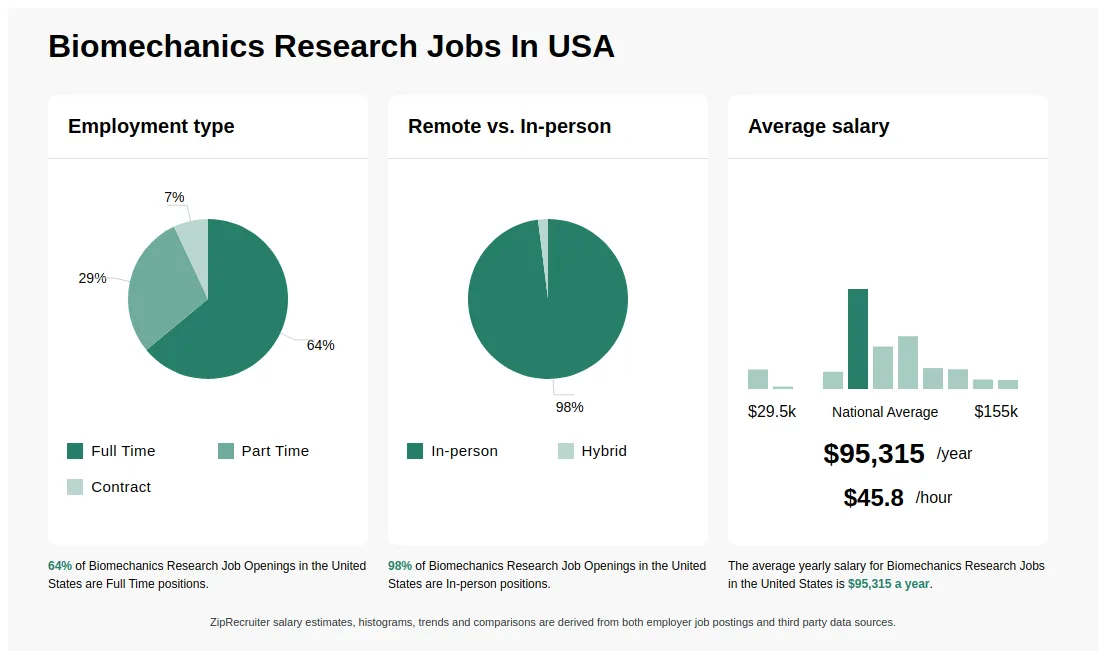
Infographic showing various Biomechanics Researcher job openings in the United States as of July 2026, with employment types broken down into 1% Internship, 42% Full Time, 54% Part Time, 1% Temporary, and 2% Contract. Highlights an 76% Physical, 1% Hybrid, and 23% Remote job distribution, with an average salary of $117,556 per year, or $56.5 per hour.
Part-Time Researcher - Biomechanics

Part-Time Researcher - Biomechanics

University of Nebraska Omaha

Omaha, NE • On-site

$22.50/hr

Full-time, Part-time

Re-posted 21 hours ago


Job description

Posting Details
Position Information
Job Title
Part-Time Researcher - Biomechanics
Department
Biomechanics
Essential Functions
Review and organize research data
Perform basic data analysis using software such as Excel, R, or Python
Create charts, tables, and summaries of research findings
Assist with writing and editing research papers, reports, and grant applications
Work Schedule
Work schedule varies.
Additional Duties
Required Qualifications
Bachelor's degree in Biomechanics or a related field
Experience working with research data.
Basic knowledge of statistics and data analysis.
Strong writing and editing skills.
Preferred Qualifications
Previous experience assisting with research publications or grant writing.
Experience using statistical or data analysis software (R, Python, SPSS, or similar).
Physical Demands
The physical demands described here are representative of those that must be met by an employee to successfully perform the essential functions of this job. Reasonable accommodations may be made to enable individuals with disabilities to perform the essential functions. Regularly sits; may stand, walk. See, hear, speak and use of hands.
Work Environment
The work environment characteristics described here are representative of those an employee encounters while performing the essential functions of this job. Reasonable accommodations may be made to enable individuals with disabilities to perform the essential functions. Regularly works indoors. Noise level is low to moderate.
Salary
$22.50/hour
Posting Detail Information
Posting Number
2026T-00122
Open Date
02/13/2026
Close Date
Open Until Filled
Yes
Special Instructions to Applicants
The University of Nebraska at Omaha is an Equal Opportunity Employer, committed to preventing and eliminating discrimination against employees and prospective employees based on race, color, ethnicity, national origin, sex, pregnancy, sexual orientation, gender identity, religion, disability, age, genetic information, veteran status, marital status, and/or political affiliation. The University of Nebraska at Omaha does not condone or tolerate discrimination. In support of this policy, the University has implemented employment programs to recruit, employ, and promote qualified individuals based solely on their knowledge, skills, abilities and talents. These factors, along with our commitment to recruit, assess and select all candidates/employees using job-related criteria, ensure fairness, equal evaluation, and treatment in our selection decisions and processes.