Product Engineer
$40.87 - $48.08/hr
Automotive Engineering * CATIA V5 * DFMEA ID:qnkTyx

Bachelor's degree in Mechanical Engineering, Automotive Engineering, Biomechanics, or related discipline. * Minimum 8-10 years of experience in Occupant Safety Engineering, Crashworthiness, or ...
Quick apply
Bachelor's degree in Mechanical Engineering, Automotive Engineering, Biomechanics, or related discipline. * Minimum 8-10 years of experience in Occupant Safety Engineering, Crashworthiness, or ...
Product Engineer
Rochester Hills, MI · On-site
$85K - $100K/yr
Automotive Engineering * CATIA V5 * DFMEA
Quick apply
Product Engineer
Rochester Hills, MI · On-site
$85K - $100K/yr
Automotive Engineering * CATIA V5 * DFMEA
Bachelor's degree in Mechanical Engineering, Automotive Engineering, Biomechanics, or related discipline. * Minimum 8-10 years of experience in Occupant Safety Engineering, Crashworthiness, or ...
Bachelor's degree in Mechanical Engineering, Automotive Engineering, Biomechanics, or related discipline. * Minimum 8-10 years of experience in Occupant Safety Engineering, Crashworthiness, or ...
IAV Group is an engineering and technical consultancy servicing the global automotive industry with approximately 7,000 employees worldwide and more than 40 years of experience. As a recognized ...
IAV Group is an engineering and technical consultancy servicing the global automotive industry with approximately 7,000 employees worldwide and more than 40 years of experience. As a recognized ...
Bachelor's degree in Mechanical Engineering, Automotive Engineering, Biomechanics, or related discipline. * Minimum 8-10 years of experience in Occupant Safety Engineering, Crashworthiness, or ...
Bachelor's degree in Mechanical Engineering, Automotive Engineering, Biomechanics, or related discipline. * Minimum 8-10 years of experience in Occupant Safety Engineering, Crashworthiness, or ...
IAV Group is an engineering and technical consultancy servicing the global automotive industry with approximately 7,000 employees worldwide and more than 40 years of experience. As a recognized ...
IAV Group is an engineering and technical consultancy servicing the global automotive industry with approximately 7,000 employees worldwide and more than 40 years of experience. As a recognized ...
IAV Group is an engineering and technical consultancy servicing the global automotive industry with approximately 7,000 employees worldwide and more than 40 years of experience. As a recognized ...
Quick apply
IAV Group is an engineering and technical consultancy servicing the global automotive industry with approximately 7,000 employees worldwide and more than 40 years of experience. As a recognized ...

Product Engineer
Auburn Hills, MI · On-site
Product Engineer - Automotive, UG NX, Communication Responsibilities: Develop improved or new designs for automotive structural restraint products and associated automotive equipment or modify ...
Product Engineer
Auburn Hills, MI · On-site
Product Engineer - Automotive, UG NX, Communication Responsibilities: Develop improved or new designs for automotive structural restraint products and associated automotive equipment or modify ...
Product Engineer - Automotive, UG NX, Communication Responsibilities: Develop improved or new designs for automotive structural restraint products and associated automotive equipment or modify ...
Product Engineer - Automotive, UG NX, Communication Responsibilities: Develop improved or new designs for automotive structural restraint products and associated automotive equipment or modify ...

MARTIN Technologies (MARTIN) is a full-service, global engineering and manufacturing company supporting OEM and Tier customers in the automotive industries. We are leaders in the mobility industry ...
Quick apply
MARTIN Technologies (MARTIN) is a full-service, global engineering and manufacturing company supporting OEM and Tier customers in the automotive industries. We are leaders in the mobility industry ...
MARTIN Technologies (MARTIN) is a full-service, global engineering and manufacturing company supporting OEM and Tier customers in the automotive industries. We are leaders in the mobility industry ...
MARTIN Technologies (MARTIN) is a full-service, global engineering and manufacturing company supporting OEM and Tier customers in the automotive industries. We are leaders in the mobility industry ...

Mandatory skills: • Bachelor's degree in Mechanical Engineering, Automotive Engineering, or related engineering discipline. • 5-10 years of experience in automotive warranty analysis, product ...
Mandatory skills: • Bachelor's degree in Mechanical Engineering, Automotive Engineering, or related engineering discipline. • 5-10 years of experience in automotive warranty analysis, product ...

Automotive Cybersecurity Engineer Location: 262 - Rotunda Court II (RCII) Location Address: 15021 Commerce Drive South, DEARBORN, MI, 48120 W2 Only Hybrid Position 4days a week onsite Position ...
Quick apply
Automotive Cybersecurity Engineer Location: 262 - Rotunda Court II (RCII) Location Address: 15021 Commerce Drive South, DEARBORN, MI, 48120 W2 Only Hybrid Position 4days a week onsite Position ...
Bachelor's degree or foreign equivalent in Mechanical Engineering, Automotive Engineering, or a closely related field, and one year of experience.
Bachelor's degree or foreign equivalent in Mechanical Engineering, Automotive Engineering, or a closely related field, and one year of experience.
Design Release Engineer - Vehicle Access Systems
Auburn Hills, MI · On-site
$38 - $43.50/hr
Working knowledge of automotive product development processes (APQP, DV/PV, gateways) * Ability to read and interpret engineering drawings and specifications * Strong problem-solving and root cause ...
Design Release Engineer - Vehicle Access Systems
Auburn Hills, MI · On-site
$38 - $43.50/hr
Working knowledge of automotive product development processes (APQP, DV/PV, gateways) * Ability to read and interpret engineering drawings and specifications * Strong problem-solving and root cause ...
Bachelor's degree or foreign equivalent in Mechanical Engineering, Automotive Engineering, or a closely related field, and one year of experience.
Quick apply
Bachelor's degree or foreign equivalent in Mechanical Engineering, Automotive Engineering, or a closely related field, and one year of experience.
Technical Program Manager (TPM) - EE/SW Integration & Release - On-Site
Novi, MI · On-site
$121K - $156K/yr
IAV Group is an engineering and technical consultancy servicing the global automotive industry with approximately 7,000 employees worldwide and more than 40 years of experience. As a recognized ...
Technical Program Manager (TPM) - EE/SW Integration & Release - On-Site
Novi, MI · On-site
$121K - $156K/yr
IAV Group is an engineering and technical consultancy servicing the global automotive industry with approximately 7,000 employees worldwide and more than 40 years of experience. As a recognized ...
Technical Program Manager (TPM) - EE/SW Integration & Release - On-Site
Novi, MI · On-site
$121K - $156K/yr
IAV Group is an engineering and technical consultancy servicing the global automotive industry with approximately 7,000 employees worldwide and more than 40 years of experience. As a recognized ...
Quick apply
Technical Program Manager (TPM) - EE/SW Integration & Release - On-Site
Novi, MI · On-site
$121K - $156K/yr
IAV Group is an engineering and technical consultancy servicing the global automotive industry with approximately 7,000 employees worldwide and more than 40 years of experience. As a recognized ...
Bachelor's degree or foreign equivalent in Mechanical Engineering, Automotive Engineering, or a closely related field, and one year of experience.
Bachelor's degree or foreign equivalent in Mechanical Engineering, Automotive Engineering, or a closely related field, and one year of experience.
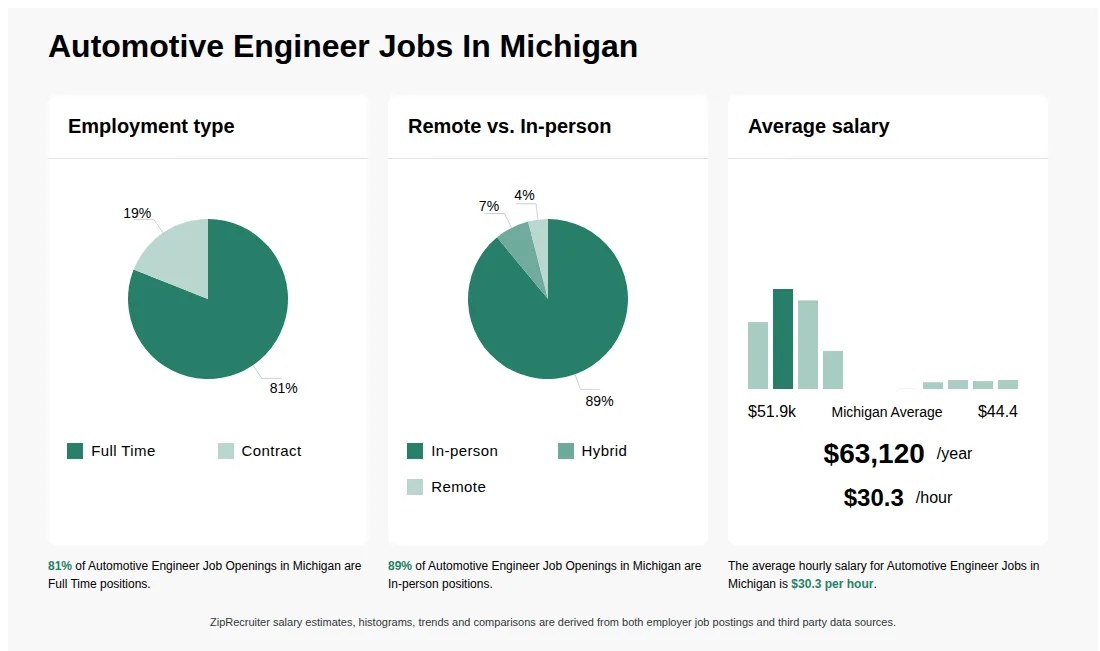
Automotive Engineer information
See Michigan salary details
$24.93 - $26.70
21% of jobs
$26.94 is the 25th percentile. Wages below this are outliers.
$26.70 - $28.48
31% of jobs
$29.92 is the 75th percentile. Wages above this are outliers.
$28.48 - $30.25
28% of jobs
$30.25 - $32.02
11% of jobs
$32.02 - $33.79
0% of jobs
$33.79 - $35.56
0% of jobs
$35.56 - $37.33
0% of jobs
$37.33 - $39.10
2% of jobs
$39.10 - $40.88
2% of jobs
$40.88 - $42.65
2% of jobs
$42.65 - $44.42
2% of jobs
$24
$30
$44
How much do automotive engineer jobs pay per hour?
As of Sep 3, 2026, the average hourly pay for automotive engineer in Michigan is $30.35, according to ZipRecruiter salary data. Most workers in this role earn between $27.02 and $30.19 per hour, depending on experience, location, and employer.
What does an automotive engineer do?
Automotive engineers design, develop, and test the mechanical components and subsystems of vehicles. As an automotive engineer, you may be asked to create engineering specifications, conduct design reviews, provide technical direction to other staff, modify existing parts in a lab, or perform various analyses. In some cases, automotive engineers perform emergency tests and checks to search for manufacturing defects and decide whether or not a recall should be ordered.
What does an automotive engineer do?
An automotive engineer is responsible for designing, developing, and testing vehicles and their subsystems. They work on improving the performance, safety, and efficiency of cars, trucks, and other automobiles. Their work often involves collaborating with other engineers to create new technologies, address regulatory requirements, and solve engineering challenges in vehicle production. Automotive engineers may specialize in areas such as structural design, electronics, or powertrain systems.
What are the key skills and qualifications needed to thrive as an automotive engineer, and why are they important?
To thrive as an Automotive Engineer, you need a solid background in mechanical engineering principles, problem-solving skills, and a relevant degree in automotive or mechanical engineering. Familiarity with CAD software, simulation tools, and knowledge of industry standards such as ISO and SAE, as well as certifications like Professional Engineer (PE), are typically required. Strong teamwork, effective communication, and adaptability help you collaborate with multidisciplinary teams and respond to rapidly changing technologies. These skills ensure successful vehicle design, compliance with safety standards, and innovation in a competitive automotive market.
What are some common challenges automotive engineers face when working on new vehicle models?
Automotive engineers often encounter challenges related to balancing innovative design with strict safety and regulatory standards. They must also work within tight project timelines and budget constraints, all while ensuring that new technologies are both reliable and manufacturable at scale. Collaboration across multidisciplinary teams—including designers, software specialists, and manufacturing engineers—is essential to address issues such as integration of electronics, fuel efficiency, and sustainability. Navigating these complexities requires strong problem-solving skills and adaptability.
What is the difference between Automotive Engineer vs Mechanical Engineer?
| Aspect | Automotive Engineer | Mechanical Engineer |
|---|---|---|
| Credentials | Bachelor's in Mechanical, Automotive, or related fields; possibly certifications like SAE or ASE | Bachelor's in Mechanical Engineering; professional engineer (PE) license optional |
| Work Environment | Automotive manufacturing plants, R&D labs, design studios | Factories, design offices, research labs across various industries |
| Industry Usage | Automotive industry focus on vehicle design, testing, and production | Broad industry application including aerospace, manufacturing, energy, and more |
Automotive Engineers specialize in vehicle design, testing, and manufacturing within the automotive industry, often requiring specific automotive certifications. Mechanical Engineers have a broader scope, working across multiple industries with similar foundational skills. Both roles share core engineering principles but differ in industry focus and application.
Are automotive engineers in demand?
Automotive engineers are in demand due to ongoing advancements in vehicle technology, electric vehicles, and autonomous systems. The field requires strong skills in CAD software, systems design, and knowledge of industry standards, with employment opportunities available in manufacturing, research, and development sectors.
More about Automotive Engineer jobs
What are the most commonly searched types of Automotive Engineer jobs in Michigan?
The most popular types of Automotive Engineer jobs in Michigan are:
What are popular job titles related to Automotive Engineer jobs in Michigan?
For Automotive Engineer jobs in Michigan, the most frequently searched job titles are:
What job categories do people searching Automotive Engineer jobs in Michigan look for?
The top searched job categories for Automotive Engineer jobs in Michigan are:
What cities in Michigan are hiring for Automotive Engineer jobs?
Cities in Michigan with the most Automotive Engineer job openings:
What are popular job titles related to Automotive Engineer jobs in MI?
For Automotive Engineer jobs in MI, the most frequently searched job titles are:
$40.87 - $48.08/hr
Full-time
Posted 6 days ago
Job description
POSITION SUMMARY:
This position is primarily accountable for the end-to-end design, innovative conception, and robust development of entirely new systems and product concepts. A core responsibility is ensuring that all developed solutions meet and exceed specified customer requirements, performance metrics, and quality standards. The role also provides critical technical leadership and serves as an authoritative subject matter expert and consultant, supporting internal teams (e.g., manufacturing, quality, sales) and external customers, partners, and suppliers from inception through production launch.
KEY ROLES AND RESPONSIBILITIES:
•Develops new concepts and products in accordance with business objectives.
•Determines feasibility of new concepts using advanced analytical tools.
•Verifies critical interfaces via design study and statistical analysis as required to ensure design robustness.
•Develops test methods and specifications based on customer requirements
•Develops and maintains strong relationships with key customer associates.
•Manages prototype builds and testing/validation for assigned products.
•Provides technical leadership to customers, manufacturing, Sales, Quality Assurance, Program Management and other groups.
•Creates, revises and checks 3D models, drawings and design studies.
•Assured root cause is identified and permanent corrective action is implemented for product test failures, quality concerns and warranty returns.
•Interacts with customers, vendors to lead VA/VE cost reduction and ease of manufacturing (DFM) activities.
•Promotes an associate relations environment that is consistent with long-term management objectives.
•Provides leadership, training and technical support to product engineers, designers and technicians.
•Leads the competitor benchmarking activities.
•Performs other duties as necessary.
Education
•4-year degree in mechanical engineering or engineering technology or equivalent field.
Functional Experience
•Thorough knowledge of applicable client products and procedures
•Thorough knowledge of engineering practices (GD&T, DOE, FMEA, DFM, CAD applications, statistical analysis, etc.).
Industry Experience
•10 or more years of experience in Automotive Engineering and Design.
Core Competencies
•Product development and design
•CAD skills: CATIA V5
•Knowledge of CAE tools and how to interpret results
•Quality tools and DFMEA
•Manufacturing processes
Required Skills
•Excellent written and verbal communication skills
•Leadership & Mentoring
•Problem-solving and critical thinking
•Project Management
•Adaptability and continuous improvement
You should be proficient in:
- Product Design Experience
- Experience in a Manufacturing Environment
- Automotive Design
- Automotive Engineering
- CATIA V5
- DFMEA