Associate Director - Assay Development and Process Engineering The mission of the Allen Institute is to unlock the complexities of bioscience and advance our knowledge to improve human health. Using ...
Associate Director - Assay Development and Process Engineering The mission of the Allen Institute is to unlock the complexities of bioscience and advance our knowledge to improve human health. Using ...

The Director, Clinical Genomics & Molecular Assay Development (MAD) will provide strategic and scientific leadership for clinical genomics, transcriptomics, and molecular biomarker assay activities ...
The Director, Clinical Genomics & Molecular Assay Development (MAD) will provide strategic and scientific leadership for clinical genomics, transcriptomics, and molecular biomarker assay activities ...

Senior Research Associate- Diagnostic Assay Development
Pleasanton, CA · On-site
$97K - $132K/yr
This role, reporting to the Sr. Manager, Diagnostic Assay Development, requires extensive hands-on experience in advanced molecular biology techniques and a dedication to high-quality data generation ...
Senior Research Associate- Diagnostic Assay Development
Pleasanton, CA · On-site
$97K - $132K/yr
This role, reporting to the Sr. Manager, Diagnostic Assay Development, requires extensive hands-on experience in advanced molecular biology techniques and a dedication to high-quality data generation ...

Senior Scientist I - IVD Assay Development
Fremont, CA · On-site
$100K - $136K/yr
Position Summary The Senior Scientist I - IVD Assay Development will lead the design, development, optimization, and validation of in vitro diagnostic assays for clinical applications. This role ...
Senior Scientist I - IVD Assay Development
Fremont, CA · On-site
$100K - $136K/yr
Position Summary The Senior Scientist I - IVD Assay Development will lead the design, development, optimization, and validation of in vitro diagnostic assays for clinical applications. This role ...

Senior Assay Development Consultant / Contractor POC IVD Clinical Chemistry
Monmouth Junction, NJ · On-site
$93K - $127K/yr
Senior Assay Development Consultant / Contractor POC IVD Clinical Chemistry | Lab-on-Spin-Disk | Lyophilized Reagent Beads Location: Monmouth Junction, New Jersey 08852 On-site preferred; part-time / ...
Quick apply
Senior Assay Development Consultant / Contractor POC IVD Clinical Chemistry
Monmouth Junction, NJ · On-site
$93K - $127K/yr
Senior Assay Development Consultant / Contractor POC IVD Clinical Chemistry | Lab-on-Spin-Disk | Lyophilized Reagent Beads Location: Monmouth Junction, New Jersey 08852 On-site preferred; part-time / ...
This role, reporting to the Sr. Manager, Diagnostic Assay Development, requires extensive hands-on experience in advanced molecular biology techniques and a dedication to high-quality data generation ...
This role, reporting to the Sr. Manager, Diagnostic Assay Development, requires extensive hands-on experience in advanced molecular biology techniques and a dedication to high-quality data generation ...

We are seeking a Principal Assay Scientist to lead the biochemical development and application of our Giant Magnetoresistance (GMR) biosensor platform. This is a foundational role within a ...
We are seeking a Principal Assay Scientist to lead the biochemical development and application of our Giant Magnetoresistance (GMR) biosensor platform. This is a foundational role within a ...
Our Assay Development team translates emerging biomarker science into robust assays for research and future clinical applications. We are seeking a Scientist / Senior Scientist who is intellectually ...
Our Assay Development team translates emerging biomarker science into robust assays for research and future clinical applications. We are seeking a Scientist / Senior Scientist who is intellectually ...

Senior/Staff Statistician, Assay Development
Palo Alto, CA · On-site
$102K - $125K/yr
Design and execute analytical validation studies across our assay development pipeline, partnering with lab, software, regulatory, and data science teams. * Apply and develop statistical methods ...
Quick apply
Senior/Staff Statistician, Assay Development
Palo Alto, CA · On-site
$102K - $125K/yr
Design and execute analytical validation studies across our assay development pipeline, partnering with lab, software, regulatory, and data science teams. * Apply and develop statistical methods ...

This position is integral to designing, developing, and qualifying biomarker assays that support drug discovery and development programs across DAx's diverse portfolio, including renal, liver ...
This position is integral to designing, developing, and qualifying biomarker assays that support drug discovery and development programs across DAx's diverse portfolio, including renal, liver ...
This position is integral to designing, developing, and qualifying biomarker assays that support drug discovery and development programs across DAx's diverse portfolio, including renal, liver ...
This position is integral to designing, developing, and qualifying biomarker assays that support drug discovery and development programs across DAx's diverse portfolio, including renal, liver ...
R&D Assay Director - Accellix
$195K - $255K/yr
This role leads the establishment and ramp-up of the ACCELLIX Assay R&D capability in Lombard, with end-to-end accountability for building the team, technology transfer from existing site, and ...
R&D Assay Director - Accellix
$195K - $255K/yr
This role leads the establishment and ramp-up of the ACCELLIX Assay R&D capability in Lombard, with end-to-end accountability for building the team, technology transfer from existing site, and ...
R&D Assay Director - Accellix
Lombard, IL · On-site
$195K - $255K/yr
This role leads the establishment and ramp-up of the ACCELLIX Assay R&D capability in Lombard, with end-to-end accountability for building the team, technology transfer from existing site, and ...
R&D Assay Director - Accellix
Lombard, IL · On-site
$195K - $255K/yr
This role leads the establishment and ramp-up of the ACCELLIX Assay R&D capability in Lombard, with end-to-end accountability for building the team, technology transfer from existing site, and ...

Staff / Senior Scientist, Assay Development (Chemistry)
Berkeley, CA · On-site
$112K - $153K/yr
Reporting to the Director of Assay Development, you will be a hands-on expert working at the chemistry-assay interface - developing the chemical methods that enable reliable, high-efficiency sample ...
Staff / Senior Scientist, Assay Development (Chemistry)
Berkeley, CA · On-site
$112K - $153K/yr
Reporting to the Director of Assay Development, you will be a hands-on expert working at the chemistry-assay interface - developing the chemical methods that enable reliable, high-efficiency sample ...
Senior Scientist I - IVD Assay Development
Fremont, CA · On-site
$100K - $136K/yr
Position Summary The Senior Scientist I - IVD Assay Development will lead the design, development, optimization, and validation of in vitro diagnostic assays for clinical applications. This role ...
Senior Scientist I - IVD Assay Development
Fremont, CA · On-site
$100K - $136K/yr
Position Summary The Senior Scientist I - IVD Assay Development will lead the design, development, optimization, and validation of in vitro diagnostic assays for clinical applications. This role ...

Senior Scientist: IVD Assay Developer
$100K - $136K/yr
Lead molecular diagnostic assay development in a hands-on manner through successful FDA submission * Manage and contribute to regulatory documents * Project management; personnel management skills ...
Senior Scientist: IVD Assay Developer
$100K - $136K/yr
Lead molecular diagnostic assay development in a hands-on manner through successful FDA submission * Manage and contribute to regulatory documents * Project management; personnel management skills ...
Senior Scientist: IVD Assay Developer
Cambridge, MA · On-site
$80K - $130K/yr
Lead molecular diagnostic assay development in a hands-on manner through successful FDA submission * Manage and contribute to regulatory documents * Project management; personnel management skills ...
Senior Scientist: IVD Assay Developer
Cambridge, MA · On-site
$80K - $130K/yr
Lead molecular diagnostic assay development in a hands-on manner through successful FDA submission * Manage and contribute to regulatory documents * Project management; personnel management skills ...
Senior Research Associate- Diagnostic Assay Development
Pleasanton, CA · On-site
$97K - $132K/yr
This role, reporting to the Sr. Manager, Diagnostic Assay Development, requires extensive hands-on experience in advanced molecular biology techniques and a dedication to high-quality data generation ...
Senior Research Associate- Diagnostic Assay Development
Pleasanton, CA · On-site
$97K - $132K/yr
This role, reporting to the Sr. Manager, Diagnostic Assay Development, requires extensive hands-on experience in advanced molecular biology techniques and a dedication to high-quality data generation ...

R&D Assay Director - Accellix
$195K - $255K/yr
This role leads the establishment and ramp-up of the ACCELLIX Assay R&D capability in Lombard, with end-to-end accountability for building the team, technology transfer from existing site, and ...
R&D Assay Director - Accellix
$195K - $255K/yr
This role leads the establishment and ramp-up of the ACCELLIX Assay R&D capability in Lombard, with end-to-end accountability for building the team, technology transfer from existing site, and ...
Senior Scientist: IVD Assay Developer
Cambridge, MA · On-site
$80K - $130K/yr
Lead molecular diagnostic assay development in a hands-on manner through successful FDA submission * Manage and contribute to regulatory documents * Project management; personnel management skills ...
Quick apply
Senior Scientist: IVD Assay Developer
Cambridge, MA · On-site
$80K - $130K/yr
Lead molecular diagnostic assay development in a hands-on manner through successful FDA submission * Manage and contribute to regulatory documents * Project management; personnel management skills ...


Assay Development information
See salary details
$20.67 - $24.39
6% of jobs
$24.39 - $28.10
17% of jobs
$28.40 is the 25th percentile. Wages below this are outliers.
$28.10 - $31.82
20% of jobs
The median wage is $34.05 / hr.
$31.82 - $35.53
11% of jobs
$35.53 - $39.25
13% of jobs
$39.25 - $42.96
3% of jobs
$44.48 is the 75th percentile. Wages above this are outliers.
$42.96 - $46.68
12% of jobs
$46.68 - $50.39
7% of jobs
$50.39 - $54.11
4% of jobs
$54.11 - $57.82
3% of jobs
$57.82 - $61.54
3% of jobs
$20
$38
$61
How much do assay development jobs pay per hour?
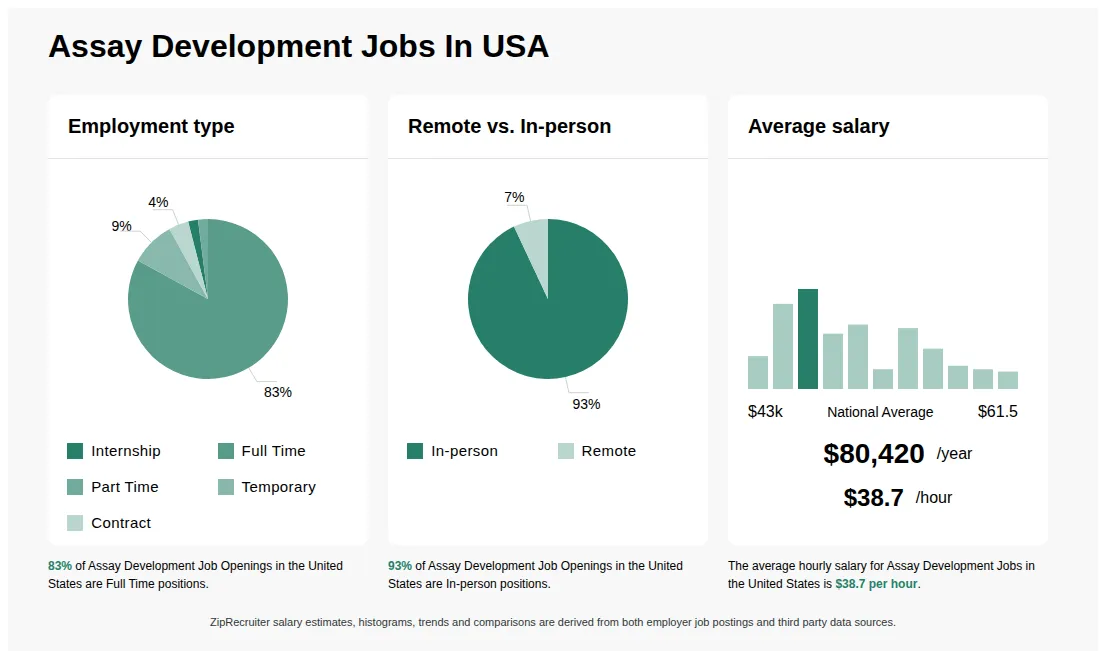
As of Jul 5, 2026, the average hourly pay for assay development in the United States is $38.66, according to ZipRecruiter salary data. Most workers in this role earn between $28.37 and $46.15 per hour, depending on experience, location, and employer.
What are some common challenges faced when developing new assays, and how can they be addressed?
Assay Development professionals often encounter challenges such as optimizing assay sensitivity and specificity, troubleshooting inconsistent results, and adapting protocols for high-throughput environments. These issues are typically addressed through systematic optimization of reagents and conditions, rigorous validation, and collaboration with cross-functional teams like R&D, quality assurance, and automation specialists. Clear documentation and regular team meetings also help in quickly identifying and resolving technical hurdles, ensuring the assay meets project goals and regulatory standards.
What are the key skills and qualifications needed to thrive in Assay Development, and why are they important?
To thrive in Assay Development, you need a solid background in biochemistry, molecular biology, or a related field, often supported by a relevant degree or advanced training. Familiarity with laboratory instrumentation, data analysis software, and validation protocols is typically required, along with experience in techniques like ELISA, PCR, or cell-based assays. Strong attention to detail, problem-solving abilities, and effective collaboration are crucial soft skills in this role. These competencies ensure the accuracy, reliability, and efficiency of assays, which are critical for research, diagnostics, and product development.
What is assay development?
Assay development is the process of designing and optimizing laboratory tests to detect or measure specific substances, such as proteins, nucleic acids, or small molecules. It involves selecting appropriate techniques, reagents, and controls to ensure accuracy, sensitivity, and reproducibility for research or diagnostic purposes. Assay development often requires knowledge of biochemistry, instrumentation, and validation procedures.
What does an assay development scientist do?
An assay development scientist designs, optimizes, and validates laboratory tests to measure specific biological or chemical substances. They work with techniques such as ELISA, PCR, or spectrophotometry, often using specialized equipment and adhering to regulatory standards. Their goal is to create reliable assays for research, diagnostics, or pharmaceutical applications.
What biology jobs pay over $100k?
Assay development roles in biotechnology and pharmaceutical companies often pay over $100,000 annually, especially for senior scientists with advanced skills in molecular biology, assay design, and data analysis. Positions such as senior research scientists, lead assay developers, and regulatory specialists typically require relevant experience, advanced degrees, and proficiency with laboratory tools and protocols.
What is an assay technician?
An assay technician is a laboratory professional responsible for performing and analyzing assays, which are tests used to measure the presence or concentration of substances in samples. They typically follow standardized protocols, operate specialized equipment, and ensure data accuracy in research or quality control settings.
What is the difference between Assay Development vs Laboratory Scientist?
| Aspect | Assay Development | Laboratory Scientist |
|---|---|---|
| Credentials | Bachelor's or Master's in Life Sciences, relevant certifications | Bachelor's or Master's in Life Sciences, relevant certifications |
| Work Environment | Research labs, biotech companies, pharmaceutical firms | Research labs, hospitals, biotech companies |
| Industry Usage | Designing and optimizing assays for research and diagnostics | Performing experiments, data collection, and analysis |
Assay Development focuses on creating and optimizing diagnostic or research assays, while Laboratory Scientists perform experiments and analyze data within the lab. Both roles require similar educational backgrounds and often work in similar environments, but their core responsibilities differ in scope and focus.
More about Assay Development jobs
What cities are hiring for Assay Development jobs? Cities with the most Assay Development job openings:
What are the most commonly searched types of Assay Development jobs? The most popular types of Assay Development jobs are:
What states have the most Assay Development jobs? States with the most job openings for Assay Development jobs include:
What job categories do people searching Assay Development jobs look for? The top searched job categories for Assay Development jobs are:

Associate Director, Assay Development and Process Engineering - Brain Health
Seattle, WA • On-site
Full-time
Medical, Dental, Vision, Life, Retirement, PTO
Posted 16 days ago
Job description
Associate Director - Assay Development and Process Engineering
The mission of the Allen Institute is to unlock the complexities of bioscience and advance our knowledge to improve human health. Using an open science, multi-scale, team-oriented approach, the Allen Institute focuses on accelerating foundational research, developing standards and models, and cultivating new ideas to make a broad, transformational impact on science.
The Allen Institute is launching a new accelerator on human brain health and disease. This initiative aims to dramatically accelerate our understanding of human brain structure and function, identify the molecular, cellular and circuit basis of disease progression, and pioneer new therapeutic strategies targeting vulnerable and affected cell types. Our mission focuses on taking a human-centric approach to understanding and treating disease, combining a large-scale open science discovery approach across multiple diseases, AI-based disease modeling, and translational programs in specific diseases to move from discovery to clinical application. We aim to make transformational change in understanding and treating brain disorders, the biggest health challenge of our time.
The Associate Director, Assay Development and Process Engineering, will play a key leadership role within the organization, leading a team to develop and implement scalable high-information content assays that meet the needs of large-scale data generation pipelines for single cell molecular and spatially-resolved analysis of brain tissues or other biological samples. Reporting to the Executive Director, Strategy and Scientific Operations, the successful candidate will be highly experienced in industry-standard assay development, and motivated to work in a team environment with laboratory scientists and managers, engineers, and computational scientists to develop robust pipelines to generate large-scale datasets for scientific discovery. This role will be responsible for supporting internal scientists' needs and staying at the forefront of technological innovation in relevant domains, managing a portfolio of technology development and implementation goals and working with similar functions across scientific units.
At the Allen Institute, we believe that science is for everyone - and should be open to everyone. We are dedicated to combating biases and reducing barriers to STEM careers more broadly.
We also believe that science is better when it includes different perspectives and voices. We strive to make the Allen Institute a place where everyone feels like they belong and are empowered to do their best work in a supportive environment.
We are an equal-opportunity employer and strongly encourage people from all backgrounds to apply for our open positions.
Essential Functions
*Note: Reasonable accommodations may be made to enable individuals with disabilities to perform the essential functions. This description reflects management's assignment of essential functions; it does not proscribe or restrict the tasks that may be assigned.*
Required Education and Experience
Preferred Experience
Work Environment
Animal Care Services
Physical Demands
Position Type/Expected Hours of Work
Travel
Additional Eligibility Qualifications
Additional Comments
Annualized Salary Range
$183,050 - $240,200 *
* Final salary depends on the required education for the role, experience, level of skills relevant to the role, and work location, where applicable.
Benefits
Employees (and their families) are eligible to enroll in benefits per eligibility rules outlined in the Allen Institute's Benefits Guide. These benefits include medical, dental, vision, and basic life insurance. Employees are also eligible to enroll in the Allen Institute's 401k plan. Paid time off is also available as outlined in the Allen Institutes Benefits Guide. Details on the Allen Institute's benefits offering are located at the following link to the Benefits Guide: https://alleninstitute.org/careers/benefits
It is the policy of the Allen Institute to provide equal employment opportunity (EEO) to all persons regardless of age, color, national origin, citizenship status, physical or mental disability, race, religion, creed, gender, sex, sexual orientation, gender identity and/or expression, genetic information, marital status, status with regard to public assistance, veteran status, or any other characteristic protected by federal, state or local law. In addition, the Allen Institute will provide reasonable accommodations for qualified individuals with disabilities.
The mission of the Allen Institute is to unlock the complexities of bioscience and advance our knowledge to improve human health. Using an open science, multi-scale, team-oriented approach, the Allen Institute focuses on accelerating foundational research, developing standards and models, and cultivating new ideas to make a broad, transformational impact on science.
The Allen Institute is launching a new accelerator on human brain health and disease. This initiative aims to dramatically accelerate our understanding of human brain structure and function, identify the molecular, cellular and circuit basis of disease progression, and pioneer new therapeutic strategies targeting vulnerable and affected cell types. Our mission focuses on taking a human-centric approach to understanding and treating disease, combining a large-scale open science discovery approach across multiple diseases, AI-based disease modeling, and translational programs in specific diseases to move from discovery to clinical application. We aim to make transformational change in understanding and treating brain disorders, the biggest health challenge of our time.
The Associate Director, Assay Development and Process Engineering, will play a key leadership role within the organization, leading a team to develop and implement scalable high-information content assays that meet the needs of large-scale data generation pipelines for single cell molecular and spatially-resolved analysis of brain tissues or other biological samples. Reporting to the Executive Director, Strategy and Scientific Operations, the successful candidate will be highly experienced in industry-standard assay development, and motivated to work in a team environment with laboratory scientists and managers, engineers, and computational scientists to develop robust pipelines to generate large-scale datasets for scientific discovery. This role will be responsible for supporting internal scientists' needs and staying at the forefront of technological innovation in relevant domains, managing a portfolio of technology development and implementation goals and working with similar functions across scientific units.
At the Allen Institute, we believe that science is for everyone - and should be open to everyone. We are dedicated to combating biases and reducing barriers to STEM careers more broadly.
We also believe that science is better when it includes different perspectives and voices. We strive to make the Allen Institute a place where everyone feels like they belong and are empowered to do their best work in a supportive environment.
We are an equal-opportunity employer and strongly encourage people from all backgrounds to apply for our open positions.
Essential Functions
- Lead, mentor, and manage a team of engineers and scientists, fostering a culture of collaboration, innovation, rigor and continuous improvement
- Collaborate with senior leadership to develop and execute strategic plans for assay development and process engineering
- Lead the design, integration, validation and implementation of novel molecular, microscopy and software components through successful pipeline implementation
- Drive the development and implementation of engineering best practices, processes, and standards across assay development and end-to-end assay pipelines to ensure high-quality, reproducible deliverables
- Oversee the design, development, and delivery of pipeline capabilities (assay workflows, automation, instrumentation/software integration, and supporting tools) for scientists, ensuring alignment with assay performance requirements and scientific use cases
- Conduct technical assessments and guide complex assay pipeline implementations, ensuring scalable throughput, operational reliability, and appropriate security/privacy controls for the lab-to-data workflow
- Ensure data integrity, quality, and governance for assay pipeline outputs (including sample metadata, QC metrics, provenance, and downstream handoffs) to enable reliable large-scale dataset generation
- Partner with Product Management and cross-functional engineering teams to drive innovation and ensure seamless integration of assay workflows, instrumentation/software components, and data pipeline capabilities
- Act as a technical advisor to key stakeholders, providing insights and recommendations to support decision-making and strategic planning
- Oversee project timelines, budgets, and resource allocation to ensure successful delivery of assay development programs and supporting end-to-end assay pipeline capabilities
- Identify and mitigate risks, manage project dependencies, and ensure alignment with organization goals and objectives
- Stay current with industry trends, emerging technologies, and best practices in high-throughput assay development, workflow automation, instrumentation/software integration, and scalable lab-to-data pipelines
- Champion the adoption of innovative tools, technologies, and methodologies that improve assay pipeline throughput, robustness, reproducibility, and data quality
*Note: Reasonable accommodations may be made to enable individuals with disabilities to perform the essential functions. This description reflects management's assignment of essential functions; it does not proscribe or restrict the tasks that may be assigned.*
Required Education and Experience
- Bachelor's degree in computer science, engineering, molecular biology, neuroscience, or a related field
- 10+ years of experience in assay pipeline engineering (lab-to-data workflows), workflow automation and instrumentation/software integration, and/or high-throughput assay development, with at least three years in a leadership or management role
- Strong technical background in development of industry-level molecular assays, including single cell and spatially resolved assays and platforms
- Strong technical knowledge of highly multiplexed transcriptomic and/or proteomic spatial and single cell assays
- Broad familiarity with molecular assay modalities beyond transcriptomics, including single-cell or fluid-based proteomics, lipidomics, and other relevant multi-omic assays
- Proven experience managing cross-functional teams and delivering complex, large-scale assay development programs and end-to-end assay pipeline capabilities (including sample metadata, QC, and downstream handoffs)
- Excellent communication, collaboration, and stakeholder management skills
- Strong analytical and problem-solving skills, focusing on driving results and innovation
Preferred Experience
- Ph.D. degree in a relevant technical discipline
- History of contributing software to open source and/or team-based projects
- Basic knowledge of neuroanatomy of mouse, monkey and human brains
Work Environment
- Exposure to and handling of laboratory animals required
- Laboratory environment - possible chemical, biological, or other hazardous substances exposure
- Possible exposure to BioSafety Level 2 organisms, such as recombinant viruses
Animal Care Services
- Exposure to and handling of laboratory animals required
- Pre and post-operative care for mice
- Administration of compounds to mice (iv, ip, sc, po, im, ro, icv)
- Perform health assessments of mice
- Perform euthanasia and tissue collections
- Perform daily vivarium maintenance and/or closing procedures
Physical Demands
- Occasional lifting up to 30 pounds
- Fine motor movements in fingers/hands to operate computers and other office equipment; repetitive motion with lab equipment.
- Push/pull up to 35 lbs
- Stooping, bending, crouching
- Reaching or climbing ladders
Position Type/Expected Hours of Work
- This role is currently working onsite and is expected to work onsite for the majority of working hours. The primary work location for this role is 615 Westlake Ave N., with the flexibility to work remotely on a limited basis.
Travel
- Occasional attendance and participation in national and international conferences may be required
Additional Eligibility Qualifications
- All employees who work with live animals must complete an Occupational Health medical history form and/or consultation with an Occupational Health Provider and receive clearance to work with animals. Depending on your health history and job responsibilities, an annual respiratory health screening and clearance to use a respirator may also be required.
Additional Comments
- **Please note, this opportunity offersrelocation assistance**
- **Please note, this opportunity offers work visa sponsorship**
Annualized Salary Range
$183,050 - $240,200 *
* Final salary depends on the required education for the role, experience, level of skills relevant to the role, and work location, where applicable.
Benefits
Employees (and their families) are eligible to enroll in benefits per eligibility rules outlined in the Allen Institute's Benefits Guide. These benefits include medical, dental, vision, and basic life insurance. Employees are also eligible to enroll in the Allen Institute's 401k plan. Paid time off is also available as outlined in the Allen Institutes Benefits Guide. Details on the Allen Institute's benefits offering are located at the following link to the Benefits Guide: https://alleninstitute.org/careers/benefits
It is the policy of the Allen Institute to provide equal employment opportunity (EEO) to all persons regardless of age, color, national origin, citizenship status, physical or mental disability, race, religion, creed, gender, sex, sexual orientation, gender identity and/or expression, genetic information, marital status, status with regard to public assistance, veteran status, or any other characteristic protected by federal, state or local law. In addition, the Allen Institute will provide reasonable accommodations for qualified individuals with disabilities.

About ALLEN INSTITUTE
Sourced by ZipRecruiter
Industry
Scientific research and development services
Company size
51 - 200 Employees
Headquarters location
Seattle, WA, US
Year founded
2003