1

Artificial Intelligence Ethics Jobs (NOW HIRING)

We are currently seeking a AI Ethics SME to fulfill customer requirements with outstanding customer ... Minimum 2 years' experience designing and running Responsible Artificial Intelligence (RAI ...

AI Subject Matter Expert

Washington, DC · On-site

$195K/yr

Analytica is seeking a highly skilled and security-cleared Artificial Intelligence Ethics Subject Matter Expert (SME) to lead and advise on the ethical implementation, integration, and governance of ...

AI Subject Matter Expert

Washington, DC · On-site

$195K/yr

Analytica is seeking a highly skilled and security-cleared Artificial Intelligence Ethics Subject Matter Expert (SME) to lead and advise on the ethical implementation, integration, and governance of ...

About the Opportunity: We are seeking an experienced Artificial Intelligence Engineer who ... Ensure compliance with AI ethics, security, and governance standards * Stay ahead of industry ...

next page

Showing results 1-20

Artificial Intelligence Ethics information

See salary details

$25.5K

$121.8K

$218K

How much do artificial intelligence ethics jobs pay per year?

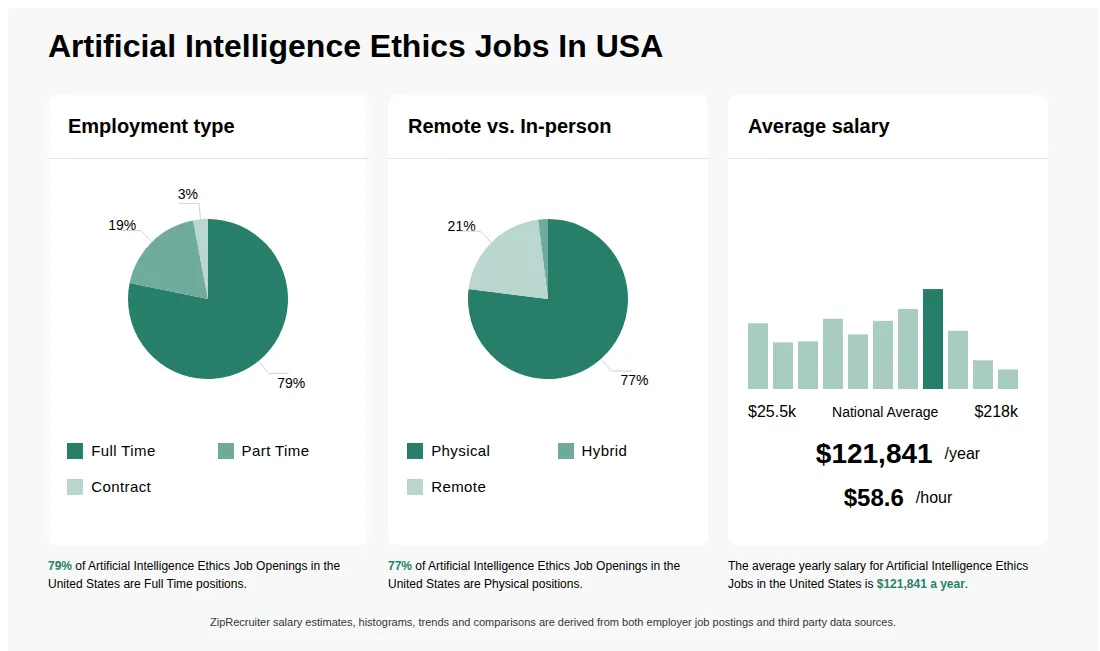
As of Sep 4, 2026, the average yearly pay for artificial intelligence ethics in the United States is $121,841.00, according to ZipRecruiter salary data. Most workers in this role earn between $79,000.00 and $158,000.00 per year, depending on experience, location, and employer.

What is artificial intelligence ethics?

An Artificial Intelligence Ethics job focuses on ensuring AI technologies are developed and used responsibly. Professionals in this field assess AI systems for fairness, transparency, bias, and societal impact. They work with developers, policymakers, and organizations to create ethical guidelines and compliance frameworks. Their goal is to minimize harm, promote accountability, and align AI with human values.

What are the key skills and qualifications needed to thrive in artificial intelligence ethics?

To excel in Artificial Intelligence Ethics, candidates typically require a background in ethics, philosophy, law, or computer science, often supported by an advanced degree in a related field. Familiarity with AI frameworks, data privacy regulations, algorithmic auditing tools, and relevant certifications such as Certified Ethical Emerging Technologist (CEET) is highly valued. Strong communication, analytical thinking, and the ability to facilitate cross-disciplinary dialogue set exceptional professionals apart. These skills are crucial to ensure AI systems are designed and deployed responsibly, transparently, and fairly in real-world applications.

What are some of the common challenges faced by professionals working in artificial intelligence ethics?

Professionals in Artificial Intelligence Ethics often face challenges such as navigating the rapidly evolving landscape of AI technology while ensuring compliance with ethical standards and legal regulations. Balancing innovation with societal impact—such as protecting privacy, preventing bias, and earning stakeholder trust—can be complex and requires ongoing learning. These roles frequently involve collaboration with data scientists, engineers, legal experts, and business leaders to evaluate potential AI risks and solutions. Staying current on best practices and global regulatory changes is essential for addressing new ethical dilemmas as they arise.

How do you become an artificial intelligence ethicist?

To become an artificial intelligence ethicist, individuals typically pursue a relevant degree such as philosophy, computer science, or law, with a focus on ethics and AI. Gaining experience through research, interdisciplinary collaboration, and staying informed about AI developments and ethical frameworks is essential; some professionals also obtain certifications in AI ethics or related fields.

Is artificial intelligence ethics a good career?

Artificial intelligence ethics is a growing field focused on ensuring AI systems are developed and used responsibly, often requiring knowledge of AI technologies, ethics, and policy. Careers in this area can be rewarding for those interested in technology, societal impact, and regulatory frameworks, with opportunities in research, consulting, and corporate ethics teams.

What jobs are available in artificial intelligence ethics?

Jobs in artificial intelligence ethics include roles such as AI ethics researcher, AI policy analyst, machine learning fairness specialist, and AI compliance officer. These positions often require knowledge of AI technologies, ethical frameworks, and sometimes certifications in data ethics or AI governance, working in research institutions, tech companies, or regulatory agencies.
More about Artificial Intelligence Ethics jobs

What cities are hiring for Artificial Intelligence Ethics jobs?

Cities with the most Artificial Intelligence Ethics job openings:

What are the most commonly searched types of Artificial Intelligence Ethics jobs?

The most popular types of Artificial Intelligence Ethics jobs are:

What states have the most Artificial Intelligence Ethics jobs?

States with the most job openings for Artificial Intelligence Ethics jobs include:

What job categories do people searching Artificial Intelligence Ethics jobs look for?

The top searched job categories for Artificial Intelligence Ethics jobs are:

Infographic showing various Artificial Intelligence Ethics job openings in the United States as of August 2026, with employment types broken down into 89% Full Time, 8% Part Time, and 3% Contract. Highlights an 85% Physical, 4% Hybrid, and 11% Remote job distribution, with an average salary of $121,841 per year, or $58.6 per hour.

Assistant Professor - in Artificial Intelligence Ethics

Uottawa

Campus, IL • On-site

$99K/yr

Full-time

Medical, Life, Retirement

Posted 9 days ago


Key responsibilities

  • Manage and contribute to the development of the interdisciplinary Master's program in Artificial Intelligence Ethics.

  • Teach undergraduate and graduate courses in Artificial Intelligence Ethics in English and French.

  • Establish a rigorous research program in Artificial Intelligence Ethics, including securing external research funding.


Job description

Posting Reason:

New Position

Job Family:

Academic Leadership and Faculty

Union affiliation:

APUO

Faculty/Department:

Department of Philosophy_Professors and Researchers

Campus:

Main Campus

Date Posted (YYYY/MM/DD):

2026/08/26

Applications must be received BEFORE (YYYY/MM/DD):

The Department of Philosophy in the Faculty of Arts at the University of Ottawa is seeking applications fr a tenur-trk Assistant Professor position specializing in Artificial Intelligence Ethics, including the philosophical and normative underpinnings of artificial intelligence, along with the philosophical challenges that arise from its applications and repercussions in political, legal, and tehnlgil spheres. The successful candidate will also be responsible for managing and contributing to the development of the interdisciplinary Master's program in Artificial Intelligence Ethics. The area of expertise for this role is flexible.

The University of Ottawa is recognized nationally and internationally as a leading university and the largest bilingual university (French and English) in the world. Located on the unceded territory of the Anishinaabe-Algonquin people, in the heart of downtown Ottawa, it contributes significantly to the economy, culture, and quality of life in Canada's capital.

The ntiipted start date fr this psitin is July 1st, 2027

Position Title: Assistant Professor

Duties: The duties of a faculty member include, in varying proportions: a) teaching activities; b) scholarly activities manifested through research and peer-reviewed publications; c) activities related to service to the university community; and d) supervision of graduate students.

A commitment to developing discipline and academic unity, including graduate programs, is required. To this end, the successful candidate must have established a rigorous research program that includes grants from major funding agencies such as SSHRC or a clearly defined plan to develop an active research program.

The successful candidate will be expected to teach at the undergraduate and graduate levels, in English and French, upon attainment of tenure.

Terms: New tenure-track position.

Salary: The starting salary for an Assistant Professor is $99,377 (according to the scale in effect as of May 1, 2025).

Benefits package: The University of Ottw provides an tensive benefits package, which includes long-term disability coverage, basic life insurance, supplementary health benefits, a pension plan, optional life insurance, and reimbursement fr relaxation expenses.

Work location: Department of Philosophy, University of Ottawa, 55 Laurier East, 8th Floor, Ottawa, Ontario K1N 6N5

Contact (for inquiries): Dr. Patrice Philie, Director, Department of Philosophy, University of Ottawa, email: Dir.Philosophie-Philosophy.Dir@uottawa.ca.

Required qualifications:

  • A Ph.D. in Philosophy or a related discipline completed no later than July 1, 2027;

  • Evidence of an established and innovative research program, together with a record of peer-reviewed publications and scholarly presentations;

  • Demonstrated ability to secure external research funding;

  • Successful teaching experience at the post-secondary level;

  • Have excellent communication skills in French or English. French-English bilingualism is an asset. Active knowledge of Canada's two official languages (French and English) is a requirement for tenure.

  • Experience recruiting and supervising graduate students (an asset).

Deadline: Applications received by October 16, 2026, will be fully nsiderd; however, the position will remain open until it is filled.

Further details about academic crrs can be found online. Applications must be submitted through the University of Ottawa's career portal, and only complete submissions will be evaluated.

Plas submit the following duments in single PDF: a ver letter, a curriculum vitae, two recent per-rviewed publications, a statement of research interests, and a sample course outline.

After an initial screening of applications, shortlisted ndidts will be invited to present their research and conduct a teaching demonstration fr the Department's faculty and students. Candidates must also provide three nfidential letters of recommendation, which should be sent directly by their referees.

To learn more about our department, please visit: https://www.uottawa.ca/faculty-arts/philosophy

The University of Ottawa is committed to ensuring equity, diversity, and inclusion in the scholarly and leadership environments of our students, staff, and faculty. Accordingly, we strongly encourage applications from Indigenous Peoples in Canada, visible minorities members (racialized persons), persons with disabilities, women, as well as from all qualified candidates with the skills and knowledge to productively engage with equitable, diverse, and inclusive communities. Candidates who wish to be considered as a member of one or more designated groups are asked to complete the confidential Self-Identification Questionnaire, to be completed at the time of application.

All qualified candidates are invited to apply; however, preference will be given to Canadians and permanent residents. When submitting your application, please indicate if you are legally entitled to work in Canada

The University of Ottawa provides accommodations for applicants with disabilities throughout the recruitment process. If you are invited to proceed in the selection process, please notify us of any accommodations that you require by contacting the Office of the Vice-Provost, Faculty Relations by email at vra.affairesprofessorales@uottawa.ca. Any information you send us will be handled respectfully and in complete confidence.

The University of Ottawa is proud of its 160-year tradition of bilingualism. Through its Official Languages and Bilingualism Institute, the University provides training to staff members and to their spouses in their second official language.

Prior to May 1, 2022, the University required all students, faculty, staff, and visitors (including contractors) to be fully vaccinated against Covid-19 as defined in Policy 129 - Covid-19 Vaccination. This policy was suspended effective May 1, 2022 but may be reinstated at any point in the future depending on public health guidelines and the recommendations of experts.