1

Access Control Technician Jobs (NOW HIRING)

... access control systems . Responsibilities include mounting and installing cameras, card readers, door hardware, and associated low-voltage devices in commercial environments. Technicians will perform ...

... access control systems . Responsibilities include mounting and installing cameras, card readers, door hardware, and associated low-voltage devices in commercial environments. Technicians will perform ...

Apply Early

next page

Showing results 1-20

Access Control Technician information

See salary details

$12

$24

$39

How much do access control technician jobs pay per hour?

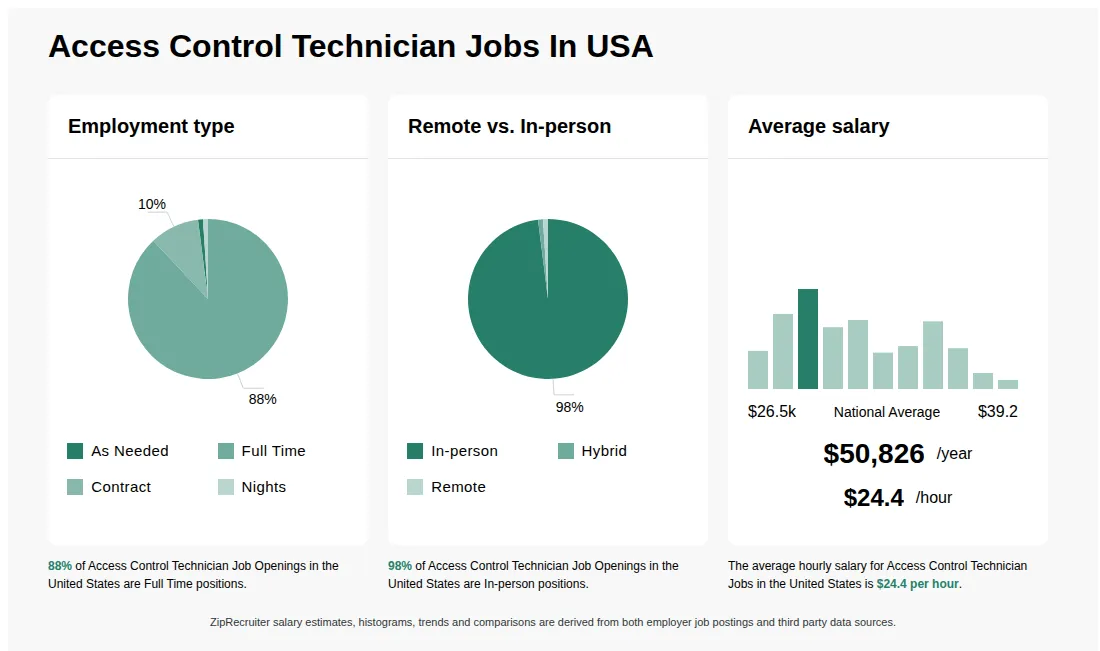
As of Jul 3, 2026, the average hourly pay for access control technician in the United States is $24.44, according to ZipRecruiter salary data. Most workers in this role earn between $18.03 and $30.53 per hour, depending on experience, location, and employer.

What qualifications do I need to install security systems?

Access Control Technicians typically need a high school diploma or equivalent, along with technical training or certification in security systems installation. Relevant skills include knowledge of electrical systems, networking, and experience with security hardware and software. Certifications such as the Security Industry Association (SIA) Certified Security Project Manager or manufacturer-specific training can enhance job prospects.

What are typical daily responsibilities for an Access Control Technician?

Access Control Technicians are responsible for installing, maintaining, and troubleshooting electronic access control systems, such as card readers, biometric scanners, and electronic locks. Their daily tasks often include wiring devices, configuring system software, performing preventative maintenance, and responding to service calls for repairs or upgrades. Technicians also collaborate closely with clients, project managers, and security teams to ensure each installation meets specific security requirements. The role requires working both independently and as part of a team, often in commercial buildings, office complexes, or other secured environments.

What is the highest paid technician?

The highest paid technicians generally include specialized roles such as industrial or aerospace technicians, with salaries reaching over $70,000 annually. Access Control Technicians with advanced certifications or experience in security systems and access management can earn higher wages, especially in high-demand industries or with additional skills in networking and troubleshooting.

What is an Access Control Technician job?

An Access Control Technician installs, maintains, and repairs security systems that regulate entry to buildings or restricted areas. They work with key card systems, biometric scanners, electronic locks, and other security technologies. Their role includes troubleshooting technical issues, programming access permissions, and ensuring system integrity. They often collaborate with security teams, IT departments, and facility managers to enhance security measures.

Which job has high job security?

Access Control Technicians often have stable employment due to the ongoing need for security systems in various facilities. Jobs in security, maintenance, and technical roles related to access control tend to offer higher job security because of consistent demand and the importance of security infrastructure. Certifications and experience can further enhance job stability in this field.

What are the key skills and qualifications needed to thrive in the Access Control Technician position, and why are they important?

To thrive as an Access Control Technician, you need a solid understanding of electronic security systems, wiring, and basic IT networking, often supported by relevant technical training or certification. Familiarity with access control software, card reader systems, surveillance integration, and certifications like Certified Security Project Manager (CSPM) or manufacturer-specific credentials is valuable. Strong troubleshooting abilities, attention to detail, and effective communication skills help technicians excel when working on installations and collaborating with clients or team members. These competencies ensure accurate system setup, reliable security solutions, and high customer satisfaction.

What does an access control technician do?

An access control technician installs, maintains, and repairs security systems that regulate entry to buildings or areas, such as electronic locks, card readers, and biometric devices. They often work with security software, troubleshoot technical issues, and ensure systems operate reliably, typically requiring knowledge of electrical systems and security protocols.
More about Access Control Technician jobs
What cities are hiring for Access Control Technician jobs? Cities with the most Access Control Technician job openings:
What states have the most Access Control Technician jobs? States with the most job openings for Access Control Technician jobs include:
What job categories do people searching Access Control Technician jobs look for? The top searched job categories for Access Control Technician jobs are:
Access Control Technician II

Full-time

Medical, Retirement, PTO

Posted 14 days ago


University Of Texas At Arlington rating

7.5

Company rating: 7.5 out of 10

Based on 29 frontline employees who took The Breakroom Quiz

268th of 544 rated colleges and universities


Job description

Position Information
Posting Number S06891P Position Title Access Control Technician II Department IT for Campus Operations Location Arlington Position Status Full-time Work Schedule
Monday - Friday; 8:00am - 5:00pm
  • Some evening and weekend.
  • On-call schedule as well.
Salary Salary is commensurate based on qualifications and relevant experience up to $62,000 Pay Basis Bi-weekly Job Summary
The Access Control Technician II is responsible for the advanced installation, programming, configuration, commissioning, repair, troubleshooting, and routine or emergency maintenance of building access control, electronic security devices, door/lock hardware, IP-based camera platforms, IP-based alarm platforms, panic alarm systems, and related security technology. Serves as an experienced technician within the access control and security systems function, with responsibility for advanced diagnostics, Mercury Security panel programming, DMP panel support, IP-based field device troubleshooting, system licensing support, network coordination, outage response, documentation, customer communication, and the ability to work independently with minimal direction on routine and moderately complex assignments. This position supports campus safety and continuity by responding to campus emergencies, urgent service needs, and system outages affecting access control, camera, alarm, panic, and related security systems
Essential Duties and Responsibilities
  • Installs, programs, tests, commissions, repairs, and maintains field devices related to the campus ID-card access-control system, including IP-based access-control platforms, wireless systems, stand-alone systems, Mercury Security intelligent controllers, downstream interface modules, electronic door locks, card readers, request-to-exit devices, door position switches, control panels, power supplies, relays, and other door hardware related to the campus card-access-control system.
  • Programs and configures Mercury Security access control panels, including controller setup, reader configuration, input/output mapping, door logic, lock schedules, alarm points, event reporting, firmware coordination, and panel-to-head-end communication.
  • Performs advanced troubleshooting of access control systems, including panel communication failures, reader bus issues, OSDP/Wiegand reader connectivity, supervised inputs, relay outputs, power supply faults, battery backup issues, lock power failures, network drops, IP addressing, VLAN coordination, and device-to-server connectivity.
  • Installs, supports, troubleshoots, and maintains IP-based camera platforms, including IP cameras, camera connectivity, device replacement, field diagnostics, camera aiming/focusing, video management system connectivity, camera licensing, and coordination of camera views with operational and security needs.
  • Installs, supports, programs, troubleshoots, and maintains IP-based alarm platforms and panic alarm systems, including DMP alarm panels, alarm points, keypads, input modules, panic buttons, monitoring paths, communication failures, notification signals, and related field devices.
  • Assists with system administration and licensing functions, including device enrollment, panel licensing, camera licensing, alarm point naming, camera naming conventions, reader/door configuration support, location data, and system documentation.
  • Applies working knowledge of university network configurations and coordinates with technology partners regarding IP addressing, switch ports, VLAN assignments, PoE requirements, network drops, firewall/routing coordination, device connectivity, and other network dependencies affecting security technology.
  • Performs system commissioning and acceptance testing, including point-to-point testing, door function testing, reader validation, lock/unlock verification, alarm event testing, camera verification, panic alarm testing, fail-secure/fail-safe confirmation, and documentation of deficiencies.
  • Reviews drawings, riser diagrams, door hardware schedules, security device schedules, submittals, shop drawings, as-builts, and project specifications to confirm system design, field conditions, pathway requirements, device locations, and integration points.
  • Coordinates and communicates with customers, contractors, vendors, third-party integrators, university IT, police/security technology staff, facilities personnel, project managers, and team members on the status of projects, repairs, outages, and service requests.
  • Works independently with minimal direction to diagnose, prioritize, and resolve routine and moderately complex service requests, repairs, outages, and installation issues; escalates highly complex or sensitive matters as appropriate.
  • Responds to campus emergencies, urgent security-related service needs, and system outages involving access control, electronic locks, Mercury panels, IP-based camera platforms, IP-based alarm platforms, DMP panels, panic systems, network-connected security devices, and related infrastructure.
  • Provides overtime, after-hours, and on-call support as required to restore system functionality, maintain campus access, support campus safety, and minimize operational disruption.
  • Keeps accurate records related to work performed and prepares and submits reports as requested. Maintains documentation of device locations, panel programming, licensing, service history, inventory usage, wiring changes, network information, project status, deficiencies, and completed work.
  • Tracks and maintains hardware inventory, including access control devices, Mercury panels and modules, DMP equipment, IP cameras, readers, locks, power supplies, batteries, cabling, relays, door hardware, and related security system components.
  • Provides technical guidance and support to lower-level technicians, student workers, temporary staff, vendors, or contractors as assigned.
  • Performs other duties as assigned.
Minimum Qualifications
  • High school diploma or equivalent.
  • Five (5) years of related experience, or an equivalent combination of education and relevant work experience, including experience with card access control systems, low-voltage wiring, electronic diagnosis and maintenance, lock hardware installation/maintenance, IP-based security systems, and network-connected field devices.
  • Experience must include installation, troubleshooting, repair, and maintenance of access control systems, electronic locking hardware, readers, door position switches, request-to-exit devices, control panels, alarm devices, and related security infrastructure.
  • Working knowledge and experience of IP-based camera platforms, IP-based alarm platforms, and the ability to respond to campus emergencies, urgent service needs, and system outages.
Preferred Qualifications
  • College coursework, associate degree, or bachelor's degree in electronics, computer hardware, networking, security technology, information technology, construction technology, or a related field.
  • More than five (5) years of related experience.
  • Experience serving as a senior technician, project lead, or field lead for enterprise access control, IP-based camera platform, IP-based alarm platform, panic alarm, or low-voltage security system installations.
  • Experience with Mercury Security access control panels, including panel programming, controller configuration, reader configuration, input/output mapping, firmware coordination, panel communication diagnostics, and commissioning.
  • Experience with DMP alarm panels, IP-based camera platforms, video management systems, IP-based alarm platforms, access control licensing, camera licensing, CBORD access-control systems, Squadron platform, AD-series locks, wireless infrastructure, PIMs, and related enterprise security technologies.
  • Experience coordinating with IT or network teams regarding IP addressing, switch ports, VLANs, PoE, network drops, firewall/routing coordination, and device-to-server communication.
  • Relevant certifications in access control, video surveillance, intrusion alarm, networking, electronics, locksmithing, or physical security systems.
  • Experience working in a university, public-sector, healthcare, municipal, large campus, or similarly complex operating environment preferred.
Knowledge, Skills and Abilities
  • Advanced knowledge of enterprise access control systems, including Mercury Security intelligent controllers, downstream modules, reader interfaces, supervised inputs, relay outputs, door controllers, power supplies, and electronic locking hardware.
  • Ability to program, configure, troubleshoot, and commission Mercury Security access control panels and related field devices.
  • Knowledge of integrator-level access control concepts, including OSDP, Wiegand, reader buses, door logic, lock schedules, access levels, alarm points, fail-safe/fail-secure operation, request-to-exit devices, door position switches, electrified hardware, and panel-to-head-end communication.
  • Working knowledge of IP-based camera platforms, including IP cameras, video management system connectivity, camera licensing, camera replacement, aiming/focusing, field diagnostics, and device-to-server communication.
  • Working knowledge of IP-based alarm platforms, DMP alarm panels, panic systems, alarm points, keypads, input modules, communication paths, monitoring connections, notification signals, and field-level alarm troubleshooting.
  • Knowledge of enterprise network dependencies for security systems, including IP addressing, VLANs, switch ports, PoE, network drops, firewall/routing coordination, and device connectivity.
  • Ability to read and interpret riser diagrams, wiring diagrams, floor plans, door schedules, hardware sets, security drawings, submittals, and as-built documentation.
  • Ability to perform point-to-point testing, device commissioning, deficiency tracking, and system acceptance testing.
  • Strong troubleshooting skills across low-voltage wiring, electronic hardware, mechanical door hardware, network connectivity, software configuration, licensing, and head-end communication.
  • Ability to coordinate effectively with customers, IT personnel, police/security technology staff, facilities personnel, project managers, contractors, vendors, and third-party integrators.
  • Ability to work independently with minimal direction, exercise sound judgment in the field, prioritize competing service needs, and escalate complex or high-risk issues appropriately.
  • Ability to respond to campus emergencies, urgent service needs, and system outages involving critical security infrastructure.
  • Strong documentation, customer service, communication, inventory, and organizational skills.
Other Requirements Workplace and Eligibility Conditions Benefits Eligible Yes Benefits at UTA
We are proud to offer a comprehensive benefits package to all our employees at the University.
https://www.uta.edu/hr/employee-benefits
To help you understand the full value of these benefits, we have created a tool that calculates the total worth of your compensation package. This tool takes into account all of the benefits that you are eligible for, including health insurance, retirement plans, and paid time off. To access this tool and learn more about the total value of your benefits, please click on the following link:
https://resources.uta.edu/hr/services/records/compensation-tools.php
CBC Requirement
It is the policy of The University of Texas at Arlington to conduct a criminal background check on any applicant who is under final consideration for employment with the University.

This position may have access to critical infrastructure as defined by Section 113.001(2) of the Texas Business and Commerce Code. If so, to be hired for and continue to be employed in this position you must maintain the security or integrity of the infrastructure as set forth in Texas Executive Order GA-48. By assuming this position, and if you have access to critical infrastructure, you authorize the University to conduct routine background checks.
EEO Statement
It is the policy of The University of Texas at Arlington (UTA or The University) to provide an educational and working environment that provides equal opportunity to all members of the University community. In accordance with federal and state law, the University prohibits unlawful discrimination, including harassment, on the basis of race, color, national origin, religion, age, sex, sexual orientation, pregnancy, disability, genetic information, and/or veteran status. The University also prohibits discrimination on the basis of gender identity, and gender expression. Retaliation against persons who oppose a discriminatory practice, file a charge of discrimination, or testify for, assist in, or participate in an investigative proceeding relating to discrimination is prohibited. Constitutionally-protected expression will not be considered discrimination or harassment under this policy. It is the responsibility of all departments, employees, and students to ensure the University's compliance with this policy.
University Information
The University of Texas at Arlington (UTA) is located in the heart of the Dallas-Fort Worth-Arlington metroplex, a vibrant and diverse metropolitan area that is home to over 7 million people, one of the fastest-growing tech economies in the United States, and a wide array of arts, entertainment, and cultural activities. As a comprehensive teaching, research, and public service institution, UTA is dedicated to the advancement of knowledge through scholarship and creative work. With an enrollment of more than 42,000 students, UTA is...

What University Of Texas At Arlington employees say

Pay

Benefits

Hours and flexibility

Workplace

Get the full story on Breakroom