
Security Officer
New Albany, OH · On-site
$22.85/hr
New Albany, OH · On-site
$22.85/hr
Logan, OH · On-site
$18/hr
Pataskala, OH · On-site
$16.50/hr
Etna, OH · On-site
$16.50/hr
Lockbourne, OH · On-site
$16.50/hr
New Albany, OH · On-site
$20/hr
Marengo, OH · On-site
$18.50/hr
New Albany, OH · On-site
$22.85/hr
Columbus, OH · On-site
$16 - $16.49/hr
Columbus, OH · On-site
$20/hr
Columbus, OH · On-site
$24 - $25/hr
Columbus, OH · On-site
$24 - $25/hr
Columbus, OH · On-site
$20 - $21/hr
Johnstown, OH · On-site
$18 - $19/hr
Security jobs are those that provide protective services for a business, facility, event, or location. Security jobs include law enforcement, private security, and private investigators. There are also many jobs available in cyber security, providing digital security. Each type of security job has a unique set of required skills and qualifications. For example, a correctional officer needs specialized de-escalation and physical training, while a digital security specialist needs education and experience related to information technology, backup, and authentication protocols.
With a background in the armed forces, you can find increased opportunities in physical security, such as corrections officers, personal security, or private security advisors. You may even be able to work as a security contractor employed by the armed forces. Cyber security positions require you have an associate or bachelor’s degree in computer science, network security, or a related subject.
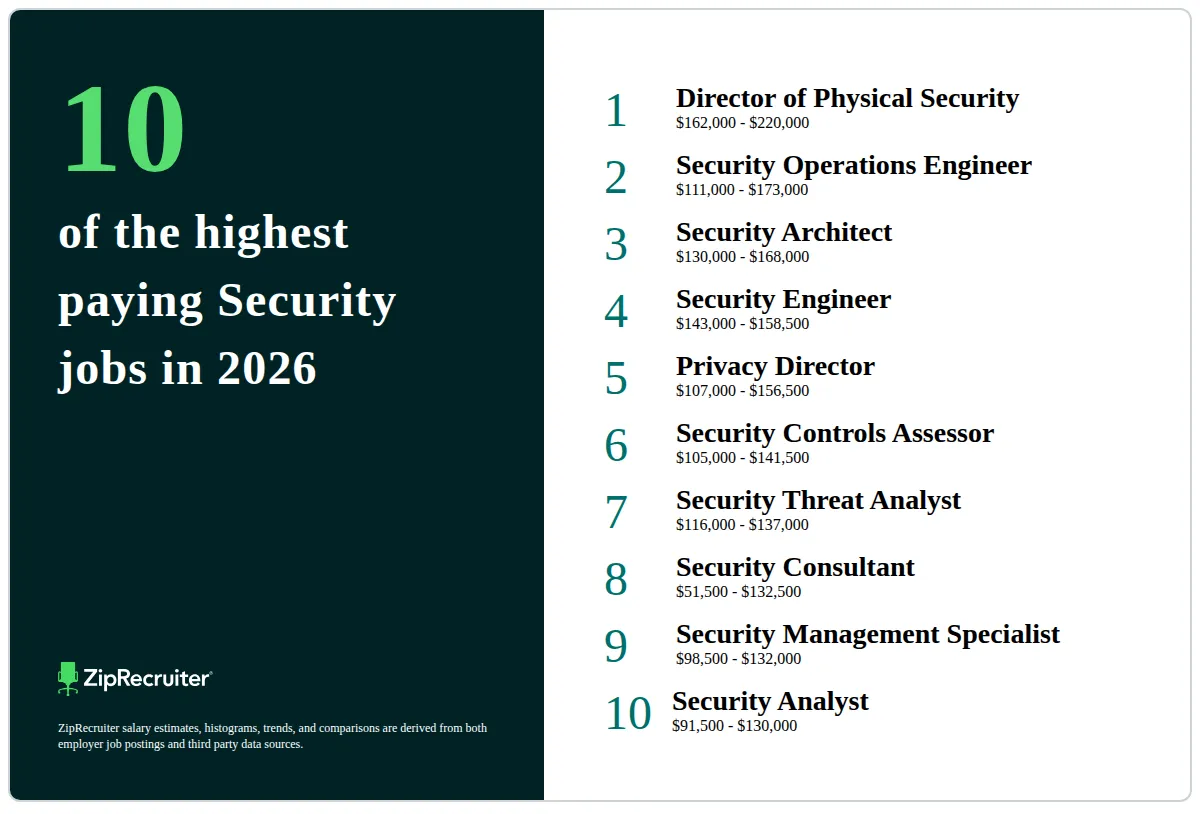
Salary range: $162,000 - $220,000
The duties of a director of physical security revolve around the physical protection of clients, companies, or members of an organization. In this career, you are responsible for the management of security operations. You come up with policies and a security process to safeguard clients and their assets. You may be involved in hiring and training other security personnel. In addition to protecting against physical or criminal attacks, you may work to ensure general safety during travel.
Salary range: $111,000 - $173,000
As a security operations engineer, your job is to monitor a network or system and help implement new methods of protection and data recovery. In this role, you may conduct a vulnerability assessment for each emerging threat, coordinate with other security specialists, and help develop responses with industry peers. This job title refers to maintaining network security systems and should not be confused with non-electronic security operations, such as safeguarding VIPs or facilities. A security operations engineer works regular hours, but employers may call you in for emergency help as needed. This position usually reports to someone, such as a chief information security officer. You may occasionally brief executives or other managers on relevant topics, so presentation skills are helpful.
Salary range: $130,000 - $168,000
A security architect helps to build, implement, oversee, and maintain cyber- and network security systems for a business or another organization such as a government or university. As a security architect, your duties and responsibilities are to plan and test technical measures to maintain the IT security, such as designing firewalls and other security measures for a business enterprise network or database. You work with other security experts and continuity managers to prepare for contingencies related to security breaches or network interruptions.
Salary range: $143,000 - $158,500
A service provider is responsible for delivering professional quality services on behalf of a business or organization. The types of services vary depending on the businesses they work with. Many companies partner with experts in the local community to perform functions on their behalf rather than developing the expertise in-house. A service provider performs the services based on a written legal agreement and charges fees for their work.
Salary range: $107,000 - $156,500
Privacy directors design, develop, and oversee an organization’s privacy programs. They implement and maintain procedures and policies to streamline IT security, monitor compliance, investigate issues or breaches, and supervise the department. Other duties may include developing strategies to examine security issues and researching new policies and programs that protect private information. Qualifications to become a privacy director include a bachelor’s degree in cybersecurity, computer science, or a related field, and five years of experience in managing an IT security department.
Salary range: $105,000 - $141,500
A security controls assessor (SCA) evaluates the security controls within network systems to identify vulnerabilities and recommend actions to correct problems, working either alone or as part of a team. As a security controls assessor, your duties begin with conducting an in-depth assessment of the management, operations, and technical security controls. You must analyze information and prepare reports describing the vulnerability level of the network with specific detail as to what compromises data systems. You then develop a plan to address vulnerabilities and continue to monitor the security of network systems.
Salary range: $116,000 - $137,000
As a security threat analyst, you assess security practices and systems to identify vulnerabilities. After your analysis, you may recommend changes to operations, policies, and practices. Your responsibilities also include the assessment of specific threats and tracking their development. A security threat analyst focuses on cybersecurity and information security, often for a business or organization. It is your job to perform analysis, identify flaws that lead to breaches, and recommend ways to correct those vulnerabilities.
Salary range: $51,500 - $132,500
A security consultant is an information technology (IT) professional who is responsible for ensuring that an organization's online website, computer hardware, and software are secure against cyber attack. They are experts in computer infrastructure, networking, and security protocols. As a consultant, you may play a number of roles within an IT organization. Your primary duties likely revolve around advising software developers and server maintainers on how to develop secure systems. You must be an expert on the latest cybersecurity solutions and their benefits to the IT organization. Your job duties also include performing penetration tests and security audits in alignment with corporate security policies.
Salary range: $98,500 - $132,000
As a security management specialist, your job is to use security assessment techniques to verify the defenses of an organization, its employees, and its facilities. Many security management specialists focus on a specific area, such as physical, personnel, or information security. Your duties in this job vary by industry. For example, hospitals have different security needs than banks, and what works for one industry is not always appropriate for another. As part of this job, you may create a process to test the company's existing security, install or modify a security system, explain the technical requirements necessary for fulfilling the company's security goals, and create security guidelines for future employees to follow.
Salary range: $91,500 - $130,000
Security analysts evaluate information systems and recommend security measures and protocols to protect a company’s sensitive data from security threats. Security administrators implement their recommendations and put suggested protocols into action. As a security analyst, your job duties include monitoring security access, performing audits of internal and external network security programs, analyzing breaches to inform future security system measures, and training colleagues in security awareness and proper procedures. You also collaborate with outside vendors on security plans, which may include website applications, container, or cloud-based solutions.
Salary range: $48,000 - $130,000
A security auditor is an IT professional in charge of evaluating cybersecurity for a company. As a security auditor, you regularly test information systems, looking for exploits or loopholes that would give an unscrupulous individual access to protected company information. Your job duties also include developing security protocols and working with other teams within the company to ensure everyone is kept up to date with the best practices and other protocols. You must also keep track of relevant laws and regulations, as well as new security threats, to maintain proper cybersecurity for your employer.
Salary range: $101,000 - $129,000
A privacy manager is responsible for risk management and data security for an organization. In this career, you achieve this security by ensuring compliance with local, state, and federal regulations and implementing a privacy program for the company to keep information safe. The information you protect can be employee biometric data, consumer credit card information, or simpler things, like sales information and market reports. As the privacy manager, you are considered the subject matter expert when it comes to risk management and data security, so your daily duties involve providing advice in these areas, working with cybersecurity teams on potential breaches, managing issue resolution, and other responsibilities depending on the industry.
Salary range: $91,000 - $127,500
A security tester works to ensure the security of computer networks and systems. Their duties are to gather information and make assessments of computer security systems for a client or employer. They perform scans, look for vulnerabilities in applications, and locate other risks. Other responsibilities include conducting research and trying to breach networks using methods commonly deployed by hackers. The qualifications to become a security tester vary but often include a degree in computer science, cybersecurity, IT, or a related field or extensive experience and technical skills. Professional certifications are available.
Salary range: $92,000 - $124,000
A privacy officer, also known as a privacy compliance officer, develops and modifies privacy policies and practices of an organization or business. As a privacy officer, your duties include assessing current policies, suggesting modifications, and training new and existing employees on these policies. You must also stay informed of changes to privacy laws to ensure that your company’s policies reflect current regulations. Your job is to oversee the implementation of the best possible privacy practices in your particular field, ensuring the privacy of personal information and records so that no legal issues arise. Privacy officer jobs are very common in the health care industry, as these organizations must meet HIPAA regulations and standards.
Salary range: $60,500 - $119,500
A director of safety and security manages the security programs and safety procedures for a facility, organization, company, or institution. You oversee all security activities and develop and implement plans to respond to issues or threats. You also ensure compliance with safety regulations. Your duties also include installing or improving systems to protect buildings, people, and assets. As a director, you also have hiring, training, and employee development responsibilities. Directors work in a variety of settings, including hotels, public venues, and campuses. You can also work for corporations, private companies, or government agencies.
Salary range: $72,500 - $115,500
A security project manager’s responsibilities are to supervise the creation of security systems for companies and organizations to ensure the safety and protection of personnel, campus assets, and information. As a security project manager, you lead a team of security professionals to generate a plan of action to mitigate threats to the company. Your duties may also include helping a company create policies to improve site security, running safety drills and tests of the safety systems, and training staff on how to follow safety procedures and help improve security through individual action steps. You must also understand and apply any municipal, state, and federal regulations related to the installation and implementation of security equipment.
Salary range: $72,000 - $113,500
A security operations analyst works with a company, organization, or government office to identify and reduce security risks to their computer network. Your duties are to keep records of any suspicious activity, install security measures to prevent breaches, and give the organization suggestions about how to avoid future incidents. As a security operations analyst, your responsibilities also include conducting research on new threats and upgrading software as necessary. You often collaborate with other employees to resolve incidents as quickly as possible.
Salary range: $39,000 - $111,000
A bodyguard provides personal protection for a client, keeping them safe from physical threats like assault, theft, kidnapping, or assassination. In this career, you may also protect the client’s belongings and privacy at the client’s request. You can work for any prominent individual, but most often, you work for celebrities, diplomats, and politicians. As a bodyguard, you also have to drive your clients from place to place, screen the area for any threats, and conduct the client where they need to go. For larger security teams, you may be responsible for a specific task or area that your client frequents.
Salary range: $103,500 - $110,500
A security researcher keeps up-to-date on all the latest developments in threats to computer software and networks. These threats include different types of malware, such as computer viruses, malicious software and scripts, and direct attacks on a network. The main duties of a security researcher are to investigate existing types of malware, analyze their capabilities, and attempt to predict new forms of malware to develop appropriate security responses. They may reverse engineer malware or test security systems.
Salary range: $45,000 - $106,000
A security administrator is responsible for all of a service’s cybersecurity features, such as protecting personal information, login information, and passwords. Their job duties are to oversee the implementation and maintenance of all security features, such as firewalls, software patches, and anti-virus software, develop any security tests to ensure the system is working correctly, and deal with any cyber breaches. A security administrator typically oversees a team of technicians and trains them in the company’s security protocols. They may also write and present reports and analyses of the organization’s security systems and address potential future threats.
Salary range: $52,000 - $100,500
As a security operations manager, you develop and implement strategies to help protect the assets of your company. As part of your duties, you may determine the best protocol for each situation, manage the hiring and training process for other security personnel, and otherwise oversee daily security needs. Many details of this job depend on the security threats your employer faces. For example, retail stores frequently face problems with theft while research companies may be more concerned with the safety of digitally-archived information. Many security operations managers focus on physical threats and collaborate with systems administrators and other computer-focused personnel to secure digital assets.
Salary range: $53,000 - $99,500
A security specialist helps to protect valuable assets for a private client, corporation, or government entity. They can also be a personal security specialist or bodyguard. As a security specialist, you undergo a wide range of training, including criminal law, self-defense, situational awareness, computer security, and other disciplines specific to your field. Different types of security specialists require special qualifications that you should acquire. Some states require you to maintain regular certification to act as a licensed security specialist, especially as a bodyguard.
Salary range: $83,000 - $98,500
As a privacy analyst, you assess business policies, procedures, and operations to ensure your company or organization meets privacy requirements and government regulations for the protection of critical information. Your duties in this career not only include analysis but also creating strategies for improvement. Your responsibilities may involve providing training or educational materials for employees so they can better manage privacy protection and mitigate risks related to the unauthorized access of sensitive information. You may focus on general operations of a business or organization, or you could focus on privacy as it relates to specific projects.
Salary range: $46,500 - $98,500
The job duties of a personnel security (PERSEC) specialist involve ensuring that employees and contractors in a facility obtain a proper security clearance. Many personnel security specialists conduct background checks for applicants who apply for government jobs that require a security clearance. You may also work for facilities like banks or airports. Your responsibilities include conducting research, establishing background check practices and procedures, and ensuring that security staff follows the check process. In addition to investigating employees who have access to secure areas, you may communicate with applicants and employees to obtain additional information if necessary.
Salary range: $47,000 - $98,500
A security intelligence analyst assesses the threat various actors pose to an organization, an industry, or general public safety. Some security intelligence analysts focus on physical threats to infrastructure or human safety, while others concentrate specifically on cybersecurity. Regardless of the type of security analysis you do, your responsibilities and duties include a mix of reading reports, making risk assessments, working to detect the source of attacks, and testing current defenses against threats. Your analysis leads to a report to your superiors identifying current threats and advising them on how to improve security measures and response to attacks.


