Texas Instruments
Texas Instruments

60 Texas Instruments Data Analyst Jobs Hiring Near You

Customer Quality Engineer (Sensing)

Dallas, TX · On-site

$65.60K - $84.70K/yr

Texas Instruments is looking for an energetic, service minded engineer, who enjoys helping business ... Solve challenging technical product quality issues, leveraging deep data analytics, manufacturing ...

Customer Quality Engineer (Sensing)

Dallas, TX · On-site

$65.60K - $84.70K/yr

Texas Instruments is looking for an energetic, service minded engineer, who enjoys helping business ... Solve challenging technical product quality issues, leveraging deep data analytics, manufacturing ...

Customer Intelligence Strategist

Dallas, TX · On-site

$110.60K - $142.90K/yr

... analysis, and reporting responsible for demonstrating ABM ROI. Texas Instruments will not sponsor ... Familiarity with data visualization tools for ABM reporting and insights (Looker/Data Studio ...

Showing results 21-40

Texas Instruments Jobs Information

What are the key skills and qualifications needed to thrive as a Data Analyst, and why are they important?

To thrive as a Data Analyst, you need strong analytical skills, proficiency in statistics, and a relevant degree such as in mathematics, statistics, or computer science. Familiarity with data analysis tools like SQL, Excel, Python or R, and experience with visualization platforms such as Tableau or Power BI are typically required. Strong problem-solving abilities, attention to detail, and effective communication skills help analysts interpret data insights and present findings clearly to stakeholders. These skills are crucial for transforming raw data into actionable business insights that drive informed decision-making.

What are some common challenges Data Analysts face when working with large datasets, and how are they typically addressed?

Data Analysts often encounter challenges such as data quality issues, missing or inconsistent values, and slow processing times when handling large datasets. These challenges are typically addressed by implementing data cleaning routines, using advanced data management tools, and leveraging programming languages like Python or R for efficient data manipulation. Collaboration with database administrators and IT teams is also common to ensure data integrity and optimize data storage solutions. Staying updated with best practices in data wrangling and visualization helps Data Analysts deliver accurate and actionable insights.

What does a Data Analyst do?

A Data Analyst is responsible for collecting, processing, and analyzing data to help organizations make informed business decisions. They use statistical tools and software to interpret data sets, identify trends, and create visual reports. Data Analysts often collaborate with other departments to provide actionable insights and support strategic planning. Their work helps organizations optimize operations, track performance, and solve business problems using data-driven approaches.

How much does an entry level data analyst make?

Entry-level data analysts typically earn between $55,000 and $70,000 annually, depending on the industry and location. Starting salaries may be higher with relevant skills in SQL, Excel, and data visualization tools like Tableau or Power BI.

What jobs make $3,000 a month without a degree?

Data analysts can sometimes earn around $3,000 per month with relevant skills in data visualization, Excel, and basic statistical tools, even without a formal degree. Entry-level roles or freelance work in data analysis, digital marketing, or customer support may also reach this income level, especially with experience and certifications. However, salaries vary based on location, industry, and skill level.

Will AI replace a data analyst?

AI tools can automate routine data processing and basic analysis tasks, but data analysts are essential for interpreting complex data, making strategic decisions, and providing context. The role of a data analyst involves skills like critical thinking, domain knowledge, and communication that AI cannot fully replicate. Therefore, AI is more likely to augment rather than replace data analysts in the foreseeable future.

What is the difference between Data Analyst vs Data Scientist?

AspectData AnalystData Scientist
Required CredentialsBachelor's degree in statistics, mathematics, or related field; often certifications in data analysis toolsBachelor's or master's in computer science, statistics, or related; often advanced certifications or degrees
Work EnvironmentBusiness settings, focusing on data reporting and visualizationResearch and development environments, focusing on predictive modeling and complex algorithms
Employer & Industry UsageRetail, finance, healthcare, and marketing companiesTech firms, research institutions, and large enterprises

While both roles analyze data, Data Analysts primarily focus on interpreting existing data to generate reports and insights, whereas Data Scientists develop predictive models and advanced algorithms to forecast trends and solve complex problems.

What is it like to work at Texas Instruments?

Texas Instruments is known for its collaborative and innovative culture, prioritizing employee growth and development through continuous learning and skill-building opportunities.

The company's team structure is organized around product lines and technology areas, with a flat organizational hierarchy that encourages open communication and cross-functional collaboration. Employees work in a dynamic and fast-paced environment, driving innovation in areas such as analog and embedded processing, and developing cutting-edge technologies for various industries.

Working at Texas Instruments may appeal to candidates who are passionate about technology and innovation, as the company offers a wide range of opportunities for professional growth and development, including mentorship programs, training initiatives, and opportunities to work on high-impact projects that can make a significant impact in the industry.

Do workers at Texas Instruments get paid breaks?

Yes. Most people get paid breaks.
79% of people say they get paid breaks.
Based on data from 34 people who took the Breakroom Quiz between May 2025 and May 2026.

Does Texas Instruments pay people when they’re sick?

Yes. Most people get paid when they’re sick.
89% of people say they would get paid if they were sick but scheduled to work.
Based on data from 37 people who took the Breakroom Quiz between May 2025 and May 2026.

At Texas Instruments, are sick days and vacation days separate paid time off?

Sick days and vacation days are used from the same paid time off.
95% of people say they have to use vacation days when they’re out sick.
Based on data from 39 people who took the Breakroom Quiz between May 2025 and May 2026.

Is the health insurance from Texas Instruments affordable enough for their workers?

Most people say the health insurance costs are okay.
97% of people say the health insurance costs are okay
Based on data from 37 people who took the Breakroom Quiz between May 2025 and May 2026.

Do people get paid time off at Texas Instruments?

Most people get paid time off work.
98% of people say they get paid time off.
Based on data from 40 people who took the Breakroom Quiz between May 2025 and May 2026.

Do workers at Texas Instruments worry about hours?

Most people don’t worry about getting enough hours.
91% of people report they don’t worry about getting enough hours.
Based on data from 32 people who took the Breakroom Quiz between April 2025 and April 2026.

Do Texas Instruments workers get to choose the shifts they work?

Some people don’t get to choose which shifts they work.
38% report that they don’t have enough control over which shifts they work.
Based on data from 52 people who took the Breakroom Quiz between December 2024 and April 2026.

How easy is it for Texas Instruments workers to change shifts?

Some people find it hard to change shifts.
52% of people report that it’s hard to change shifts if they need to.
Based on data from 31 people who took the Breakroom Quiz between November 2024 and February 2026.

How easy is it to get time off at Texas Instruments?

Most people find it easy to get time off.
81% of people report it’s easy to get time off.
Based on data from 36 people who took the Breakroom Quiz between May 2025 and May 2026.

Do Texas Instruments managers change schedules at the last minute?

Most managers don’t change people’s schedules at the last minute.
100% of people say their manager doesn’t change their shift schedule at the last minute.
Based on data from 33 people who took the Breakroom Quiz between April 2025 and April 2026.

Do workers at Texas Instruments do extra work that they don't get paid for?

Rarely. Most people don’t do unpaid extra work.
81% of people report that they don’t do extra unpaid work.
Based on data from 57 people who took the Breakroom Quiz between November 2024 and April 2026.

How easy is it to take sick days at Texas Instruments?

Most people find it easy to take sick days.
81% of people report that it’s easy to take time off if they are sick.
Based on data from 37 people who took the Breakroom Quiz between May 2025 and May 2026.

Is working at Texas Instruments good if you’re a parent or caregiver?

Most parents and caregivers say this is a good place to work.
85% of people who care for a child or other relative report this is a good place to work.
Based on data from 26 people who took the Breakroom Quiz between November 2024 and April 2026.

Do people at Texas Instruments feel treated with respect by their managers?

Most people feel treated with respect by their managers.
82% of people say they’re treated with respect by their managers.
Based on data from 44 people who took the Breakroom Quiz between April 2025 and April 2026.

Do people at Texas Instruments get to take their breaks without interruption?

Most people get breaks without interruption.
77% of people report that they get to take their breaks without interruption.
Based on data from 35 people who took the Breakroom Quiz between May 2025 and May 2026.

Is it stressful to work at Texas Instruments?

Most people feel stressed out here.
76% of people say they often feel stressed out at work.
Based on data from 37 people who took the Breakroom Quiz between May 2025 and May 2026.

Do people at Texas Instruments enjoy their jobs?

Most people enjoy their job.
72% of people report they enjoy their job.
Based on data from 32 people who took the Breakroom Quiz between May 2025 and May 2026.

Do people at Texas Instruments recommend working with their team?

Only some people recommend working with their team.
38% of people report that they wouldn’t recommend working with their immediate team to a friend.
Based on data from 40 people who took the Breakroom Quiz between May 2025 and May 2026.

Do people get enough training when they start at Texas Instruments?

Some people didn’t get enough training when they started.
39% of people report they didn’t get enough training when they started working here.
Based on data from 36 people who took the Breakroom Quiz between May 2025 and May 2026.

Do people get support to advance at Texas Instruments?

Only some people are given support to advance their career here.
In the last year, 38% of people report not being given support to advance their career here.
Based on data from 34 people who took the Breakroom Quiz between May 2025 and May 2026.

Do people think Texas Instruments’s headquarters understands what’s happening where they work?

Most people think headquarters doesn’t understand what’s happening where they work.
94% of people think that this employer’s headquarters or owners don’t have a good understanding of what’s really happening where they work.
Based on data from 35 people who took the Breakroom Quiz between May 2025 and May 2026.

Do workers feel well informed about how Texas Instruments is doing?

Only some people feel well informed about how the company is doing.
39% of people feel that they aren’t kept well informed about how the company is doing as a whole.
Based on data from 38 people who took the Breakroom Quiz between May 2025 and May 2026.
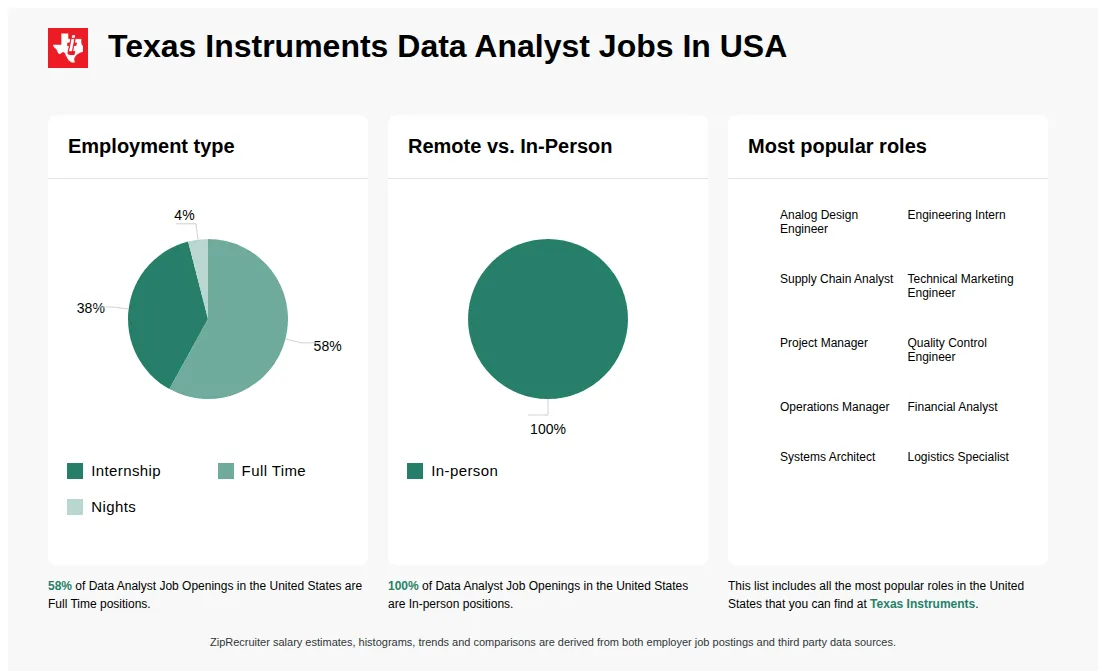
Infographic showing various Data Analyst job openings at Texas Instruments in the United States as of May 2026, with employment types broken down into 5% Internship, 93% Full Time, and 2% Nights. Highlights an 100% Physical job distribution.
Talent Development Business Partner

Talent Development Business Partner

Texas Instruments

Dallas, TX • On-site

Full-time

Posted 20 days ago


Texas Instruments rating

8.1

Company rating: 8.1 out of 10

Based on 83 frontline employees who took The Breakroom Quiz

40th of 137 rated electronics manufacturers


Job description

Job Description
Change the world. Love your job.
We're looking for a Talent Development Business Partner to join our team and serve as a strategic partner to our businesses!
As a Talent Development Business Partner, you will have the opportunity to support multiple worldwide organizations and work directly with senior leaders and HR partners to craft and execute a talent strategy built around bench, organization and leadership development.
Your key responsibilities will include:
  • Conducting organizational analysis to develop talent strategies, focusing on business needs and employee support through centralized programs and solution-based initiatives
  • Leverage advanced data analytics and visualization to identify talent gaps, forecast workforce needs, and measure the impact of development programs
  • Strengthening organizational and managerial capabilities while also enabling employees to own their careers
  • Creating and driving strategies, programs, and processes to identify and develop our talent pipeline
  • Consulting and partnering with business leaders and HRBPs as a thought leader
  • Utilizing talent development data and analytics to inform strategic decisions

We are looking for someone who:
  • Builds business-driven development solutions tied to organizational priorities
  • Maintains an enterprise-wide mindset while also addressing local and org specific needs
  • Acts as a strategic partner, taking initiative to lead and proactively identify challenges and solutions
  • Demonstrates a mindset of continuous improvement and learning
  • Seamlessly transitions between consulting, strategic planning, and implementation
  • Works effectively in highly ambiguous and global environments
  • Possesses strong facilitation and project management skills

If you're passionate about talent development and ready to make a significant impact, we encourage you to apply!
Qualifications
Minimum requirements:
  • Bachelor's degree in Human Resources, Business, Management Information Systems or a related field
  • Minimum of 3 + years experience in talent development, HR or project management
  • Project management experience with a proven track record of developing, maintaining and maximizing the impact of programs
  • Experience partnering with business leaders to provide business-specific recommendations and solutions
  • Experience utilizing data analytics to drive decisions in an HR or related function

Preferred Qualifications:
  • Possess strong critical thinking and problem-solving skills
  • Experience leading and operating in a global environment
  • Strong verbal and written communication skills
  • Ability to work effectively in an interrupt-driven, fast-paced and rapidly changing environment
  • Demonstrated ability to build strong, influential relationships
  • Ability to work in teams and collaborate effectively with people in different functions
  • Ability to take initiative and drive for results
  • Strong time management skills that enable on-time project delivery
  • Experience extracting insights from large HR datasets to guide strategy
  • Proficiency with data analysis and visualization tools is a plus (e.g., Excel, SQL, Spotfire or Tableau/Power BI)
  • Functional knowledge of learning platforms (LMS) and other HR tech stacks like LXP
  • Experience leveraging Artificial Intelligence (AI) within HR functions to enhance talent analytics or automate processes

About Us
Why TI?
  • Engineer your future. We empower our employees to truly own their career and development. Come collaborate with some of the smartest people in the world to shape the future of electronics.
  • We're different by design. Diverse backgrounds and perspectives are what push innovation forward and what make TI stronger. We value each and every voice, and look forward to hearing yours. Meet the people of TI
  • Benefits that benefit you. We offer competitive pay and benefits designed to help you and your family live your best life. Your well-being is important to us.

About Texas Instruments
Texas Instruments Incorporated (Nasdaq: TXN) is a global semiconductor company that designs, manufactures and sells analog and embedded processing chips for markets such as industrial, automotive, data center, personal electronics and communications equipment. At our core, we have a passion to create a better world by making electronics more affordable through semiconductors. This passion is alive today as each generation of innovation builds upon the last to make our technology more reliable, more affordable and lower power, making it possible for semiconductors to go into electronics everywhere. Learn more at TI.com.
Texas Instruments is an equal opportunity employer and supports a diverse, inclusive work environment. All qualified applicants will receive consideration for employment without regard to race, color, religion, creed, disability, genetic information, national origin, gender, gender identity and expression, age, sexual orientation, marital status, veteran status, or any other characteristic protected by federal, state, or local laws.
If you are interested in this position, please apply to this requisition.

What Texas Instruments employees say

Pay

Benefits

Hours and flexibility

Workplace

Get the full story on Breakroom


Texas Instruments logo

About Texas Instruments

Sourced by ZipRecruiter

As a global semiconductor company, we design, manufacture, test and sell analog and embedded processing chips to nearly 100,000 customers. Our products enable electronics everywhere and in things you experience every day - from health care, smart homes and connected cars to drones, smart phones and more. Our passion to create a better and more sustainable world by making electronics more affordable through semiconductors drives us to make our technology smaller, more efficient, more reliable and more affordable.

Industry

Semiconductor and electronic component manufacturing

Company size

10,000+ Employees

Headquarters location

Dallas, TX, US

Year founded

1930