1

Social Science Jobs (NOW HIRING)

Social Science Teacher

Clovis, CA · On-site

$81K - $103K/yr

CRESCENT VIEW WEST PUBLIC CHARTER Full Time, Monday - Friday COMPENSATION: Clear Credential: $81,885/year - $103,721/year Preliminary Credential: $70,967/year Intern Credential: $68,128.32/year Help ...

$83 - $138/hr

Advanced degree (PhD preferred) in a quantitative social science field, or equivalent experience * Demonstrated ability to design and conduct quantitative research projects efficiently * Knowledge of ...

New

Showing results 41-60

social science information

See salary details

$31.5K

$50.6K

$68K

How much do social science jobs pay per year?

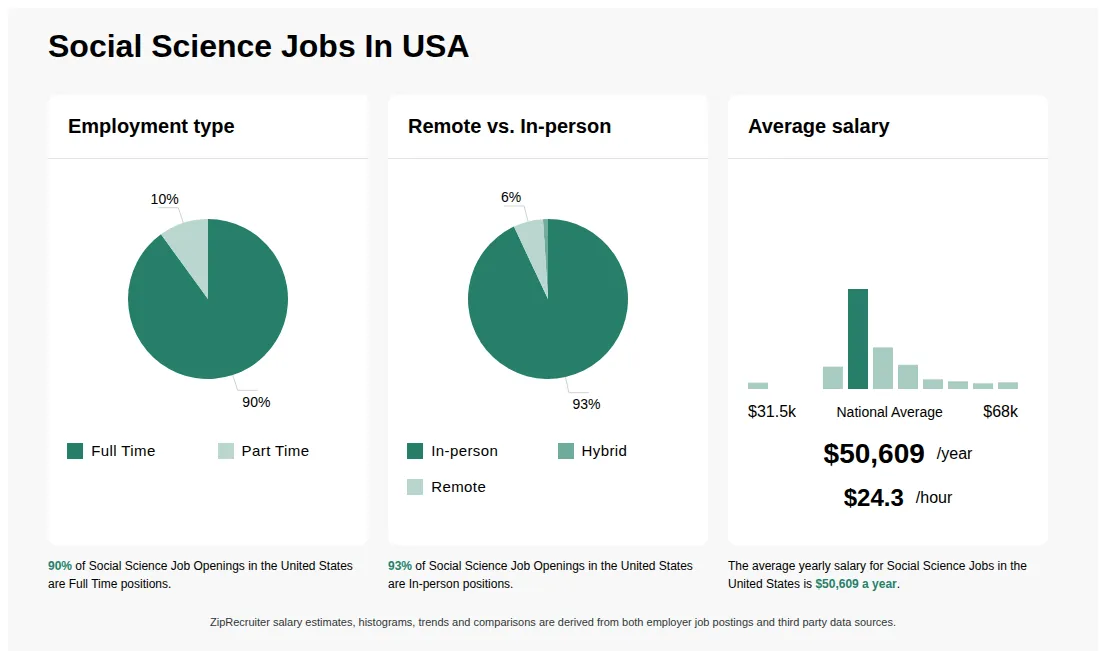
As of Aug 19, 2026, the average yearly pay for social science in the United States is $50,609.00, according to ZipRecruiter salary data. Most workers in this role earn between $46,500.00 and $53,000.00 per year, depending on experience, location, and employer.

What is a social science job?

Social science jobs are roles that involve studying human behavior, society, and social relationships using research and analytical methods. These jobs can include positions such as sociologists, psychologists, anthropologists, political scientists, and social workers. Professionals in social science often work in research, education, government, or non-profit organizations, aiming to understand and address social issues. Their work helps inform policies, support communities, and contribute to a better understanding of societal dynamics.

How to get a job in social science?

There are a variety of jobs available in social science, though a few require significant formal qualifications, such as a master’s degree or doctorate. Narrow your search to careers you are interested in before delving into specific job requirements, and then gain related experience at internships available through university programs. Subsequent to that, you should pursue entry-level research opportunities whenever they are available.

What are the key skills and qualifications needed to thrive as a social scientist, and why are they important?

To thrive as a Social Scientist, you need a solid background in research methods, data analysis, and a relevant degree such as sociology, psychology, or anthropology. Familiarity with statistical software (e.g., SPSS, R, or Stata), qualitative analysis tools, and sometimes advanced certifications in research methods are typically required. Strong critical thinking, communication, and collaboration skills help in interpreting findings and conveying results to diverse audiences. These competencies are crucial for producing rigorous, impactful research that informs policy, academia, or organizational decision-making.

What are some common challenges social science professionals face when working on interdisciplinary teams?

Social science professionals often collaborate with colleagues from fields such as public health, engineering, or data science. One common challenge is bridging differences in research methodologies and terminology, which can lead to misunderstandings or communication gaps. Successful collaboration requires strong interpersonal skills, adaptability, and the ability to explain social science concepts in accessible ways. By fostering open dialogue and mutual respect, social scientists can contribute valuable perspectives and ensure their insights are integrated into broader projects.

What is the difference between Social Science vs Sociology?

AspectSocial ScienceSociology
CredentialsBachelor's or higher in social sciences, often with specializationBachelor's or higher in sociology or related fields
Work EnvironmentResearch institutions, government agencies, NGOsAcademic settings, research organizations, community programs
Industry UsageBroad social sciences including anthropology, political scienceFocused on social behaviors, institutions, and society

Social science is a broad field encompassing various disciplines like anthropology, political science, and sociology. Sociology is a specific social science focused on studying social behaviors, institutions, and societal structures. While sociology is a subset of social science, the latter covers a wider range of disciplines and applications.


What can I do with social science?

A social science degree prepares individuals for careers in research, policy analysis, community development, education, and government roles. Professionals in this field often work as social scientists, policy analysts, market researchers, or educators, utilizing skills in data analysis, critical thinking, and communication. Job opportunities are available in public and private sectors, often requiring strong analytical tools and understanding of social systems.

What careers come from social science?

Social science graduates can pursue careers such as social researcher, policy analyst, community development specialist, human resources manager, and market researcher. These roles often require strong analytical, communication, and research skills, and may involve working in government, non-profits, or private sectors.

What cities are hiring for Social Science jobs?

Cities with the most Social Science job openings:

What are the most commonly searched types of Social Science jobs?

The most popular types of Social Science jobs are:

What states have the most Social Science jobs?

States with the most job openings for Social Science jobs include:

Infographic showing various Social Science job openings in the United States as of August 2026, with employment types broken down into 100% Full Time. Highlights an 100% In-person job distribution, with an average salary of $50,609 per year, or $24.3 per hour.

Full-time

Re-posted 10 days ago


Job description

 Work Habits 

  • Work with all major departments and divisions to achieve strategic initiatives. 
  • Maintain professionalism in dress, speech and manner.  
  • Communicate and deal effectively with all members of the school community and community at large. 
  • Perform in a manner that reflects positively on the school. 
  • Maintains a pattern of prompt and regular attendance. 

  Essential Functions 

  • Plan and implement instructional programs and activities that further the goals of the school. 
  • Ensure that the classroom atmosphere fosters the development of specific academic skills and knowledge, as well as moral and emotional development and respect and consideration for others. 
  • Adapt methods to account for different learning styles.  
  • Plan for both long-term and short-term instructional goals in accordance with the scope and sequence of the adopted curriculum. 
  • Commit to adapt to changes in delivery method of instructional hours to meet educational needs. 
  • Present a clear description of the learning task and its content by instructing students, monitoring student understanding, and re-teaching when necessary.  
  • Assess and record student progress through the interpretation of student work, test data and the monitoring of classroom performance.  
  • Complete grading, comments, posting of assignments and grades, and parent communications in a timely fashion. 
  • Communicate effectively to parents, students, and colleagues.  
  • Create and maintain a classroom environment conducive to learning.   
  • Attend all regularly scheduled faculty meetings, assemblies, and chapel and Eucharist services. 
  • Attend and participate in pre and post planning days, Back to School night, Professional Development days, Parent Conference days, Open House, and Graduation. 
  • Commit to improving his/her educational skills and knowledge. 
  • Share the responsibility regarding supervising students and maintaining appropriate student department outside of his/her classroom and willingly accept supervisory assignment as requested. 
  • Support extra-curricular student life by sponsoring student clubs, chaperoning student activities, and attending student events. 
  • Assist in risk management. 
  • Supports and enforces all school policies as stated in the Family and Employee handbooks.   
  • Perform other duties as requested by supervisors. 

 Training and Experience 

  • Maintains expertise in assigned areas. 
  • Participates successfully in professional learning opportunities available to increase skill and proficiency related to assignment. 
  • Participates successfully in computer training to attain and/or maintain skills necessary to achieve proficiency of performance responsibilities. 

  Personal Qualities 

  • Demonstrates a positive attitude towards work assignment. 
  • Accepts responsibility for work assignments. 
  • Accepts constructive criticism. 
  • Upholds the strictest of confidentiality in all work. 
  • Minimum of bachelor’s degree in a related field. 
  • 3+ years of teaching experience preferred. 
  • Demonstrates a passion for, an affinity towards, and has experience working with student populations in grade levels 7-12. 
  • Ability to clearly articulate the mission and vision of Holy Trinity Episcopal Academy.
  • Possess good judgement, discretion in speech, and respect for confidentiality. Must be a problem solver, skilled in engaging in difficult conversations.
  • Knowledge of prescribed curriculum and child development; demonstrate oral and written.
  • Must be able to communicate effectively and professionally with students, parents, school employees, and the general public. 

Lower School * 1720 Peachtree St. * Melbourne, FL 32901 * Ph: 321-723-8323 * Fax: 321-723-2553

Upper School * 5625 Holy Trinity Dr. * Melbourne, FL 32940 * Ph: 321-723-8323 * Fax: 321-308-9077

http://www.htacademy.org