1

Rocket Propulsion Jobs (NOW HIRING)

$165 - $190/hr

The successful candidate will provide technical engineering support involving rocket propulsion systems, guidance, navigation, control, modeling and simulation, and aerospace vehicle performance ...

New

You'll work alongside world-class engineers to push the boundaries of rocket propulsion and space transportation technologies. Essential Job Duties * Design and analyze liquid and solid propulsion ...

Description As a Propulsion Test Engineer at Impulse , you will be responsible for liquid rocket propulsion test operations while working closely with a fast paced, agile team that produces high ...

Showing results 41-60

rocket propulsion information

See salary details

$41K

$102.8K

$167.5K

How much do rocket propulsion jobs pay per year?

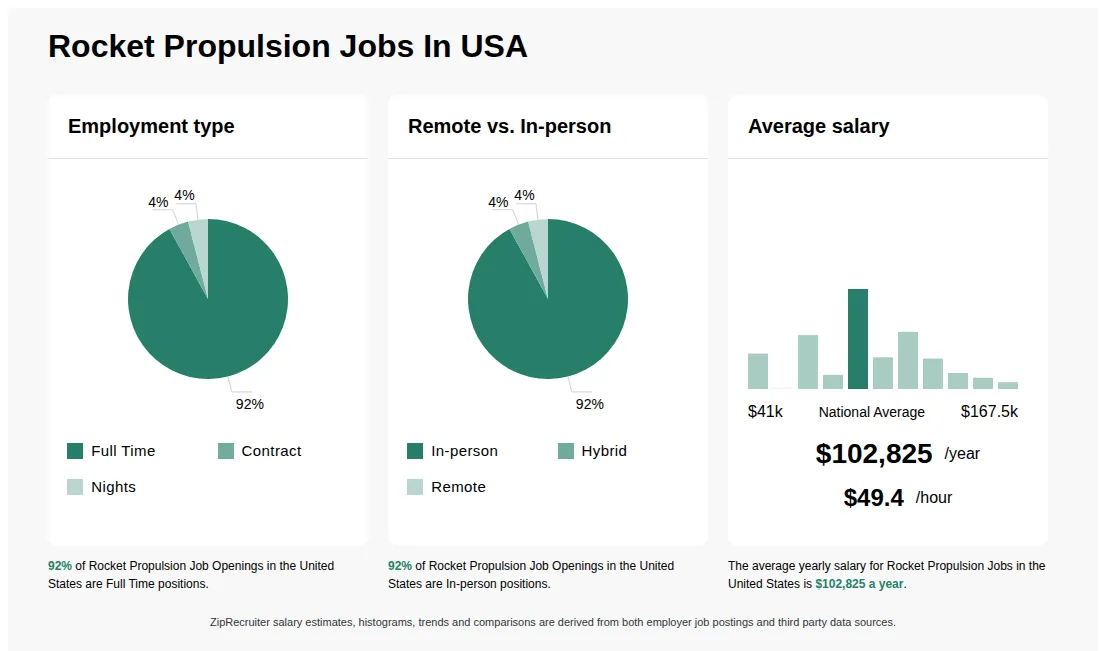
As of Sep 3, 2026, the average yearly pay for rocket propulsion in the United States is $102,825.00, according to ZipRecruiter salary data. Most workers in this role earn between $82,500.00 and $118,000.00 per year, depending on experience, location, and employer.

What is a rocket propulsion?

A Rocket Propulsion job involves designing, testing, and analyzing propulsion systems that power rockets and spacecraft. Engineers in this field work with liquid, solid, hybrid, or electric propulsion technologies to improve efficiency, thrust, and reliability. They collaborate with teams to develop engines, optimize fuel performance, and ensure safety in space missions. Roles in this field exist in aerospace companies, government agencies, and research institutions, contributing to advancements in space exploration and defense applications.

What are the main challenges faced in a rocket propulsion role?

Professionals in Rocket Propulsion often work on complex engineering problems that require innovative solutions to maximize efficiency, power, and safety of propulsion systems. Common challenges include managing high-temperature materials, optimizing fuel efficiency, and ensuring system reliability under extreme conditions. The role typically involves close collaboration with structural engineers, test technicians, and quality assurance teams to integrate propulsion systems into larger aerospace projects. Overcoming these challenges not only requires technical expertise, but also the ability to communicate and coordinate effectively within a multidisciplinary team environment.

What are the key skills and qualifications needed to thrive in a rocket propulsion position, and why are they important?

To thrive in Rocket Propulsion, you need a strong background in aerospace or mechanical engineering, physics, and thermodynamics, often supported by a relevant engineering degree or advanced studies. Familiarity with propulsion system modeling software, simulation tools like MATLAB or ANSYS, and knowledge of industry standards such as those set by NASA or the Department of Defense are important. Strong problem-solving, teamwork, and clear communication skills help you navigate complex technical challenges and collaborate across multidisciplinary teams. These abilities are essential for ensuring the safe, reliable, and innovative development of propulsion systems for spacecraft and launch vehicles.

More about rocket propulsion jobs

What cities are hiring for Rocket Propulsion jobs?

Cities with the most Rocket Propulsion job openings:

What are the most commonly searched types of Rocket Propulsion jobs?

The most popular types of Rocket Propulsion jobs are:

What states have the most Rocket Propulsion jobs?

States with the most job openings for Rocket Propulsion jobs include:

What job categories do people searching Rocket Propulsion jobs look for?

The top searched job categories for Rocket Propulsion jobs are:

Infographic showing various Rocket Propulsion job openings in the United States as of August 2026, with employment types broken down into 97% Full Time, 2% Part Time, and 1% Contract. Highlights an 95% Physical, 3% Hybrid, and 2% Remote job distribution, with an average salary of $102,825 per year, or $49.4 per hour.

Senior Propulsion Endineer

Cornerstone Signals & Cyber Technologies LLC

Dayton, OH โ€ข On-site

$185K/yr

Full-time

Re-posted 11 days ago


Job description

Senior Propulsion Engineer
Location: Dayton, Ohio - NASIC
Employment Type: Full-Time
Clearance: Active TS/SCI 
Cornerstone Signals & Cyber Technologies LLC is a certified Small Business, Service-Disabled Veteran-Owned Small Business (SDVOSB), Woman-Owned Small Business (WOSB), and Economically Disadvantaged Woman-Owned Small Business (EDWOSB) providing engineering, technical, advisory, intelligence, and program management services to Federal Government customers. Our professionals support mission-critical national security programs across the Department of Defense, Intelligence Community, and Federal civilian agencies.
Position Summary
Cornerstone is seeking a highly motivated Senior Propulsion Engineer to support an advanced aerospace and missile systems program in Dayton, Ohio. The successful candidate will provide technical engineering support involving rocket propulsion systems, guidance, navigation, control, modeling and simulation, and aerospace vehicle performance analysis.
This position supports Government customers by evaluating propulsion technologies, conducting engineering analyses, performing technical research, and developing formal engineering assessments related to liquid rocket engines, solid rocket motors, and associated propulsion subsystems.
The selected candidate will operate with minimal supervision while collaborating with multidisciplinary engineering teams to deliver technically sound, mission-focused solutions.
Primary Responsibilities
  • Provide technical analysis and engineering support for advanced propulsion systems supporting aerospace and missile programs.
  • Research, evaluate, and assess liquid rocket engines, solid rocket motors, and associated propulsion technologies.
  • Respond to Government technical inquiries through engineering analyses, literature reviews, and formal technical reports.
  • Perform propulsion performance evaluations using analytical methods, engineering software, and established technical databases.
  • Support design reviews, trade studies, and technical risk assessments.
  • Analyze propulsion system performance, combustion processes, thermal environments, and fluid flow characteristics.
  • Support modeling and simulation activities associated with propulsion system performance.
  • Collaborate with multidisciplinary engineering teams to evaluate total vehicle performance and subsystem integration.
  • Prepare technical briefings and engineering documentation for Government stakeholders.
  • Maintain awareness of emerging propulsion technologies and applicable engineering standards.
Required Qualifications
  • Bachelor's degree in Aerospace Engineering or Mechanical Engineering from an ABET-accredited institution.
  • Eight (8) or more years of professional engineering experience supporting propulsion systems, aerospace systems, fluid mechanics, or closely related disciplines.
  • Working knowledge of:
    • Thermodynamics
    • Chemical equilibrium
    • Stoichiometry
    • Compressible flow
    • Rocket nozzle theory
    • Structural mechanics
    • Classical mechanics
  • Experience performing engineering calculations using one or more of the following:
    • Python
    • MATLAB
    • C
    • C++
    • Fortran
  • Ability to independently conduct technical research and develop engineering reports.
  • Excellent written and verbal communication skills.
Preferred Qualifications
  • Master's degree in Aerospace Engineering or Mechanical Engineering with emphasis in chemical propulsion.
  • Eight (8) or more years of propulsion engineering experience.
  • Experience supporting Department of Defense or Intelligence Community aerospace programs.
  • Experience with liquid rocket engines and/or solid rocket motors.
  • Experience utilizing JANNAF propulsion databases.
  • Experience using NASA Chemical Equilibrium with Applications (CEA) or comparable propulsion analysis software.
  • Knowledge of:
    • Propellant combustion
    • Feed systems
    • Injector design
    • Cooling systems
    • Igniter design
    • Propellant grain design
    • Structural analysis of rocket motors
    • Pressure loss analysis
    • Propulsion instrumentation including pressure transducers, thermocouples, and flow measurement systems.
  • Experience participating in multidisciplinary engineering design reviews.
Desired Skills
  • Strong analytical and critical thinking abilities.
  • Ability to independently solve complex engineering problems.
  • Strong technical writing and presentation skills.
  • Effective collaboration within integrated engineering teams.
  • Ability to manage multiple technical priorities while meeting project deadlines.
  • Commitment to technical excellence and continuous professional development.
Base salary is currently $185,000, possibly more depending on qualifications, directly related experience, technical expertise, and security clearance.