Music Industry Adjunct
Tigerville, SC · On-site
The Cline School of Music at North Greenville University is seeking a dynamic, forward-thinking professional to implement our Bachelor of Music in Music Industry program. The ideal candidate will ...
Tigerville, SC · On-site
The Cline School of Music at North Greenville University is seeking a dynamic, forward-thinking professional to implement our Bachelor of Music in Music Industry program. The ideal candidate will ...
Tigerville, SC · On-site
The Cline School of Music at North Greenville University is seeking a dynamic, forward-thinking professional to implement our Bachelor of Music in Music Industry program. The ideal candidate will ...
The Cline School of Music at North Greenville University is seeking a dynamic, forward-thinking professional to implement our Bachelor of Music in Music Industry program. The ideal candidate will ...
The Cline School of Music at North Greenville University is seeking a dynamic, forward-thinking professional to implement our Bachelor of Music in Music Industry program. The ideal candidate will ...
Normal, AL · On-site
MUSIC INDUSTRY Examples of Duties The Department of Visual, Performing and Communication Arts is seeking adjuncts in the following areas: * MUSIC INDUSTRY Typical Qualifications Minimum Position ...
Normal, AL · On-site
MUSIC INDUSTRY Examples of Duties The Department of Visual, Performing and Communication Arts is seeking adjuncts in the following areas: * MUSIC INDUSTRY Typical Qualifications Minimum Position ...
Position Information Job Title Instructor of Music Technology and Music Industry Department School of Music Essential Functions The School of Music seeks a dynamic and collaborative educator to teach ...
Position Information Job Title Instructor of Music Technology and Music Industry Department School of Music Essential Functions The School of Music seeks a dynamic and collaborative educator to teach ...
Omaha, NE · On-site
$51K/yr
Teach courses in music technology and music industry. Work collaboratively with all faculty. Willingness to contribute to all aspects of life in the School of Music including active involvement in ...
Omaha, NE · On-site
$51K/yr
Teach courses in music technology and music industry. Work collaboratively with all faculty. Willingness to contribute to all aspects of life in the School of Music including active involvement in ...
Student Title Classification Information Quick Link Job Number SE232924 Position Information Department or Unit Name Conservatory of Music- Music Position Headcount 1 Position Title Music Industry ...
Student Title Classification Information Quick Link Job Number SE232924 Position Information Department or Unit Name Conservatory of Music- Music Position Headcount 1 Position Title Music Industry ...
Orange, CA · On-site
$16.90/hr
Serve as a student representative for the Music Industry Studies program by participating in student panels, recruitment events, and outreach activities. * Provide tours of music facilities and ...
Orange, CA · On-site
$16.90/hr
Serve as a student representative for the Music Industry Studies program by participating in student panels, recruitment events, and outreach activities. * Provide tours of music facilities and ...
Boone, NC · On-site
$80 - $100/hr
Assistant Professor of Music Industry Studies job at Appalachian State University. Boone, NC. Assistant Professor of Music Industry Studies Tenure Status: Tenure Track Department: School Of Music ...
Boone, NC · On-site
$80 - $100/hr
Assistant Professor of Music Industry Studies job at Appalachian State University. Boone, NC. Assistant Professor of Music Industry Studies Tenure Status: Tenure Track Department: School Of Music ...
The Music Industry program is well-established, and includes multiple, music focused undergraduate majors as well as a graduate degree option through the MBA- Music Industry Emphasis offered in ...
The Music Industry program is well-established, and includes multiple, music focused undergraduate majors as well as a graduate degree option through the MBA- Music Industry Emphasis offered in ...
Position Details Position Information Division Academic Affairs Department Music Working Title Adjunct Instructor of Music Industry (Fall 2026) Vacancy Type Part-Time Temporary Min T/E Requirements ...
Position Details Position Information Division Academic Affairs Department Music Working Title Adjunct Instructor of Music Industry (Fall 2026) Vacancy Type Part-Time Temporary Min T/E Requirements ...
DISCO is the industry standard for managing, organising and sharing music and other media. We make music and media workflow fast, intuitive and simple, directly connecting people and their work to ...
DISCO is the industry standard for managing, organising and sharing music and other media. We make music and media workflow fast, intuitive and simple, directly connecting people and their work to ...
Lead faculty and industry discussions to design and implement curriculum in commercial music and worship arts. * Oversee facilities renovations, including the design and equipping of teaching ...
Lead faculty and industry discussions to design and implement curriculum in commercial music and worship arts. * Oversee facilities renovations, including the design and equipping of teaching ...
Lead faculty and industry discussions to design and implement curriculum in commercial music and worship arts. * Oversee facilities renovations, including the design and equipping of teaching ...
Lead faculty and industry discussions to design and implement curriculum in commercial music and worship arts. * Oversee facilities renovations, including the design and equipping of teaching ...
Valuation Analyst (Music Catalogs) Full-Time | Remote The role: You will work with a premium, sell-side advisory firm specializing in the valuation, positioning, and strategic sale of music rights ...
Valuation Analyst (Music Catalogs) Full-Time | Remote The role: You will work with a premium, sell-side advisory firm specializing in the valuation, positioning, and strategic sale of music rights ...
Position description The UCLA Herb Alpert School of Music invites applications for a part-time Lecturer in Music Industry for the Fall quarter of the 2026-27 academic year to co-teach the UCLA Music ...
Position description The UCLA Herb Alpert School of Music invites applications for a part-time Lecturer in Music Industry for the Fall quarter of the 2026-27 academic year to co-teach the UCLA Music ...
Glassboro, NJ · On-site
Adjunct - Music Industry / Technology - Logic Pro X & Ableton, Department of Music Job no: 501584 Work type: Temporary Part-Time Location: Glassboro, New Jersey Categories: Faculty - College of the ...
Glassboro, NJ · On-site
Adjunct - Music Industry / Technology - Logic Pro X & Ableton, Department of Music Job no: 501584 Work type: Temporary Part-Time Location: Glassboro, New Jersey Categories: Faculty - College of the ...
$150K/yr
You will also become an active part of the music industry, building relationships, attending industry events and developing a network that helps make Trolley the first company music businesses think ...
$150K/yr
You will also become an active part of the music industry, building relationships, attending industry events and developing a network that helps make Trolley the first company music businesses think ...
Adjunct - Music Industry / Technology - Logic Pro X & Ableton, Department of Music Apply now Job no: 501584 Work type: Temporary Part-Time Location: Glassboro, New Jersey Categories: Faculty ...
Adjunct - Music Industry / Technology - Logic Pro X & Ableton, Department of Music Apply now Job no: 501584 Work type: Temporary Part-Time Location: Glassboro, New Jersey Categories: Faculty ...
This role is ideal for someone who combines strong platform knowledge with creative instincts, analytical thinking, and enthusiasm for music, nightlife, pop culture, and live entertainment. What You ...
This role is ideal for someone who combines strong platform knowledge with creative instincts, analytical thinking, and enthusiasm for music, nightlife, pop culture, and live entertainment. What You ...
West Hollywood, CA · On-site
$95K - $110K/yr
GTC is seeking a high-energy Motion Designer to join our fast-moving Los Angeles promo team. This role is built for a rhythm-driven creator with experience in animation of promo material for artist ...
Quick apply
West Hollywood, CA · On-site
$95K - $110K/yr
GTC is seeking a high-energy Motion Designer to join our fast-moving Los Angeles promo team. This role is built for a rhythm-driven creator with experience in animation of promo material for artist ...
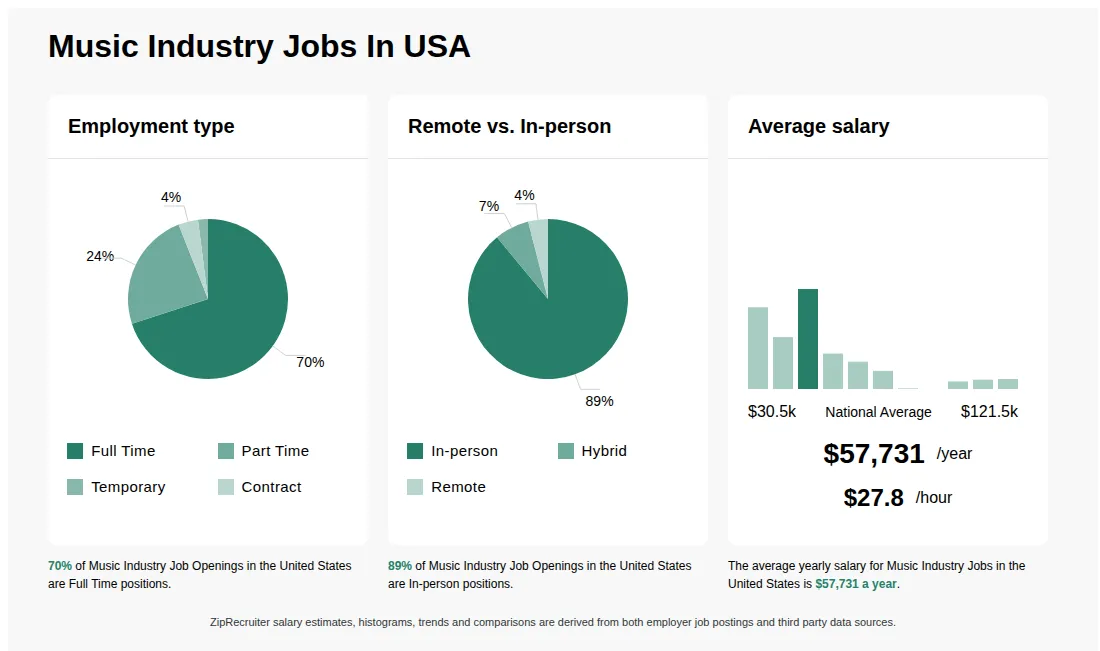
$30.5K - $38.8K
24% of jobs
$39.2K is the 25th percentile. Wages below this are outliers.
$38.8K - $47K
16% of jobs
The median wage is $49.8K / yr.
$47K - $55.3K
31% of jobs
$58.8K is the 75th percentile. Wages above this are outliers.
$55.3K - $63.6K
11% of jobs
$63.6K - $71.9K
7% of jobs
$71.9K - $80.1K
5% of jobs
$80.1K - $88.4K
0% of jobs
$88.4K - $96.7K
0% of jobs
$96.7K - $105K
2% of jobs
$105K - $113.2K
2% of jobs
$113.2K - $121.5K
2% of jobs
$30.5K
$57.7K
$121.5K
There are many careers in the music industry. For example, you might work as a musician or singer or in a technical position, as a music studio sound engineer, producer, or board operator. There are more physically oriented positions like roadies, who load and set up equipment for concerts. There are positions in talent management, music promotion, and record sales. The duties and responsibilities of each of these positions vary widely from one to the next, but each in some way supports the performance, recording, or sale of music. For example, if you promote a music label, you may travel across the country to meet with radio station executives to buy ad space or represent bands and coordinate promotional events. Talent managers help manage bands, book gigs, and negotiate contracts. As there are so many types of music industry jobs, you may consider narrowing your search terms to better find opportunities suited to your particular experience and skills.
Cities with the most Music Industry job openings:
The most popular types of Music Industry jobs are:
States with the most job openings for Music Industry jobs include:
The top searched job categories for Music Industry jobs are:
Instruct classes as assigned and prepare lesson plans and course material.
Assess students' academic performance and maintain accurate student records, grades, and attendance.
Utilize the Canvas learning management system and ensure the security of assessment tools and confidential documentation.

Sourced by ZipRecruiter
Colleges, universities, and professional schools
501 - 1,000 Employees
Tigerville, SC, US
1892