1

Visual Spatial Jobs (NOW HIRING)

Translate store feedback, field insights, and spatial challenges into thoughtful, strategic visual solutions * Concept and execute floor sets for product launches, seasonal collections, and brand ...

Spatial Design Lead

New York, NY · On-site

$123K - $160K/yr

The Spatial Design team is where Gymshark takes physical form: the stores and spaces where the community shows up in the real world. As Spatial Design Lead, you'll be the craft authority and systems ...

... visual, spatial, and sensor data to make sense of the physical world • Tackle complex domains at massive scale using simple, well-crafted solutions • Take initiative, be proactive in problem ...

Emphasizes developing visual-spatial communication skills and connects ASL to Deaf culture, accessibility, and interpreting career pathways. * Curriculum Awareness & Adaptive Instruction: Familiar ...

American Sign Language Tutor

AZ · Remote

$18 - $40/hr

Emphasizes developing visual-spatial communication skills and connects ASL to Deaf culture, accessibility, and interpreting career pathways. * Curriculum Awareness & Adaptive Instruction: Familiar ...

Emphasizes developing visual-spatial communication skills and connects ASL to Deaf culture, accessibility, and interpreting career pathways. * Curriculum Awareness & Adaptive Instruction: Familiar ...

Emphasizes developing visual-spatial communication skills and connects ASL to Deaf culture, accessibility, and interpreting career pathways. * Curriculum Awareness & Adaptive Instruction: Familiar ...

next page

Showing results 1-20

Visual Spatial information

See salary details

$15

$26

$69

How much do visual spatial jobs pay per hour?

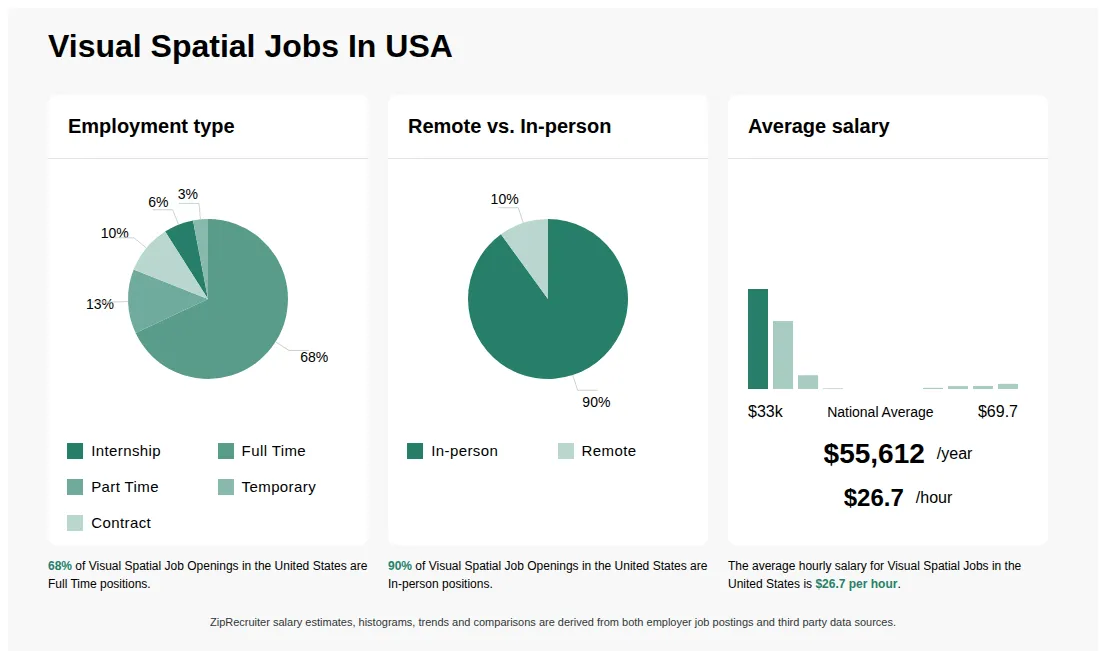
As of Aug 18, 2026, the average hourly pay for visual spatial in the United States is $26.74, according to ZipRecruiter salary data. Most workers in this role earn between $18.03 and $24.04 per hour, depending on experience, location, and employer.

What is a visual spatial?

A Visual Spatial job involves working with visual information, spatial reasoning, and design. Professionals in this field often excel in understanding spatial relationships, interpreting maps, creating 3D models, and visualizing concepts. Common roles include architects, graphic designers, engineers, and animators. These jobs require strong problem-solving skills and the ability to think in multiple dimensions. Many industries, such as gaming, urban planning, and engineering, rely on visual-spatial professionals.

What does a visual spatial do?

Visual-spatial specialists commonly work on projects that involve creating floor plans, models, or visual diagrams to help communicate spatial layouts and designs. Their responsibilities may include collaborating with architects, engineers, or designers to translate ideas into technical drawings, 3D visualizations, or presentation materials. They often participate in team meetings to provide input on conceptual layouts and troubleshoot spatial challenges. This role offers valuable exposure to a variety of projects in architecture, engineering, or design firms, providing meaningful opportunities for growth and specialization over time.

What are the key skills and qualifications needed to thrive in the visual spatial position?

To thrive in a visual-spatial specialist role, strong abilities in spatial reasoning, technical drawing, design principles, and a relevant degree in architecture, engineering, or design are often required. Proficiency with tools like CAD software, 3D modeling programs, and design visualization platforms is essential. Strong communication, teamwork, and creativity help professionals share complex visual ideas and collaborate effectively with teams and clients. These skills are critical for developing accurate visual representations and ensuring successful project outcomes.

More about Visual Spatial jobs

What states have the most Visual Spatial jobs?

States with the most job openings for Visual Spatial jobs include:

Infographic showing various Visual Spatial job openings in the United States as of August 2026, with employment types broken down into 1% As Needed, 68% Full Time, 26% Part Time, 1% Temporary, 3% Contract, and 1% Nights. Highlights an 93% Physical, 1% Hybrid, and 6% Remote job distribution, with an average salary of $55,612 per year, or $26.7 per hour.

Full-time

Re-posted 23 days ago


Job description

The Spatial Designer is a creative problem-solver with a strong visual sensibility and technical expertise, bringing conceptual ideas to life through detailed design schematics and technical drawings. In this role, the Spatial Designer will collaborate closely with internal teams and external partners to develop and execute immersive spatial experiences. From ideation to fabrication, the Spatial Designer will be responsible for ensuring that all design assets meet project specifications and align with creative intent. The ideal candidate is detail-oriented, adaptable, and passionate about translating bold creative visions into tangible, high-quality environments.
Responsibilities:
  • Participate in concepting and creative brainstorming sessions
  • Lead the design development through visual / vision boards, surveying, and 2D floor plans, scenic and 3D renderings
  • Provide creative POV across materiality, exterior/interior, decor selections, and staging considerations from design development through fabrication oversight
  • Support and oversee the technical drawings/plans to execute key design elements for scalable activations and staging
  • Partner with cross-discipline Leads for quality assurance and expectation management of design workflow, process, and delivery

Qualifications:
  • 5+ years of experience in architecture, interior/set design, industrial design, scenic design, or a related field.
  • Expertise in concept development, including visual research, mood boards, and spatial storytelling.
  • Strong skills in 2D floor plans, scenic design, and 3D renderings.
  • Experience in material selection, environmental design, and décor curation, with the ability to oversee projects from concept through fabrication.
  • Ability to review and refine technical drawings to ensure seamless execution of design elements in large-scale activations and built environments.